Gibson
Ripper
A bass so complicated Gibson pressed a record to explain it. The best review took one sentence.
1974. Gibson has a new long-scale bass with a four-way switch you have to learn, so it cuts a 7-inch single to walk you through it: Richard Evans narrating, the settings on the sleeve, Phil Upchurch playing “It’s Your Thing.” The bass is big, heavy, and maple. It’s called the Ripper.
- Introduced
- 1973
- Type
- Solidbody electric bass
- Class
- Production
The short version
1973
NAMM, Chicago
June. Prototypes on a different body, which got beveled because the flat edge was uncomfortable.
1973
The first 39
Nineteen ebony, twenty natural. List price $450.
1974
The biggest year
More than 3,000 natural basses alone, by the shipping cells. Some accounts give 1976 as the peak instead.
1975
Alder, and a fretless
Most bodies go alder, the horns get longer and sharper, and the L9-FS fretless arrives.
1977
Maple again
The hyphen moves, L9-S to L-9S. Same bass.
1978
The Last Waltz
Rick Danko plays one in Scorsese’s film.
1982
The end, roughly
Discontinued in ’82, or still in the 1983 catalog. Few shipped in the ’80s either way.
2009
Ripper II
350 basses, a shorter scale, a six-way switch. Not the same instrument.
Side A
A1
A bass that came with a record
In 1974 Gibson put out a 7-inch single for a bass. Side one had Richard Evans talking you through the settings, printed on the sleeve so you could follow along, with Phil Upchurch playing “It’s Your Thing.” Side two was Bass Meant, Dartanyan Brown with Chase.
That tells you two things about the Ripper. Gibson thought the switch was the point. And Gibson figured you’d need help.
It also tells you what the record couldn’t. The Ripper was big: a wide, contoured double-cut in maple, with a 34½-inch scale. One weighed on a scale came in at 4.2 kilos, and that’s just one bass. For a lot of people, that was the end of the conversation.
A2
Nobody agrees who drew it
Gibson wanted a long-scale bass that wasn’t an EB. Players had tired of the EBs that carried the ’60s. Mahogany was out.
The first ones weren’t quite this bass. At the June 1973 NAMM show in Chicago, Gibson showed prototypes on a different body, shallow cutaway on top, deep on the bottom. Brown remembered going over those first drafts with Bruce Bolen, and with Greg Lake. The flat edge was uncomfortable, so they beveled it. Even the January 1974 ad bass was a mock-up.
Who designed it depends who you ask. One account gives Bill Lawrence the whole bass. Another gives him just the pickups. Ralphe Armstrong says he met Bolen and “designer Walt Johnston,” wrote down what he wanted, “and that’s how they came up with this bass called the Ripper and the G-3.” Three answers. Keep them all.
Nineteen ebony and twenty natural basses shipped in 1973. List was $450.
A3
Four sounds and a switch
Two identical Super Humbuckers, with fewer turns than the old EB humbucker and a cleaner sound. A volume, a midrange roll-off, a treble roll-off, and a four-position switch. That switch is the Ripper.
Position one: both pickups in series, the “more bite” setting. Two: bridge only, “maximum treble.” Three: both in parallel, “more bottom end.” Four: both in series and out of phase, which Gibson’s 1978 sheet described as “funky, dirty.” That last one is the setting to try first.
Four sounds, and none of them is the neck pickup alone.
That was on purpose. A neck-only setting was drawn and then left out of production. The mid knob cuts, and doesn’t boost. The pickups and knobs sit on the pickguard, not routed into the wood, which saved the factory time.
Flip the record · By the numbers
4
Positions on the switch. Series, bridge only, parallel, and series out of phase.
$450
List price, June 1973. By July 1980 it was $699.
39
Basses in the 1973 shipping cells.
10,017
Basses in the shipping cells through 1979. After that nobody printed the count.
Side B
B1
Maple, alder, maple
The Ripper changed wood twice in five years. Maple first. By late 1974 or 1975, alder for most of them, with longer, sharper horns and a slightly narrower body. Maple again in 1977. Nobody agrees about 1976. The fretless L9-FS came in 1975, and 898 of them shipped by 1979.
The hyphen moved along the way. L9-S until 1976, L-9S after. Same bass.
The shipping cells show more than 3,000 natural basses in 1974 alone, making it the biggest year. Some accounts say 1976. After 1979 the counts stop: small numbers at least into 1982, a line in the 1983 catalog, and a few after. Nobody printed how many. In 2009 Gibson made 350 of a Ripper II, with a shorter scale and a six-way switch. It borrowed the name.
B2
Too big for most people
Suzi Quatro played a tan one for about three years. “Very very big body… neck was also thick and long… good woody sound… but cumbersome.” She moved on. When the Grabber came, it “had none of the tone or feel of the Ripper.”
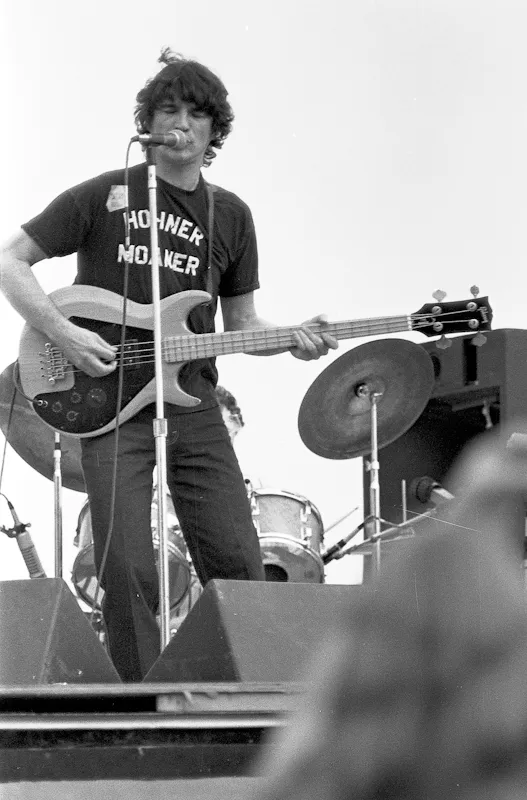
Rick Danko played one in The Last Waltz. Bill Wyman got one from Gibson in 1975 and used it to promote his solo album. Gene Simmons gigged one, though the bass on the Alive! cover is a Grabber. Lou Barlow cut the first Dinosaur album and half of the second on a Ripper before trading up to a Rickenbacker. Mike Dirnt’s Dookie bass is a G-3. It wasn’t this one.
Then there’s Krist Novoselic. He’s six foot seven, and he says that’s why a big bass suited him. “I played a blonde Ripper on Nevermind.” He had a black one too, and it “sounded different.” Both were stolen.
Gibson spent a whole record explaining the Ripper. Novoselic needed one line:
“It’s big and heavy, it’s a big gun, but it’s got that sustain that I really like.”
Put this on
You’ve read about it. Now hear it. Here’s what this guitar sounds like, and what to listen for.
Nevermind
“I played a blonde Ripper on Nevermind,” Krist Novoselic said. That’s the whole album in his words, with no track sheet behind it.
Find it on YouTube (opens in a new tab)The Last Waltz
Rick Danko plays a Ripper in Scorsese’s film. No song in it is pinned to the bass, so watch his hands.
Watch it on YouTube (opens in a new tab)Dinosaur
Lou Barlow played a Ripper on the band’s first album and half the second. He called the tone nasal, which is why it stands out.
Find it on YouTube (opens in a new tab)
The cast
The people, and the specific guitars, that made the legend.
1991
Krist Novoselic
A blonde Ripper, and a black one
Nirvana. The blonde is on Nevermind. The black one “sounded different.” Both were stolen.
1978
Rick Danko
Ripper, and a natural L-9S
The Band. Plays one in The Last Waltz; photographed with a natural L-9S on tour with Paul Butterfield in 1979. Not proven to be the same bass.
Suzi Quatro
Tan Ripper
About three years on one. Big body, thick neck, “good woody sound… but cumbersome.” The Grabber after it didn’t measure up.
Lou Barlow
Ripper
Dinosaur Jr. The first album and half of You’re Living All Over Me, then a Rickenbacker 4001. The Grabbers on Sweep It Into Space are other basses.
1974
Greg Lake
Ripper prototype
Looked over the first drafts, and called his prototype the most “reliable and accurate” instrument on the market. Not an ELP credit.
1975
Bill Wyman
Ripper, a gift from Gibson
Used it through 1976 to promote his solo album Stone Alone. Not a Stones record.
Liner notes
Specs, construction, rarity, value, and every source we used.
Two Super Humbuckers and a four-way Q-system on a set neck — Gibson's Ripper, not the Grabber you slide.
- Body
- Solid double-cut, contoured. 1975 catalog: alder, 21½" long, 14½" wide, 1¼" deep. FlyGuitars: maple 1973–74, alder 1975–76, maple from 1977. Wikipedia's infobox puts maple back in 1976 and alder in 1975 only. Do not average the woods.
- Neck
- Three-piece laminated maple, set. FlyGuitars's 1976 example: glued in. Andy Baxter: "set-neck (through-body)." Both stand. Black headstock, gold script, Les Paul outline. Not the Grabber's V, and not a bolt-on.
- Fingerboard
- Maple on natural, ebony on black and sunburst. Dot inlays, 20 frets. 1975 catalog does not list rosewood. Fretless, from 1975, is not this row.
- Scale
- 34½" (1975 catalog; FlyGuitars; Vintage Guitar). Millimetres unpublished on the vintage sources. Do not convert. The 2009 Ripper II is 34". Do not average.
- Pickups
- Two Super Humbuckers. Neck and bridge are the same part (13679)
- Hardware
- Three-point Tune-o-matic with a handrest. Combination tailpiece: through the body, or at the bridge. Open-gear tuners 1973–74; Schaller BM usual later
- Electronics
- Passive. Volume, midrange roll-off, treble roll-off, four-position transfer switch. No factory neck-pickup-only
- Finish
- Natural, ebony, tobacco sunburst. A handful of 1974 cherry sunbursts were never a catalog color. No shipping cell
- Nut
- 1⅝" (1975 catalog; FlyGuitars). Wikipedia: plastic on the original. Millimetres unpublished. Do not convert
Open the full research fileConstruction details, the complete player record, production numbers, dated value estimates, and sources
Classic living example = 1970s Kalamazoo L9-S / L-9S Ripper (two Super Humbuckers, Q-system, set neck). No current Gibson USA Ripper (no product page on Gibson.com, 29 September 2026). Ripper II (2009) is not this table: maple, rosewood, 34" scale, 12" radius (Sweetwater), Corian nut, top-load only, Seymour Duncan humbuckers, six-way switch, 350 basses. Blue Book runs that limited series summer 2009–2011; Wikipedia's period column stops at 2009. Scale inches disagree with the 1970s 34½". Mix flagged. The Grabber is the bolt-on you slide. The G-3 is three fixed single-coils. The Thunderbird is the bird. An Epiphone Ripper, when that brand offered one, was usually a bolt-on with a humbucker or a P/J, not these pickups. The EB-3 is the short-scale set-neck.
Construction
The job was a long-scale Gibson that was not an EB. FlyGuitars: players had tired of the EB basses that carried the 1960s, and a mid-'70s ad said they hadn't been hanging about for fifteen or twenty years. Mahogany was out. The earliest bodies are maple. A big contoured double-cut, two new humbuckers, and a circuit you had to learn. No fancy inlays. Plastic covers. Knobs and pickups on the guard, which saved the factory time against routing them into the wood. Still a large bass. No short-scale twin. All-maple examples can be heavy. One 1976 bass on FlyGuitars weighed 4.2 kg. That is one instrument.
Not a Grabber. Not a G-3. Not an EB-3. Not a Thunderbird. Vintage Guitar (Willie G. Moseley, January 2015) gives the mid-'70s trio one new body: 14½" wide, 1¼" deep, maple neck, 20 frets, 34½" scale. Gibson's Gazette (18 November 2025) still files the Ripper beside the Grabber and the G-3. The outline is what they share. The Grabber (gibson-grabber) is the bolt-on you slide. The G-3 is three fixed coils. The EB-3 (gibson-eb-3) stays short-scale. The Thunderbird (gibson-thunderbird) is the other long-scale Gibson. This plate is the set neck and the four-way switch.
The start is more than one date. FlyGuitars: a small batch of 1973 prototypes, a different body, shallow cutaway on top like a 335, deep on the bottom, pickups and controls in the wood, electronics from the back. Shown at the June 1973 NAMM show in Chicago. UK magazine Guitar, via FlyGuitars, reported an L65 guitar and an L95 bass — the magazine's spelling — and did not use the name Ripper. Dartanyan Brown, of Chase, told FlyGuitars those were first drafts Bruce Bolen reviewed with him, with Greg Lake, and probably others. The flat edge was uncomfortable. They beveled it. The January 1974 ad guitar was a mock-up grabbed ahead of the line: smaller guard, one pickup in it, EB-style humbuckers, no bridge cover. Shipping, from Larry Meiners's Gibson Shipment Totals as printed by FlyGuitars, already has cells in 1973: 19 ebony and 20 natural maple gloss. Vintage Guitar and Andy Baxter (Bass Guitar Magazine) both open the model in 1973. This plate starts at 1973. It does not bury the prototype body, and it does not pretend the January ad was a shipping guitar.
Who drew it splits. FlyGuitars: Bill Lawrence, then at Gibson, designed the Ripper and the L6-S. Wikipedia says the same, on a page that still asks for citations. Baxter is narrower: Lawrence designed the pickups. The pickup page on FlyGuitars agrees he did the humbucker and the circuit, and that he was there only briefly in the early and mid-1970s. Ralphe Armstrong, to FlyGuitars in June 2007: he met Bruce Bolen and "designer Walt Johnston," wrote down what he wanted, "and that's how they came up with this bass called the Ripper and the G-3." Three accounts. Not one designer.
The name on the page changed with the hyphen. FlyGuitars: Gibson's literature says L9-S from 1973–1976, and L-9S after. Same bass.
The point of the bass is the Q-system, and it does not solo the neck pickup. Two Super Humbuckers, identical, part 13679. Sidewinder coils, fewer turns than the EB humbucker of fifteen years earlier, a cleaner sound, an Indox magnet at each side (FlyGuitars). The 1975 catalog: master volume, midrange and treble roll-off, a four-position transfer switch. Vintage Guitar quotes the owner's manual: 1, both pickups, series, in phase; 2, bridge only; 3, both, parallel, in phase; 4, both, series, out of phase. The 1978 sheet, via FlyGuitars, adds the words: more bite; maximum treble; more bottom end; funky, dirty. FlyGuitars calls that a varitone. The catalog says transfer switch. Same four throws. The mid control is a roll-off. Lake's prototype write-up calls it a choke. Not an active boost. Lawrence's notes, via FlyGuitars: a neck-only setting was drawn, and production left it out. Gibson cut a vinyl 7-inch in 1974 so a player could find the tones. Richard Evans narrates side one, settings on the sleeve, Phil Upchurch on "It's Your Thing." Side two is Bass Meant, Dartanyan Brown with Chase.
Then the body changed in ways that date a bass. Earliest production: wider, short round horns, tortoiseshell guards from deep red to nearly black. Wikipedia: a few early guards are bright red, and some "black" guards are dark tortoiseshell. FlyGuitars: by late 1974, with alder, the horns get longer and sharper and the body a little narrower. Wikipedia puts that slimmer body in 1975. The wood years are in the spec table. Baxter agrees maple returns in 1977, and says the majority of 1975 are alder, not every one. 1976 is the year FlyGuitars and Wikipedia do not share.
Pickups moved the same years, not the same week. First covers: two screws through the middle, into the wood. FlyGuitars: late 1976 or early 1977, three screws into the guard, and the route changes shape. The pickup page says the three-tab cover is 1977. Wikipedia says three posts from 1976 on. Coils unchanged. The tabs break, and the cover does not come off cleanly, so a broken ear often means another pickup. Stringing changed with them. Early: four separate holes in the back. Late 1976 / early 1977: a recessed black plate. The tailpiece could already be strung at the bridge. The Grabber cannot. Tuners: unnamed open-gear in 1973–74, Schaller BM after. The 1976 bass on FlyGuitars has the Schallers.
Fretless is 1975, L9-FS. Same list as the fretted bass, except tobacco sunburst at $30 more from November 1975 until 1 January 1977. The 1975 catalog: sunburst, ebony board. Ebony and natural by 1977. Maple board by 1978. The 898 shipped 1975–79 are in the rarity table.
The end does not agree with itself. Vintage Guitar: the trio discontinued in '82. FlyGuitars: Meiners stops at 1979; small numbers at least as late as 1982; still in the 1983 catalog; few shipped in the 1980s. Wikipedia: 1973–1983, then the 2009 reissue. Reverb's product page prints 1973–1985. July 1980 is the last list on FlyGuitars's price page. The 1981 catalog is the close-out.
2009 is the caption, not a second spec sheet. Ripper II: 350 basses, 34" against 34½", rosewood, Corian, top-load only, Seymour Duncan humbuckers, a six-way switch instead of four. Sweetwater: maple, 12" radius. Blue Book runs the limited series summer 2009–2011. Wikipedia stops the period column at 2009. One Music Zoo listing called a natural an ash body. Don't average that with maple.
Players
Krist Novoselic — a blonde one, on Nevermind. Guitar World (Joel McIver, 18 February 2022, reprinting a 2011 Bass Player interview): "I played a blonde Ripper on Nevermind." He is six foot seven, which he offers as the reason a big bass suited him. "It's big and heavy, it's a big gun, but it's got that sustain that I really like." Two of them were stolen. The blonde "sounded different from my other black one." That is the album, in his mouth. It is not a track sheet, and it is not the Grabber. Baxter notes he also used an RD Artist and a Thunderbird. Those are other basses. Mike Dirnt played a G-3. Gibson Gazette (18 November 2025): his original G-3 on Dookie (1994), notably "Longview." The Gazette's sentence that lumps him with Novoselic as someone who loved "these" basses does not move Dookie onto a Ripper.
Rick Danko — the film, and a later photograph. Vintage Guitar: the Ripper's most notable appearance is Martin Scorsese's The Last Waltz, the 1978 documentary, "wherein bassist Rick Danko played one." The same article's caption is a different day: a natural L-9S in 1979, on tour with Paul Butterfield. Bob Sanderson's photograph. Two appearances. Not one guitar proved to be both, and no song on the film is pinned here.
Lou Barlow — the first Dinosaur album, and half of the second. Reverb's interview (14 November 2016): "I initially had a Gibson, it was a Ripper. We actually recorded the first and half the second album with a Ripper." He calls the tone nasal and says it stands out, then he "upgraded to a really nice 4001 Rickenbacker." He names that second record in the same interview: You're Living All Over Me. Which half is unpublished. Sweep It Into Space (2021) is a different story: Guitar World has a pair of Grabbers on that album, and a '65 Precision on "Garden" and "Wonder Why." Not this bass.
Suzi Quatro played one for about three years and then did not want the next Gibson. FlyGuitars, June 2006: "very very big body... neck was also thick and long... good woody sound... but cumbersome... pretty colour... tan... finally moved on." The Grabber, after it, "had none of the tone or feel of the Ripper." Vintage Guitar lists her with the Ripper endorsers. Both stand. No album is pinned on the three years.
Greg Lake — a prototype, in print in 1974. FlyGuitars's report of Guitar Player, September 1974: a new prototype Gibson called The Ripper, more powerful pickups than the standard bass humbuckers, a midrange choke, four different sounds. Lake calls it the most "reliable and accurate" instrument on the market. That is a prototype in a magazine, the same season Brown says Lake was looking at first drafts with Bolen. It is not an ELP track list. The production bass has 20 frets.
Peter Cetera posed for the ad. Vintage Guitar: he posed with one for an ad in '79. FlyGuitars has the ad "It Sounds Like Peter Cetera." A pose. Not a Chicago record.
Bill Wyman — a gift, for a solo album, not a Stones record. FlyGuitars, citing Andy Babiuk's Rolling Stones Gear: Gibson gave him the Ripper in 1975, and he used it through 1976 to promote Stone Alone. A Stones record does not move onto it.
Gene Simmons gigged one. The Alive! cover is the other bass. Vintage Guitar: a Grabber, natural headstock, on the cover of Alive!, September 1975. "Simmons also gigged with a Ripper." Which songs are which is unpublished here.
Louis Johnson was photographed with one. FlyGuitars: he and George posed for Gibson on a Grabber, a G-3, and a Ripper. On the Ripper photo the bridge cover is off and the knobs are not stock, which is why FlyGuitars thinks it was not only a pickup from the shoot. Vintage Guitar lists him as an endorser. No Brothers Johnson hit is pinned on it here.
Also known to play stays short. Vintage Guitar's endorser line adds Mel Schacher of Grand Funk. No album is pinned. Dave Kiswiney, with Ted Nugent, told FlyGuitars the Ripper "was like a godsend" — balance, the tones, "that big maple body." Justin Meldal-Johnsen told FlyGuitars he has two mid-'70s examples, one maple, one black. Armstrong is in the design argument above, and FlyGuitars shows him with one.
Rarity
You cannot buy a new Gibson Ripper. Ripper II and any Epiphone on the silhouette are other instruments, already out of this table. Japanese lawsuit-era copies — FlyGuitars names Aria, Cortez, Shaftesbury, Ventura, Westminster — are not Kalamazoo either.
No lifetime factory census. FlyGuitars prints Meiners through 1979 only. The natural-satin total cell on that page is blank. 2,242 is 1,057 + 1,185. The year-sum row is those cells added, not a row Meiners printed. The cells come to 10,017. FlyGuitars's 898 fretless, "around 10% of the total," is the two fretless rows. Against 10,017 that is closer to 9%. The phrase is theirs. It is not a second count.
| 1973 | 1974 | 1975 | 1976 | 1977 | 1978 | 1979 | Total | |
|---|---|---|---|---|---|---|---|---|
| Fretless L9-FS | 95 | 107 | 76 | 74 | 352 | |||
| Fretless, tobacco sunburst | 108 | 255 | 57 | 79 | 47 | 546 | ||
| Ebony | 19 | 426 | 118 | 734 | 442 | 466 | 198 | 2,403 |
| Natural maple gloss | 20 | 3,075 | 715 | 351 | 187 | 4,348 | ||
| Natural satin | 1,057 | 1,185 | 2,242 | |||||
| Tobacco sunburst | 5 | 22 | 52 | 19 | 28 | 126 | ||
| Year sum | 39 | 3,501 | 1,288 | 2,291 | 1,373 | 991 | 534 | 10,017 |
Wikipedia calls 1976 the peak year. In this table 1974 is the peak, on the strength of 3,075 natural maple-gloss basses, and 1976 is second. 1976 does lead the ebony, natural-satin, and fretless-sunburst cells. Keep the sentence and the table. After 1979 the cells stop. Small numbers into 1982, a 1983 catalog line, few shipped. That is why a full-run total is unknown.
What is actually thin: a 1973 bass, 39 of them in the cells; fretted tobacco sunburst, 126 through 1979; the unlisted 1974 cherry sunbursts, a handful and not a catalog color; the June 1973 prototype body, which is not this outline. The fretless row without a finish name is 352, and it does not say how they were painted. Novoselic's blonde and his black one were stolen. They are missing objects, not a vintage Ripper.
Value
Informal estimate, 29 September 2026. Not an appraisal.
Asking prices are not sold prices. Celebrity instruments are not comps. A Ripper II is not a 1975. An Epiphone is not Kalamazoo money. A Grabber is not this bass. Period list, FlyGuitars: June 1973 $450; January 1975 $449; November 1975 $469; June 1976 $499; January 1977 $539; January 1978 $559; January 1979 $599; July 1980 $699. The March 1976 list puts the Ripper at $469–$499, from the EB-3's $469 and up, over the G-3 at $389–$469 and the Grabber at $329–$379, under the Les Paul Triumph at $679. The tobacco fretless carried the extra $30 noted above. All of that is 1970s money.
New street. None. No Gibson USA Ripper product page turned up on 29 September 2026. No 2009 list price in a Gibson document this pass. Musician's Friend's Epiphone Limited Edition Ripper page is unavailable. Not a 2026 cart, and not this table when it was.
Used modern. No clean sold band for the 2009 Ripper II, or for an Epiphone Ripper, this pass. 350 is a production count, not a price.
Vintage / collectible. The dollar widget on Reverb's L-9S price-guide page did not render (29 September 2026). Flag: thin sold-comp access. Reverb's Brazil mirror of that guide printed R$7,809–R$14,786, 386 orders, Good to Mint, "All Models," and said the estimate is from US sales. Reais are not a dollar band. Do not convert them. One US listing's own widget, a 1979 natural, printed $1,996–$2,599. That is one listing's widget, not the 386-order band. Named asks, not hammers, on pages fetched the same day: Willie's American Guitars, a 1974 natural in Good condition, $3,600. FlyGuitars's live sale links: a 1976 with the original case, $3,400; a 1979 fretless ebony, $2,999; a 1979 natural stamped Second, one pickup rewound, $3,250; an untested bass, $2,500. A $3,500 ask on that page has Seymour Duncans in it. Not a stock comp. Do not average the asks. No hammer for the stolen Novoselic basses, Danko's, or Wyman's is in these sources.
See also
- gibson-grabber — the same outline, a bolt-on, and one coil you slide; not this set neck or this switch
- gibson-eb-3 — the short-scale set-neck the March 1976 list priced the Ripper beside
- fender-precision-bass — the long-scale bolt-on Gibson was selling the 1970s basses against; not this body
Sources
- FlyGuitars, Gibson Ripper — 1973 launch; maple, alder 1975–76, maple from 1977; 34½"; nut 1⅝"; three-piece set maple; 20 frets; Q-system; 1975 catalog body 21½" × 14½" × 1¼"; combination tailpiece; Meiners shipping table through 1979; 898 fretless; L9-S vs L-9S; June 1973 NAMM prototypes; Dartanyan Brown on the ad mock-up; late-1974 body change; pickup and string-through changes late 1976 / early 1977; 1983 catalog, few shipped; Japanese copies
- FlyGuitars, Ripper publicity and pricing — lists June 1973 $450 through July 1980 $699; March 1976 ladder against Grabber, G-3, EB-3, Les Paul Signature, Les Paul Triumph; tobacco fretless +$30, November 1975 to 1 January 1977; 1974 promo 7-inch, Richard Evans, Phil Upchurch, "It's Your Thing," Bass Meant
- FlyGuitars, Ripper controls (1978 sheet) — four positions and the tonal words; no neck-only; Lawrence's notes
- FlyGuitars, Ripper humbucker — Lawrence; part family; sidewinders; fewer turns than the EB humbucker; Indox magnets; two-screw cover, three-tab cover in 1977
- FlyGuitars, 1976 Ripper — set neck, glued in; Schaller BM; weight 4.2 kg on the pictured bass
- FlyGuitars, Ripper users — Armstrong, June 2007, Bolen and Walt Johnston; Guitar Player, September 1974, on Lake's prototype; Cetera ad; Johnson photograph; Wyman via Babiuk, Rolling Stones Gear, 1975 gift, Stone Alone through 1976; Kiswiney; Meldal-Johnsen
- FlyGuitars, Suzi Quatro interview, June 2006 — about three years on a tan Ripper; big body, thick neck, woody sound; Grabber rejected after it
- *Vintage Guitar*, Willie G. Moseley, Gibson Basses in the '70s (January 2015) — debut '73; 14½" × 1¼"; 34½"; 20 frets; Q-system from the owner's manual; sunburst dropped for black by 1975; fretless 1975; Lake, Schacher, Quatro, Johnson, Cetera ad in '79; Danko in The Last Waltz (1978) and the 1979 Butterfield photograph; Simmons gigged a Ripper, Grabber on Alive!; trio discontinued '82; Novoselic and Dirnt only as later players of the trio
- Andy Baxter, 1973: Grabber and Ripper (*Bass Guitar Magazine*) — 1973; maple, majority alder in 1975, maple again in 1977; Ripper "set-neck (through-body)"; Les Paul headstock; natural / black / tobacco sunburst and which board; Lawrence designed the pickups; Novoselic, and also an RD and a Thunderbird
- Wikipedia, Gibson Ripper — 1973–1983 and 2009; peak year stated as 1976; alder-in-1975-only infobox, which disagrees with FlyGuitars on 1976; 1975 body change; three-post pickups from 1976; cherry sunburst a 1974 handful, never catalogued; plastic nut; Ripper II Corian, top-load only, Seymour Duncan, six-way, midrange notch. The page asks for citations. The user list is not a credit
- *Guitar World*, Krist Novoselic (18 February 2022) — blonde Ripper on Nevermind; black one sounded different; both stolen; six foot seven; sustain
- Reverb, Lou Barlow (14 November 2016) — Ripper on the first Dinosaur album and half of the second; then a 4001
- *Guitar World*, Lou Barlow (20 September 2021) — Grabbers on Sweep It Into Space; '65 Precision on "Garden" and "Wonder Why"; not the Ripper
- Gibson Gazette, Epiphone Mike Dirnt Grabber G-3 (18 November 2025) — original G-3 on Dookie, "Longview"; Ripper named as a sister model, which is not a session credit
- Sweetwater, Gibson Ripper II — 2009 limited run, 350; maple; rosewood; 34" scale; 12" radius; Corian nut; Seymour Duncan; six-way
- Blue Book of Guitar Values, Ripper II (BAR2) — 350; set three-piece maple; rosewood; 34"; Grover Shamrock; six-way; natural; summer 2009–2011. Dollar figure paywalled
- Reverb, Gibson L-9S Ripper — years printed 1973–1985; the blurb's six-position switch is the reissue, not the 1975 catalog; dollar widget did not render, 29 September 2026
- Reverb Brazil, Gibson L-9S Ripper price guide — 386 orders, Good to Mint; R$7,809–R$14,786 from US sales; not converted
- Reverb, 1979 Ripper natural — that listing's widget, $1,996–$2,599; not the all-models band
- Reverb, 1974 Ripper, Willie's American Guitars — ask $3,600, Good; one bass at 8 lb 4 oz, not a model weight
- The Music Zoo, 2009 Ripper II — one natural described as ash; conflicts with Sweetwater and Blue Book maple; 350
Keep digging
Guitars this one gets compared to, confused with, or descended from.
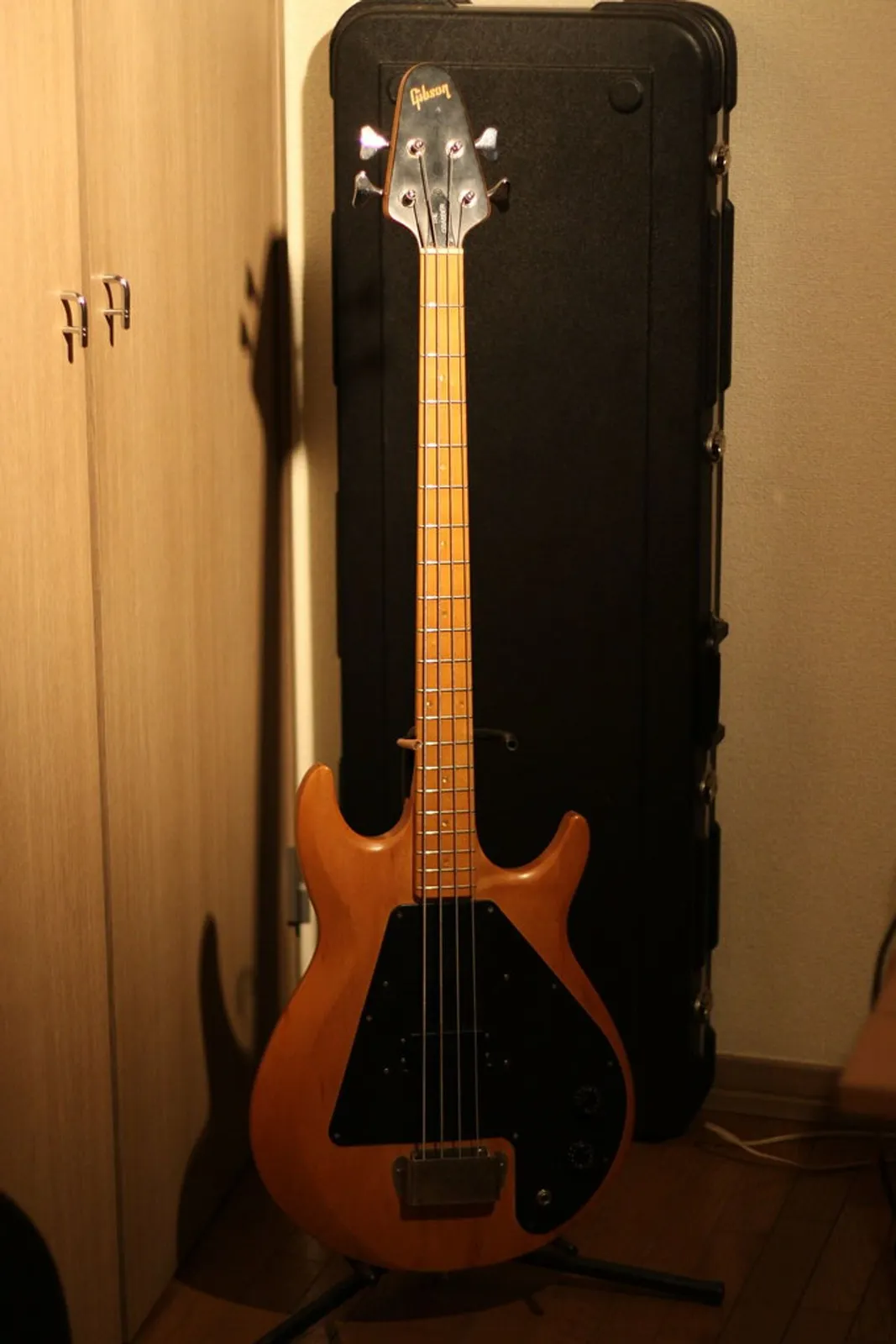
Photo: zenmai461 / Flickr / CC BY 2.0 Gibson
Grabber
1973
Gibson named its cheapest bass after what your hand did to the pickup: grab it and slide it.
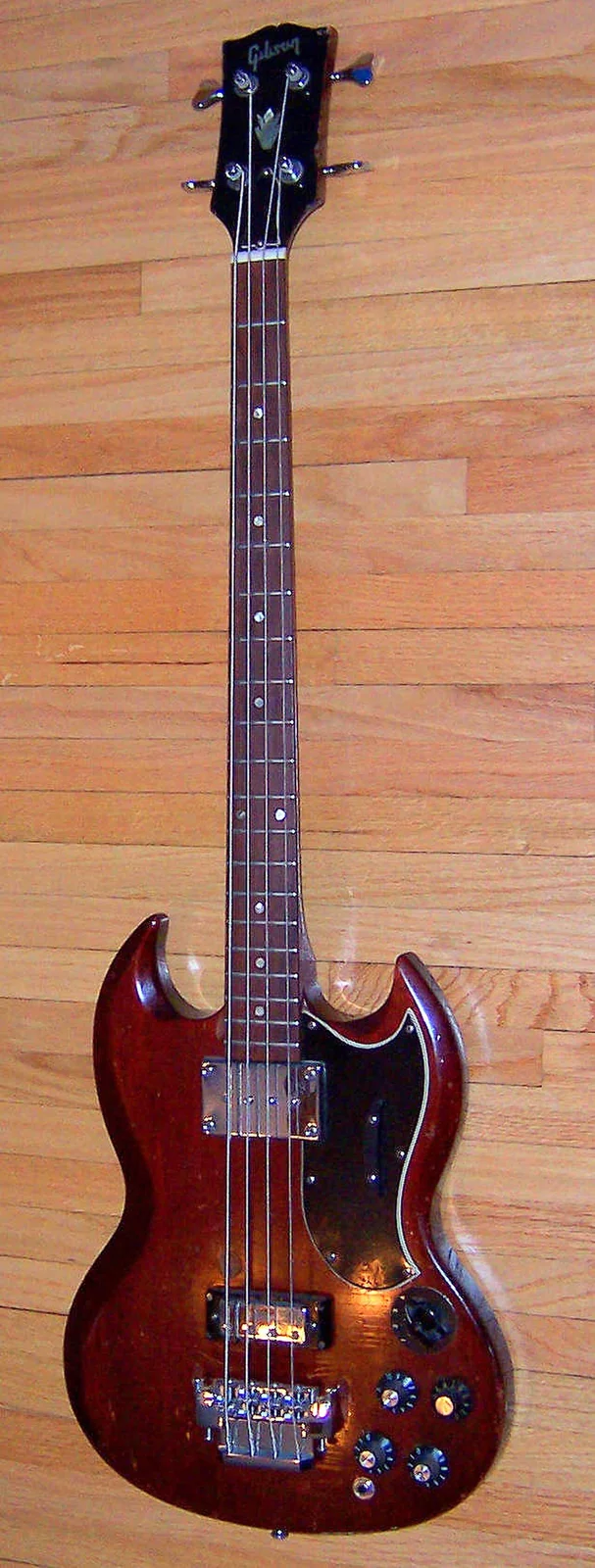
Photo: Jpkotta / Wikimedia Commons / CC BY-SA 3.0 Gibson
EB-3
1961
Jack Bruce wanted to bend bass notes like a guitarist. At thirty and a half inches, the EB-3 let him.

Photo: Infrahertzz / Wikimedia Commons / CC BY-SA 3.0 Fender
Precision Bass
1951
Leo’s bass let the player at the back be heard. You know their lines by heart. You mostly don’t know their names.