Fender
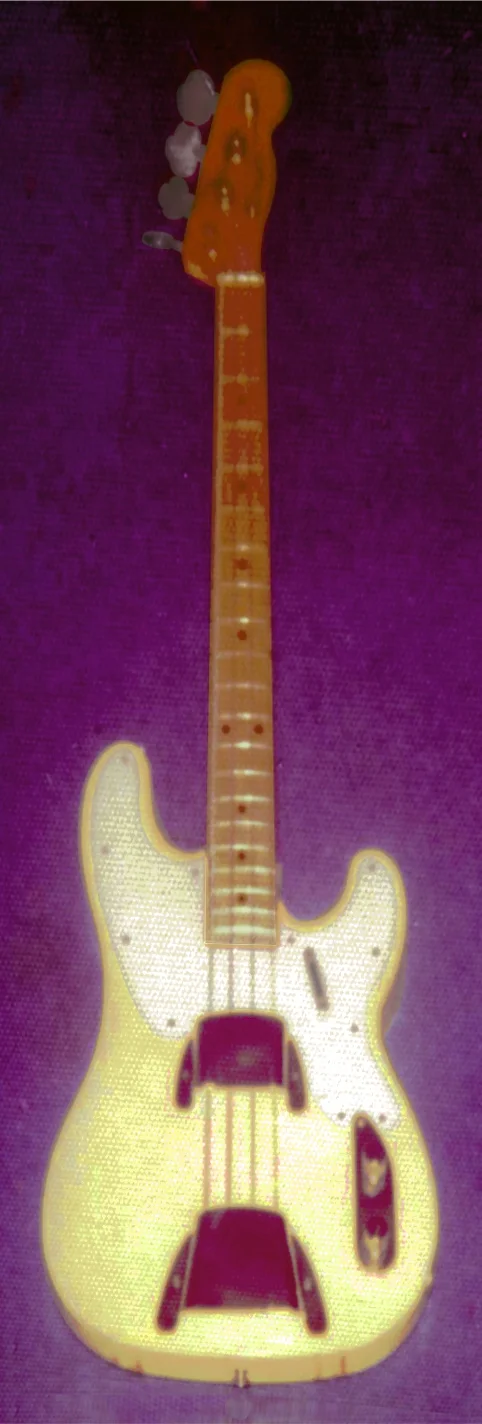
Telecaster Bass
Fender’s first reissue was a bass it had already thrown away. George Porter Jr. found one covered in cobwebs.
May 1968. Fender is owned by CBS, the Precision Bass has been redesigned twice, and somebody goes back for the version the company dropped years ago: the flat 1951 slab with the small headstock. It needs a new name. Fender calls it the Telecaster Bass, which is a little unfair to everybody involved.
- Introduced
- 1968
- Type
- Solidbody electric bass
- Class
- Production
The short version
1951
The original
The first Precision Bass. Slab body, small headstock, one single-coil.
1957
Redrawn
After contours in 1954, the Precision gets a split-coil pickup and a bigger headstock. The old one is gone.
1968
Back, under a new name
The Telecaster Bass arrives in May at $302.50. Fender’s first reissue of anything.
1968
Wallpaper
Paisley Red and Blue Flower options appear, and don’t last long.
1969
The corner of the studio
George Porter Jr. finds a dusty Telecaster Bass while making the Meters’ second album.
1972
The big humbucker
Seth Lover’s Wide Range bass humbucker replaces the single-coil. Some date the change to late 1971.
1979
Done
The original run ends, in September by one account.
2023
Back again
A Mexican Vintera II ’70s version recreates the humbucker bass.
Side A
A1
The one they put away
Companies don’t usually go back for the things they threw out. Fender did in 1968, and it had never done it before.
The original Precision Bass of 1951 was a flat slab with a small headstock and one single-coil pickup. Then Fender kept improving it. Body contours came in 1954. In 1957 it got a split-coil pickup and a bigger headstock. The old design wasn’t retired so much as painted over.
In May 1968, with CBS running the company, Fender brought the 1951 version back. That made it Fender’s first reissue. But the Precision name was taken by the living, redesigned bass, so the old one needed a new name.
They called it the Telecaster Bass, because the small headstock looked like a Tele’s. Fender’s own history is pretty blunt about that: “there was really very little about it that had anything to do with the Telecaster guitar.” The headstock had been on the Precision all along. It’s a full 34-inch four-string with a double-cutaway body. It is not a Tele with the top two strings missing.
A2
Leftover parts and wallpaper
The earliest prototypes were built with leftover 1952 Precision parts, which is about as literal as a reissue gets. The production version was close to the old recipe: slab body, one single-coil in the middle, strings through the body, a two-saddle bridge. A few things changed. The pickguard was white instead of black. Some early ones borrowed the tuners from the Jazz Bass.
It listed at $302.50, a little more than a Precision and a lot less than a Jazz Bass.
Then Fender got groovy. For a short stretch in 1968 you could order a Telecaster Bass in Paisley Red or Blue Flower. That’s self-adhesive wallpaper on the top and back, sunburst on the sides, a thick clear coat over everything, and a clear pickguard so you could see the flowers. They didn’t last. They are exactly as 1968 as they sound.
The Precision had been redrawn twice. The Telecaster Bass was Fender going back for the first draft.
A3
Ronnie’s bass
The sound of that single-coil is the sound of the original Precision: forward, punchy, all middle, the kind of bass note you feel in your chest rather than hear underneath everything. It suited British blues-rock fine.
Ron Wood played bass in the Jeff Beck Group on Truth in 1968 and Beck-Ola in 1969, and he had a 1968 Telecaster Bass. He also had a Jazz Bass he “obtained” from a shop near the rehearsal room. He later admitted he borrowed it, never took it back, and paid for it about five years later. So not every note on those records is the Telecaster Bass, and nobody has sorted them out track by track.
Flip the record · By the numbers
$302.50
List price in 1968, between a Precision at $293.50 and a Jazz Bass at $356.50.
1st
Fender reissue ever. The company had never gone back for an old design before.
100
Porter still has one of the first hundred Telecaster Basses made in Fullerton.
34"
Scale length, same as any full-size Fender bass. It isn’t a short-scale Tele with four strings.
Side B
B1
The big humbucker
Around the start of the ’70s, Fender redesigned it. The dates don’t agree: late 1971 or 1972. The small single-coil went out, and in went Seth Lover’s big Wide Range bass humbucker, shoved right up against the neck. Fender had hired Lover away from Gibson in 1967. The pickguard grew, the neck went to three bolts, and the logo went from silver to gold.
That pickup moved the sound somewhere else entirely: rounder, darker, fatter, more boom than punch. Two basses under one name.
The original run ended in 1979. Nick Lowe had one on the “So It Goes” video and on the cover of Jesus of Cool. Later, Paul McGuigan of Oasis used one in videos and early shows. Fender Japan’s ’51 Precision from 1994 counts as a reissue of the reissue, if you like, though it wears the Precision name. Today’s Vintera II copies the humbucker version.
B2
Cobwebs
In 1969 George Porter Jr. and the Meters were making their second album. “Cissy Strut” had been cut on a Gibson. In the studio, Porter found something else.
An old Telecaster Bass sitting in the corner. It had cobwebs all over it, but when I played it — man, it had such a ballsy tone. I used that bass to record a great deal of music.
The Telecaster Bass was barely a year old in 1969, but it was already an old bass in every way that counted. It was a design Fender had shelved, brought back under a borrowed name, and then shelved again in the corner of a recording studio.
Porter picked it up anyway. Fender went back for this bass once, on purpose, with a new name and a price list. The second time it was just a bass player and a dusty corner. He still has one of the first hundred ever made.
Put this on
You’ve read about it. Now hear it. Here’s what this guitar sounds like, and what to listen for.
Look-Ka Py Py
The Meters’ second album, made after George Porter Jr. found the cobwebbed Telecaster Bass in the studio. He says he used it to record “a great deal of music.” “Cissy Strut,” from before, was a Gibson. This is where the Tele Bass comes in.
Find it on YouTube (opens in a new tab)So It Goes (video)
Lowe with a Telecaster Bass in the video. He’s holding one on the cover of Jesus of Cool, too.
Watch it on YouTube (opens in a new tab)
The cast
The people, and the specific guitars, that made the legend.
1969
George Porter Jr.
An early Fullerton Telecaster Bass
Found one in a studio corner making the Meters’ second album, and still has one of the first hundred built.
1968
Ron Wood
1968 Telecaster Bass
Bass in the Jeff Beck Group on Truth and Beck-Ola, alongside a borrowed Jazz Bass he paid for years later.
1978
Nick Lowe
Telecaster Bass
On the “So It Goes” video and on the cover of Jesus of Cool.
1994
Paul McGuigan
Telecaster Bass
Oasis’s bassist used one in several music videos and early performances. Videos are the solid part; don’t pin every album on it.
Charlie Tumahai
Telecaster Bass
Be-Bop Deluxe’s bassist, on Fender’s own list of players.
1972
Seth Lover
Designer, Wide Range bass humbucker
Hired from Gibson in 1967. His big humbucker is what turned the reissue into its own bass.
Liner notes
Specs, construction, rarity, value, and every source we used.
Fender’s first reissue: a 1951 Precision slab with a Tele headstock, 34-inch and four strings — not the guitar, not the split-coil P-Bass, and not a Bass VI.
- Body
- Alder; Precision-shaped double-cut slab
- Neck
- Bolt-on maple, 3-bolt with Micro-Tilt; Mid-’70s “C”; gloss urethane
- Fingerboard
- Maple, 7.25" (184.1 mm) radius, 20 vintage-tall frets, black dots
- Scale
- 34" (864 mm)
- Pickups
- One vintage-style Fender Wide Range bass humbucker (neck)
- Hardware
- Vintage-style 2-saddle adjustable bridge with steel barrel saddles; Fender ’70s stamped open-gear tuners; wooden tug bar
- Electronics
- Master volume, master tone
- Finish
- Gloss polyester body; gloss urethane neck
- Nut
- Synthetic bone, 1.625" (41.3 mm)
Open the full research fileConstruction details, the complete player record, production numbers, dated value estimates, and sources
Current Mexican Vintera II ’70s (late 2023; Fender $1,239.99, sale $699.99 this pass, sold out on Fender.com; Sweetwater no longer available). This is the 1972-descended neck-humbucker spec, not the 1968 single-coil. Squier Classic Vibe (August 2025; Fender $579.99) is the cheap door: poplar, contours, 4-saddle, 9.5" radius — not this table. Vintera III (April 2026) did not carry a Telecaster Bass. Not a Precision, Jazz Bass, Bass VI, or Telecaster guitar. Mixed inch/mm flagged.
Construction
The job was putting the discarded 1951 Precision back on a CBS counter. Fender: the company’s first-ever reissue. May 1968. The living Precision had already been redrawn twice — contours in 1954, split-coil and Strat-like headstock in 1957 — so the old slab with the Tele peghead needed a new name. Telecaster Bass. Fender is blunt: “there was really very little about it that had anything to do with the Telecaster guitar.” The headstock shape was already on the original Precision. The body is a double-cut 34" four-string slab, not the single-cut six-string Tele (fender-telecaster). Not a Jazz Bass. Not a Bass VI.
List $302.50 — between a Precision at $293.50 and a Jazz Bass at $356.50 (Fender). 1960s money, not 2026 street.
1968 first version. Slab body, one single-coil in the middle of the bout, Tele-style chrome control plate, pickguard covering the upper bout, string-through two-saddle bridge, chrome covers. Fender vs the 1951 Precision: white guard instead of black; smaller, slightly raised string ferrules instead of flush. Two-piece maple-cap neck, no skunk stripe; some later-1968 examples went back to a one-piece maple neck. Some early examples used the paddle tuners from the 1966 Jazz Bass. Three headstock decals: prototype-only silver Telecaster guitar logo with “bass” underneath; a larger black “Telecaster Bass” script; then the common silver Fender script with sans-serif “Telecaster Bass.” Fender and Wikipedia: earliest prototypes used leftover 1952 Precision parts.
Paisley Red and Blue Flower. Fender’s Precision essay: short-lived 1968 options; self-adhesive wallpaper on top and back, sunburst-shaded sides, thick clear coat, clear pickguard. guitarhq dates pink paisley and blue floral on Tele guitars 1968 & 1969 only — not a factory last-year for the bass. Reverb: paisley examples “command 5-figure prices.” They are not a blonde 1968.
The first version lasts until the redesign. Fender dates that new instrument 1972. Wikipedia (Brosnac) and Reverb put the change in 1971 / “toward the end of 1971.” guitarhq has the Telecaster Bass on the early-1971 3-bolt list with Strat and Thinline. Keep 1971 and 1972. Do not pick a winner.
Second version. Small single-coil out; Seth Lover’s large Wide Range bass humbucker in, shoved up against the neck. Fender hired Lover from Gibson in 1967; the same family of humbuckers lands on the Tele Thinline (1971), Tele Custom (1972), and Tele Deluxe (1973). Chrome control plate gone; a larger pickguard runs down over the lower bout. Three-bolt neck plate with Micro-Tilt. Bullet truss at the headstock. Logo from silver to gold with black outlining. That is the bass Vintera II is recreating.
Original U.S. run 1968–1979. Wikipedia, citing Brosnac: discontinued September 1979. Fender: “throughout the rest of the decade until … 1979.”
Reissues, named, not a SKU dump. Fender Japan ’51 Precision Bass, 1994 — Fender: “may also be seen as a reissue of the 1968–1971 version of the Telecaster Bass.” It wears the Precision name. It lives on the Precision plate. Squier Vintage Modified Precision Bass TB, spring 2007–2014, copies the 1972–79 humbucker. Fender Modern Player Telecaster Bass (2011): two Wide Range humbuckers, contoured body, four saddles — a different circuit on this silhouette. Parallel Universe (2018): limited blonde P/J, not this pickup. Vintera II ’70s, late 2023: Mexican alder, 3-bolt, one Wide Range, two saddles — the table above. Classic Vibe Telecaster Bass, August 2025: Squier, contoured poplar, 4-saddle, alnico Wide Range. Do not average it with Vintera II. Squier Vintage Modified Telecaster Bass (2012) is a Tele guitar-shaped 32" bass. It is not this instrument.
Classic vs current: 1968 single-coil, four-bolt, chrome plate against 1972-onward Lover humbucker, 3-bolt, bullet — and against a Mexican poly reissue Fender still lists, sold out this pass.
Players
Do not hang a 1957-onward Precision or a Jazz Bass on this plate. Do not recruit Sting’s or Mike Dirnt’s ’51 Precision signatures as if they were named Telecaster Basses. Do not flatten Dusty Hill’s pawn-shop Precision onto this silhouette. Fender lists Hill; the bass he is famous for is a Precision.
George Porter Jr. — the Meters, Look-Ka Py Py (1969). Guitar World / Bass Player: Cissy Strut was a Gibson EB-2. In the studio for the second album he found “an old Telecaster Bass sitting in the corner. It had cobwebs all over it, but when I played it — man, it had such a ballsy tone. I used that bass to record a great deal of music.” Premier Guitar: he still has “one of the first 100 Telecaster basses produced in Fullerton.” Named early object. Not the 1969 debut single.
Ron Wood — Jeff Beck Group, Truth (1968) and Beck-Ola (1969). Guitar World (July 2026): in addition to a 1968 Telecaster Bass, he played a Fender Jazz Bass he “obtained” from a shop near rehearsal — Guitar Player, 1975: borrowed, never took it back, paid about five years later. Do not stamp every Truth track on one serial. The stolen Jazz is a different bass.
Paul McGuigan (Oasis). Fender names him. Propstore (23 October 2025) sold his Telecaster Bass case — Oasis stencil, Definitely Maybe-era travel — as the case for the bass “used … in several music videos and early performances.” Equipboard puts him on camera with a Telecaster Bass. Videos are the fact. Do not hang every album credit on this guitar.
Also known, short: Charlie Tumahai (Be-Bop Deluxe) — Fender. Nick Lowe — Equipboard: Telecaster Bass on the “So It Goes” video; he holds one on the Jesus of Cool (1978) cover. Fender also lists Victor Damiani (Cake), Lou Barlow (Dinosaur Jr.), Mike Dirnt. No canonical Telecaster Bass serials located this pass for those three.
Rarity
You can still find a new one if a Classic Vibe or leftover Vintera II is on a wall. Vintera III did not replace it. Custom Shop is not a current Telecaster Bass program. Japan ’51 Precisions and Modern Player dual-humbuckers are other names and circuits.
Official Telecaster Bass shipping totals are unpublished. Serials were shared across models; they date a guitar, they don’t count a year. That is why a first-year census is unknown, not the chapter.
What is actually thinner: 1968 four-bolt single-coil examples, especially complete with covers; Paisley Red / Blue Flower wallpaper basses; unmolested first-year decals. Porter’s early Fullerton and McGuigan’s Oasis object are unique. They are not a vintage Telecaster Bass.
Value
Informal estimate, 17 September 2026. Not an appraisal.
Asking prices are not sold prices. Factory totals unpublished. Serials ≠ shipping. Artist-owned examples (Porter, McGuigan) sit outside these ranges. Reissues do not substitute for 1968–79 Fullerton. U.S. Reverb Price Guide dollar widgets for both vintage buckets were bot-blocked this pass. Flag: thin sold-comp access. Reverb Canada prints a 1968–1971 Good–Mint band; named U.S. figures below are asks unless labeled sold.
New street. Mexico Vintera II ’70s $1,239.99 (Fender); sale $699.99 this pass, sold out. Guitar Center the same $699.99, sold out. Sweetwater: no longer available. Squier Classic Vibe $579.99 (Fender, August 2025 listing; sold out this pass). Historical 1968 list $302.50 is 1960s money.
Used modern. Named Vintera II asks, not a hammer: Sweetwater Gear Exchange Excellent Surf Green $844.95; Dave’s Guitar Shop 2023 Vintage White Very Good $850; Palen Excellent Vintage White $1,057.65. Reverb France used estimate €767–€916. No clean U.S. Classic Vibe sold band isolated this pass. Modern Player dual-humbucker and guitar-shaped 32" Squier are different circuits; don’t average them in.
Vintage / collectible. Reverb Canada, 1968–1971 Good–Mint: C$3,095–C$5,764 (79 orders). Named 2025–26 solds in that widget: Good C$3,839.71 (5 June 2026), Very Good C$3,615.13 (2 Feb 2026), Good C$3,620.92 (18 Jan 2026), Excellent C$7,628.71 (12 Oct 2025), Very Good C$5,071.32 (11 July 2025). A C$2,028.53 Very Good (5 Aug 2025) is an outlier in the same table, not a midpoint. Named U.S. first-version asks this pass, not a sold band: 1969 Very Good $4,995; 1968 Good $3,800; 1968 Good on sale $5,945.75 from $6,995. Named 1972–79 humbucker asks: 1972 Very Good $3,800; Guitar Center 1973 black $3,299.99; 1972 sunburst $3,495. Do not average asks with the 79-order CAD sold band. Paisley is a separate market: Reverb “5-figure”; named ended listing $19,500; UK ask £13,649. That is wallpaper, not a blonde 1968. McGuigan’s case lot (Propstore, £2,520) is not a bass.
See also
- Precision Bass — 1951 original this reissued, and the 1957 split-coil it is not
- Jazz Bass — 1960 34" four-string. Offset kin, different job
- Telecaster — 1950 single-cut six-string. The name, not the bass
Sources
- Fender: The First Fender Reissue: A Telecaster Bass History — May 1968 intro; first reissue; 1951 Precision not Tele guitar; $302.50 / $293.50 / $356.50; white guard, raised ferrules, maple-cap neck, paddle tuners, three decals; paisley/floral; 1972 Lover humbucker, larger guard, 3-bolt, bullet, gold logo; 1979 end; Japan ’51 1994; Squier VM TB 2007; named players
- Fender: The Precision Bass story — 1968 Telecaster Bass as first reissue of 1951 Precision; Paisley Red / Blue Flower wallpaper, clear guard; 1972 Seth Lover humbucker version
- Wikipedia, Fender Telecaster Bass — May 1968 (Brosnac); 1968–71 first version; 1971 second version; September 1979 end; 2007 Squier; 2011 Modern Player; 2018 Parallel Universe; 2023 Vintera II; August 2025 Classic Vibe
- guitarhq.com Fender general specs — Telecaster Bass neck code 23; 3-bolt on Telecaster Bass early 1971; paisley/floral Teles 1968–69; Telecaster Bass 1968 decal scan
- Vintera II ’70s Telecaster Bass — current spec; 34" / 7.25" (184.1 mm); 3-bolt; Wide Range; 2-saddle; $1,239.99 / sale $699.99; sold out this pass
- Musician’s Friend: Vintera II ’70s Telecaster Bass — 1.625" (41.3 mm) synthetic bone; gloss polyester; 20 vintage-tall
- Sweetwater: Vintera II ’70s Telecaster Bass — no longer available this pass; 1979 discontinuation; 2-saddle, tug bar
- Guitar Center: Vintera II ’70s Telecaster Bass — $699.99; sold out this pass
- Classic Vibe Telecaster Bass — Squier $579.99; poplar; alnico Wide Range; 4-saddle; 9.5" (241 mm); 1.625" (41.3 mm) bone; contoured
- No Treble: Vintera III bass series — April 2026; Jazz, Precision, Bass VI — no Telecaster Bass
- Guitar World: Squier Classic Vibe 2025 collection — August 2025 Classic Vibe Telecaster Bass
- Reverb: Telecaster Bass 1968–1971 — first-run as ’51 Precision reissue; paisley 5-figure; change toward end of 1971; U.S. dollar widget bot-blocked this pass
- Reverb Canada: Telecaster Bass 1968–1971 — C$3,095–C$5,764, 79 Good–Mint orders; named 2025–26 solds
- Reverb: Telecaster Bass 1971–1979 — second version end of 1971; 3-bolt, humbucker; U.S. dollar widget bot-blocked this pass
- Guitar World: George Porter Jr. on Look-Ka Py Py — Cissy Strut EB-2; Look-Ka Py Py Telecaster Bass in the corner
- Premier Guitar: George Porter Jr. — one of the first 100 Fullerton Telecaster basses
- Guitar World: Ronnie Wood stolen Fender bass — 1968 Telecaster Bass and Jazz Bass; Guitar Player 1975 borrow story; Truth / Beck-Ola
- Propstore: Paul McGuigan Telecaster Bass case — 23 October 2025; videos and early performances; £2,520
- Equipboard: Paul McGuigan — Telecaster Bass on camera
- Equipboard: Nick Lowe, Jesus of Cool — Telecaster Bass, “So It Goes” video
- Premier Guitars Australia: 1968 Telecaster Bass — 34"; nut 1¾"; August 1968 neck
- Reverb France: Vintera II ’70s Telecaster Bass — used estimate €767–€916
- Sweetwater Gear Exchange: used Vintera II Surf Green — Excellent ask $844.95
- Dave’s Guitar Shop: used Vintera II ’23 — Very Good $850
- Palen Music: used Vintera II Vintage White — Excellent $1,057.65
- Guitar Center: 1973 Telecaster Bass black — ask $3,299.99
- Reverb: 1968 Pink Paisley Telecaster Bass (ended) — ask $19,500; 34"; nut 1¾"; 9.30 lb
Keep digging
Guitars this one gets compared to, confused with, or descended from.

Photo: Infrahertzz / Wikimedia Commons / CC BY-SA 3.0 Fender
Precision Bass
1951
Leo’s bass let the player at the back be heard. You know their lines by heart. You mostly don’t know their names.

Fender Jazz Bass from 1966 in Olympic white with the transition fingerboard (bindings and dot inlays). Photo by Th. Ott. Licensed under CC BY-SA 3.0. Via Wikimedia Commons. Fender
Jazz Bass
1960
Built for jazz players who mostly passed on it. Then bass players started using it to take the solo.
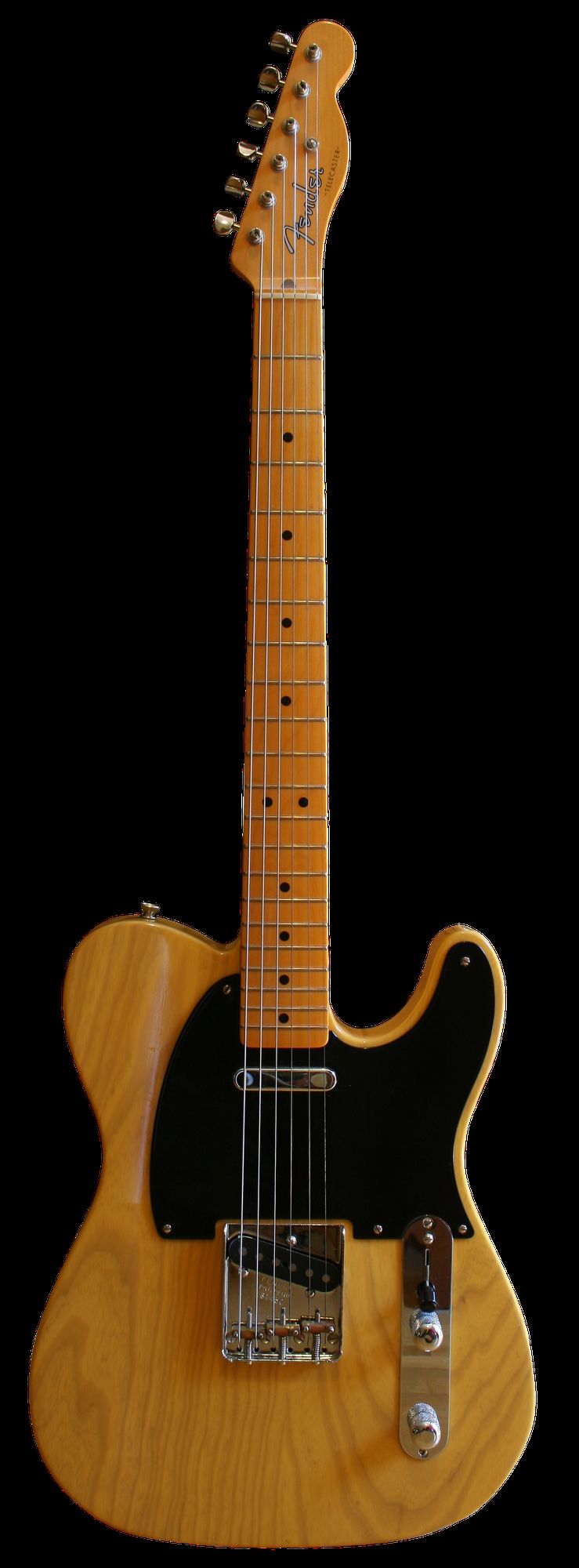
Fender Telecaster American Vintage 1952 with transparent background. Photo by Massimo Barbieri. Licensed under CC BY-SA 3.0. Via Wikimedia Commons. Fender
Telecaster
1950
Leo built it like a tool. The famous ones look like they just clocked off a double shift.