Gibson
EB-3
Jack Bruce wanted to bend bass notes like a guitarist. At thirty and a half inches, the EB-3 let him.
1966. Jack Bruce has played most of Cream’s first album on a Fender six-string bass. By the time the band hits the road, he’s holding something else: a short, pointed mahogany Gibson with two pickups and a rotary knob, and a scale three and a half inches shorter than a Fender’s.
- Introduced
- 1961
- Type
- Solidbody electric bass
- Class
- Production
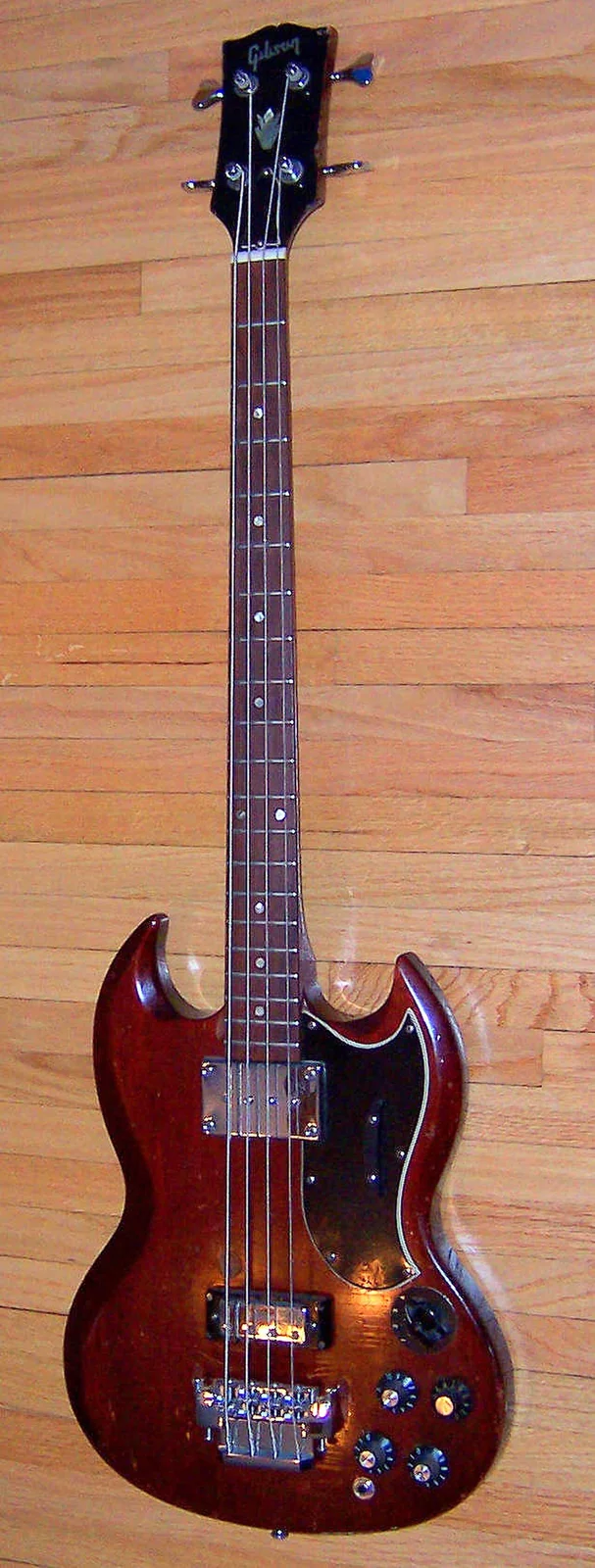
The short version
1961
Summer NAMM
Gibson shows the EB-3 in July. Dealers are quoted $285 in June; by September it lists at $310.
1962
Metal covers
Both pickups get metal covers.
1967
Disraeli Gears
Jack Bruce plays the EB-3 on Cream’s second album, and on the Cream records after it.
1968
Free
Andy Fraser makes an early-’60s EB-3 his main bass.
1969
A long-scale option
The long-scale EB-3L arrives. Sources put it anywhere from 1969 to 1971. It never outsells the short one.
1972
Rebuilt
Maple neck, pickups moved toward the bridge, a new logo.
1973
Peak year
Gibson ships 2,421 EB-3s, short and long scale together.
1979
The end
The last 75 ship, and the EB-3 is discontinued.
Side A
A1
Bass like a guitar
By the time the EB-3 came along, the bass guitar already had a standard size, and it was Fender’s: 34 inches from nut to bridge. The EB-3 was 30½. For a lot of players that made it the wrong bass. For a few, it was the only one that fit.
Jack Bruce was one of the few. He knew exactly what he was after:
I wanted to play bass like a guitar, and you can’t do that on a regular Fender — you can’t bend the strings… I didn’t want it to sound like a Fender… The EB-3 fit the bill.
A shorter scale means looser strings at the same pitch, and looser strings bend. That’s the whole trick. Bruce could push a note up like a guitarist, and in a band as loud and loose as Cream, that mattered.
A2
Shorter neck, stranger knob
Gibson had been making short, mahogany basses since the violin-shaped Electric Bass of 1953. Then came the hollow EB-2 in 1958 and the one-pickup EB-0 in 1959. Fender brought out the two-pickup Jazz Bass in 1960. The EB-3 turned up at the summer trade show in 1961. Whether it was Gibson’s answer to the Jazz or just a dressed-up EB-0 is still argued about.
It was more than an EB-0 with a second pickup. The neck pickup is a big humbucker people call the “mudbucker,” and the nickname tells you what it sounds like: round, deep, a little woolly. At the bridge sits a smaller humbucker. Then there’s a four-way rotary knob that picks neck, bridge, or both, plus a “choke” setting that thins the tone out into something brighter and almost baritone. Nobody agrees on the order of the positions, so try every one.
A3
Small, as am I
Andy Fraser of Free took to the EB-3 the way Bruce had, for his own reasons:
I was immediately at home with the EB3. First, it is small, as am I… with the extra pickup, one could get a wide variety of tones. I really felt one with that model. Was not happy to have it stolen!!!
His was most likely a 1961 or 1962. Somebody took it. Somebody took Bruce’s, too. He said it “got nicked in the ’70s.” The two most famous EB-3s in the world both walked out of the building without their owners.
Flip the record · By the numbers
30½"
Scale length, in inches. A Fender Precision or Jazz is 34.
$285
Launch price quoted to dealers in June 1961. It was $310 by September.
132
EB-3s shipped in 1961, the first year.
14,655
Shipped 1961–79, by one count. Others say 14,167, or just “more than 14,000.”
Side B
B1
Glam, Tull, and the Spiders
The short-scale sound suited a lot of bands. Glenn Cornick of Jethro Tull used a ’69: “the short scale Gibsons had a fullness of tone that was very suited to the sound of the band.” Jim Lea of Slade moved up from an EB-0. Trevor Bolder played one with David Bowie on the early ’70s albums and in the Ziggy Stardust concert film. Bob Daisley’s white EB-3 is on Ozzy Osbourne’s Blizzard of Ozz. Even Bill Wyman took one on the Rolling Stones’ 1973 tours.
And it sold. About two-thirds of all EB-3s shipped between 1969 and 1973, and 1973 alone saw 2,421. There was even a long-scale EB-3L, about Fender length, from somewhere between 1969 and 1971, depending on who you ask. It cost the same and never outsold the short one. In 1972 Gibson rebuilt the bass with a maple neck and the pickups moved toward the bridge. The ’70s ones are heavier, too: a ’60s EB-3 comes in around 3.7 kilos, a ’70s one around 4.6. By 1979 it was gone. The last year, Gibson shipped 75.
B2
A toy, later
When Cream reunited in 2005, Jack Bruce didn’t bring the EB-3. By then, the short scale felt like a toy to him.
That doesn’t undo anything. A young man who wanted his bass to sing like a lead guitar found a small Gibson that let him do it, and it’s all over Disraeli Gears. Almost forty years later it didn’t fit him anymore. Both are true. The right bass is the one that fits the player you are that year, and the records don’t mind which year it was.
Put this on
You’ve read about it. Now hear it. Here’s what this guitar sounds like, and what to listen for.
Sunshine of Your Love
From Disraeli Gears, which Gibson says Bruce played on the EB-3. Listen to the bass doubling that riff. It’s not sitting under the song. It’s leading it.
Find it on YouTube (opens in a new tab)Cum On Feel the Noize
Jim Lea started on an EB-0 and moved to an EB-3 in the late ’60s. Gibson names this one among his EB-3 songs.
Find it on YouTube (opens in a new tab)Ziggy Stardust and the Spiders from Mars — The Motion Picture
Trevor Bolder, live, on his short-scale EB-3. He played one on the early-’70s Bowie albums too.
Watch it on YouTube (opens in a new tab)
The cast
The people, and the specific guitars, that made the legend.
1967
Jack Bruce
EB-3
Cream’s live sound, and Disraeli Gears, Wheels of Fire, Goodbye, and Live Cream. The bass was stolen in the ’70s.
1968
Andy Fraser
1961 or 1962 EB-3
Free’s bassist. “First, it is small, as am I.” Also stolen.
1973
Trevor Bolder
Short-scale EB-3
With David Bowie and the Spiders from Mars, on record and in the concert film.
1969
Glenn Cornick
’69 EB-3
Jethro Tull. One of four Gibson basses he used.
late 1960s
Jim Lea
EB-3
Slade. Switched from an EB-0.
1980
Bob Daisley
White EB-3
On Ozzy Osbourne’s Blizzard of Ozz.
Liner notes
Specs, construction, rarity, value, and every source we used.
A large neck humbucker, a mini at the bridge, and a four-way rotary on 30½-inch mahogany — Gibson’s EB-3, not the one-pickup EB-0, not the hollow EB-2, and not a Thunderbird.
- Body
- Solid mahogany; pointed double-cut. FlyGuitars measured a 1961: 17" long, 13" wide, 1.37" thick; 41" overall. Mix flagged.
- Neck
- Set mahogany; one-piece through most of the 1960s. Joins the body at the 17th fret (guitarhq / Vintage Guitar).
- Fingerboard
- Unbound rosewood, pearl dots, 20 frets
- Scale
- 30½" (FlyGuitars). Wikipedia 30.5" (775 mm). Mix flagged. Not Fender 34", not Thunderbird 34".
- Pickups
- Large neck humbucker (“mudbucker”) + mini-humbucker at the bridge
- Hardware
- Nickel type-1 bar bridge; under-bridge mute; Kluson 538; nickel handrest (early). Front-mounted jack.
- Electronics
- Volume and tone per pickup; four-way rotary (choke / Varitone). Passive.
- Finish
- Cherry nitro typical
- Nut
- FlyGuitars timeline 1¾" (1961); 43 mm on a documented 1961. 1 11/16" by 1964. Mix flagged.
Open the full research fileConstruction details, the complete player record, production numbers, dated value estimates, and sources
Classic living example = 1960s Kalamazoo EB-3. No current Gibson EB-3 SKU this pass (fetched 16 September 2026). USA SG Standard Bass (Heritage Cherry BASG00HCCH1, Ebony BASG00EBCH1, $1,999) is the living short-scale double-cut, not this table: Rhythm / Lead SG Bass pickups, 2 volume + 1 master tone, no rotary, trapezoids, Graph Tech 1.6" / 40.64 mm, 30.5" / 774.7 mm. Mix flagged. EB-0 is one pickup. EB-2 is the semi-hollow. Thunderbird is the 34-inch bird. EB-3L is the long-scale variant. Epiphone EB-3 was a 34-inch Asian line, discontinued early 2020 (Wikipedia). Gibson Custom Gene Simmons EB-0 is an EB-0, not this bass.
Construction
The job was a two-pickup short-scale Gibson. Kalamazoo already had the violin-shaped Electric Bass in 1953 (later EB-1), the semi-hollow EB-2 in 1958, and the one-pickup EB-0 in 1959. Fender’s two-pickup Jazz arrived in 1960. Vintage Guitar (Willie G. Moseley, January 2008): whether the EB-3, introduced 1961, was a “response” to the Jazz is debatable; some saw it as an upgraded EB-0. There was more to both.
Not an EB-0. Not an EB-2. Not a Thunderbird. EB-0 is the one-humbucker sibling — same short scale, same pointed horns from 1961, no mini, no four-way rotary. EB-2 is the semi-hollow with f-holes; guitarhq: dropped 1961, back 1964. Thunderbird II/IV are 1963, Gibson’s first 34" basses — that plate. This one stays 30½".
FlyGuitars: announced summer 1961, Summer NAMM in July. June 1961 dealer letter: EB-3 $285, EB-0 $195. September 1961 pricelist: $310. A documented 1961, serial 288**, shipped 12 October 1961. vintageguitarandbass.com: the 1962 full-line catalog (printed May 1961) is the first brochure to show the EB-0 and EB-3. Historical list, not 2026 street.
What you get is a thin mahogany double-cut with pointed horns — the same year the factory restyled its solidbodies that way. This is a bass. Not that guitar. Crown inlay, rosewood dots, 20 frets, neck into the body at 17. Early: wide-spaced controls, a large back cavity the EB-0 did not share. Nickel bar bridge, mute, handrest. Neck pickup under a silvered bakelite cover; mini at the bridge with a silvered ring. Series 1 loom: large rectangular metal tone choke, part GA-90C-1 (FlyGuitars).
The four-way rotary is why it is not an EB-0 with an extra pickup. Vintage Guitar: 1 neck, 2 both, 3 bridge, 4 neck with “choke” — brighter, baritone-like, kin to the EB-2’s pushbutton. FlyGuitars’ 1961 clips label 1 as neck with choke and 2 as bridge only. Wikipedia’s Series 1 list is a third mapping. Keep all three. FlyGuitars: 1970s Series 2 looms reverse the switch.
Then it changed. 1962: both pickups metal-covered (VG; guitarhq). Mid-1963: nickel neck cover. Late 1963: crown dropped toward center. 1964: nut 1 11/16". Mid-1965: tighter controls, chrome, type-2 bar; list $337.50 (M.J. Carlucci to dealers, 28 June 1965: volume economies). 1966–67: thinner neck (Gibson / VG); witch-hats; 2-point Tune-o-matic, mute kept. Walnut 1968. Late 1969: three-piece mahogany; chrome bridge cover for the handrest; slotted “window” headstock into 1970–71 (19 frets on FlyGuitars’ 1970 notes).
EB-3L is the long-scale sibling, not this table. guitarhq: 34.5" from 1969 until 1972. FlyGuitars: available 1970, with 1971–79 finish cells. Blue Book: 34.5", 1971–79. Wikipedia: 34", 1969–72. Keep the year range and the 34" / 34.5" split. Mix flagged. FlyGuitars: it never outsold short-scale, same price.
1972 rebuilds it again. Maple three-piece with volute; pickups moved toward the bridge; Series 2 choke; silkscreen logo. FlyGuitars: 21 frets on the short-scale, 20 on the EB-3L. Three-point bridge 1973. White 1976. Discontinued 1979.
The living double-cut is the SG Standard Bass, not a Historic EB-3. Wikipedia: TB+ neck, no Varitone, more treble than the mudbucker. Gibson’s 2013 “60 Years” copy called it “essentially the same instrument.” Keep both. It is not this table.
Players
Jamerson, Duck Dunn, and Carol Kaye stay on the Precision. McCartney’s identity bass is the Höfner 500/1. Dennis Dunaway’s Rock Hall bass is an EB-0 (Gibson, 10 Champions). Gene Simmons’s Custom Shop is an EB-0. They do not belong here.
Jack Bruce — Cream, from the Bass VI onto the EB-3. Identity instrument for this plate. Official site, via the Bass VI plate: most of Fresh Cream (1966) on the six-string; the EB-3 became the live Cream sound. Do not stamp Disraeli Gears on the Bass VI. Gibson (Ted Drozdowski, 12 May 2010): by the time he hit the road he had switched; EB-3 on Disraeli Gears (1967), Wheels of Fire, Goodbye, Live Cream. Vintage Guitar, 2002: “I wanted to play bass like a guitar, and you can’t do that on a regular Fender — you can’t bend the strings… I didn’t want it to sound like a Fender… The EB-3 fit the bill.” MusicRadar, 18 March 2014: that bass “got nicked in the ’70s.” Which year it was built is unpublished here. Guitar World on the 2005 reunion: the short scale felt like a toy; he did not bring it. Artist-owned — not a comps tape.
Andy Fraser — Free, from 1968. FlyGuitars interview: “I was immediately at home with the EB3. First, it is small, as am I… with the extra pickup, one could get a wide variety of tones. I really felt one with that model. Was not happy to have it stolen!!!” FlyGuitars dates the photographed bass most likely 1961 or 1962, guard and handrest off. An Epiphone Rivoli was the change of tone, possibly after the theft. Named Free sides are unpublished here.
Trevor Bolder — David Bowie, Spiders from Mars. Gibson, 10 Champions (Russell Hall, 3 February 2017): short-scale EB-3 on the early-’70s albums; live on Ziggy Stardust and the Spiders from Mars — The Motion Picture (1983 film).
Glenn Cornick — Jethro Tull, 1969–70. Gibson, 10 Champions: a ’69 EB-3 among four Gibsons (also a ’59 EB-0, an EB-2, a reverse Thunderbird). FlyGuitars: “For the music I was playing with Tull, the short scale Gibsons had a fullness of tone that was very suited to the sound of the band.” The cousins stay off this plate.
Jim Lea — Slade. Gibson, 10 Champions: started on an EB-0, switched to an EB-3 in the late ’60s; “Gudbuy T’ Jane,” “Cum on Feel the Noize.” The EB-0 years are not this guitar.
Also known to play stays short. Gibson, 10 Champions: Bill Wyman (Wikipedia pins the 1973 Pacific and European tours), Chris White, Jermaine Jackson. Gibson, 60 Years: Doug Yule, Mike Watt. No Treble (31 May 2012): Bob Daisley, white EB-3 on Blizzard of Ozz (1980). Bass Player (1 April 2013, via Wikipedia) has Watt on a modified ’69; his current thudstaffs page (fetched 16 September 2026) lists other basses first — do not pin that object here. None invented.
Rarity
You cannot buy a new Gibson EB-3. The original run ended in 1979. The living USA double-cut is the SG Standard Bass. Epiphone and Orville copies are other factories on this silhouette. They are not a 1961 Kalamazoo.
Gibson did not publish an official lifetime total as a factory census in the sources in-hand. What we have are attributed shipping tables. FlyGuitars: 14,655 shipped 1961–1979; about two thirds 1969–73. Wikipedia, citing gibsonbassstore.com: 14,167. Gibson, 60 Years (2013): more than 14,000. Keep all three. Serials date a guitar. They don’t count a year.
FlyGuitars year cells, 1961–1970 (finish and scale not split; long-scale “certainly shipped in 1970,” presumably inside these numbers):
| 1961 | 1962 | 1963 | 1964 | 1965 | 1966 | 1967 | 1968 | 1969 | 1970 |
|---|---|---|---|---|---|---|---|---|---|
| 132 | 273 | 214 | 277 | 339 | 467 | 631 | 565 | 1,716 | 1,940 |
1971–79 are split by finish and by EB-3L. Peak year 1973: 2,421 across short- and long-scale. Last year 1979: 75. FlyGuitars / Blue Book scarce cells: ebony 10 (1973); natural 49; white 69 (FlyGuitars) / “approx. 70” (Blue Book, 1976–79). Custom-color 1960s (Pelham Blue, white, ebony) sit above cherry. First-year wide-control 1961s are the thin end. Slotted-head 1970–71 is a short window, not a different model. Bruce’s stolen Cream bass and Fraser’s stolen Free bass are unique objects. They are not a vintage EB-3.
Value
Informal estimate, 16 September 2026. Not an appraisal.
Asking prices are not sold prices. Celebrity lots are not-comps. Epiphone is not USA money. An SG Standard Bass is not 1961–68 EB-3 money. A slotted-head 1970 is not a first-year wide-control. Period $285 / $310 (June / September 1961, FlyGuitars) is 1960s money, not 2026 street.
New street. None under EB-3 this pass. Current USA SG Standard Bass $1,999 (Ebony / Heritage Cherry, Gibson.com, fetched 16 September 2026) — adjacent, not this table. Gibson Custom Gene Simmons EB-0 $6,999 — EB-0, not this bass.
Used modern. Epiphone EB-3 Reverb Price Guide $275–$394 (412 Good-to-Mint orders; page fetched 28 August 2026). Adjacent. USA SG Standard Bass used: no clean 2024–26 Reverb sold band captured this pass. Do not invent one.
Vintage / collectible. Reverb Price Guide exists on Gibson EB-3 1961–1968; the dollar widget was bot-blocked on the product page this pass. A listing-page extract of that guide printed $1,947–$4,142 (76 Good-to-Mint orders), with named hammers from $1,999.95 (Excellent, 23 Nov 2025) to $6,000 (Excellent, 21 May 2025). Treat as Reverb’s published band plus named solds, not a series to average. Named asks, not hammers: 1961 first-year cherry $6,999; 1965 cherry $3,600; 1962 cherry UK £3,399; 1969 one-owner $3,700. 1970s sit under 1960s cherry in the asks in-hand: 1973 walnut $2,100; 1978 walnut $2,200. Custom-color and first-year sit above typical cherry. Bruce / Fraser instruments are a separate market.
See also
- gibson-thunderbird — Gibson’s 34-inch bird; reverse then non-reverse; not this short-scale rotary bass
- fender-precision-bass — Leo’s 34-inch bolt-on split-coil; the bass this 30½-inch set-neck is not
- fender-bass-vi — Bruce’s Fresh Cream six-string; the instrument he left for this one
Sources
- *Vintage Guitar*, Willie G. Moseley, The Gibson EB-3 (January 2008) — 1961 intro; mahogany / 30.5" / cherry; four-way mapping; Bruce 2002 quote; Fraser named; white special-order 12 Sep 1962; white standard 1976–79; discontinued 1979
- guitarhq.com, Gibson electric bass models — EB-3 / EB-3L 1961–1979; 30.5"; two humbuckers; 4-position rotary; mute; 17th-fret join; 1962 metal covers; 1969 slotted / 34.5" EB-3L until 1972; 1972 solid peghead; 1976 white
- FlyGuitars, Gibson EB-3 — NAMM July 1961; launch $285; ~15,000; 30½"; mudbucker + Varitone; 1960s 3.7 kg vs 1970s 4.6 kg; Walnut 1968, White 1976
- FlyGuitars, 1961 EB-3 — shipped 12 Oct 1961; Sept 1961 list $310; 30½"; 17" / 13" / 1.37" / 41"; 43 mm nut; 3.7 kg; 132 first year
- FlyGuitars, EB-3 timeline — year changes 1961–79; 1¾" then 1 11/16"; Series 1/2; slotted 1970–71; maple 1972
- FlyGuitars, EB-3 shipping — 14,655 total; 1961–70 year cells; 1971–79 finish / EB-3L split; 10 ebony; 49 natural; 69 white
- FlyGuitars, EB-3 publicity and pricing — June 1961 $285; Sept 1961 $310; June 1965 $337.50 / Carlucci letter
- FlyGuitars, EB-3 technical — Series 1 choke GA-90C-1 (1961–71); Series 2 reverse switch (1972–79)
- vintageguitarandbass.com, 1962 Gibson catalog — first brochure with EB-0 / EB-3 / EB-6; printed May 1961
- Wikipedia, Gibson EB-3 — 1961–1979; 30.5" (775 mm); 14,167 (gibsonbassstore); EB-3L year/scale split; SG Standard Bass vs mudbucker; Epiphone 34" discontinued 2020. Lead only on player list.
- Gibson, 60 Years of Lowdown Sound (Ted Drozdowski, 25 June 2013) — 1961 shipping; Disraeli Gears; >14,000; SG Standard Bass “essentially the same”; Yule / Fraser / Watt
- Gibson, The Cream of Jack Bruce (Ted Drozdowski, 12 May 2010) — Bass VI on Fresh Cream; EB-3 on Disraeli Gears, Wheels of Fire, Goodbye, Live Cream
- Gibson, 10 Champions of the Gibson EB Bass (Russell Hall, 3 February 2017) — Bruce; Fraser quote; Bolder / Ziggy film; Cornick ’69 EB-3; Lea EB-0 then EB-3; Wyman / White / Jackson / Watt. Dunaway is EB-0.
- FlyGuitars, Andy Fraser interview — EB-3 as Free main bass; stolen; Rivoli as the other
- MusicRadar, Jack Bruce on beloved basses (18 March 2014) — EB-3 stolen in the ’70s
- Guitar World, Jack Bruce on the 2005 Cream reunion — later dropped the short scale; La Bella lights for bends
- No Treble, Stories Behind the Songs: Bob Daisley (31 May 2012) — white EB-3 on Blizzard of Ozz
- Gibson SG Standard Bass, Ebony — BASG00EBCH1, $1,999; 30.5" / 774.7 mm; 2 vol + 1 tone; Graph Tech 1.6" (16 Sep 2026)
- Gibson SG Standard Bass, Heritage Cherry — BASG00HCCH1, $1,999
- Gibson Custom Gene Simmons EB-0 — $6,999; EB-0, not this plate
- Reverb Price Guide, Gibson EB-3 1961–1968 — years 1961–1968; dollar widget bot-blocked this pass; listing-page extract $1,947–$4,142 (76 orders)
- Reverb Price Guide, Gibson EB-3 1972–1979 — widget bot-blocked this pass
- Reverb Price Guide, Epiphone EB-3 — used $275–$394 (412 orders)
- Blue Book of Guitar Values, EB-3 — 1961–1979; ebony 10 (1973); white approx. 70 (1976–79); EB-3L 34.5" 1971–79
- Wikimedia Commons, 1967 Gibson EB-3 — 1967 cherry, not a current SG Standard Bass and not an EB-0

Keep digging
Guitars this one gets compared to, confused with, or descended from.
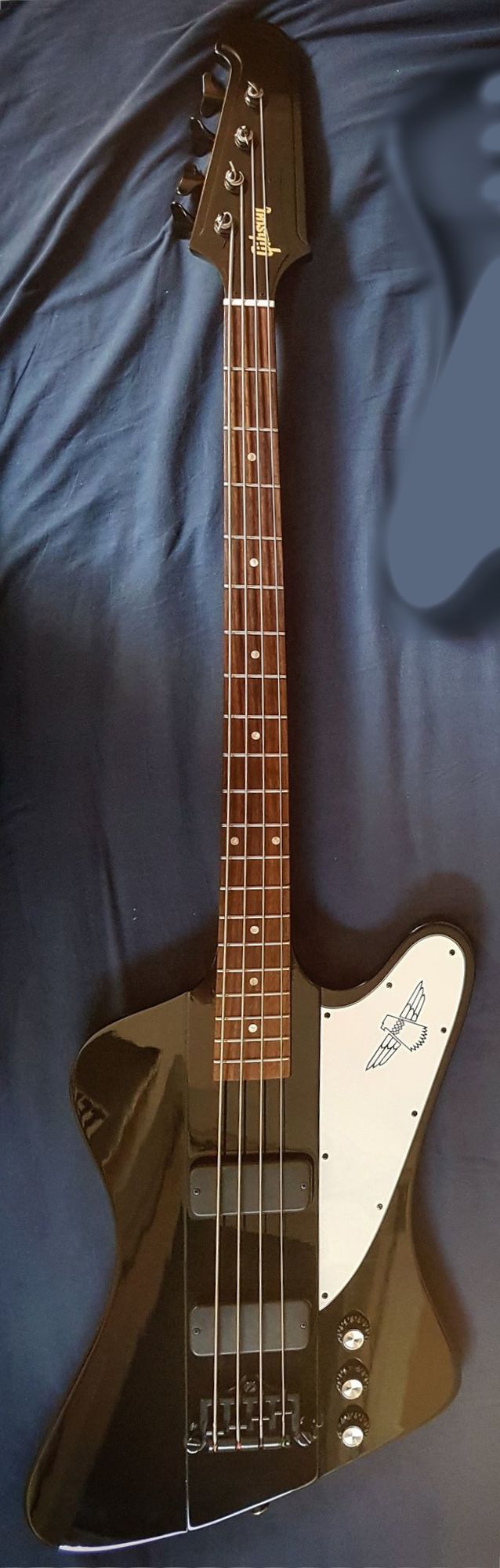
2013 Gibson Thunderbird ebony, clipped from a two-bass photograph. Original photo by MaxVaudous; derivative by Clusternote. Licensed under CC BY-SA 4.0. Via Wikimedia Commons. Gibson
Thunderbird
1963
John Entwistle thought the neck was too thin. So he kept the body and changed the neck.

Photo: Infrahertzz / Wikimedia Commons / CC BY-SA 3.0 Fender
Precision Bass
1951
Leo’s bass let the player at the back be heard. You know their lines by heart. You mostly don’t know their names.
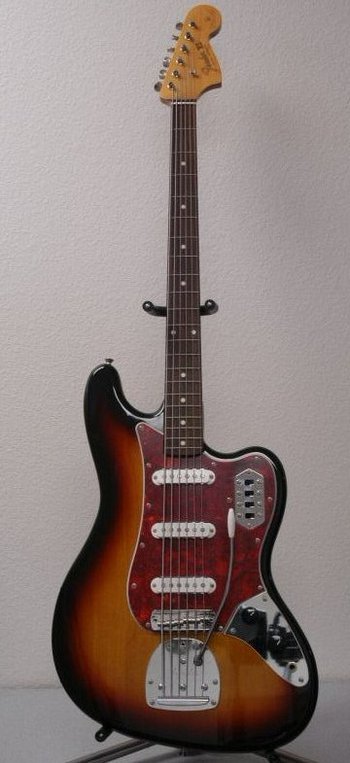
Photo: Blackyde / Wikimedia Commons / CC BY-SA 3.0 Fender
Bass VI
1961
Six strings, an octave down. It’s what a guitar player picks up when somebody hands them the bass part.