Fender
Bass VI
Six strings, an octave down. It’s what a guitar player picks up when somebody hands them the bass part.
London, 1969. The Beatles are working on the songs that become *Let It Be*. On the title track, by the usual account, the bass is John Lennon, playing a six-string Fender tuned exactly like his guitar, one octave lower.
- Introduced
- 1961
- Type
- Solidbody electric (6-string bass / baritone-adjacent)
- Class
- Production
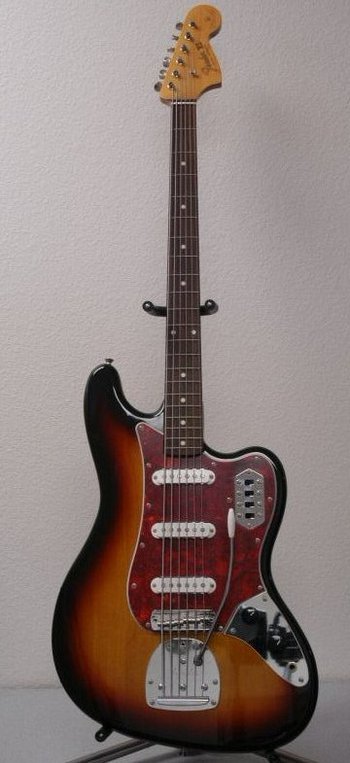
The short version
1956
Danelectro gets there first
The UB-2 six-string bass starts doubling uprights on Nashville “tic-tac” sessions.
1961
“New six-string Bass Guitar”
Shown at NAMM in July, in production that fall. You’ll see 1962 in print too.
1962
Jet Harris
“Besame Mucho” and the Man with the Golden Arm theme, both on a Bass VI.
1963
Jaguar parts
Claw pickups, a foam mute, and a fourth switch, borrowed from the Jaguar.
1966
Fresh Cream
Jack Bruce records most of Cream’s debut on one.
1968
The care package
Fender sends the Beatles a Bass VI. Lennon and Harrison both use it.
1975
Original run ends
Fourteen years of a guitar that bass players mostly didn’t want.
1976
“Back in the Saddle”
Joe Perry opens Aerosmith’s Rocks on a Bass VI.
Side A
A1
A bass for guitar players
In 1961 Fender’s catalog introduced a “New six-string Bass Guitar.” It was tuned E-A-D-G-B-E, same as a guitar, just an octave down, with heavy wound strings on a 30-inch scale. That’s shorter than a Precision or Jazz Bass, both 34.
Fender sold it as a bass. It isn’t a baritone, which is a guitar tuned down a few notes. It isn’t a Jazz Bass with extra strings, either. It’s its own odd animal.
It wasn’t even the first idea of its kind. Danelectro’s UB-2 had been playing Nashville “tic-tac” since 1956: a muted six-string bass doubling the upright, so the bass line had a click on the front of it.
When exactly Fender’s arrived depends who you ask. It was shown at NAMM in July 1961 and built from that fall, though you’ll see 1962 in print too, and at least one early neck is dated late 1960. The strings sat close together, which guitar players liked and bass players mostly didn’t. That tells you who it was really for.
A2
Switches, claws, and a tremolo on a bass
It came with an offset body and a floating tremolo, on a bass. On the headstock, in gold, “Fender VI,” and under it in smaller letters, “Electric Bass Guitar.” The 1962 list price was $329.50 in sunburst.
The first year had three Strat-style pickups and three on/off sliders. In 1963, after the Jaguar came out, the Bass VI took its notched claw pickups, a foam mute, and a fourth slider that cuts the low end. The mute and the fourth switch were there to give it a darker tone. That four-switch version is the one that stuck.
It never sold much. Maybe a hundred a year shipped before CBS bought Fender in 1965.
A3
Besame Mucho and Fresh Cream
Jet Harris was the first real star of the thing. In 1962 he put out “Besame Mucho” and the Man with the Golden Arm theme on a Bass VI. His 1963 single “Diamonds” is another story. It may have been a Jaguar, or a Gretsch tuned down to D. I’ll leave it out.
One of Jack Bruce’s first electric basses was a Bass VI, and he recorded most of Fresh Cream on it. Then he moved to the Gibson EB-3 that everybody pictures with Cream.
Flip the record · By the numbers
30"
Scale length. A Precision or Jazz Bass is 34". A Strat is 25.5".
$329.50
List price in 1962, sunburst.
~100
Shipped per year before the CBS sale, roughly. An estimate, not a factory count.
4
Slider switches from 1963 on. The fourth one cuts the bass. Players call it the strangle.
Side B
B1
The Beatles’ care package
In 1968 Fender sent the Beatles some instruments, including a bound Bass VI and a Jazz Bass. The guitarists mostly skipped the Jazz Bass. They didn’t skip the Bass VI.
The usual account of the Get Back sessions has Lennon playing it on “Dig It,” “Let It Be,” and “The Long and Winding Road,” and Harrison on “Two of Us.” They’d both already used a Bass VI on the White Album. Fender’s own list goes further, with Lennon on “Helter Skelter,” “Back in the U.S.S.R.,” and “Rocky Raccoon,” and Harrison on “Honey Pie” and “Birthday.” That’s the company talking, not a session log.
How old was it? Depends who you ask. Some say Harrison’s sunburst was a 1967 that he got that same year. Others date the Get Back guitar 1968.
Lennon and Harrison mostly ignored the Jazz Bass. They didn’t ignore this one.
B2
Back in the saddle
The original run ended in 1975. The Bass VI kept finding guitar players anyway.
Joe Perry bought one after he watched Peter Green pick up a six-string bass with Fleetwood Mac. When he sat down with it, he says, the intro and riffs to “Back in the Saddle” “just fell into place.” Live, Brad Whitford takes the solos, and Perry stays on the six-string. Robert Smith played one on the Cure’s Faith in 1981 and all over Disintegration. Steve Kilbey of the Church played it with a pick, not fingers, and said “the six was like a sports car.”
Fender has reissued it several times since, from Japan in 1995 to a Mexican Vintera III in 2026 built to match the 1963 version. Bass players still mostly shrug. That’s fine. It was never really theirs. It belongs to the guitar player who looks at the empty bass spot on the stage, sighs, and says fine, I’ll do it. This is the one that lets them keep their own hands.
Put this on
You’ve read about it. Now hear it. Here’s what this guitar sounds like, and what to listen for.
Besame Mucho
Harris was the Bass VI’s first real star, and this is one of his two 1962 sides on it.
Find it on YouTube (opens in a new tab)Fresh Cream
Jack Bruce recorded most of this album on a Bass VI, before the Gibson EB-3 that became the live Cream sound.
Find it on YouTube (opens in a new tab)Let It Be
Lennon on the Bass VI Fender sent over in 1968, by the usual account of the sessions. A guitar player covering the bass, and playing it like one.
Find it on YouTube (opens in a new tab)Back in the Saddle
Joe Perry’s Bass VI on the intro and riffs. Tom Hamilton’s four-string is a separate part. Listen for both.
Find it on YouTube (opens in a new tab)
The cast
The people, and the specific guitars, that made the legend.
1962
Jet Harris
Bass VI
Fender’s first master of it. “Diamonds” is disputed and may be a different guitar, so it isn’t here.
1966
Jack Bruce
Bass VI
One of his first electrics. Most of Fresh Cream, then the Gibson EB-3.
1969
John Lennon
The Beatles’ Bass VI
“Dig It,” “Let It Be,” and “The Long and Winding Road.”
1969
George Harrison
The Beatles’ Bass VI
“Two of Us.” His sunburst is dated 1967 or 1968, depending who you ask.
1976
Joe Perry
Bass VI
Bought one after watching Peter Green pick up a six-string bass. The “Back in the Saddle” intro and riffs “just fell into place.”
1989
Robert Smith
Bass VI
First on Faith, and prominently on Disintegration.
Liner notes
Specs, construction, rarity, value, and every source we used.
Six strings tuned an octave below guitar on a 30-inch offset with a tremolo — Fender’s Bass VI, not a Jazz Bass, and not a baritone.
- Body
- Alder; Bass VI offset
- Neck
- Bolt-on maple, 4-bolt; Early ’60s “C”
- Fingerboard
- Round-laminated rosewood, 7.25" (184.1 mm) radius, 21 vintage-tall frets, clay dots
- Scale
- 30" (762 mm)
- Pickups
- Three vintage-style Early ’60s Bass VI single-coils
- Hardware
- 6-saddle vintage-style adjustable bridge; floating tremolo with lock button and push-in arm; Bass VI mute; vintage-style tuners
- Electronics
- Master volume, master tone; three pickup on/off sliders; one low-cut (“strangle”) switch
- Finish
- Gloss polyester body; gloss urethane neck
- Nut
- Bone, 1.650" (42 mm)
Open the full research fileConstruction details, the complete player record, production numbers, dated value estimates, and sources
Current Mexican Vintera III Early ’60s (April 2026; Fender $1,499.99). This is the 1963-descended four-switch / claw-pickup spec Fender is selling, not the 1961 three-switch Strat-pickup first year. Mixed inch/mm flagged. Squier Classic Vibe is the cheap door, not this table. Not a Jazz Bass, Precision, Jaguar guitar, or Mustang Bass.
Construction
The job was a six-string bass guitarists could already play. Danelectro’s UB-2 had been doing Nashville “tic-tac” — muted six-string doubling an upright — since 1956. Fender’s 1961 catalog called this one the “New six-string Bass Guitar.” Tuned E-A-D-G-B-E an octave below a Spanish guitar, heavy wound strings, 30" (762 mm) scale. Not a Jazz Bass. Not a Precision. Those are 34" four-strings. Not a baritone either: Fender offered it as a bass, not a guitar tuned a fourth or fifth down.
GuitarHQ dates introduction late 1961. Fender, Vintage Guitar (Eric C. Shoaf, Feb. 2002), Premier Guitar, and MusicRadar the same year. RetroFret: NAMM July 1961, production that fall; they have not seen a production neck earlier than October. Guitar.com (2020 vintage bench) prints 1962. Keep 1961 as the plate year; keep 1962 as the minority print. A Guitar World collector (Feb. 2025) reports an example with neck date 11/60 and pots January 1961 — one early object, not a catalog year.
Offset body, Jazzmaster-family floating tremolo, six individual saddles, 21-fret rosewood, tight spacing that guitarists liked and bassists mostly did not. Vintage Guitar: headstock gold script “Fender VI” with smaller block “Electric Bass Guitar.” (Fender’s own essay types “Fender IV” — treat that as a slip; VG and MusicRadar both read VI.) Sunburst standard; custom colors later. 1962 list $329.50 sunburst (Premier Guitar) — 1960s money, not 2026 street.
1961 first year. Slab rosewood, clay dots, three Strat-style single-coils in smooth chrome rings, three on/off sliders, volume and tone on the jack plate. No strangle switch. No foam mute. That is the thin original.
1963 — after the Jaguar guitar, 1962 — is the spec that stuck. GuitarHQ / MusicRadar: veneer rosewood, foam mute, notched Jaguar claws, fourth slider (bass-cut / “strangle”). Premier Guitar: mute and fourth switch “to allow for a darker tone.” That four-switch claw guitar is what Vintera III is recreating. Fender’s 2026 copy says the Vintera III is “particularly faithful to the version we designed in 1963.”
Later dated changes, not a SKU dump: plastic guard late 1964 (GuitarHQ / MusicRadar); binding late 1965; blocks mid-1966; black logo and polyester 1968. Original U.S. run 1961–1975. Japan reissue 1995–1998 (Fender: four-switch 1962 recreation). Custom Shop ’64 2006–2008. Pawn Shop Bass VI 2013–2014 — HSS, five-way blade, not this circuit. Jaguar Bass VI Custom (2004–2007) is 28.5" with two pickups and an Adjusto-Matic — Fender calls it more guitar-like. It is not this instrument. Jaguar Bass (Jazz pickups in a Jaguar-shaped four-string) is a different bass on the Jazz Bass plate.
Current Vintera III is the table above. Classic vs current: 1961 three-switch Strat rings against 1963-onward claws, mute, and strangle — and against a Mexican poly reissue you can order in 2026.
Players
Do not hang a Jazz Bass or a Precision on this plate. Do not recruit every six-string “baritone” as if it were octave-down E. Do not flatten the Beatles’ Fender care package onto McCartney’s Höfner or Jazz Bass.
Jet Harris. Fender: first master of the instrument; 1962 solo hits “Besame Mucho” and the Man with the Golden Arm main-title theme on Bass VI. Fretted Americana cites the same two sides (May / September 1962). “Diamonds” (Harris–Meehan, 1963) is contested — Wikipedia puts that single and after on Jaguar / Gretsch detuned to D, not this bass. Stay inside the two Fender-named 1962 sides.
Jack Bruce — Cream, Fresh Cream (1966). Official site: one of his first electrics was a Bass VI, EADGBE an octave down; “Jack recorded most of Fresh Cream with this bass” before the Gibson EB-3 that became the live Cream sound. Vintage Guitar: it served that band; Bruce played bass more like a solo instrument. Do not stamp Disraeli Gears or the Marshall-stack EB-3 years on this guitar.
John Lennon and George Harrison — 1968 Fender care package Bass VI. Guitar World (Get Back gear, Chris Gill): CBS-era, bound, large headstock; Fender also sent a right-handed Jazz Bass the guitarists mostly skipped. Lennon: “Dig It,” “Let It Be,” “The Long and Winding Road.” Harrison: “Two of Us.” Both had already used a Bass VI on the White Album. Fender’s model essay adds Lennon on “Helter Skelter,” “Back in the U.S.S.R.,” “Rocky Raccoon” and Harrison on “Honey Pie” and “Birthday.” Manufacturer track list, not a session log in-hand. Custom Shop / No Treble (Aug. 2026): Harrison’s sunburst dated 1967, “acquired by Harrison in 1967”; Guitar World dates the Get Back guitar 1968. Keep both. The 2026 Limited Edition George Harrison 1967 VI is a Custom Shop recreation, not the Abbey Road object.
Joe Perry — Fender Bass VI on “Back in the Saddle” (Rocks, 1976). Guitar Player / Guitarist (2024): he bought one after watching Peter Green pick up a six-string bass with Fleetwood Mac; the intro and riffs “just fell into place.” Live, Brad Whitford takes the solos and Perry stays on the six-string — Guitar World. Tom Hamilton’s four-string is a different part. Do not hang Toys in the Attic.
Robert Smith (the Cure). Fender: first on Faith (1981), then mid-’80s records, and prominently on Disintegration (1989), Wish, Wild Mood Swings, Bloodflowers, 4:13 Dream. Manufacturer association. Song-by-song studio diaries were not in-hand here. Porl Thompson and Perry Bamonte also used one in that band (Fender).
Also known, short: Steve Kilbey (the Church) — Fender quotes him: pick, not fingers; strings too close; “the six was like a sports car.” Peter Green — Joe Perry’s named influence; Wikipedia’s Bass VI page captions him with one. Do not invent Fleetwood Mac album credits. Fender also lists Entwistle, Danko, Haydock, Frusciante, Placebo, Auerbach. No canonical serials located this pass.
Rarity
You can buy a new Bass VI tomorrow. Vintera III, Squier Classic Vibe, and the 2026 Harrison Custom Shop all coexist. Custom Shop is limited current, not vintage-scarce. Japan 1990s reissues and Pawn Shop HSS examples are other factories and circuits on this silhouette.
Official Bass VI shipping totals are unpublished. Serials were shared across models; they date a guitar, they don’t count a year. Vintage Guitar (Shoaf, 2002): “Only about 100 per year were shipped before the company was sold to CBS in ’65.” Named estimate, not a factory ledger. Keep it attributed. That is why a first-year census is unknown, not the chapter.
What is actually thinner: 1961 three-switch slab-board Strat-ring examples; custom-color pre-CBS; complete originals with mute and claws intact. Harrison’s sunburst and Perry’s Rocks six-string are unique objects. They are not a vintage Bass VI.
Value
Informal estimate, 8 September 2026. Not an appraisal.
Asking prices are not sold prices. Factory totals unpublished. Serials ≠ shipping. Artist-owned examples (Harrison, Perry) sit outside these ranges. Reissues do not substitute for 1961–75 Fullerton. Public 2024–26 sold comps are usable for the Reverb 1961–1964 bucket and for used Japan / Vintera II; thinner for clean custom-color originals (mostly dealer asks). Reverb’s 1965–1974 bucket printed “used estimate unavailable” this pass.
New street. Mexico Vintera III Early ’60s $1,499.99 (Fender, April 2026). Squier Classic Vibe $569.99. Custom Shop Limited Edition George Harrison 1967 VI MSRP $9,500 (No Treble, 28 August 2026) — a named recreation, not vintage.
Used modern. Reverb Price Guide, Vintera II ’60s: $816–$1,138 (181 Good–Mint orders). MIJ Bass VI 1993–1997: $1,717–$2,925 (53 orders). Named used Vintera III ask this pass: $1,303.64. Used Classic Vibe commonly a couple hundred below new. Pawn Shop HSS is a different circuit; don’t average it in.
Vintage / collectible. Reverb Price Guide, 1961–1964 Good–Mint: $6,314–$11,187 (39 orders). Named 2024–25 solds in that widget: Excellent $9,500 (13 Dec 2025), Very Good $10,499 (28 June 2025), Good $8,800 (17 March 2025), Excellent $10,331.73 (9 Aug 2024). A $2,999 Excellent (21 July 2024) is an outlier in the same table, not a midpoint. Dealer asks sit above: Austin Vintage 1963 sunburst $11,900; Guitar Barn 1963 $12,500; 1969 black $16,200 ask. CBS 1970s original-finish asks this pass cluster roughly $8,000–$9,000 (named 1974 Excellent $8,950 / $7,999). Do not average asks with the 39-order sold band. Shoaf’s 2002 “demand is low except among Fender completeists” is a 2002 sentence, not 2026.
See also
- Jaguar — 1962 24" guitar; the claws, strangle, and mute the VI borrowed in 1963. Not this 30" six-string bass
- Jazz Bass — 1960 34" four-string. Offset kin, different job
- Mustang Bass — also 30", four strings, student bass; not this six-string
Sources
- Fender: The Bass VI: Part Guitar. Part Bass. All Epic. — 1961 intro; catalog “New six-string Bass Guitar”; octave-down E vs baritone tunings; 30"; Jazz Bass/Jaguar cross; 1963 claws/strangle/mute; binding 1965, blocks 1966, poly/black logo 1968; 1961–75 run; Japan 1995–98; Custom Shop ’64 2006–08; Pawn Shop 2013–14; Jaguar Bass VI Custom 2004–07 28.5"; Jet Harris, Bruce, Beatles, Perry, Smith, Kilbey quote
- Vintage Guitar: Fender Bass VI (Eric C. Shoaf, Feb. 2002) — 1961 intro; 30" vs 34" P/J; “Fender VI” / “Electric Bass Guitar” logo; ~100/year pre-CBS; 1975 end; 1963 pickup change; 1965 binding; 1966 blocks
- guitarhq.com Fender model notes — late 1961 intro; slab / 3 switches; 1963 veneer, mute, 4th switch; 1964 plastic guard; 1965 binding; 1966 blocks; 1968 black logo / poly; 1975 drop; 1995 Japan; collectibility C+ / C-
- guitarhq.com Fender timeline — “1961 late, Bass VI”
- Premier Guitar: 1963 Fender Bass VI and 1966 Fender Bassman — 1961 intro; octave-down guitar tuning; 1962 list $329.50; 1963 Jaguar pickups, mute, fourth switch; tic-tac; Harris / Bruce
- MusicRadar: Classic gear: Fender Bass VI — 1961; 30" / 7¼" / 21 frets; 1963 Jaguar upgrades; year-by-year 1961–75; gold “Fender VI” logo
- Vintera III Early ’60s Bass VI — current spec; 30" (762 mm); 7.25" (184.1 mm); 1.650" (42 mm) bone; $1,499.99
- No Treble: Vintera III bass series — April 2026 launch; Bass VI $1,499
- Fender: Brian Robert Jones plays Vintera III Bass VI — Vintera III faithful to 1963
- Guitar World: Vintera III Early ’60s Bass VI review — $1,499 list; 9.7 lb; 42 mm nut
- Classic Vibe Bass VI — Squier $569.99
- Reverb Price Guide: Bass VI 1961–1964 — $6,314–$11,187, 39 Good–Mint orders; named 2024–25 solds
- Reverb: Bass VI 1965–1974 — used estimate unavailable this pass
- Reverb Price Guide: Bass VI MIJ 1993–1997 — $1,717–$2,925, 53 orders
- Reverb Price Guide: Vintera II ’60s Bass VI — $816–$1,138, 181 orders
- Guitar World: The Beatles’ Get Back gear (Chris Gill) — 1968 Bass VI; Lennon Dig It / Let It Be / Long and Winding Road; Harrison Two of Us; White Album prior use; Jazz Bass in the same package
- Guitar World: Fender Limited Edition George Harrison 1967 Bass VI — Custom Shop 2026; gifted 1968 vs 1967 dating; Hey Jude promo
- No Treble: Custom Shop George Harrison 1967 Bass VI — acquired 1967; Birthday / Honey Pie; MSRP $9,500
- Jack Bruce official: Gear — Bass VI on most of Fresh Cream; then EB-3
- Guitar Player: Joe Perry on “Back in the Saddle” — Bass VI riff; Peter Green; Rocks
- Guitar World: Joe Perry on Back in the Saddle — live six-string; Whitford solos
- RetroFret: 1961 Bass VI — NAMM July 1961; fall production; October earliest neck; 10-61 example
- Fretted Americana: 1961 Bass VI — slab, 3 switches; nut just over 1½"; 30"; Jet Harris 1962 sides
- Guitar.com: Vintage Bench Test, 1963 Bass VI — prints 1962 intro; 1963 Jaguar claws / four-switch / mute; 30"/762 mm; nut 39.3 mm
- Guitar World: The Fender Bass VI defies categorization — 1961; 11/60 neck / Jan 1961 pots on one early example
- Wikipedia, Jet Harris — Besame Mucho / Golden Arm on Fender VI; Diamonds onward Jaguar/Gretsch detuned to D
- Wikipedia, Fender Bass VI — 1961–75; octave-down E; 1963 Jaguar electronics; Peter Green caption
Keep digging
Guitars this one gets compared to, confused with, or descended from.
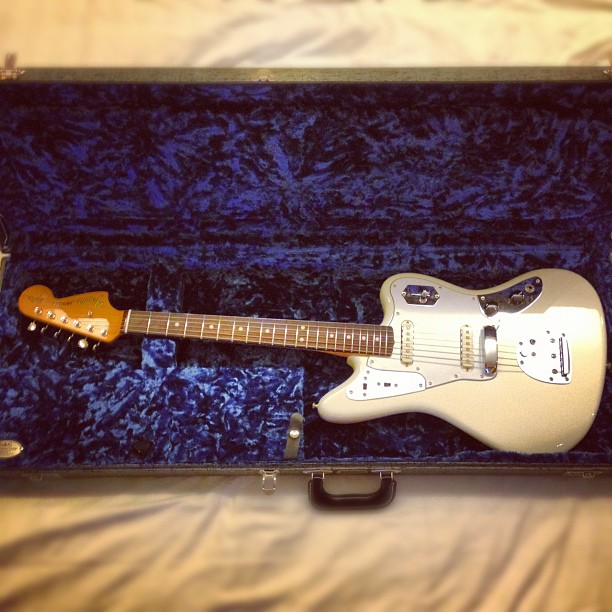
Fender Jaguar Johnny Marr signature. Photo by ToGa Wanderings. Licensed under CC BY 2.0. Via Wikimedia Commons. Fender
Jaguar
1962
It was the top of Fender’s catalog in 1962. By the late ’70s it was a pawn-shop guitar, and somebody’s only one.

Fender Jazz Bass from 1966 in Olympic white with the transition fingerboard (bindings and dot inlays). Photo by Th. Ott. Licensed under CC BY-SA 3.0. Via Wikimedia Commons. Fender
Jazz Bass
1960
Built for jazz players who mostly passed on it. Then bass players started using it to take the solo.
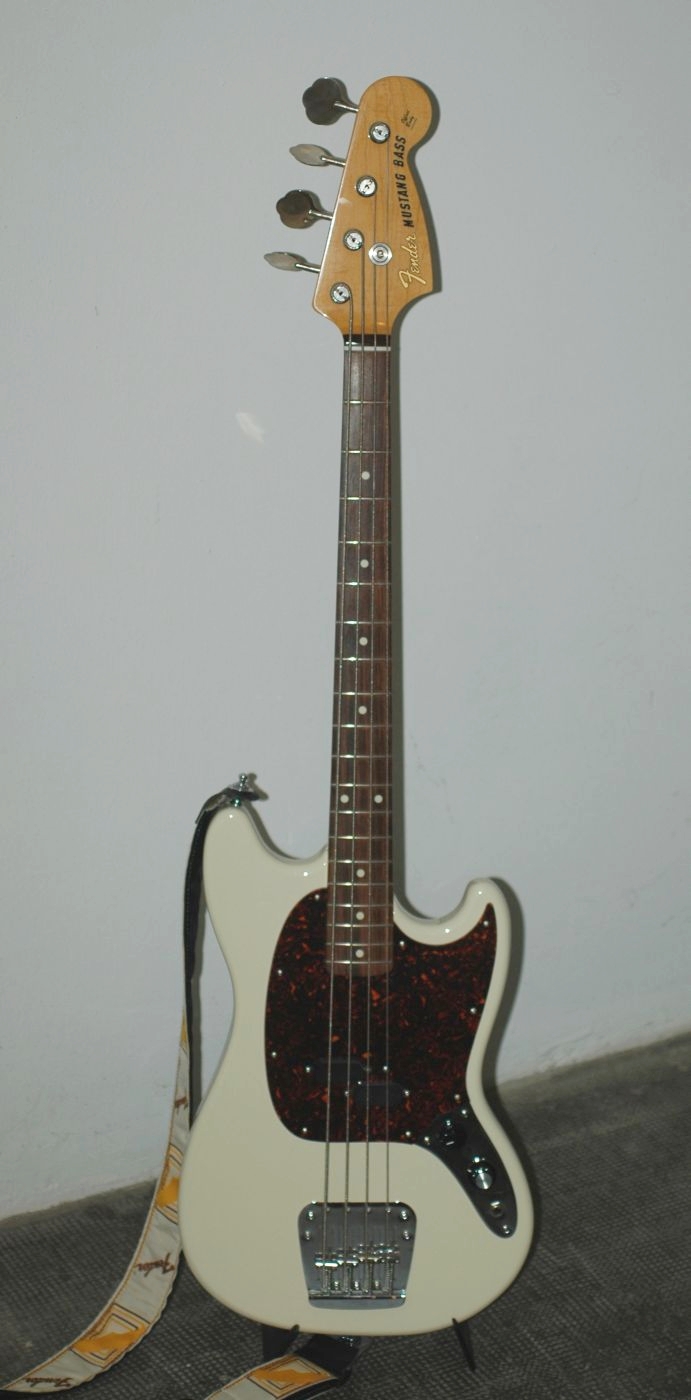
E-Bass Fender Mustang, shortscale 30". Photo by Joachim Hensel-Losch. Licensed under CC BY 2.5 (also offered as CC BY-SA 3.0). Via Wikimedia Commons. Fender
Mustang Bass
1966
Leo Fender’s last bass for Fender was a short, cheap student model. That was the whole idea.