Ampeg
Baby Bass
Bass players were being handed a Fender. Ampeg handed them a plastic upright with a scroll.
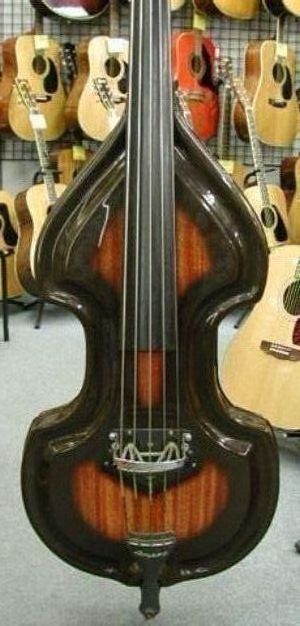
The Baby Bass is a cello-sized, fretless electric upright from Ampeg in Linden, New Jersey: a plastic body, a maple neck, and a pickup that listens to two steel discs under the bridge instead of the strings. It isn't the Zorko it grew out of, and it isn't Ampeg's horizontal Scroll Bass.
- Introduced
- 1962
- Type
- Electric upright bass
- Class
- Production
The short version
1958
The Zorko
A Dopera brothers brochure calls their hollow fiberglass Zorko the "First electric nylon or gut string bass fiddle."
1962
Ampeg's turn
Everett Hull's Ampeg takes over the design, and the Baby Bass comes out.
1963
The pickup patent
Hull, Jess Oliver, and Harry Bloom file for the diaphragm pickup on 9 July. It's granted in April 1966.
1964
175
A company report in March counts 175 sold, a year and a half in.
1966
The scroll moves
The Baby Bass headstock turns up on a horizontal bass, Ampeg's fretted Scroll Bass.
1970–72
Off the list
The four-string leaves the price list somewhere between 1970 and 1972, depending on the source.
1997
The reissue
Steve Azola builds an official Ampeg-badged Baby Bass, with a piezo added to the diaphragms.
Side A
A1
Something you could get in a car
While Jess Oliver was testing a new bass amp, the B-15, he was out playing gigs on a bass his company had just started making. It was a Baby Bass.
Ampeg made amplifiers. The company was named for Everett Hull's amplified peg, a pickup in the end pin of a double bass. The players Hull cared about stood behind uprights, and by the early sixties a lot of them were being handed a horizontal bass instead.
The Baby Bass was Ampeg's answer: a short, cello-sized upright with f-holes, a scroll, and no frets. Small enough to get in a car. Loud enough, plugged in, to be heard.
A2
Born in somebody else's shop
It didn't start in Linden. In the late fifties the Dopera brothers, the family behind National and Dobro, were making the Zorko: a hollow fiberglass upright with a bolt-on maple neck and a slightly scaled-down head. A 1958 brochure called it the "First electric nylon or gut string bass fiddle."
Ampeg took the design over. Most accounts put that at 1962, and Oliver says that's when the bass came out. When the deal was done, 25 or 30 hollow fiberglass shells were left over. Ampeg put Oliver's pickup in them, with Zorko necks and Ampeg logos, and sold those first. When the shells ran out, the body changed.
A3
A pickup that doesn't hear the strings
Oliver's pickup is the clever part. He patented it with Hull and Harry Bloom, filed in July 1963 and granted in April 1966.
Under each foot of the bridge sits a thin steel disc. Each disc faces a magnet and a coil, about 12,000 turns of very fine wire. The strings shake the bridge, the bridge shakes the discs, and the coils hear the discs. They never hear the strings at all.
That meant gut, nylon, or steel all worked. An upright player didn't have to change strings to go electric. It isn't a piezo, and it isn't a guitar pickup under a string.
The scroll had a second life. In 1966 someone at Ampeg, probably Hull, put it on the end of a fretted horizontal bass, and the Scroll Bass that came out of it uses a variation of this pickup. That's a different instrument.
Flip the record · By the numbers
41"
The scale, or 41¼, or 41½, depending on whose tape measure.
25 or 30
Leftover hollow Zorko shells that became the first Ampeg Baby Basses.
12,000
Turns of wire, roughly, in each pickup coil the patent describes.
175
Sold by March 1964, against press copy that talked about "great demand."
Side B
B1
Plastic that warps in the sun
The production body is Uvex, a plastic, filled with foam. Some sources say fiberglass, and the argument hasn't settled, but the luthiers who've worked on them say Uvex.
It has its problems. It's unstable, it has a low melting point, it smells of plastic, and it warps if you leave it in a hot car. Filled and damped, it rings with fewer overtones than the hollow Zorko did. What you get is a short, percussive note with not much sustain.
The f-holes are cut into a filled body, so there's no box behind them. Whatever you hear comes up through the bridge, the discs, and the coils.
B2
A hundred and seventy-five
It didn't sell the way Ampeg hoped. A company report in March 1964, a year and a half in, counted 175 sold. The press copy at the time talked about "great demand" and more than 4,000 square feet given over to making it.
Charles Mingus had one. So did the classical virtuoso Gary Karr, and both did ads for it. Chubby Jackson promoted it early. Karr tried to get an orchestra to take it on, and classical players mostly wouldn't. Latin players came through the shop, Bobby Rodríguez and Julio Andino among them.
Tony Levin, in New York in the late sixties, had a Baby Bass and a B-15 and nothing else. Then, in his words, he
"got a Fender because that's what everyone wanted."
How many were made in all, nobody can say. The records went missing in later buyouts. Estimates run from "hundreds" in the sixties to about a hundred a year for ten years. The four-string left the price list somewhere between 1970 and 1972, depending on who's counting.
B3
Thirteen years old
Andy González's father bought him a Baby Bass in 1964, when he was 13. He got a second one, a 1965, later on.
On the gigs he played an acoustic upright, a German one or a Czech one. In the studio he reached for one of the two Baby Basses.
Steve Azola built an Ampeg-badged reissue in the late nineties, with a piezo added to the discs, and others still build basses on the outline. Ampeg doesn't make one now.
Everyone wanted a Fender. The kid whose father bought him a plastic upright in 1964 was still carrying it into the studio as a grown man.
The cast
The people, and the specific guitars, that made the legend.
1962
Jess Oliver
Baby Bass, Linden
Ampeg's engineer. Co-patented the pickup, helped design the vacuum-form machine, and gigged a Baby Bass while he tested the B-15 amp.
Early 1960s
Chubby Jackson
Baby Bass, in the ads
One of its first promoters.
1960s
Charles Mingus
Baby Bass
Owned one and did ads for it, by Oliver's account. No record is pinned to it.
1960s
Gary Karr
Baby Bass
Owned one and did ads. Tried to get an orchestra to take it on. Classical players mostly wouldn't.
1964
Andy González
A 1964 Baby Bass his father bought him at 13, and a 1965
Played acoustic uprights on the gigs and reached for one of the two Baby Basses in the studio.
Late 1960s
Tony Levin
Baby Bass and a B-15, New York
All he had, he says, until he "got a Fender because that's what everyone wanted."
Liner notes
Specs, construction, rarity, value, and every source we used.
A cello-sized plastic upright and a bridge that hears two steel discs, not the string — Ampeg’s Baby Bass, not the Zorko it came from and not the Scroll Bass.
- Body
- 3/4 upright, violin or cello outline, f-holes, retractable end pin (Blue Book BB-4). Production body is foam-filled Uvex (Clevinger; Jill Azola). Blue Book also says fiberglass, then Uvex. Wikipedia’s instrument note: Uvex, “not fiberglass.” NAMM’s card: fiberglass. Early hybrids used leftover hollow Zorko shells (Azola: 25 or 30). Mix flagged. Not an acoustic box.
- Neck
- Bolt-on maple. Tilt-adjustable on Twelfth Fret’s 1968 archive bass and on Cream City’s.
- Fingerboard
- Fretless. Ebony on the Twelfth Fret, Cream City, RetroFret, and Bass Shop examples. Blue Book’s BB-4 line does not name the wood.
- Scale
- Blue Book 41". Twelfth Fret’s 1968 archive bass 41 1/4". One late-’60s Bass Shop sheet 41.5". Mix flagged. Do not average. Do not invent millimetres. The ABB-1 reissue’s 41.5" is not this row.
- Pickups
- Two diaphragms under the bridge feet, a coil under each disc. Patent: silicon steel. Clevinger: spring steel. Keep both. Not a piezo. Not a string-reading magnetic. Gut, nylon, or metal.
- Hardware
- Aluminum bridge (Clevinger). Tailpiece. Retractable end pin. Open scroll, 2+2. The reissue’s maple bridge is not this one.
- Electronics
- Passive volume and tone. No selector.
- Finish
- Blue Book: Mahogany Wood Grain, White, Red, Black, Turquoise. Dealer sheets often say sunburst for the wood-look ones.
- Nut
- No published model width. One late-’60s Bass Shop sheet: 1 7/16". That bass only. No millimetres invented.
Open the full research fileConstruction details, the complete player record, production numbers, dated value estimates, and sources
Classic living example = 1960s Linden BB-4, the foam-filled upright players mean by Baby Bass. BB-5 (Blue Book 1964–1971) is the five-string. The Zorko is the earlier Dopera bass. The ABB-1 (Blue Book 1997–2000) is Azola’s Ampeg-badged reissue, diaphragm plus piezo. No current Ampeg Baby Bass this pass. RetroFret’s late-’60s #013873 prints 60" (152.4 cm) overall, 18" (45.7 cm) wide, 3.5" (8.9 cm) deep, scale blank. That bass only. Inch/cm mix flagged. Do not convert 41", 41 1/4", or 41.5". Standalone. No Gibson SKUs.
Construction
The job was an upright you could get into a car and still hear. Ampeg made amps. Everett Hull’s amplified peg. The players he cared about were being handed a horizontal bass. What got the company name was not a Precision. It was a short upright, cello-sized, with a scroll.
It was not born in Linden. Martin Clevinger’s evolution essay, quoted on TalkBass: by the late 1950s, Rudy and Ed Dopera — National and Dobro — had the Zorko. Hollow fiberglass, bolt-on maple, a slightly scaled-down head, and a 1958 brochure calling it the “First electric nylon or gut string bass fiddle.” One bridge cut the downbearing. The other carried a magnet, and a coil sat beside it. Twelfth Fret’s archive copy prints that brother’s name as Ruby. Clevinger says Rudy. Keep both. A post on that thread dates the Dopera sale to Ampeg as 1962. Jill Azola, writing there as the shop that had held the basses, does not put a year on the sale. She says that when Zorko sold it, 25 or 30 hollow fiberglass shells were left, and Ampeg fitted those with Jess Oliver’s pickup — Zorko necks, serials in the 200s, Ampeg logos — then went to foam-filled Uvex once the shells were gone. Wikipedia and Blue Book put 1962 on Hull’s acquisition and on the Baby Bass introduction. Oliver, to Chris Jisi (Guitar World, 8 January 2020): it “came out [1962].” YAML is that Ampeg year. The Zorko is earlier. Do not collapse them.
Clevinger’s Ampeg body is the heavier Uvex: unstable, low melting point, an odor from the plastic, warps in a hot car, filled and dampened, fewer overtones than the hollow Zorko, a percussive tone and little sustain. Blue Book’s BB-4 line is fiberglass and later Uvex, 1962–1972. Wikipedia’s instrument note says cello-sized Uvex, “not fiberglass, as is often stated,” and “around 1962.” NAMM’s oral-history card says fiberglass and calls Oliver the inventor of the first electronic upright. That card skips the Zorko. Keep it. Don’t let it win.
Oliver told Jisi he helped design the vacuum-form machine, and that he gigged the bass while he tested the B-15. The pickup patent is his, with Hull and Harry Bloom. Filed 9 July 1963, granted 5 April 1966, US 3,244,791. Two discs under the bridge feet. Silicon steel in the patent, spring steel in Clevinger. Each disc faces a magnet and a coil. The patent’s preferred coil is about 12,000 turns of No. 42. The coils hear the discs. They do not hear the string, so gut, nylon, or metal all work. Not a piezo. Volume and tone. Aluminum bridge. The reissue’s maple bridge is later.
Not the Scroll Bass. Vintage Guitar: the AEB-1’s mystery pickup is a variation of this 1963 unit, and early sheets printed this patent number. Someone, that article says probably Hull, put this scroll on the horizontal bass in 1966. The AEB-1 is a fretted solid. The Burns guitars Ampeg imported are another line.
Blue Book’s four-string is the table: f-holes, retractable end pin, open head, fretless, 41". The holes sit on a filled body. They are not a sound chamber. Scale will not sit still: 41" (Blue Book), 41 1/4" (Twelfth Fret, 1968), 41.5" on one Bass Shop sheet. The ABB-1 is 41.5" too, and it is not this measurement. Don’t average. Don’t convert. That sheet’s 1 7/16" nut is one bass. BB-5 stays off the table.
The end of the run splits the same way. Wikipedia’s instrument paragraph, flagged unsourced there: on the price list until about 1970. Twelfth Fret: until 1971. Blue Book: 1972 on the four-string, 1971 on the five. Vintage Guitar: sales had stagnated since 1962. Spanish Wikipedia quotes Hopkins and Moore, Ampeg: The Story Behind the Sound: a March 1964 company report, a year and a half in, counted only 175 sold, against press copy about “great demand” and more than 4,000 square feet given to the bass. Clevinger says hundreds in the ’60s. Jill Azola’s shop math is about 100 a year for ten years. None of that is a surviving ledger. Don’t average 175 with 100 a year.
The reissue is another shop. Azola’s archived story (Jedistar): Steve Azola got Ampeg’s authorization, showed a prototype at NAMM, and was later asked to build the official one. Ampeg went back on the headstock. His story ends the contract in 1999. A vintage-style fiberglass Baby with the diaphragm pickup stayed at Azola until 2008. Blue Book’s ABB-1 is 1997–2000: foam and fiberglass over an aluminum structure, tilt-adjustable maple, Macassar ebony, diaphragm plus dual piezo, volume, blend, and tone. Clevinger’s essay, as quoted in 2005, still had Azola building that reissue for St. Louis Music. Keep 1999 and 2000. Blue Book’s roughly 1,200 Azola basses, 1994–2010, is every model he built, then he stopped. Not a Baby Bass count. Ray Ramírez, in Puerto Rico, builds replicas and later basses on the silhouette (Bass Musician Magazine, 2021). Not an Ampeg.
Classic vs current: a 1960s Linden BB-4 — scroll, fretless, two discs, no piezo — against nothing you can order new from Ampeg.
Players
A Zorko, a Scroll Bass, a Dan Armstrong, and an Azola are not this upright. Latin use stays with the people a source names.
Charles Mingus and Gary Karr. Oliver, to Jisi: both had Baby Basses and did ads. No side is pinned there. The symphony is a different claim. Spanish Wikipedia’s quotation of Hopkins and Moore: Karr tried to get the Kansas City Symphony to take it, and classical players mostly would not. Yamaha’s company history says the same thing without the city. The ads are sourced. A symphony job is not.
Chubby Jackson. NAMM: an early promoter, in advertisements, early 1960s. Not a session. The “first electronic upright” line is on NAMM’s Oliver card, not his. The Zorko is still earlier.
Andy González. Bill Milkowski, JazzTimes: on the gigs in that piece he played a German acoustic or a Czech one. In the studio, one of two Ampeg Baby Basses — a 1964 his father bought when González was 13, or a 1965 he got later. The article does not put Rumba Buhaina or a Fort Apache side on either. Don’t.
Tony Levin. Same Jisi interview, his own line: in New York in the late ’60s he only had a Baby Bass and a B-15, then “got a Fender because that’s what everyone wanted.” White Elephant and Double Fantasy, which he confirms there, are B-15 credits. Not this bass.
Bobby Rodríguez. Oliver names him, with Julio Andino, among Latin players who came through the shop. The Hopkins and Moore passage puts him on the promotion list. A TalkBass post, citing Rubén Rodríguez, says Bobby preferred a Zorko to the foam-filled Baby Bass, had Ampeg update that Zorko’s electronics, and after it was stolen in the late 1960s mostly played bass guitar. A different thread, about the scroll bass, has a repairman saying he fixed Bobby’s Ampeg — no P-bass pickup in it — and that it was stolen on a Tito Puente tour in Israel. That is the AEB-1 (ampeg-aeb-1), if the thread has the right bass. Three objects. No Puente side is pinned on this upright.
Julio Andino is a shop visitor in Oliver’s list, and a name in that promotion passage. That is the claim. No record.
Rarity
No new Ampeg Baby Bass. Azola’s contract reissue is over, and his shop closed in 2010. A Ramírez bass is a living luthier’s instrument. It is not a Linden BB-4.
Ampeg published no total. Vintage Guitar’s reason on the horizontal basses covers the period: the production records were lost in the buyouts. The numbers that exist are not the same kind of number. Hopkins and Moore, via Spanish Wikipedia: 175 sold by March 1964. Clevinger: hundreds in the ’60s. Jill Azola: about 100 a year for ten years, her calculation, plus those 25 or 30 fiberglass hybrids. Don’t average them. Serials don’t count a year. Reverb’s #00239, a current ask, is described by the seller as a Uvex shell. A 200-series number alone does not prove a Zorko body.
What is actually thin: an unwarped Uvex body, a hybrid that still has the Zorko neck, an original aluminum bridge, a five-string. González’s 1964 and 1965 are two basses. Oliver’s own is a third.
Value
Informal estimate, 26 October 2026. Not an appraisal.
Ask vs sold labeled. Provenance is not a comp. No invented medians, list prices, or factory counts. No new Ampeg cart. Azola’s 1999 sheet prints the vintage-style Baby as “CALL,” not a dollar, and it is not 2026 street.
New street. None.
Used modern. An ABB-1 or a Ramírez replica is another bass. No clean 2026 sold band for either isolated this pass. Don’t price a 1960s BB-4 off them.
Vintage / collectible. Reverb’s BB-4 sunburst guide says the used estimate is unavailable. The chart says “based on 3 orders.” The transaction table on that page, fetched 26 October 2026, lists seven solds. Named solds, not a median: 18 May 2026, Good, $1,941; 8 March 2025, Very Good, $2,599; 11 November 2024, Excellent, $3,000; 28 August 2024, Good, $2,000; 26 July 2024, Good, $2,499.99; 24 July 2024, Very Good, $2,300; 9 May 2024, Excellent, $3,090. Named asks the same day, not hammers: a Good sunburst $5,500; a Very Good sunburst $4,139.49, down from $6,265.17; a Very Good black $4,500, down from $5,000. Mario’s Gear Outlet, Chicago, Very Good #00239, $4,500: seam repairs, original bridge swapped for sandalwood, the old bridge in the sale. Not a stock comp. Do not average the asks with the solds. Heritage, 20 June 2015, serial 000568, Oliver’s bass, with his letter: the hammer was not public this pass. His bass. Not a street tape.
See also
- ampeg-aeb-1 — the horizontal Scroll Bass; this headstock and a variation of this pickup, fretted, not an upright
- fender-precision-bass — the horizontal bass players were being handed when this one stalled
- ampeg-dan-armstrong — 1969 Linden Lucite guitar; the See-Through bass is that sibling, not a Baby Bass
Sources
- Martin Clevinger, evolution of the EUB, quoted on TalkBass (4 Dec 2005) — late 1950s Rudy and Ed Dopera; 1958 brochure line; hollow fiberglass Zorko; double-bridge pickup; Ampeg aluminum bridge, two spring-steel diaphragms, Uvex, heat warp; hundreds in the ’60s; Azola reissue for St. Louis Music as of that essay. The live clevinger.com page no longer carries the essay (fetched this pass).
- TalkBass, Zorko Bass thread — a post on the thread dates the Dopera sale 1962; Jill Azola: 25 or 30 leftover shells, Oliver pickup, serials in the 200s, then foam-filled Uvex; her ~100-a-year figure over ten years. Not a ledger. A later post cites Rubén Rodríguez on Bobby Rodríguez’s Zorko.
- Wikipedia, Ampeg — 1962 introduction from the Zorko, acquired from the Dopera brothers; Oliver pickup. Instrument section: around 1962, Uvex, “not fiberglass,” price list until about 1970, citation needed on that paragraph.
- Blue Book, Baby Bass series — BB-4 1962–1972, fiberglass then Uvex, 41", f-holes, retractable end pin, open head, fretless; finishes Mahogany Wood Grain, White, Red, Black, Turquoise; BB-5 1964–1971; ABB-1 1997–2000, 41.5", diaphragm plus piezo
- Blue Book, Ampeg — 1962, Hull acquired the rights; Oliver’s diaphragm pickup
- Blue Book, Azola — 1997 contract for the official reissue; about 1,200 basses of all models, 1994–2010
- US 3,244,791 — filed 9 July 1963, granted 5 April 1966; Hull, Oliver Jespersen, Harry Bloom; silicon-steel discs; about 12,000 turns of No. 42; gut or metal
- Guitar World, Chris Jisi, 8 January 2020 — Oliver: vacuum-form machine; out 1962; Mingus and Karr had Baby Basses and did ads; Bobby Rodríguez and Julio Andino at the shop; Levin’s late-’60s Baby Bass, then a Fender. White Elephant and Double Fantasy are B-15 credits.
- Vintage Guitar, Ampeg Horizontal Basses (March 1997) — introduced 1962, sales stagnated; scroll reused on the AEB-1; mystery pickup a variation of the 1963 unit; records lost in the buyouts
- NAMM oral history, Jess Oliver — fiberglass; calls it the first electronic upright; Chubby Jackson ads, early 1960s. Skips the Zorko.
- NAMM oral history, Chubby Jackson — early promoter of the early-1960s model
- Yamaha Hub, The Ampeg Story (4 Feb 2020) — fiberglass; symphonies did not take it as Hull hoped; some Latin bands, no names
- JazzTimes, Bill Milkowski, Andy González — studio: a 1964 his father bought when he was 13, and a 1965; the gigs in that piece are acoustic
- Spanish Wikipedia, Baby bass, quoting Hopkins and Moore — March 1964 report, 175 sold; “great demand”; more than 4,000 square feet; Karr and the Kansas City Symphony; Rodríguez on the promotion list. Garbled names on that page are not used. The article is flagged as needing sources.
- Jedistar, Azola’s archived story — Ampeg contract ended 1999; vintage-style diaphragm Baby from Azola until 2008
- Azola 1999 upright price list — vintage-style Baby listed as CALL
- Bass Musician Magazine, Ray Ramírez (16 Aug 2021) — replicas and later basses; original volume and tone; two discs under a metal bridge
- Twelfth Fret archive, 1968 BB-4 — 1962 to 1971; Uvex; tilt-adjustable maple; ebony; 41 1/4"; prints “Ruby” for the Dopera brother
- RetroFret, late-1960s #013873 — sold; 60" (152.4 cm), 18" (45.7 cm), 3.5" (8.9 cm); scale field blank. Inch/cm mix flagged.
- Reverb, BB-4 sunburst guide — used estimate unavailable; seven solds through 18 May 2026; asks fetched 26 October 2026, including #00239 at $4,500 with a sandalwood bridge
- Reverb, The Bass Shop, late-’60s BB-4 — one bass: 41.5", nut 1 7/16", foam-filled Uvex, maple, ebony, volume and tone. Sold listing, three years old.
- Cream City, 1960s BB-4 — maple, ebony, slotted scroll, foam-insulated plastic, volume and tone
- TalkBass, Rodríguez scroll bass — a repairman: Bobby’s Ampeg, no P-bass pickup, stolen on a Tito Puente tour in Israel. Scroll-bass thread, not this upright.
- Heritage Auctions, 20 June 2015, #000568 — Oliver’s bass; hammer not public this pass
Keep digging
Guitars this one gets compared to, confused with, or descended from.
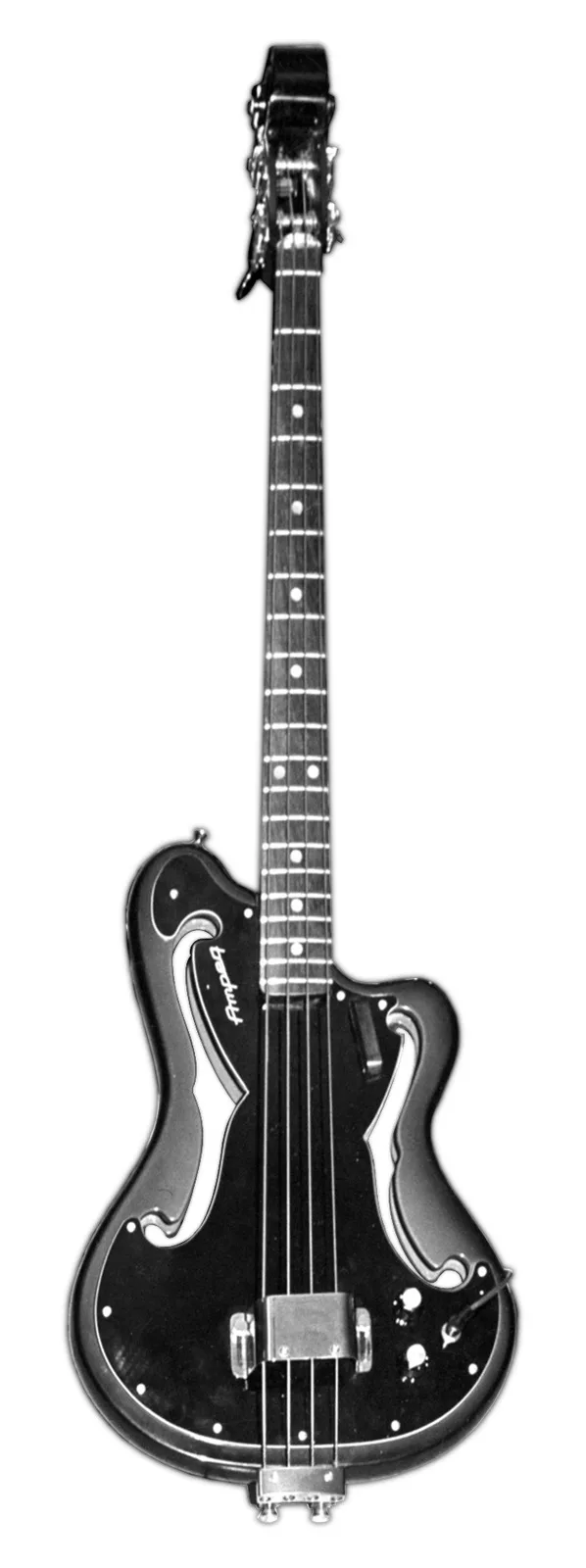
Photo: Firstgarden / Shoulder-synth / Wikimedia Commons / Public domain Ampeg
AEB-1
1966
An electric bass with a violin scroll, built by an amp company whose boss thought fretted, steel-strung basses were a fad.
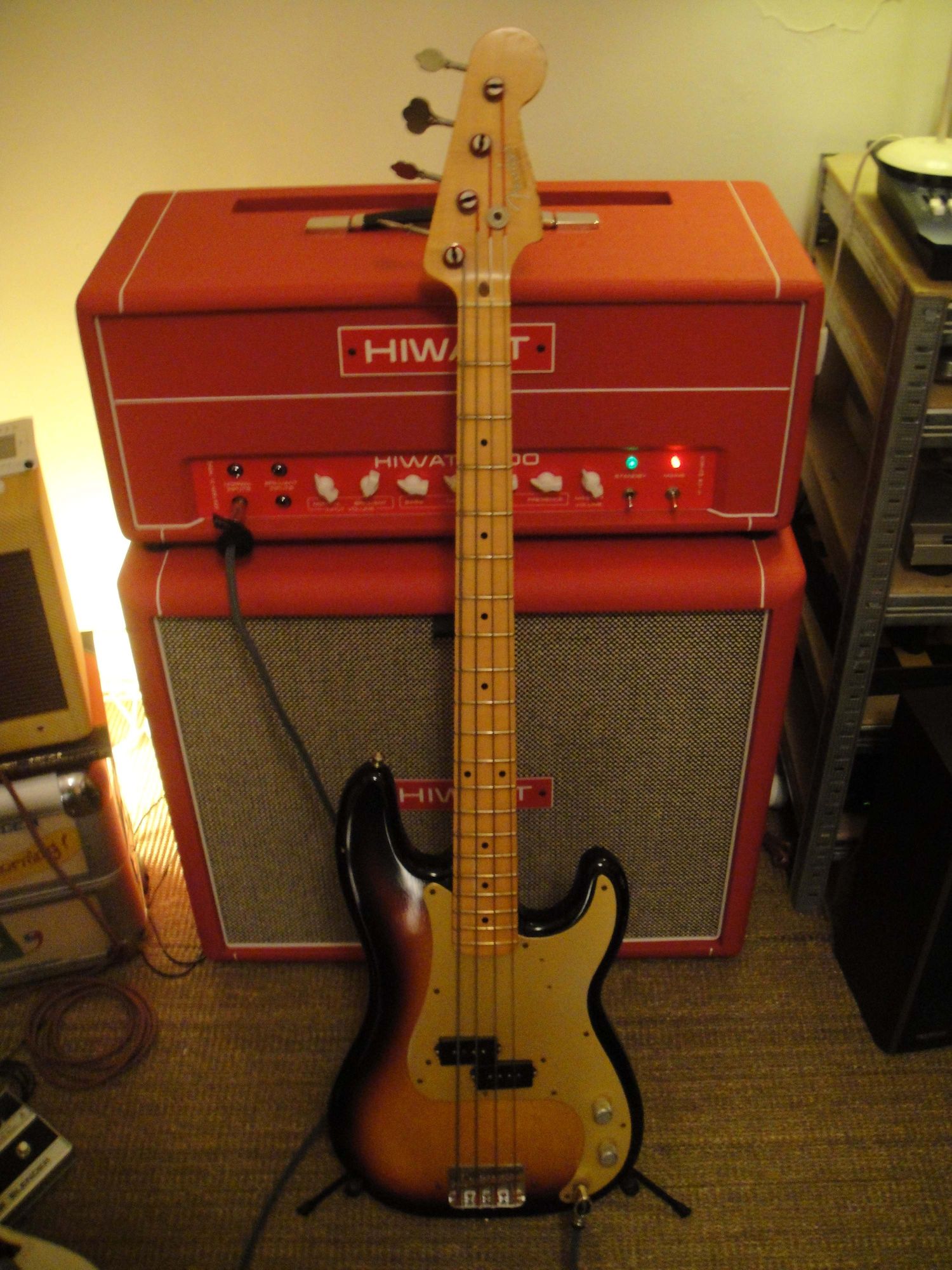
Photo: Infrahertzz / Wikimedia Commons / CC BY-SA 3.0 Fender
Precision Bass
1951
Leo’s bass let the player at the back be heard. You know their lines by heart. You mostly don’t know their names.
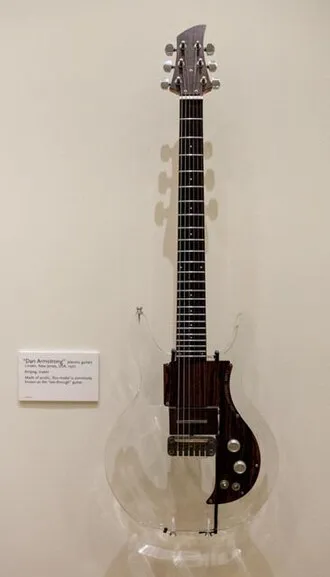
Photo: Frank Kovalchek / Wikimedia Commons / CC BY 2.0 Ampeg
Dan Armstrong
1969
A repairman who spent his days inside other people’s guitars designed one you could see straight through.