Ashbory
Bass
It started as a rubber band stretched over a pickup. It became an 18-inch fretless bass.
Two men in Cornwall built a bass with silicone strings and a piezo under them. Their first big backer wanted it to look like a real bass. They kept the dogbone.
- Introduced
- 1987
- Type
- Solidbody electric bass
- Class
- Production
Have a photograph of this guitar? Send a picture
The short version
1985
A rubber band in Cornwall
Alun Ashworth-Jones stretches a rubber band over a transducer and gets a bass note out of it.
1985
The Barbican, in October
The first prototype is shown at a London guitar weekend. Chris Martin IV hears it.
1986
Pink, in Britain
A woodworking firm cuts thirty-five bodies. British magazines review it, and by September it’s at Guild in Westerly.
1987
NAMM, Anaheim
The official launch, in January. Guild’s own serials and some histories put production in 1986.
1989
The license ends
Ashbory pulls out just before Guild is sold again.
1990
The Mark II
A longer, black bass is shown in Frankfurt. About eighty are made, or it was scrapped, depending who you ask.
1999
Korea, and the dogbone again
Fender, which now owns Guild, brings the original shape back under the DeArmond name.
2008
Al Jones
Alun Ashworth-Jones dies on 1 June.
Side A
A1
A rubber band in Cornwall
In 1985, in Cornwall, Alun Ashworth-Jones stretched a rubber band over a guitar transducer and plucked it. It made a big bass note.
Al made transducers. His partner was Nigel Thornbory. Between them they turned the rubber band into a bass: a body shaped like a dog’s bone, one piece with the neck, silicone strings tuned E-A-D-G, and a piezo in the bridge to hear them. Steel strings need a magnet under them. Silicone doesn’t give a magnet anything to read. A piezo hears the string moving.
Lesley Ashworth-Jones named it. Ashworth plus Thornbory. The runners-up were Thornworth, Albory, Jonesbory, and Nigal.
A2
Precision, Steinberger, or dogbone
In October 1985 the first prototype went to the Barbican Guitar Weekend in London. Chris Martin IV heard it and commissioned prototypes in two shapes people already trusted: a Precision outline, and a headless Steinberger outline.
Both inventors thought those shapes would get it dismissed as a toy. So they built Martin the two he asked for, and sent him a third, in the dogbone he had already seen.
The strings took longer. They tried rubber bands and O-rings before silicone, and the early silicone stretched, broke, and went sticky. Al’s patent on the strings and the shielded transducer dates back to August 1985. It was granted in 1988.
A3
Shocking pink
By 1986 Nigel was building them to order. A woodworking firm cut thirty-five bodies, and they went to players, to shops, and to the press. One British reviewer got a shocking-pink one “around eighteen inches long,” with fret marks and no frets, and a switch for off, passive, and active. The same review called the bass’s turn on the BBC’s Tomorrow’s World a couple of months earlier cack-handed.
Then George Gruhn called, and Guild got interested. Guild changed owners during the talks, and the man who started them was out. By September 1986 it was at Guild in Westerly, with the contract still pending. The official launch was January 1987, at NAMM in Anaheim. Serial-number data and some histories put the first Guilds in 1986. Keep both years.
Flip the record · By the numbers
18"
Scale length. A standard bass is 34".
35
Bodies cut in Britain for the first handmade run, before Guild.
8,000
Friction pegs Guild bought, and wouldn’t change until they were used up. Pegs, not basses.
~1,500
Guild Ashborys made, by one inventor’s count. Other counts run from about 1,200 to 2,000.
Side B
B1
Talc, and snot
The Guild is one piece of poplar with lines printed on a plastic fingerboard. There’s no truss rod, because silicone barely pulls on the neck, and nothing to adjust.
Play it with your fingers. Slap and pick work less well. Mute with your fretting hand as you pluck and it goes almost synth-like. Snap a string and it slaps like an upright. Some say you need talc on the strings because the rubber grips. A 2006 guide said you don’t need it, but it does make things easier. Take your pick.
Trevor Dunn’s dad bought him a Guild in the late ’80s. The strings, he said, “sort of look like snot,” so it became the Booger Bass. He used it on Mr. Bungle’s “Bungle’s Golem.”
B2
Eight thousand pegs
The tuners were Thornbory’s regret. They had picked friction pegs, like a banjo’s, because the strings barely pulled. Once the strings got tighter, the pegs failed. Guild had bought eight thousand adapted Schaller friction pegs and would not change them until the stock was gone.
Just before Guild was sold again in 1989, Ashbory ended the license. Thornbory reckons Guild had made about 1,500. Other counts say 1,235, or 1,200, or 2,000. Nobody kept a ledger anyone can find.
In February 1990 the inventors tried again in Frankfurt with a Mark II. The dogbone was gone. It had a 22-inch scale, geared tuners, black only. About eighty were made, by Thornbory’s count. Another history just says it was scrapped.
B3
The shape that came back
Fender bought Guild in November 1995. Tim Shaw took the Ashbory to a Korean factory, and they had both shapes to choose from. They chose the dogbone, and gave it geared tuners. It launched under Fender’s DeArmond badge at Summer NAMM in Nashville, July 1999, in Black, Frost Red Metallic, and Moon Blue, with a gig bag in the box. In late 2002 Fender took the DeArmond name off. Same bass.
Al Jones died on 1 June 2008.
The Ashbory you can order today is something else: a 24-inch mahogany bass made in China. The 18-inch one you find used is still the Korean dogbone, or a Westerly Guild if you’re lucky. It was asked to look like a real bass. It never did, and that’s the shape that lasted.
Put this on
You’ve read about it. Now hear it. Here’s what this guitar sounds like, and what to listen for.
Bungle’s Golem
Trevor Dunn says he used his Guild Ashbory, the one he calls the Booger Bass, on this track.
Find it on YouTube (opens in a new tab)
The cast
The people, and the specific guitars, that made the legend.
1985
Alun Ashworth-Jones
Inventor
Made transducers, found the bass note in a rubber band, and patented elastomeric strings over a shielded transducer. Al Jones on his folk records.
1985
Nigel Thornbory
Co-inventor
The “bory” in Ashbory. Hand-built the early ones and later wrote down the whole story.
1985
Chris Martin IV
Commissioned the first prototypes
Heard it at the Barbican and asked for Precision- and Steinberger-shaped versions. He got those, and a dogbone.
Trevor Dunn
Guild Ashbory, late ’80s
A present from his dad. He named it the Booger Bass and used it on “Bungle’s Golem.”
Tony Levin and Doug Wimbish
The 22-inch second version, not the dogbone
A shop history says the second version found favour with them. No song or year comes with it.
Liner notes
Specs, construction, rarity, value, and every source we used.
A rubber band over a pickup became a bass: silicone strings, 18 inches, fretless, and a piezo — the dogbone Ashbory, not a Guild flat-top.
- Body
- Solid dogbone, one piece with the neck. DeArmond / Fender sheet: agathis. Guild (Westerly): poplar.
- Neck
- That same piece. No truss rod. Wikipedia files the joint as neck-thru. Not a bolt-on.
- Fingerboard
- Plastic, fretless, printed lines. Fender sheet: flat, two octaves, 24 fret-lines. Not wire frets.
- Scale
- 18" on the Fender sheet, the July 1999 flyer, and the Guild / DeArmond comparison. Inventors, on the Martin prototypes: 18" / 46 cm. International Musician, May 1986, on the UK review bass: 450 mm (approx. 18"). Mix flagged.
- Pickups
- One Ashworth piezo in the bridge. Active. The strings are not metal, so a magnetic pickup has nothing to read.
- Hardware
- Fender sheet: white-tipped geared tuners; fixed Ashworth bridge. Comparison chart: four geared in-line, black hardware, no bridge cover. Guild: adapted Schaller friction pegs, nickel, a bridge cover. Bridge and neck are not adjustable.
- Electronics
- Fender / DeArmond: volume, active bass, active treble. The preamp comes on when the cable is plugged in. Guild adds an active / passive toggle and a red LED.
- Finish
- Fender sheet: high-gloss polyurethane. July 1999 flyer: Black, Frost Red Metallic, Moon Blue, gig bag in the box.
- Nut
- 1 3/4" on the Fender sheet. One DeArmond, measured by Ikebe: 45.0 mm. Mix flagged. Guild nut width unpublished.
Open the full research fileConstruction details, the complete player record, production numbers, dated value estimates, and sources
*Classic living example = the 18" dogbone: Guild, Westerly, 1986–88, then DeArmond / Fender, Korea, from July 1999. The table is the Fender product sheet, because that is the complete published spec. Guild is the same scale and the same job, in poplar, with friction pegs and a toggle. No current Guild or Fender dogbone (no Fender.com Ashbory page this pass, 21 October 2026). Wikipedia’s infobox closes Fender at 2012. Mark II is a 22" / 56 cm English bass, not this table. The Bass Centre’s current Ashbory is mahogany, bolt-on, 24", China, fretted Richlite or a lined-fretless option — not this table. The Bass Centre uke is a second current SKU. Not a Precision. Not a Mustang Bass. Not a Steinberger. Not an M-20, not a Starfire. Standalone. No Gibson SKUs. One Ikebe DeArmond measured about 770 mm (30 inch) overall and about 1.0 kg. Large Sound’s tour says less than 3 lb. Not a factory weight, and not the Bass Centre’s 2.5 kg (5.5 lb). Do not average 18" / 46 cm / 450 mm, or 1 3/4" with 45.0 mm, or 770 mm with “18 inches long.”*
Construction
The job was a bass that could reach E-A-D-G without a 34" neck. Alun Ashworth-Jones made transducers. A rubber band across one of them made a bass note. Nigel Thornbory’s line, in Terry Burrows’s 1001 Guitars and in his own account: Al found that a rubber band stretched over a guitar transducer produced an impressive bass note when plucked. That is 1985, in Cornwall. Not a catalog.
Lesley Ashworth-Jones named it. Ashworth plus Thornbory. Thornbory lists the rejects: Thornworth, Albory, Jonesbory, Nigal. The folk-record credit is Al Jones. Large Sound’s obituary is the same man: Alun Ashworth-Jones, 1945–2008, died the morning of 1 June 2008. He is not a second inventor.
October 1985. International Musician, May 1986: the first prototype was at the Barbican Guitar Weekend “last October.” Chris Martin IV heard it and commissioned prototypes, a Precision outline and a headless Steinberger outline. Both men thought those shapes would get the bass dismissed as a toy. Scale on those prototypes, in Thornbory’s account: 18" / 46 cm. They sent Martin a third one in the dogbone he had already seen. Not a Precision (fender-precision-bass). Not a Steinberger (steinberger-xm). The dogbone is the instrument.
They tried banjo-style friction pegs, because the strings barely pulled. Thornbory calls that a mistake. Silicone came in after rubber bands and O-rings. The early strings stretched, broke, and went sticky. US patent 4,750,397, Alun D. Ashworth-Jones: elastomeric strings and shielded bimorphic transducers. Priority 21 August 1985. US filing 15 August 1986. Granted 14 June 1988.
1986 is real, and it is not this plate’s year. Nigel was already hand-building for orders. A woodworking company cut thirty-five bodies. Clive Cherry lacquered them. Some sold, some went to players, some went to Andy’s Guitars and the Bass Centre, some went to the press. One Two Testing, June 1986: polymer elastomeric strings, a one-piece transducer, an active circuit from Alun Jones of Ashworth Electronics, a three-way toggle (off, passive, active, LED), fret marks and no frets, a shocking-pink body “around eighteen inches long,” the 24th position in reach. The same review calls the Tomorrow’s World spot, a couple of months earlier, cack-handed. That pink bass is a UK handmade. It is not a Westerly Guild.
George Gruhn called. Mark Dronge, then president of Guild, met Al in New York. Thornbory: during the talks Guild was taken over by Avnet and became the Guild Guitar Corporation under Jerre Haskew, and Dronge was out. September 1986, Westerly. The contract was still pending. The official launch, his words, was January 1987, NAMM, Anaheim. The 1999 DeArmond flyer cites “Guild’s 1987 literature.” He dates the Guild contract to 1987. This plate starts in 1987.
Do not bury 1986. Wikipedia’s infobox opens Guild production in 1986 and closes it in 1988. Large Sound’s FAQ, “judging from the serial number data,” prints last serials AJ23 (1986), AJ1109 (1987), AJ1235 (1988). The next sentence on that page says 23 were made in 1987, 1,086 in 1987, and 126 in 1988 — the first “1987” fights the page’s own AJ23 line. Brock Frazier, emailing Thornbory, says he was fifteen and didn’t play “when they were introduced in 1986.” Keep the January 1987 launch and the 1986 serials. Don’t average them into one quiet year.
What Guild built is the dogbone you mean. One piece of poplar. Silicone, tuned E-A-D-G. Lines on the plastic, no frets. Piezo in a bridge that does not move, and no truss rod, because the strings barely pull. Large Sound: no pitch shift, no MIDI. The preamp only lifts the piezo. The note is the string. Burrows, via Wikipedia, says talc is necessary, the rubber grips, and you play it fingerstyle — slap, pop, and a pick work less well. Mute with the fretting hand and strike, and it goes synth-like. Snap the string and it slaps like an upright. Large Sound’s 2006 guide, on the bass then in production, says talc is not necessary and does make the strings easier. Keep both.
The pegs failed once the strings got tighter. Guild had bought eight thousand adapted Schaller ukulele friction pegs — pegs, not basses — and would not change them until that stock was gone. The comparison chart calls the same parts Schaller banjo tuners. Keep ukulele and banjo. Both are friction pegs. Neither is the later geared set.
Avnet sold Guild on. Thornbory: investors, then the Faas Corporation in 1989, Faas becoming US Music as it took Guild. Just before that sale, Ashbory ended the license. “At that time, Guild had made approximately 1,500.” The launch paragraph says an initial run of two thousand was already underway — a run started, not a count of basses out the door. The other totals are in Rarity. They do not agree. No factory ledger.
Mark II is not this bass. Wikipedia, citing Burrows: an attempt in 1990, scrapped. Thornbory: Frankfurt, February 1990, the dogbone gone, scale 22" / 56 cm, geared heads, glass-reinforced nylon where they could, black only, heavier blue strings. About eighty made, then the CNC was busy and a second batch would have cost twice as much. Large Sound: longer scale, different body, England, not Guild, sold mostly in the UK, fewer than the Guild run. Keep “scrapped” and “about eighty.” He also says the Mark II never really reached America, “apart from the one which lurks somewhere in the Gibson factory.” That is his aside. It is not a Gibson model. Hohner and Gibson had already sniffed at the license after Guild. No Gibson SKUs.
Fender bought Guild from US Music in November 1995. Bill Acton, Guild’s marketing manager, costed a run of 1,000. A costing, not a shipment. Tim Shaw took the design to a Korean factory. They chose the dogbone, not the Mark II, and they fitted geared tuners. DeArmond — Fender’s import badge — launched it at Nashville Summer NAMM, July 1999. The flyer: 18" fretless, silicone, the Ashworth transducer, Black, Frost Red Metallic, Moon Blue, gig bag included, and Guild’s 1987 line about “the epitome of originality.” One-piece agathis, not poplar. Comparison chart: improved piezo, volume and active bass and treble, a smaller LED, no toggle, no bridge cover, black hardware, Korea. Blue Book adds English electronics. The tags are in Value. They do not match, and neither is 2026 street.
Late 2002 Fender took the DeArmond name off. Large Sound: body mark, headstock, gig-bag badge. Same bass. Part numbers in 2007 match the 2003 DeArmond. Wikipedia’s infobox ends Fender at 2012. No discontinuation notice turned up beside that line.
The bass you can order now is a different object. Bass Centre, fetched 21 October 2026: mahogany offset, bolt-on maple, 24", 22-fret Richlite or a lined fretless, an adjustable bridge, about 2.5 kg (5.5 lb), China. “30 years on,” and no catalog year on the page. Not the dogbone. Not the Mark II. Classic against what you meet: 1987 Westerly poplar and friction pegs, against a Korean agathis dogbone with gears, against no new one of either.
Players
Trevor Dunn. His own gear page: his dad bought him a Guild in the late ’80s. He believes Guild stopped in ’88, and that only about 1,200 were made. That number is his, not a ledger. The strings “sort of look like snot,” so he called it the Booger Bass. He used it on “Bungle’s Golem.” He does not name the album here. Don’t hang Disco Volante on the sentence.
The Bass Centre’s page says the second incarnation — the ergonomic one, the shape it ties to Steinberger sticks — “found favour” with Tony Levin and Doug Wimbish. No song, no serial, no year. That sentence is the 22" bass, not a Guild dogbone. The same page then lists Jack Bruce, Alec John Such, Pino Palladino, Nathan East, Tom Hamilton, Mike Watt, Rudy Sarzo, and a longer tail that includes David Gilmour, Les Claypool, and Peter Gabriel. Shop list. Not a session log. Levin’s Stick and his Music Man are not this. Gilmour’s Strat is not this. A coffee-shop story about Gilmour practicing a Guild Ashbory is on Equipboard, credited only to “Steveadelson.” The interview did not turn up. It is not used here.
Also known to play: nothing further sourced. The 1999 flyer says famous and unknown players recorded with original Guilds, and names nobody.
Rarity
You cannot buy a new dogbone from Guild or from Fender. Fender’s site search does not list one (21 October 2026). A Bass Centre Ashbory in the cart is the 24" China bass, or the uke. Different scale. Different factory.
Guild never published a dogbone total. The numbers in print do not agree, and they are not the same kind of number. Thornbory: a run of 2,000 underway at the 1987 launch, and approximately 1,500 made when the license ended. Large Sound’s FAQ: 1,235, from the AJ endpoints, with that page’s own year-split sentence mislabeling the first 23. Blue Book: an estimate of 2,000. Dunn: about 1,200. Acton’s 1,000 is a Fender-era costing. The eight thousand is a peg purchase. The thirty-five is the UK body order before Westerly. Don’t add them. Serial prefixes date a bass. They don’t count a year. That is why a first-year census is unknown, not the chapter.
Fender and DeArmond, 1999–2012 on Wikipedia’s infobox, have no published total either. None invented. Korea made them long enough that a used one is an ordinary short-scale, not a museum piece.
What is actually thinner: a Guild you can show is still on the friction pegs, with the toggle and the bridge cover; an AJ number at or under the FAQ’s AJ23 line; a Mark II, if you accept “about eighty” rather than “scrapped.” Dunn’s Guild is one bass. The pink review guitar is one bass. Hartenberger’s Westerly Ashbory, stamped AJ 383 and “made in USA,” is one bass — between the FAQ’s 1986 and 1987 endpoints, which is a reading of that table, not a factory date. A refret, or a magnetic pickup forced into the cover, is a different instrument.
Value
Informal estimate, 21 October 2026. Not an appraisal.
Asking prices are not sold prices. A Korean agathis dogbone is not a Westerly poplar bass, not a Mark II, and not the Bass Centre’s 24". No invented medians. Flag: thin sold-comp access. Reverb’s price-guide dollars for the dogbone did not render as a clean band this pass. Blue Book’s value table is behind a login. Celebrity instruments are not comps. Dunn’s Guild has no hammer here.
New street. None for the dogbone. Historical lists, not a 2026 cart: Large Sound’s comparison chart, Guild $545, gig bag $50 and sold separately; the same chart, DeArmond / Fender $499.99 with the bag. The FAQ cites a 1987 Guild suggested-retail list for that $50 bag, and does not print the $545 as a line on it. Blue Book says the Fender reissue “retails for $400,” undated. Don’t average $545, $499.99, and $400.
What you can order under the name, fetched 21 October 2026, is the other bass. Bass Centre Ashbory £395 inc. 20% VAT, worldwide £329.17. The uke £295 / £245.83. Elites strings £39.50. China, 24", mahogany. Not this table.
Used modern. Named solds, not a series. DeArmond early-2000s red sparkle, Very Good, Coypu Music on Reverb: $349.97. DeArmond red metallic, Good, Ikebe on Reverb: $519.87 (shipping on that listing $255.69, not the hammer). eBay, Fender black, best offer accepted at US $400; the sold line reads Tue, Jan 6, and does not print a year. Gardiner Houlgate, 5 March 2024, Ashbory by Fender with gig bag: estimate £80–120, sold £170. Don’t average a dollar listing with a pound auction.
Vintage / collectible. The Westerly Guild is the thin one, and a clean sold band did not turn up. Named old ask, not a 2026 hammer: Music Castle, a USA Guild, listing ended, ask $299, listed about ten years ago. Hartenberger’s AJ 383 is a collection object. Not a comp. A Mark II is a different market, and no sold price for one turned up this pass.
See also
- fender-precision-bass — 34" fretted four-string. About twice this scale, and the outline Martin commissioned and did not get
- fender-mustang-bass — 30" student bass, metal strings, a magnetic pickup. Not silicone, and not this dogbone
- steinberger-xm — 1987 headless bass. The other shape they were asked to copy. Graphite neck, not a piezo dogbone
Sources
- Wikipedia, Ashbory bass — infobox: Guild 1986–1988, Fender 1999–2012; solid; neck-thru; 18"; agathis, Guild poplar, one-piece; plastic fretless; one active piezo; Black, Frost Red, Moon Blue. Body cites Burrows for the rubber-band quote, Mark II 1990 “scrapped,” talc, no truss rod, no adjustments, fingerstyle, slap and pick weaker. Article flags itself as single-source. “18 inches long” is the article’s wording, not a measured overall
- Terry Burrows, ed., *1001 Guitars to Dream of Playing Before You Die* (2013), p. 600 — Wikipedia’s cited source for the history and features above. Book not opened past that citation
- The Bass Centre, Ashbory story (Thornbory) — 1985 Cornwall; Lesley names it; Barbican; Martin’s Precision and Steinberger prototypes; 18"/46 cm; thirty-five bodies; September 1986 Westerly; official launch January 1987 Anaheim; run of 2,000 underway; 8,000 Schaller uke pegs; Faas 1989; about 1,500 made; Mark II, Frankfurt February 1990, 22"/56 cm, about eighty, blue strings; Gibson-factory aside; Fender buys Guild November 1995; Acton costs 1,000; Tim Shaw; Korea; dogbone not Mark II; Nashville NAMM July 1999; flyer colors and the “epitome of originality” line. Current shop: £395 / £329.17, uke £295 / £245.83, strings £39.50. Levin and Wimbish on the second incarnation; the longer name list
- The Bass Centre, Ashbory Bass Natural — current spec: mahogany, bolt-on maple, 22-fret Richlite, 24", adjustable under-saddle piezo, active 2-band, about 2.5 kg (5.5 lb), China, gloss black or natural; lined-fretless option on the button. Fetched 21 October 2026
- Large Sound, general FAQ — E-A-D-G; no pitch shift; serial endpoints AJ23 / AJ1109 / AJ1235 and the 1,235 total, with the year-split sentence; 1987 price list, gig bag $50; DeArmond from July 1999 Summer NAMM; DeArmond name dropped late 2002; Korea; name from Ashworth and Thornbory; no production left-hand
- Large Sound, Guild vs DeArmond comparison — poplar vs agathis; friction pegs vs geared; 18" both; piezo; toggle vs no toggle; list $545 + $50 bag vs $499.99 with bag; Westerly vs Korea
- Large Sound, user’s guide, Brock Frazier, 1 November 2006 — silicone; no truss rod; zero adjustments; talc not required; geared tuners on the then-new bass; full-time active; patent link
- Large Sound, tour overview — 18" against a 34" bass; less than 3 lb, that site’s claim; bridge not adjustable
- Large Sound, Alun Ashworth-Jones, 1945–2008 — died the morning of 1 June 2008; “Al Jones” on records; Frazier’s first Ashbory a 1987 Guild
- *International Musician*, Dave Burrluck, Ashbory Mini-Bass, May 1986 — Barbican “last October”; 450 mm (approx. 18"); 24 positions
- *One Two Testing*, Matt Black, Ashbory Original Bass, June 1986 — Tomorrow’s World; polymer elastomeric strings; Ashworth active circuit; toggle and LED; shocking pink; body around eighteen inches; 24th position
- US patent 4,750,397 — elastomeric strings and shielded bimorphic transducers; priority 21 August 1985; filed 15 August 1986; granted 14 June 1988; Alun D. Ashworth-Jones
- Trevor Dunn, gear page (archived) — Guild from his dad, late ’80s; his “about 1,200”; Booger Bass; “Bungle’s Golem”
- Hartenberger World Musical Instrument Collection, Guild Ashbory — AJ 383, made in USA; “one of only 1235”; “18 inches long”; 1987 NAMM and 1986–1988 in the same note
- Blue Book of Guitar Values, Guild Ashbory — mfg. 1986–88; estimated 2,000; Fender reissue, Korean, English electronics, “retails for $400.” Value table behind a login this pass
- Amazon, Fender Ashbory, Frost Red listing — Fender spec block: agathis, fretless two-octave, 18", 24 fret-lines, nut 1 3/4", white-tipped tuners, Ashworth piezo, volume and active treble and bass, gig bag, gloss polyurethane
- Reverb, Fender Ashbory Bass listing reprinting that spec block — same sheet; black; color code 306 on the copied text
- Reverb, Ikebe, DeArmond red metallic — sold price shown $519.87; one example about 1.0 kg, about 770 mm (30 inch) overall, nut 45.0 mm
- Reverb, Coypu, DeArmond red sparkle — Very Good, sold price shown $349.97; Korea; early 2000s
- Reverb, Music Castle, Guild USA — listing ended; ask $299; listed about ten years ago
- eBay, Fender Ashbory black — best offer accepted US $400; sold line Tue, Jan 6, year not printed; agathis; gig bag
- Gardiner Houlgate, 5 March 2024, lot 550 — Fender Ashbory with gig bag; estimate £80–120; sold £170
Keep digging
Guitars this one gets compared to, confused with, or descended from.
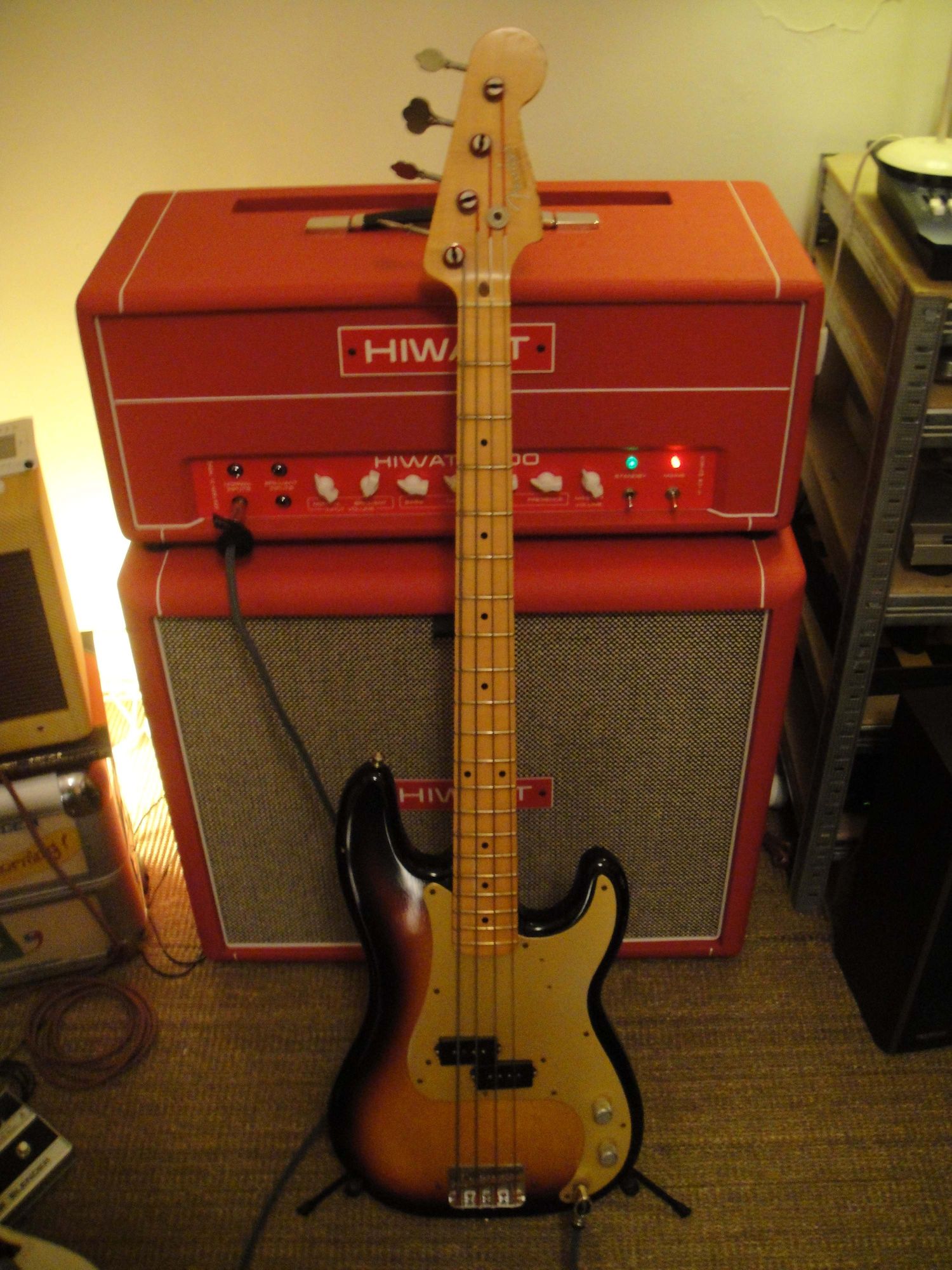
Photo: Infrahertzz / Wikimedia Commons / CC BY-SA 3.0 Fender
Precision Bass
1951
Leo’s bass let the player at the back be heard. You know their lines by heart. You mostly don’t know their names.
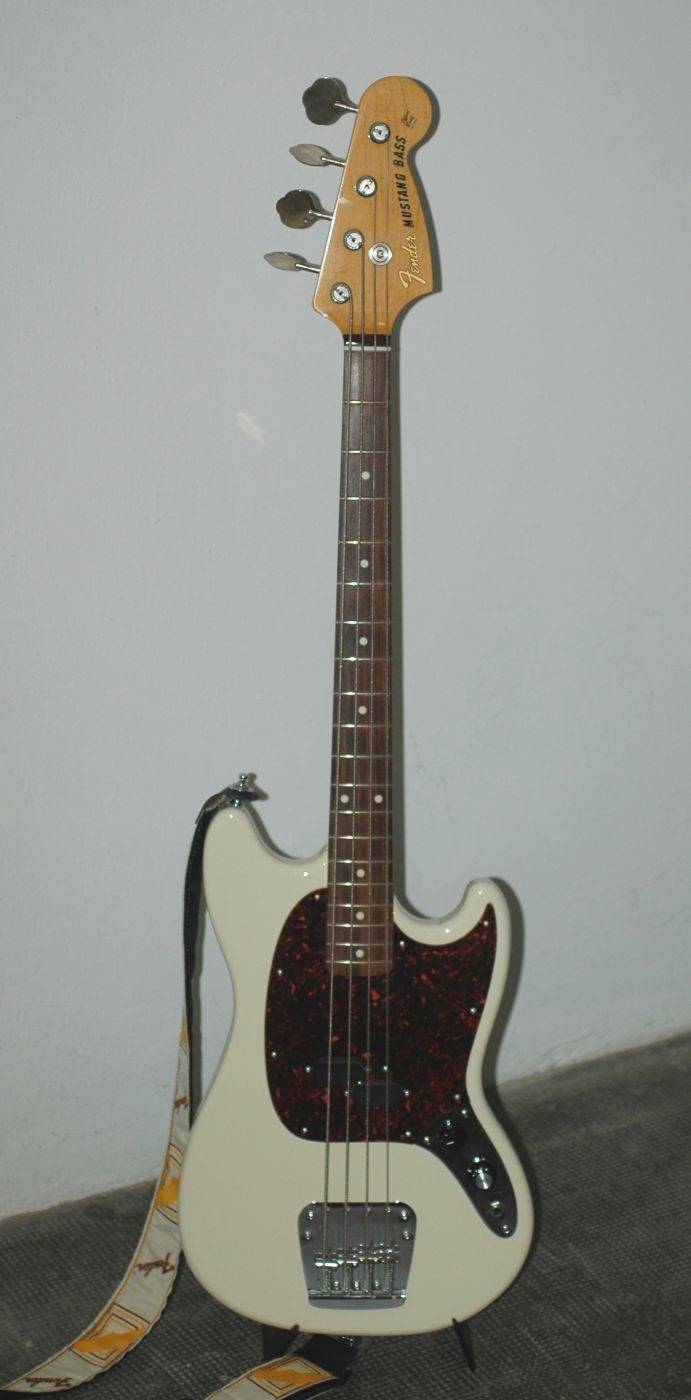
E-Bass Fender Mustang, shortscale 30". Photo by Joachim Hensel-Losch. Licensed under CC BY 2.5 (also offered as CC BY-SA 3.0). Via Wikimedia Commons. Fender
Mustang Bass
1966
Leo Fender’s last bass for Fender was a short, cheap student model. That was the whole idea.
- Send a picture
Steinberger
XM
1987
Bill Wyman said the little Steinberger looked like a machine gun. The full-size one, he kept.