Fodera
Monarch
In 1983 a new Brooklyn shop brought a bass to a teenager’s session. It’s still Victor Wooten’s number one.
1983. A studio bass isn’t working, and a teenager named Victor Wooten needs another one. Somebody from a brand-new shop on Avenue O in Brooklyn turns up with a Monarch. Where the session was, and who brought the bass, depends who you ask.
- Introduced
- 1983
- Type
- Solidbody electric bass
- Class
- Production
The short version
late 1970s
Ken Smith’s bench
Vinny Fodera builds for Ken Smith. Joey Lauricella sells for him. They meet in Brooklyn.
1983
Their own door
Fodera opens on Avenue O. The first bass off the bench is the one the Monarch grows from.
1983
Number 37
Victor Wooten gets the Monarch he still plays. He thinks it cost $900.
1990
Industry City
The shop leaves Avenue O for Industry City.
1996
A Show of Hands
Wooten’s solo album, cut in 1993–94 on a Fodera four-string, comes out in February.
2011
Standards
A no-options line, because people wanted a lower price.
2013
Monarch 4 Standard ships
January 1, at $4,750. One spec.
2018
Thirty-five for the 35th
An anniversary run of 35 basses.
Side A
A1
Two guys from Ken Smith’s bench
In the late 1970s Joey Lauricella met Vinny Fodera at a guitar shop in Brooklyn, not far from where Joey lived. Vinny was building basses for Ken Smith. Joey was selling them. The two of them crossed paths on Avenue O for a few years, and then they opened their own door, in 1983, on the same street.
The idea, in the company’s own words, was a premium custom brand, “something that had not existed in the 80’s.” Not a Ken Smith with a new decal.
The first instrument they numbered was a six-string guitar. The second was a bass: bird’s-eye maple, an ebony fingerboard. That one became the Monarch. It was the first model, and it still sells.
A2
A butterfly, not a surname
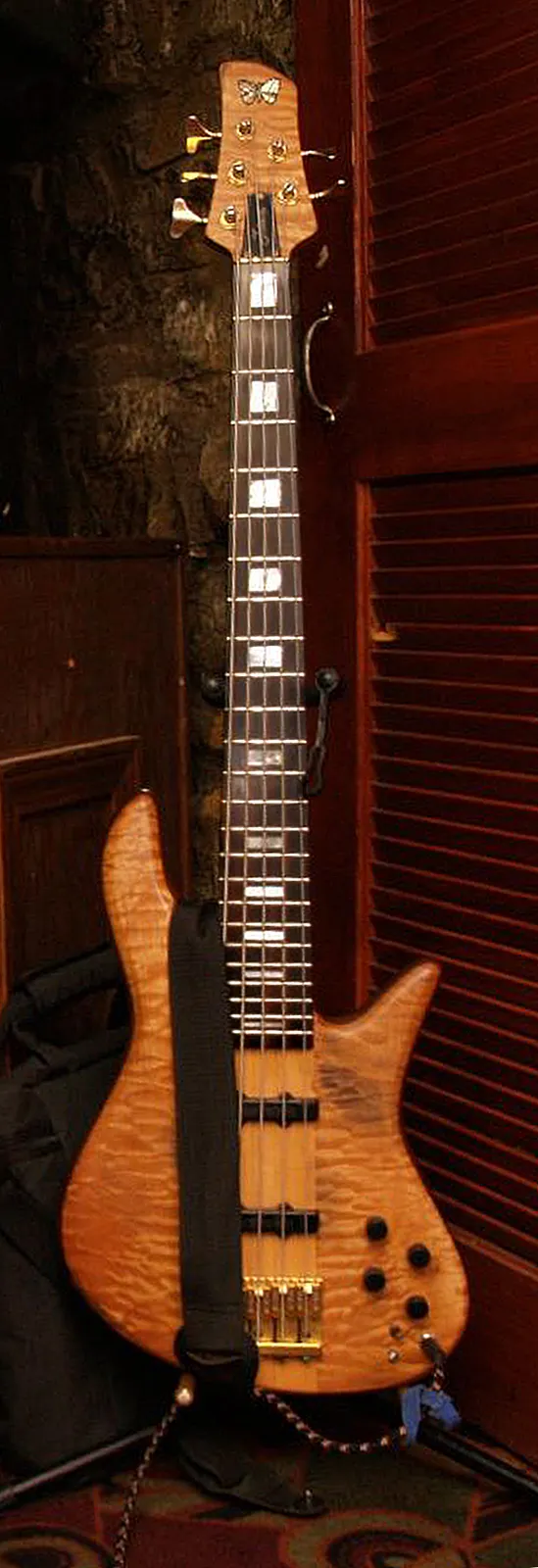
Look at the peghead. That’s a butterfly, drawn by Vinny with a stylized F worked into it, and every model took a butterfly’s name: Monarch, Emperor, Imperial.
It isn’t a pun on the family name. “Fodera” means a case, or a covering. The Italian for butterfly is farfalla.
The Monarch is the compact one, a double-cut with its horns closer to even. The Emperor is bigger, lopsided, closer to a Jazz Bass. If you’ve seen a Fodera in a small, tidy, almost symmetrical shape, it was probably this one.
A3
Pay me when you get it
- A studio bass wasn’t working. Victor Wooten had been playing an Alembic, because he was chasing Stanley Clarke. One telling makes it a Series II, too big for him. Another comes out as a Series I.
So does the rest. One version: Bloomfield, New Jersey. Wooten is nineteen, the producer hates the sound, somebody calls Vinny, and Fodera shows up with two Monarchs. Another has Joey driving the two basses to Bloomfield. Wooten’s own memory puts him at “17, barely 18.” He has also said “I think in Connecticut,” and, another time, New York. In his version Joey left him a four-string Monarch with a maple top and a simple deal.
“Pay me when you get it.”
The bass everyone agrees on is number 37. Wooten thinks it cost him $900. That’s his memory, not a 1983 price list.
An early Monarch from that year shows what the shop was building: an oil finish, EMG pickups, tulip inlays at the 12th and 24th frets, a 34-inch scale. The replica of 37 the factory makes now has a dovetail neck with no heel, EMG pickups, flame maple over mahogany.
Flip the record · By the numbers
$900
What Victor Wooten thinks number 37 cost him in 1983. His memory, not a price list.
3,000+
Instruments Fodera had built by 2012, all models. The Monarch was the most popular.
28 months
About how long you wait for a new one, custom or Standard.
35
Basses in the 35th-anniversary Monarch run, 2018.
Side B
B1
Twenty-eight months
The shop stayed on Avenue O until 1990, then moved to Industry City. It stayed small, about five people, until 2009, then grew to around fifteen. They rough a blank out on a machine, which they got in the summer of 2010, and a PLEK has dressed the frets since early 2012. The rest is by hand.
In 2011 Fodera started a line of Standards, because people wanted a lower price. The Monarch 4 Standard was one spec, no options, shipping January 1, 2013, at $4,750. The one on the order sheet today is a walnut body with an ash top, a three-piece maple neck, ebony, Fodera/Duncan dual-coils, and a Trickfish preamp you can switch off.
You still wait. About twenty-eight months, Standard or custom, and the deposit only holds your place in line.
B2
Still number one
The Monarch gets the credit for A Show of Hands. Wooten’s own account of the sessions is narrower: 1993 and 1994, a Fodera four-string, standard tuning, recorded direct with a microphone on the strings. The title track is a different bass, with a piezo under every string and magnetic pickups, panned apart. It came out in February 1996.
The Yin Yang came later, his signature on the same outline. Whether Fodera ever paid him before that depends on who you ask. One account says no paycheck until the Yin Yang Standard. Another calls him the company’s first endorser. On What Did He Say?, the fretless on “Bro, John” is a yin-yang, not 37.
But the factory still says he uses number 37, and still calls it his number one. In his telling, a teenager walked out of a session with a bass from a shop that had barely opened, on a promise to pay when he could. More than forty years later he hasn’t put it down.
Put this on
You’ve read about it. Now hear it. Here’s what this guitar sounds like, and what to listen for.
A Show of Hands
Recorded 1993–94 on a Fodera four-string, standard tuning, direct with a mic on the strings. The Monarch is the bass credited. Skip the title track for this one; that’s a different four-string, piezo and magnetic pickups panned apart.
Find it on YouTube (opens in a new tab)
The cast
The people, and the specific guitars, that made the legend.
1983
Victor Wooten
Monarch number 37
The bass the shape is stuck to. Got it as a teenager; the factory still calls it his number one. His later Yin Yang signature uses the same outline.
1983
Joey Lauricella
Co-founder
Sold basses for Ken Smith before Fodera. In Wooten’s telling, the man who left him a Monarch and said, “pay me when you get it.”
1983
Vinny Fodera
Co-founder and builder
Built for Ken Smith, then drew the butterfly with an F in it that gave the models their names.
Oteil Burbridge
Signature Monarch 6 Elite
Handmade Fodera sixes after years of Modulus. Walnut and kingwood, neck-through, 35 inches. A Monarch, but not the four-string in this story.
Liner notes
Specs, construction, rarity, value, and every source we used.
A compact Brooklyn double-cut with a butterfly on the peghead — Fodera’s first bass, not an Emperor, and not the six-string guitar that wears the same name.
- Body
- Walnut, ash top with dark pore filler; compact double-cut. The price list titles this SKU “(Ash).”
- Neck
- Bolt-on 3-piece maple. Walnut/holly peghead inlay.
- Fingerboard
- Ebony, clay dots, 24 frets, PLEK’d compound radius. Radius number unpublished.
- Scale
- 34"
- Pickups
- Fodera/Duncan dual-coils, ’70s spacing; parallel, plus a full single-coil mode
- Hardware
- Black; fully adjustable bell-brass bridge; 19.0 mm spacing
- Electronics
- Fodera × Trickfish Standard 3-band, v.4; active/passive
- Finish
- Unpublished on the current factory spec list
- Nut
- Unpublished on the current factory spec list. Width and material omitted.
Open the full research fileConstruction details, the complete player record, production numbers, dated value estimates, and sources
Current typical = 4-string Monarch Standard (Brooklyn; deposit page, fetched 28 September 2026). Factory list $5,450 (effective 15 December 2025). Mix flagged: the same sheet prints 34" and 19.0 mm. No millimetres invented for the scale. Do not import a dealer Special’s 864 mm or a nut width. Deluxe is the dovetail. Elite is neck-through. Monarch-P, the 5-string, the fretless, and the ’83 tributes are other sheets. The Monarch guitar is 25 1/8", 22 frets. Not this table.
Construction
The job was a bass a working player would spec, off a bench that had been someone else’s. Late 1970s: Joey Lauricella met Vinny Fodera at a Brooklyn guitar shop near where Joey lived (Staten Island Advance, 22 May 2015). Jason DeSalvo, on a 2016 shop video, names it. Vinny was building for Ken Smith. Joey was selling for Ken Smith. They crossed on Avenue O. A few years of that, then their own door. 1983, still Avenue O. Factory history calls it a premium custom brand, “something that had not existed in the 80’s.” Not a Ken Smith with a new decal.
Serial #01 is a six-string guitar. The first bass is #02 (Staten Island Advance). Premier Guitar (Steve Cook, 10 December 2012): the Monarch is the popular bass, and it is based on #2 — bird’s-eye maple, an ebony board, later the seed of the Yin Yang. Bonedo (26 October 2015): the four-string Monarch was the first model, and it still sells. Mike Bendy, company channel, 6 May 2022, calls #78 a Monarch 4 Deluxe from that first year. This plate starts in 1983.
The insect is the logo, not the Italian. FAQ: Vinny drew a butterfly with a stylized F, and the models took butterfly names — Monarch, Emperor, Imperial. “Fodera” means a case or a covering. Butterfly is farfalla. Bonedo, on a Standard Classic: the Monarch is the compact, more symmetrical double-cut, smaller than the asymmetric Jazz-like Emperor and the single-cuts.
An early one is narrower than the outline. Bendy’s #78: Indian rosewood top, maple veneer, Honduran mahogany, maple tone block, three-piece maple neck, Indian rosewood board, tulips at the 12th and 24th, oil, the old EMGs, 34". The demo stayed on the passive setting. The factory ’83 Classic page says Wooten bought #037 in 1983, still calls it number one, and the replica is a dovetail “heel-less” neck, EMG P/J, flame maple over mahogany. Wooten remembers a maple top. Premier’s 2018 anniversary note points the same joint at a second bass: the dovetail “like Victor Wooten’s ’87 Monarch.” Keep #37 and the ’87. Do not average #78’s rosewood top with #37’s maple.
The catalog then split one outline into joints. Factory construction page: bolt-on; Deluxe, the dovetail, not offered on six-strings; Elite, neck-through, heel block and wings chosen apart. A custom top there is a quarter-inch slab. That is the custom order, not the Standard sheet. On the December 2025 list, alder, mahogany, and walnut are no charge; ash is extra; gloss starts at $1,500. The Standard finish is unpublished.
The no-options bass is later. Factory: Standards in 2011, because people wanted a lower price. Yin Yang Standard, Winter NAMM 2011 (Premier). No Treble, 21 September 2012: the Monarch 4 Standard finished that series out — one spec, unveiled 20 October 2012, first shipping 1 January 2013, then $4,750. Ash, 5A flame, one-piece maple, pau ferro, bolt-on, Pope 3-band. The legacy page is the next step: three-piece maple, clay dots, 19.0 mm, Duncan, still Pope. The living sheet has moved. Walnut, ash top, ebony, Trickfish. Same outline. Same slug.
The preamp moved. #78 and the ’83 replica are EMG. The 2012–2018 sheets are Fodera/Pope. This Standard is Trickfish 3-band, v.4, active or passive, Duncan dual-coils in parallel — a quiet single-coil, or a true single-coil mode. ’70s spacing here. Victor’s tribute is his P/J spacing. Don’t mix them.
They rough the blank on a machine and finish by hand. FAQ: first CNC, summer 2010; a PLEK, early 2012. About 28 months either way, Custom or Standard. Avenue O until 1990, then Industry City. About five people until DeSalvo in 2009, then about fifteen; the 2015 shop piece still counted nearly a dozen. He retired December 2019. Laura Fodera is partner and CEO.
Not an Emperor or an Imperial. Not a Yin Yang — his later signature on this outline, and a separate 2011 Standard. Not the 2017 Monarch-P Classic: passive, 22 frets, $3,950 direct. Not a Monarch 6 Elite (35", neck-through). Not the Monarch guitar, 25 1/8", from $6,500. Not an Anthony Jackson Presentation. That body sits with the contrabass on the price list, and Deluxe is not offered on it.
Classic vs current: a 1983 oil-finished four-string — EMG, tulips, the dovetail on the ’83 replica — against the living bolt-on. Walnut, ash top, ebony, Duncan dual-coils, Trickfish, $5,450, twenty-eight months.
Players
Victor Wooten. The bass this shape is stuck to. In 1983 a studio bass was not working, and the accounts split on the room and the courier. Premier: Bloomfield, New Jersey, age nineteen, the producer hated the sound, Vinny was called, Fodera showed up with two Monarchs. Wooten, at a Martin Music clinic: Joey Lauricella left a four-string Monarch, “pay me when you get it,” and he puts himself at “17, barely 18,” maple top. A 2017 video: “I think in Connecticut.” Thomann’s 2018 NAMM tape: New York. DeSalvo, 2016, matches the town and the courier — Joey drove two Monarchs to Bloomfield. The bass they agree on is #37. Wooten thinks it cost $900. His memory, not a 1983 list.
He was on an Alembic, and which one is split. Bonedo’s 2016 Bass Day write-up says a Series II, too big for him, because he was chasing Stanley Clarke. The clinic auto-transcript comes out “Series I,” and the model name is garbled. Keep both. Clarke’s Alembic is not a Monarch.
Premier, 2012: the Monarch is what you hear on A Show of Hands. Narrower. Guitar World (Nick Wells, 5 July 2026), quoting Bass Player, February 2002: recorded 1993–94, a Fodera four-string, standard tuning, direct through Demeter and ADA, a mic on the strings. The title track is a different four-string — piezo per string plus Bartolini magnetics, panned apart. Wikipedia and AllMusic: released 20 February 1996. No Treble’s thirtieth-anniversary note: 16 February 1996. Don’t hang every track on #37.
The Yin Yang is later, still this outline. Premier: no paycheck from Fodera until that Standard. Bonedo calls him the first endorser. Keep both. In the 2017 video the bass in his hands is the Yin Yang, “over a decade old,” EMG, Pope. What Did He Say? (Guitar World, 8 January 2024): the yin-yang fretless is under “Bro, John,” not #37. The factory still says he uses #037 and still calls it number one. Both can be true.
Oteil Burbridge. A Monarch, not this table. Signature sheet: Monarch 6 Elite, walnut, kingwood, neck-through, 35", Duncan dual-coils, bridge 17.5 mm, set up 18.0 mm, list $11,875. Bass Magazine sets that six beside a Modulus and a Sandberg. Guitar World (8 January 2024): handmade Fodera sixes after years of Modulus. No album pinned here. In Tedeschi Trucks he has also said a part was a P-bass. That P-bass is not this Monarch.
Also known, signature sheets only, no session pinned: Ryan Martinie (“Blondie,” “Black Beauty”), Tony Grey, Michel Labaki. Anthony Jackson’s Fodera is the Presentation. The fretless that left Brooklyn with a cassette of A Show of Hands was shipping to Marcus Miller. Neither belongs here.
Rarity
You can order a new Monarch. The wait is the constraint: about 28 months, and a non-refundable $1,000 or $2,000 only holds the slot.
No Monarch total was published. None invented. Serials run across the shop — #01 a guitar, #02 the first bass, #37 and #78 Monarchs from 1983 — so a number dates a place in line. It does not count a model. Premier, December 2012: more than 3,000 instruments, company-wide, the Monarch the most popular. Fourteen years old. Not a 2026 census.
What is actually thinner: an oil-finished 1983 Deluxe; a dovetail, because the Standard on the list is a bolt-on; a six-string, because Deluxe is not offered. Premier said a 30th-anniversary Monarch, drawn from #37, would be five. An announcement, not a later delivery count. The 35th is a real number: 35 basses, $7,550, January 2018. The 37th, olive over mahogany, was called limited and given no count. #37, #78, and the ’87 are single objects. They are not a vintage Monarch.
Value
Informal estimate, 28 September 2026. Not an appraisal.
Ask vs sold labeled. Celebrity instruments are not-comps. No invented medians. Flag: thin sold-comp access. The US Reverb Price Guide dollar widget did not render. An Australia storefront showed a converted band and said it rested on US sales. That conversion is not a US sold median.
New street. One named price, not a discount band. MSRP effective 15 December 2025: Monarch 4 Standard (Ash) $5,450. Sweetwater’s Fodera page lists the natural Monarch 4 Standard at the same $5,450. The $1,000 deposit is not the price. Adjacent, not averaged in: Standard Classic $5,700; fretless Standard $5,650; Monarch 5 $6,950; Monarch 4 P $4,550. Custom starts: 4-string bolt-on $7,300, Deluxe $8,100, Elite $9,100. The 2012 figure $4,750 is historical. The Monarch guitar starts at $6,500. Not a bass.
Used modern. No clean 2026 hammer series for this fretted Standard. Don’t borrow the neighbors. A 2017 Monarch P, passive, 22 frets: Sweetwater Gear Exchange ask $4,050. eBay, 5 January 2026: a 2025 lined-fretless Standard sold at $5,250. Sweetwater Specials at $6,350 and $6,550 are other woods. One St. Louis card prints 33" and 22 frets at $4,999. Not this 34" / 24-fret table.
Vintage / collectible. Early Monarchs are the same shop, older. No Vintage Guitar band this pass. Wooten’s $900 is 1983 memory. The 2018 run of 35 at $7,550, and the 2020 anniversary at $7,750 / $8,550 against a $9,900 custom list (No Treble, 7 April 2020), were new prices. The current Victor Wooten Classic is $8,450. #37 and #78 are not comps. A refinish off the old oil is a different object.
See also
- alembic-series-i — the bass in his hands when #37 showed up; Series I or II stays split; not this double-cut
- sadowsky-nyc-bass — the other New York working bass, bolt-on, two coils; not a butterfly
- spector-ns-2 — Brooklyn’s other shop bass, neck-through; not a Monarch
Sources
- Fodera, Monarch 4 Standard deposit — walnut body, ash top, 3-piece maple, ebony, clay dots, 34", 24 frets, 19.0 mm, ’70s spacing, Duncan dual-coils, Trickfish v.4; page title “(Ash) $5,450”; fetched 28 September 2026
- Fodera, 2025 price list (PDF, effective 15 December 2025) — Standard $5,450; Classic $5,700; fretless $5,650; 5-string $6,950; P $4,550; custom 4-string bolt-on $7,300, Deluxe $8,100, Elite $9,100; Oteil signature $11,875; Victor Wooten Classic $8,450; Monarch guitar from $6,500; gloss from $1,500
- Fodera, History — 1983, Avenue O; Industry City 1990; Standards 2011; DeSalvo 2009, about 5 people then about 15, retired December 2019; Laura Fodera partner/CEO
- Fodera, FAQ — butterfly logo and model names; “Fodera” vs farfalla; CNC summer 2010, PLEK early 2012; about 28 months; deposits $2,000 / $1,000
- Fodera, Construction — bolt-on; Deluxe dovetail, not on 6-strings; Elite neck-through; quarter-inch custom tops
- Fodera, Victor Wooten ’83 Classic Monarch — #037, 1983, still his number one; replica dovetail, EMG P/J, flame maple over mahogany; $8,450
- Fodera, 35th Anniversary Monarch 4 Deluxe — dovetail “like Victor Wooten’s ’87 Monarch”; only 35
- Fodera, Oteil Burbridge signature — Monarch 6 Elite, neck-through, 35", 17.5 mm bridge, set up 18.0 mm
- Fodera, Monarch guitar — 25 1/8", 22 frets; a guitar
- No Treble, Monarch 4 Standard, 21 September 2012 — unveiled 20 October 2012, shipping 1 January 2013, $4,750; ash, 5A flame, 1-piece maple, pau ferro, Pope
- No Treble, Monarch-P, 8 January 2017 — passive, 22 frets, $3,950
- No Treble, 37th Anniversary, 7 April 2020 — $7,750 and $8,550 vs a $9,900 custom list; no edition count
- Premier Guitar, 35th Anniversary, 18 January 2018 — only 35; retail $7,550
- Premier Guitar, Builder Profile, Steve Cook, 10 December 2012 — Monarch based on #2; more than 3,000 instruments; #37, Bloomfield, age 19; A Show of Hands; no pay until the Yin Yang Standard; 30th-anniversary run announced as five; Yin Yang Standard at NAMM 2011
- Staten Island Advance, 22 May 2015 — late-1970s meeting; #01 guitar, #02 first bass; nearly a dozen builders
- Jason DeSalvo, Fodera overview, 1 September 2016 — Ken Smith bench; Joey took two Monarchs to Bloomfield
- Mike Bendy on #78, 6 May 2022 — 1983 Monarch 4 Deluxe; rosewood top, Honduran mahogany, oil, EMG, 34"
- Bonedo, Standard Classic test, 26 October 2015 — four-string Monarch as the first model; compact beside the Emperor
- Bonedo, Thomann Bass Day, 6 November 2016 — Alembic Series II; #37; “first endorser,” contested by Premier
- Victor Wooten, Martin Music clinic — Joey, 1983, maple top, “I think” $900, “barely 18”; auto-transcript “Series I”
- Victor Wooten, “Me and My Bass Guitar,” 2017 — Yin Yang in his hands; “I think in Connecticut”
- Thomann NAMM 2018 — “recording in New York in 1983”
- Guitar World, 5 July 2026, quoting Bass Player, February 2002 — recorded 1993–94; Fodera 4-string; title track is the piezo/Bartolini bass; cassette shipped to Marcus Miller
- Wikipedia, A Show of Hands — 20 February 1996; AllMusic the same day
- No Treble, 17 February 2026 — 16 February 1996
- Guitar World, 8 January 2024, What Did He Say? — yin-yang fretless on “Bro, John”
- Guitar World, Oteil Burbridge, 8 January 2024 — Fodera six-strings after Modulus
- Bass Magazine, Oteil gear — Signature Monarch 6-string; a TTB part on a P-bass
- Sweetwater, Fodera basses — Monarch 4 Standard $5,450; Specials $6,350 and $6,550
- Sweetwater Gear Exchange, used Monarch P — ask $4,050; 2017 passive, 22 frets
- eBay sold, 5 January 2026, lined fretless Standard — $5,250; not the fretted table
- Eddie’s Guitars, 2025 Standard Special — one card prints 33" and 22 frets, ask $4,999
Keep digging
Guitars this one gets compared to, confused with, or descended from.
- Send a picture
Alembic
Series I
1972
The sound wizards behind the Grateful Dead got tired of noisy pickups, so they built bass players a better one.
Photo: Nir Yaniv / Wikimedia Commons / CC BY-SA 4.0 Sadowsky
NYC Bass
1982
Built for the New York session bassist whose engineer wasn’t going to reset the board for him.
- Send a picture
Spector
NS-2
1979
It started with a man looking for a belt sander. Sting found his lying on the stage before soundcheck.