Roscoe
SKB
Roscoe’s middle-size bass is the one called Skyscraper. The big one came along about ten years later.
Greensboro, North Carolina. A shop that built hundreds of custom guitars, most of them airbrushed, put the six-strings on the shelf and started making basses. The first two shapes got nicknames. The SKB, the one in the middle, is still on every series they sell.
- Introduced
- 1990
- Type
- Solidbody electric bass
- Class
- Production
Have a photograph of this guitar? Send a picture
The short version
1971
A shop in Greensboro
Repairs begin, by one count. Others say the company formed in 1980, or started manufacturing around 1983. Keep them all.
1990
Nine hundred guitars
More than 900 custom guitars by now, most of them airbrushed. And a six-string SKB that Keith Roscoe dates to this year.
1999
The long horn
The Century is designed late in the year and released at the turn of the century.
2000
A bass shop
Bass orders are ahead of the guitars.
2008
The four-string argument
A seller says the SKB was never offered as a four. An owner corrects him on the same thread.
2016
A bigger room
Out of an unmarked downtown shop into a room three times the size, PLEK machine already running.
2020
Two old SKBs
The shop posts a pair from the late ’80s, maybe early ’90s. One was Kim Stone’s.
Side A
A1
The green one belonged to Kim
June 2020. The Roscoe shop in Greensboro posts a photo of two old SKBs and dates them the way you date something from your own past: “late 80s, maybe early 90s.” Somebody at the shop thinks the green one was made for Kim Stone. Dave Masson replies to settle it: “Yes, the green one belonged to Kim.”
Keith Roscoe chimes in about the shape. The old cutaway, he says, gave you complete access to the top of the neck. It also tended to fall off your knee.
That’s a builder’s memory in one sentence: the thing he got right and the thing that bugged him, thirty years on.
A2
Nine hundred airbrushed guitars
When the shop started depends on who you ask. One history has Keith leaving school in 1971 and fixing guitars for about twenty years, with a building shop by 1983. Another says the company formed in 1980. The general manager put the start of manufacturing around 1983 or ’84. Keep them all.
What everyone agrees on is that it was a guitar shop first. Four or five guitars a year, then twenty to thirty a month, and more than nine hundred custom guitars by 1990, about three quarters of them airbrushed or custom-colored.
Then, by the ’90s, the six-strings went on the shelf. The first two models offered were basses: the LG and the SKB. By 2000, bass orders were ahead of the guitars, and for years after, the shop was mostly basses.
A3
Little Girl and the Skyscraper
Gard Lewis, the general manager, confirmed the letters on a forum. LG is Little Girl. SKB is Skyscraper Bass.
The joke is that the Skyscraper isn’t the biggest. It’s the middle one, a little larger than the LG. The long-horn Century, the actual largest, wasn’t designed until late 1999. The shop still calls the SKB “a classic Roscoe shape,” and every series, Standard up to Signature, offers all three outlines.
A body size sounds like a small choice until you’ve played a long gig. The LG sits small against you. The Century reaches out. The SKB is the one in between.
LG is Little Girl. SKB is Skyscraper Bass.
Flip the record · By the numbers
900+
Custom guitars by 1990, about three quarters of them airbrushed or custom-colored. Guitars, not basses.
3
Body outlines, LG, SKB, and Century, offered on every series.
35"
The scale on the headless five-, six-, and seven-string versions. A 34 is made “under duress.”
4
Screws in the neck joint of a reviewed SKB six. It’s a bolt-on, whatever the ad says.
Side B
B1
The neck-through it isn’t
The joint people search for is the one the order sheet doesn’t sell. An SKB is a bolt-on. A reviewed SKB six Custom had four screws and a rounded heel. Neck-through isn’t on the options page.
The confusion is understandable. The joint is tidy enough that a store demo of an SKB five called it “faux neck through.” A 2019 ad called one a neck-through outright, and a big-box used listing did the same. Those are sellers talking. Look at the back of the body before you believe them.
Arguments about the SKB are a small hobby. In 2008 a seller said the SKB was never offered as a four-string. An owner on the same thread said a four had always been available, just rarely ordered. The seller withdrew the claim. The current sheet still prices a four.
The other thing to know is the scale. Keith’s shop is known for the low B and the extended scale. The headless versions of these shapes are 35 inches on five, six, and seven strings. He’ll do a 34 “under duress,” and then, it turned out, 33s and 32s. A long scale is what keeps a low B tight instead of floppy.
B2
Brown at the saw, purple in the air
The neck recipe has moved around. A visitor in 2010 was shown a maple, purpleheart, maple neck as standard on all three shapes, and told that purpleheart is brown when you cut it and turns purple in the air. Today’s Standard neck is maple only, with graphite. Purpleheart moved up to the Custom.
That 1990 six Keith dated is the old way: purpleheart in the neck, walnut stripes, 24 frets, a Wilkinson bridge, and the old deep cutaway, the one that tended to fall off your knee. A Standard SKB today has a three-piece maple neck, a Hipshot bridge, and Bartolini pickups with a three-band preamp.
The shop changed around it. A Haas machine roughs the necks and bodies, and hands finish them. The PLEK does the frets and the nut. In 2016 they moved out of an unmarked downtown shop into a room three times the size, and someone said they were “selling a fair amount more guitars than we’re making.”
Different neck, different bridge, a different room. Same body in the middle, and still the one called the Skyscraper.
The cast
The people, and the specific guitars, that made the legend.
Kim Stone
A green SKB, late ’80s or early ’90s
“I think that one was originally made for Kim Stone,” the shop wrote. “Yes, the green one belonged to Kim,” came the reply. No record is pinned to it.
Keith Roscoe
Builder
Left school in 1971 and fixed guitars for about twenty years before the basses took over. Known for the low B and the long scale.
Gard Lewis
General manager
The one who spelled out the nicknames. LG is Little Girl. SKB is Skyscraper Bass.
Liner notes
Specs, construction, rarity, value, and every source we used.
Swamp ash, a bolt-on, and a body they call a skyscraper — Roscoe’s mid-size SKB, not the little LG and not a neck-through.
- Body
- Mid-size double-cut. Factory: a bit more compact than the Century. Standard sheet: swamp ash, mahogany, alder, or Spanish cedar. No exotic top on this tier.
- Neck
- 3-piece quarter-sawn maple, graphite, tilt-back headstock. A reviewed Custom is four bolts, rounded heel. Neck-through is not on the options page.
- Fingerboard
- Maple or pau ferro, fretted or fretless, on the Standard sheet. Fret count unpublished there. A 2015 Standard card and a 2017 review print 24.
- Scale
- Unpublished on the Standard sheet. Headless page: 35" on 5-, 6-, and 7-string versions of these shapes.
- Pickups
- US Bartolini CB. Hum-free JJs, an MM, and a J+MM are options. MM is not offered on a 6.
- Hardware
- Chrome Hipshot B-style bridge, Gotoh tuners. A gigbag. Custom sheet is a black Hipshot A and Ultralights.
- Electronics
- Bartolini 3-band. Aguilar “AGV” is the vintage-tone option, 4- and 5-string.
- Finish
- Natural oil or satin. High gloss is $300 on the sheet.
- Nut
- Unpublished on the factory sheet. Width and material omitted.
Open the full research fileConstruction details, the complete player record, production numbers, dated value estimates, and sources
Current typical = Standard-series SKB, no top, Greensboro, on the sheet the factory still links. The PDF is titled 2017. LG is the small body. Century is the long horn. Classic J, P, and M are other outlines. Mix flagged: the sheet is inches and dollars. A 2015 Bass Direct card prints 35" beside a 46 mm nut and 19 mm spacing. A six-string listing prints 34" and 18 mm. Do not average 35" with 34", or 19 mm with 18 mm.
Construction
The job was a body between the little one and the long horn. Greensboro calls it a skyscraper. The letters are SKB.
The bench is older, and the dates stay split. Blue Book, citing Wheeler’s American Guitars: The Guitar Shop, Greensboro, 1971. Four or five guitars a year, later twenty to thirty a month, more than 900 custom guitars by 1990, three quarters airbrushed or custom-colored. Guitars, not this bass. Tune Your Sound: left school in 1971, repaired for about twenty years, a building shop in 1983, bass orders ahead of the guitars by 2000. Premier Guitar, 21 March 2014: formed in 1980, the past fifteen years mostly bass. Gard Lewis, via Jedistar, 24 March 2008: manufacturing about 1983–84. The plate does not start on the repair bench.
By the 1990s the six-string work was shelved, and the first models offered were the LG and the SKB (Smart Bass Guitar, 19 May 2015). The shop’s page, 15 June 2020: two SKBs “date back to the late 80s, maybe early 90s.” Keith, on Harbor Music’s serial 3184, calls that SKB-3006 a 1990. The plate starts there. The late-1980s half stays. No debut ad was found.
Gard, on TalkBass: LG is Little Girl, SKB is Skyscraper Bass. Century, he wrote, was designed in late 1999 and released at the turn of the century. WRAL, 12 April 2023: “that’s an SKB, which skyscraper bass,” koa over swamp ash. Kyle is in the shop with him.
Blue Book: slightly larger than the LGs. The options page calls it “a classic Roscoe shape” and puts all three outlines on every series. Keith, under the 2020 post: the old cutaway gave complete access, and it tended to fall off your knee. That note is those two basses.
The joint people search for is the one the sheet does not sell. Dan Veall, Guitar Interactive, 3 May 2017, on an SKB 6 Custom: bolt-on, rounded heel, four screws, 35", 24 frets, the nut printed Graphtec. Options list maple, a purpleheart center, or the wedge. Not a neck-through. A Bass Club Chicago demo of an SKB 3005 is titled “faux neck through.” A 2019 Basschat ad called an SKB 5006 one: mahogany, figured maple top and back, seven-piece maple and purpleheart, 35", Bartolini as it left. His count of that run is not a factory total. Guitar Center calling a used swamp-ash 3006 neck-through is a dealer sentence.
The Standard PDF prints no scale, no fret count, and no nut. The headless page prints 35" on the 5-, 6-, and 7-string versions of these shapes. Keith, 21 August 2022, on the shop: known for the low B and the extended scale; a 34 “under duress,” then 33s and 32s. The 35" he gives Jimmy in that clip is Haslip’s bass, not an SKB. Dealer cards that mix inches and millimetres are flagged under the table. Don’t average them.
BLOGoZON, autumn 2010, was shown maple, purpleheart, maple, with graphite, as the standard neck on an LG, an SKB, and a Century, and a five-piece signature, center strip tapered, two purpleheart stringers. Purpleheart, he was told, is brown at the saw and purple in the air. A figured top that day was still one piece of wood. One visit. The living Standard neck is maple only. Purpleheart is the Custom. The Signature is the wedge, wider at the heel than at the peghead. Harbor’s 3184: maple, purpleheart, maple, walnut streamers, abalone and onyx, 24 frets, maple top, sunburst gloss, Bartolini, a Wilkinson, Sperzels, a backplate mid, dip switches inside. Not the living Hipshot B.
A Haas VF-3 SS roughs necks and bodies. Hands finish. The house PLEK does the board, the frets, and the nut, and is $250 on a bass that isn’t theirs. Triad City Beat, 8 June 2016: out of the unmarked downtown shop — Tate Street about twenty years earlier — into a room three times the size, the PLEK already on. “Selling a fair amount more guitars than we’re making.” The 2017 sheet says 1216 Perry Street. The column doesn’t. Don’t merge them.
A September 2008 Basschat seller said the SKB was not offered as a four. An owner on the thread said a four has always been available, and that few are ordered. The seller withdrew it. The sheet still prices a Standard 4. Classic J, P, and M are other outlines.
That 1990 six is purpleheart, a Wilkinson, and the deep cutaway. A living Standard, from $2,625, is the maple neck and the Hipshot B. Same middle body.
Players
Kim Stone. Shop post, 15 June 2020, on the green one of those two late-’80s / maybe early-’90s SKBs: “I think that one was originally made for Kim Stone.” Dave Masson: “Yes, the green one belonged to Kim.” Keith answers about the cutaway, not a record. No album here is pinned to that bass.
Haslip’s six is the other body. Rocket Music, 15 June 2012: live since 1998 on an LG-3006, smaller than a six he tried in a shop, pickups angled so the low strings sit nearer the bridge. Basschat, 12 November 2013, quotes his site — “My main Bass Guitar is my LG3006” — and those lines also have him playing Mike Tobias. A poster on the thread has seen an SKB 3007. A sighting, not the main. The 35" Keith names on the 2022 tour is the bass in the room with Jimmy. Haslip’s name for the six he plays is the LG.
WRAL, 12 April 2023, ties a worn bass to Springsteen’s longtime bassist and names Luke Bryan, Bruno Mars, Hank Williams Jr., and Taylor Swift’s bassist. Triad, 8 June 2016: Swift’s, Bruno Mars’s, and the guy from Florida Georgia Line “has one.” Neither source says SKB.
Also known stays empty.
Rarity
You can still order the shape, on Standard, Plus, Custom, and Signature. FretSpot, a listed dealer, July 2025: many recent orders back in 3–6 months. His year. Not the factory’s, and not a 1990 wait.
No SKB total. None invented. Gard, 24 March 2008: no sure date from a serial. After about 5000, a computer list of basses. Before that, a guess from the number and the instrument. One sequence. It will not count a shape. Wheeler’s 900 is custom guitars. 3184 is one six Keith called 1990.
Thinner than a new order: the old cutaway; a real neck-through, which the living sheet is not; a seven, because Standard stops at six. Blue Book’s SKB-3008 eight-string, discontinued 2008, last MSR $4,275, shares a page that also retires the Century. The factory still sells the Century. That eight-string date is the page’s. Kim Stone’s green bass is one object, not a bin of old SKBs.
Value
Informal estimate, 2 October 2026. Not an appraisal.
Ask vs sold labeled. No celebrity SKB hammer this pass. Haslip’s LG is not a comp. No invented medians. No Reverb Price Guide band. Flag: thin sold-comp access.
New street. The Standard sheet still linked, titled 2017, and the page that still prints the same start: $2,625 / $2,875 / $3,125 (4 / 5 / 6). Gloss +$300. Left-handed +$175. Hardshell +$75 on top of the gigbag. Headless +$500. Standard Plus opens at $2,975. The Plus PDF then prints two lines both labeled Standard Plus 5, $3,275 and $3,475. The six is not labeled. Don’t assign it. Custom, same outline, $3,750 / $4,000 / $4,275 / $4,750 (4 / 5 / 6 / 7). Signature $4,575 / $5,025 / $5,525 / $6,100. Those are 2017 MSP titles the site still offers as the download. No 2026 revision was found. Classic from $2,395 is the other outline.
Used modern. Asks, not hammers. Sweetwater Gear Exchange, a 2025 SKB 3005 Custom, exhibition quilt, swamp ash, serial 7138: $5,035 (was $5,300). Guitar Center / Musician’s Friend, a used swamp-ash SKB 3006 the card calls neck-through: $3,599.99. Bass Direct, a 2015 SKB Standard, ash, pau ferro: £1,399, out of stock on that page. A “Darth Roscoe” six, the seller’s phrase for a finish Keith named, ask $3,245 (was $3,895). That card prints 34". Don’t average a near-new Custom ask with a 2015 Standard in pounds.
Vintage / collectible. No clean 1990 hammer. Harbor Music’s serial 3184: ask $2,599.99. A TalkBass classified marked sold, a late-’90s SKB 3006, was listed at $2,300 shipped. The hammer is not a separate figure. An ’80s SKB 3006 classified at $2,999 OBO was also marked sold. OBO is not a hammer. The decade on that ad is the seller’s. Blue Book’s $3,475 / $3,750 / $3,995 lines for an SKB-3000, an SKB-3005, and an SK-3006 do not match the sheet the factory still links. Stale. Not a 2026 band.
See also
- music-man-stingray — the sheet’s MM pickup is that voicing, not this Greensboro body
- tobias-classic — Haslip’s site, quoted on Basschat, still lists Mike Tobias next to the LG he calls his main. Not this outline
- lakland-55-94 — a 35-inch five with a soapbar and a J. An SKB is still the Greensboro body
Sources
- Roscoe, build options — Century largest, SKB mid-size, LG smallest; all three shapes on all models; Standard neck 3-piece maple, graphite, tilt-back headstock; Custom maple/purpleheart; Signature wedge; fetched 2 October 2026
- Roscoe, 2017 Standard Retail (PDF) — $2,625 / $2,875 / $3,125; swamp ash, mahogany, alder, or Spanish cedar; Bartolini CB and 3-band; Hipshot B, Gotoh; gloss +$300; headless +$500; MM n/a on 6; Perry Street; still the download on the basses page
- Roscoe, Standard page — still prints $2,625.00; Greensboro; fetched 2 October 2026
- Roscoe, 2017 Standard Plus Retail (PDF) — Plus 4 $2,975; two lines both labeled Plus 5 at $3,275 and $3,475
- Roscoe, Standard Plus page — starts at $2,975
- Roscoe, 2017 Custom Retail (PDF) — $3,750 / $4,000 / $4,275 / $4,750; maple/purpleheart/maple; Hipshot A and Ultralights
- Roscoe, Custom page — from $3,750
- Roscoe, 2017 Signature Retail (PDF) — $4,575 / $5,025 / $5,525 / $6,100; five-piece wedge
- Roscoe, Signature page — from $4,575
- Roscoe, headless — +$500; 35" on 5-, 6-, and 7-string versions
- Roscoe, Classic — J, P, and M; from $2,395; not this outline
- Roscoe, homepage — PLEK in production; $250 on other instruments
- Roscoe, about — Haas VF-3 SS roughs only; hands still finish
- Blue Book, Roscoe — Wheeler, American Guitars: The Guitar Shop, 1971; 4–5 a year, later 20–30 a month; over 900 custom guitars by 1990, three quarters airbrushed
- Blue Book, Roscoe basses — SKB slightly larger than the LG; SKB-3008 discontinued 2008, last MSR $4,275; Century called discontinued 2008, which the living site contradicts; dollar lines stale against the 2017 sheet
- Tune Your Sound, Keith Roscoe — 1971 repair shop; 1983 building shop; bass-only by 2000
- Jedistar, Roscoe — Gard Lewis, 24 March 2008: manufacturing about 1983–84; no certain serial date; computer list after about serial 5000
- Premier Guitar, LG-322, 21 March 2014 — company formed 1980; guitars were the heart; past fifteen years primarily bass
- Smart Bass Guitar, Gard Lewis, 19 May 2015 — early-’70s repair shop; by the 1990s, bass only; first models LG and SKB
- TalkBass, Roscoe Club — Gard confirms LG = Little Girl, SKB = Skyscraper Bass; Century designed late 1999, released at the turn of the century
- The Real Roscoe Guitars Page, 15 June 2020 — Facebook’s own slug; late ’80s, maybe early ’90s; green one “I think” for Kim Stone; Masson: it belonged to Kim; Keith: the old cutaway fell off the knee
- Harbor Music, SKB-3006 serial 3184 — Keith dates it 1990; maple/purpleheart/maple, walnut streamers; 24 frets; Wilkinson; Sperzel; ask $2,599.99
- WRAL Tar Heel Traveler, 12 April 2023 — auto-transcript “skyscraper bass”; koa over swamp ash; Kyle; Springsteen’s bassist, Luke Bryan, Bruno Mars, Hank Williams Jr., Swift’s bassist, models not named
- Roscoe factory tour, 21 August 2022 — Keith on shop scale: extended scale and the low B; 34" under duress, then 33 and 32. The 35" in that clip is Jimmy Haslip’s bass. His account of that bass is the LG-3006, not an SKB
- Jimmy Haslip on the LG-3006, 15 June 2012 — the six played live since 1998 is an LG, not an SKB; angled pickups
- Basschat, Haslip’s Roscoe, 12 November 2013 — site quote: main bass is the LG3006; he also plays Mike Tobias; a poster has seen an SKB 3007
- Guitar Interactive, SKB 6 Custom, 3 May 2017 — bolt-on, four screws, 35", 24 frets, Graphtec nut as printed
- BLOGoZON, factory visit, autumn 2010 — maple/purpleheart/maple as the then-standard neck; purpleheart; one-piece bodies on the visit
- Triad City Beat, Brian Clarey, 8 June 2016 — Tate Street, then downtown, then a larger room; PLEK running; Swift’s, Bruno Mars’s, and Florida Georgia Line’s bassists, models unstated
- Bass Direct, 2015 SKB Standard — ash, pau ferro, 24 frets, 35", nut 46 mm, spacing 19 mm, £1,399; mix flagged
- Basschat, SKB 5006 neck-through, 23 May 2019 — seller calls it neck-through; the count in the ad is not a factory total
- Basschat, SKB 3000 four-string, September 2008 — a seller said the SKB was not offered as a four; an owner corrected him on the same thread; the seller withdrew it
- Equipboard, SKB-3005 — lists the Bass Club Chicago demo titled “Walnut Faux Neck Through”
- FretSpot, SKB-3005 Custom, 4 July 2025 — dealer’s 3–6 month report
- Sweetwater Gear Exchange, 2025 SKB 3005 Custom — ask $5,035, was $5,300; serial 7138
- Guitar Center, used SKB 3006 swamp ash — ask $3,599.99; the card says neck-through
- Reverb, SKB 3006 “Darth Roscoe” — ask $3,245, was $3,895; card prints 34" and 18 mm
- TalkBass classified, late-’90s SKB 3006 — listed $2,300 shipped; marked sold; hammer not separate
- TalkBass classified, ’80s SKB 3006 — listed $2,999 OBO; marked sold; the decade is the seller’s
Keep digging
Guitars this one gets compared to, confused with, or descended from.
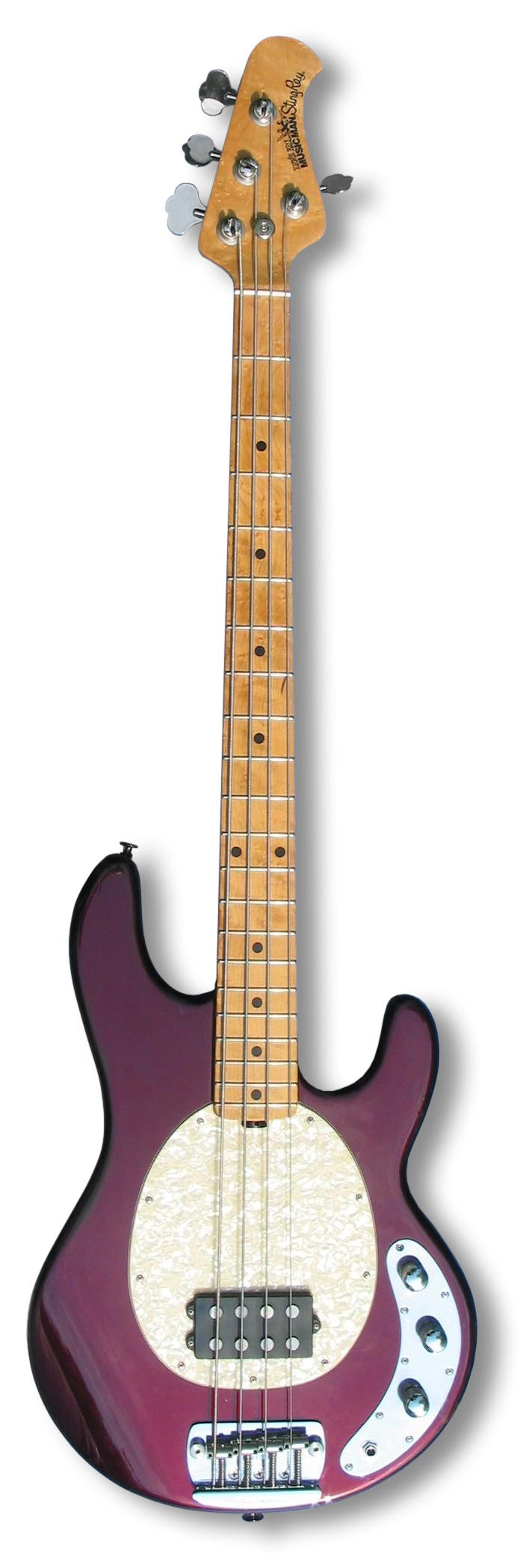
Photo: Th. Ott / Wikimedia Commons / CC BY-SA 3.0 Music Man
StingRay
1976
Leo Fender wanted a wide, bright bass. Louis Johnson hit it with his thumb, and funk had its sound.
- Send a picture
Tobias
Classic
1986
You didn’t take a Tobias Classic off a wall. You ordered one from a Hollywood shop, and you waited.
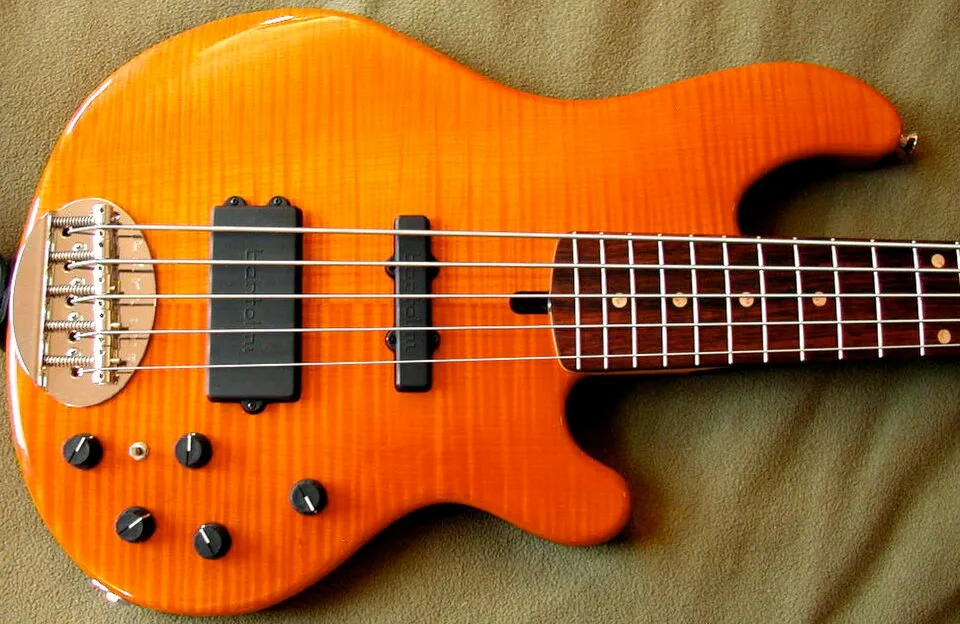
Photo: Dale Cruse / Wikimedia Commons / CC BY 2.0 Lakland
55-94
1996
A five-string for bass players who never wanted one: an extra inch of scale, and a neck that feels like home.