Ibanez
ATK 300
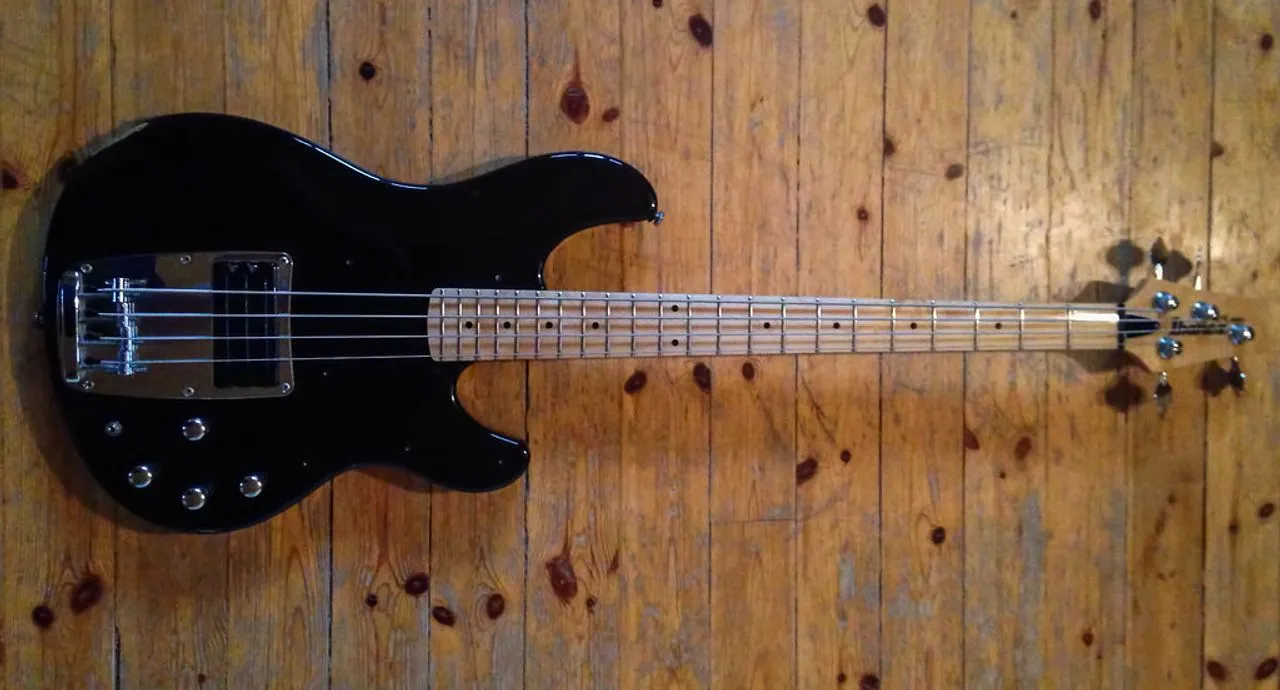
Ibanez called it the anti-Soundgear: a big ash body, a thick neck, and one huge pickup at the bridge.
The mid-’90s. Grunge is still in force, and Ibanez already has a slim bass, the Soundgear. So its designers go the other way, after the note you’d get slapping bass strings against a redwood.
- Introduced
- 1994
- Type
- Solidbody electric bass
- Class
- Production
The short version
1994
On the list
Absent from the January price list. On the September one at $699.95.
1995
“New”
The catalog calls the Attack series new. Ibanez later says it was released this year.
1999
Dropped
Greg K. of the Offspring is on a custom ATK300. After this year, the 300 is gone.
2007
The return
The ATK comes back, now made in Indonesia.
2009
The pawn-shop ATK
Paul Gray turns down Soundgears and says he’d switch if Ibanez built his pawn-shop ATK again.
2010
The 300 stops
The Indonesian run ends. Other ATK numbers carry the shape.
2018
Mothballed
The ATK series goes quiet.
Side A
A1
Not the slim one
By the mid-’90s Ibanez already had a working bass. The Soundgear was the slim one: thin neck, long horn.
Not everybody did. Paul Specht, speaking for Ibanez years later, called the ATK the “anti-Soundgear.” It was released “when grunge was still in force,” he said, for players who wanted
a big-bodied, big-necked bass.
The 1995 catalog put the sound in a picture: the designers were after the note you’d get from slapping bass strings onto a redwood. Big ash. A thick maple neck. One pickup, parked at the bridge. Players had their own nickname for it, “Stingray killers.” That was their word, not Ibanez’s.
The ATK300 is the four-string in the middle of that first list.
A2
One pickup, three voices
The ATK300 has a light ash body with an asymmetric double cut and a smooth heel so your hand gets to the top frets. The neck is three pieces of maple, with a maple board, black dots, and 22 frets. Scale is 34 inches, full size.
The pickup is the whole idea. It’s a single triple-coil, set down at the bridge, with a three-way switch. Every position is humbucking, so you get three different voices and none of them hum. Behind that sits an active three-band EQ, bass, mid, and treble, each one boost or cut, running off a 9-volt battery. There’s no passive bypass in the catalog list, so when the battery goes, you’ll know.
You can string it through the body or through the back of the bridge. Ibanez let you have it both ways.
A3
The year, and the factory
The ATK300 isn’t on Ibanez’s US price list for January 1994. It’s on the September 1994 list, at $699.95. The 1995 catalog calls the series new, and Specht, looking back, says it was released in 1995. Both years stay.
Where it was built is split too. The usual answer is South Korea. Specht said, “Various ATK’s were made in Japan, Korea and the United States from 1995 to 1999.” The American ones had their own names and prices: a USATK4 was $999.95 on the July 1995 list, while the 300 stayed at $699.95. Some sellers call their 300s Japanese. Nobody has settled which 300s came from where.
Flip the record · By the numbers
$699.95
The ATK300 on Ibanez’s September 1994 US price list.
3
Coils in one bridge pickup, and three humbucking voices off one switch.
2
Ways to string it. Through the body, or through the back of the bridge.
22
Frets on a maple board with black dots.
Side B
B1
A lefty and a punk
The 1995 catalog names one player in its ATK copy. Mark White of the Spin Doctors was a lefty, and he’s one reason the left-handed bass is in the line. The catalog doesn’t say which songs.
Then, in June 1999, Bass Player caught Greg K. of the Offspring mid-switch. He’d come off an old P-Bass onto “a custom Ibanez ATK300.” The magazine doesn’t say what was custom about it, or which record it’s on.
It was the end of the first run. Ibanez dropped the 300 after 1999, Specht said, for the trends, and for Soundgear and the BTB. The slim bass won.
B2
The one he wouldn’t trade
For a while, anyway. The ATK came back for 2007, built in Indonesia, with the same bridge triple-coil, the same three-band, and the same choice of through-body or through-bridge. That 300 lasted until 2010. Other ATK numbers carried the shape after that, until the series was put away after 2018.
The best argument for the idea came from a player. In June 2009, at Download, Paul Gray of Slipknot told Total Guitar that on the last album he had bought a bass in a pawn shop: “this Ibanez ATK that they’ve stopped making.” Ibanez sent him Soundgears. He didn’t want them. He said he’d switch if they built that ATK again.
In another interview he said his tech had found an old left-handed ATK on tour. It had one huge pickup, lows and mids with sharp highs, and a wider neck. He asked Ibanez to bring that bass back.
Be careful with this part. Gray never calls either bass a 300, and his signature models are different instruments, with different wood and his own inlays. But the point stands. Ibanez built the ATK for players who didn’t want the slim bass. Then Ibanez offered one of them the slim bass, and he didn’t want it.
The cast
The people, and the specific guitars, that made the legend.
2007
Paul Specht
Ibanez Communications
The one who called the ATK the “anti-Soundgear,” built for players who wanted “a big-bodied, big-necked bass.”
1995
Mark White
Left-handed ATK
Spin Doctors. Named in the 1995 catalog as one reason the lefty is in the line. No songs logged.
1999
Greg K.
Custom ATK300
The Offspring. Moved off an old P-Bass onto “a custom Ibanez ATK300.” What was custom, and which record it’s on, aren’t known.
2009
Paul Gray
A found ATK, and his PGB signature
Slipknot. Bought an ATK in a pawn shop, and his tech found a left-handed one on tour. He never calls either one a 300. His signature is a different bass.
Liner notes
Specs, construction, rarity, value, and every source we used.
A bridge triple-coil with three humbucking voices and a three-band on a big ash bolt-on — Ibanez’s ATK 300, the fat anti-Soundgear, not a StingRay and not Paul Gray’s signature.
- Body
- Asymmetric double-cut solid. Light ash. Bolt-on.
- Neck
- 3-piece maple, ATK4 profile, All Access joint. Not a through-neck.
- Fingerboard
- Maple, black dots, 22 nickel-silver frets. Rosewood is the ATK300R.
- Scale
- 864 mm / 34". Mix flagged.
- Pickups
- One ATK-A triple-coil humbucker, mounted in the bridge
- Hardware
- Chrome. ATK4 bridge, 19 mm string spacing; through the body or through the bridge. Wilkinson open-gear tuners, clover keys.
- Electronics
- Volume; bass, mid, and treble boost/cut; 3-way humbucking selector; 9V. No passive bypass in the catalog list.
- Finish
- Gloss. First-run colors include amber, black, ivory, sunburst, and transparent black.
- Nut
- Plastic, 42 mm on the 1994–99 sheet. 2007–10 sheet: 42.5 mm. Mix flagged.
Open the full research fileConstruction details, the complete player record, production numbers, dated value estimates, and sources
Classic living example = 1990s ATK300 (Ibanez Standard; wiki files it South Korea). No current ATK300 this pass: none on ibanez.com, 25 September 2026. Factory millimetres with inch equivalents as printed. Mix flagged. Do not average 42 mm, 42.5 mm, and a shop card’s 1-5/8". ATK305 is the five-string. ATK300L is the lefty. ATK300FL is fretless. ATK300R is rosewood. ATK100, ATK500, USATK4, and USATK5 are other 1995 numbers. ATK700, ATK200, ATK800, ATK1200, and the PGB Paul Gray basses are later SKUs. Soundgear is the slim Ibanez bass, not this table. No Fender SKU. No Music Man SKU.
Construction
The job was a low E with a body behind it. The 1995 USA catalog calls the Attack series new and says the designers were after the note you would get from slapping bass strings onto a redwood. Big ash. A thick maple neck. One pickup, and it sits in the bridge.
Ibanez already had the other bass. Soundgear is the slim one: thin neck, long horn, the working SR. Paul Specht of Ibanez Communications, February 2007, called the ATK the “anti-Soundgear,” released “when grunge was still in force,” for players who wanted “a big-bodied, big-necked bass.” Not a Precision (fender-precision-bass). Not a StingRay (music-man-stingray). The wiki’s nickname, “Stingray killers,” is player talk. Specht’s sentence is the factory one. This plate is the ATK300, the four-string in the middle of that first list.
The year is split. The USA price list effective 1 September 1994 names an ATK300 at $699.95. It is absent from the 1 January 1994 list. Ibanez wiki files the model as introduced for 1994, then prints years offered 1995–1999, and the first full-line catalog scans it cites are 1995. The 1995 catalog itself says new. Specht, looking back in 2007, says the ATK “was released in 1995.” Keep 1994 and 1995. This plate starts in 1994.
What that catalog describes is the whole instrument. Light ash, asymmetric double-cut, All Access heel. Three-piece maple, ATK4. Maple board, black dots, 22 frets. Scale 864 mm / 34". Plastic nut 42 mm. One ATK-A triple-coil in the ATK4 bridge, 19 mm spacing, and three humbucking settings off a 3-way. Volume, bass, mid, treble, 9 volts. No bypass in the list. String it through the body or through the back of the bridge. Wilkinson open-gear tuners. The lefty and the fretless in the same paragraph are the ATK300L and the ATK300FL.
Where it was built is split too. Wiki: South Korea, Standard line. Specht: “Various ATK’s were made in Japan, Korea and the United States from 1995 to 1999.” The July 1995 list is how you separate the USA basses from this one. USATK4 is $999.95. USATK5 is $1,199.95. ATK500 is $899.95. The ATK300 stays $699.95. Named sale cards still call some 300s Japan-made. Tone House, serial FC5070132, listed one at $999.99 and marked it sold. A Basschat seller dated his 1994 and called it Japan. Don’t pick a factory. A serial dates a bass. It doesn’t settle a contract.
Then the number left and came back. Wiki: discontinued after 1999. Specht: dropped in 1999 for the trends, and for Soundgear and the BTB. The wider series, on the wiki, runs through 2003, goes quiet, and returns for 2007. Harmony Central, 12 February 2007: light ash, 3-piece maple, maple board, black, natural, Tri-Fade Burst, list printed $666,65. The five-string on that note is $706.65. The ATK700 — quilted top, 5-piece maple/walnut, $933.32 — is not this table.
The second 300 is Indonesia, 2007–2010, then gone. Same bridge coil, same 3-band, same choice of through-body or through-bridge. Harmony Central calls the switch a character switch, every position humbucking, and puts the bridge where a slap falls. Nut on this sheet is 42.5 mm. The 2008–2012 ATK4 table: 63 mm at the last fret, 21 mm at the first, 24 mm at the twelfth, radius 240 mm R / 9 7/16". The 1990s radius is not in that table. Mix flagged. Do not average. A Chicago Music Exchange card for a Korean ivory 300 prints nut 1-5/8", radius 10", 9 lb 7 oz. Tone House’s seller-called MIJ prints nut 1-5/8", radius 9.5", 10 lb 1 oz. Named objects. Not a census. Indonesia guards follow the finish: black on natural, white pearloid on black, bright blue, and red sparkle. Bright blue is 2008. Red sparkle is 2008–2010, USA. Tri-Fade Burst is 2007 only.
After 2010 the 300 stops. ATK200, ATK800, and ATK1200 carry the shape. A 2013 catalog index prints the Prestige ATK1200 at $1,699.99 in the USA column and $2,266.65 in the price-list column. Other bass. Wiki: the series mothballed after 2018. No ATK300 on Ibanez’s current pages this pass.
Classic vs current: a 1990s ATK300 — light ash, 3-piece maple, one bridge triple-coil, 3-band, 42 mm nut — against no new 300 you can order in 2026. The Indonesia bass wears the same name and the same circuit. Other factory. Other nut.
Players
Do not hang a Soundgear, a StingRay, or a Precision on this plate. Do not treat Paul Gray’s signature as a stock ATK300. He never calls the found bass a 300, and he does not assign Iowa or the debut to it.
Greg K. (the Offspring). Bass Player, June 1999, in the season of Americana: he had come off an old P-Bass onto “a custom Ibanez ATK300,” and off a Gallien-Krueger 400RB onto a 2000RB with Mesa 2x15 and 4x10 cabs. Custom is the magazine’s word. What was changed, and which record the 300 tracked, are unpublished there.
Mark White (Spin Doctors). The 1995 USA catalog names him in the ATK copy: a lefty, and one reason that bass is in the line. The left-handed number on the year’s list is the ATK300L — amber in the USA through 1996, gone after 1997. Which songs are unpublished. Catalog credit, not a taped part.
Paul Gray (Slipknot). Two finds, neither of them labeled ATK300. Total Guitar, recorded at Download in June 2009: on “the last album” he bought, in a pawn shop, “this Ibanez ATK that they’ve stopped making.” Ibanez sent Soundgears. He didn’t want them. He said he would switch if they built that ATK again. In June 2009 the last album is All Hope Is Gone. No song named. Ibanez.com, via Blabbermouth, 20 January 2010: his tech found an old left-handed ATK on tour. One huge pickup, lows and mids with sharp highs, a wider neck, spacing he liked. He asked them to bring that bass back. The next answer — nine people, don’t get muddy — is about the signature, the one with his inlays. PGB1 and PGB1L, 2007–2010. Musician’s Friend’s PGB1L sheet: 5-piece maple/walnut, rosewood, factory low B, the switch labeled Trad / Bright / Attack. Not this 3-piece maple board with dots. Warwick is the earlier company in the same Total Guitar interview: a Corvette “or some model,” from Ozzfest, when the band had no money.
Also known to play stays short. The 1995 ATK paragraph stops at White. Fieldy is on the TR bass page of that catalog. His later signature is a K5. Not an ATK300.
Rarity
You cannot order a new ATK300. The first run ends with 1999. The second ends after 2010. Later standards, Premiums, Prestiges, and the Paul Gray basses are other numbers. Wiki’s last year for the series is 2018.
Ibanez did not publish ATK300 unit totals. None invented. A price list proves the model was offered. It doesn’t count a year. That is why a first-year census is unknown, not the chapter.
What is actually thinner: basses from the September 1994 list; ATK300L lefties, gone after 1997; catalog fretless; a 1990s 300 whose 9-volt board has not been pulled. Gray’s found ATK and Greg K.’s custom are unique objects. They are not a vintage ATK300.
Value
Informal estimate, 25 September 2026. Not an appraisal.
Ask vs sold labeled. Celebrity instruments are not-comps. No invented medians or factory counts. Period USA list, via the wiki: $699.95 on 1 September 1994 and through 1995–1996; $699.99 in 1997; $749.99 in 1998–1999. Japan, same line: ¥60,000 (1995–1998), ¥65,000 (1999). Tax status unpublished. 1990s money, not 2026 street. The 2007 return, Harmony Central: $666,65, comma and all.
New street. None. No ATK300 page on ibanez.com, 25 September 2026. The 2013 ATK1200 figures above are a Prestige cart.
Used modern. Indonesia, 2007–2010. Reverb Price Guide, Good to Mint, seven orders: $267–$481. Named hammers on that guide, not a series to average: 26 July 2026 Excellent $351; 21 July 2026 Very Good $360; 23 May 2026 Good $400; 28 November 2025 Very Good $400; 11 October 2025 Excellent $449.95; 29 April 2025 Good $200; 16 November 2024 Excellent $355. A guitar-list ask, not a hammer: Red Sparkle, Very Good, $499.95.
Vintage / collectible. The 1994–1999 Reverb guide did not return a dollar band this pass. Flag: thin sold-comp access. Named asks, late August 2026, not hammers: 1990s sunburst, Good, $722.24; a 1994, Good, $450; 1995–99 light ash, Excellent, $901.83; 1997 Vintage Sunburst, Very Good, $601.72. Do not average them. Basschat, Sandy, Bedfordshire, sold 20 June 2025 at £250: seller-called 1994 Japan, a lot of chips, collection only. One sale. Gray’s found ATK and Greg K.’s custom are not comps.
See also
- music-man-stingray — the bridge-humbucker active bass this gets compared to; Specht’s brief was the Soundgear, not a StingRay clone
- fender-precision-bass — the split-coil Greg K. left; not this triple-coil
- aria-pro-ii-sb-1000 — another high-output active, through-neck and a six-position filter, not a bridge triple-coil
Sources
- Ibanez Wiki, ATK300 (1994–1999) — introduced for 1994; years offered 1995–1999; South Korea; light ash; AANJ; ATK4 bridge, 19 mm; ATK-A triple-coil; 3-band; 9V; 3-piece maple; maple board; 22 frets; plastic nut 42 mm; 864 mm / 34"; Wilkinson; MSRP $699.95 (1995–96), $699.99 (1997), $749.99 (1998–99); ¥60,000 (1995–98), ¥65,000 (1999); finishes; discontinued after 1999
- Ibanez Wiki, 1994 USA catalog — ATK300 absent from the 1 January 1994 list; $699.95 on the 1 September 1994 list, with ATK300L, ATK300FL, and ATK305
- Ibanez Wiki, 1995 USA catalog — Attack (ATK) series; January and July prices; USATK4 $999.95, USATK5 $1,199.95, ATK500 $899.95, ATK300 $699.95, ATK100 $569.95 from July
- Internet Archive, Ibanez Guitar Catalog 1995 — “new” ATK series; light ash; 3-piece maple; triple-coil with three humbucking settings; 3-band; through-body or through the bridge; All Access joint; left-handed and fretless; Mark White of the Spin Doctors; Fieldy caption sits on the TR bass spread, not the ATK
- Ibanez Wiki, ATK300 (2007–2010) — Indonesia; light ash; ATK-A; 3-band; 9V; nut 42.5 mm; 864 mm / 34"; finishes including Bright Blue and Red Sparkle; discontinued after 2010
- Ibanez Wiki, ATK series — introduced 1994; “Stingray killers” as the common nickname; counterpoint to Soundgear; series off after 2003, back for 2007, mothballed after 2018; Paul Gray signature models
- Ibanez Wiki, list of bass neck profiles — ATK4, 2008–2012: 42.5 mm nut, 63 mm at the last fret, 21 mm / 24 mm thickness, 240 mm R / 9 7/16"; K5 listed as Reginald “Fieldy” Arvizu, 2009–2026
- Ibanez Wiki, 2013 catalogs — ATK1200 Prestige: USA column $1,699.99, price-list column $2,266.65; ATK200 and ATK800 still catalogued; no ATK300
- Harmony Central, Ibanez announces the return of the ATK, 12 February 2007 — Paul Specht, “anti-Soundgear,” released 1995, Japan / Korea / USA through 1999; character switch, all humbucking; through-body or through-bridge; ATK300 list printed $666,65; ATK305 $706.65; ATK700 $933.32
- Total Guitar / MusicRadar, Paul Gray, 26 May 2010 — Download, June 2009; pawn-shop ATK “on the last album”; refused the Soundgears; Warwick Corvette “or some model” from Ozzfest
- Blabbermouth, Ibanez.com interview with Paul Gray, 20 January 2010 — tech found a left-handed ATK on tour; one huge pickup; wider neck; the following answer is the signature
- Musician’s Friend, PGB1L — signature, not the 300: 5-piece maple/walnut; rosewood; 42.5 mm; 240 mm radius; ATK triple-coil; Trad / Bright / Attack; factory low B
- Bass Player, Greg Kriesel, June 1999, via Another Offspring Homepage — custom Ibanez ATK300 off an old P-Bass; GK 2000RB; Mesa cabs; written around Americana
- Reverb Price Guide, ATK300 Standard (2007–2010) — $267–$481, seven orders; named hammers through 26 July 2026
- Reverb, ATK300 Standard 1994–1999 — product years 1994–1999, Korea; dollar widget did not return this pass
- guitar-list, ATK300 asks, USA — late-August 2026 asks, not hammers: $722.24, $450, $901.83, $601.72, Red Sparkle $499.95
- Basschat, ATK300 sold, 20 June 2025 — £250, seller-called 1994 Japan, heavy wear, collection only
- Chicago Music Exchange, ATK300 Ivory (Reverb) — Korea card: nut 1-5/8"; radius 10"; 9 lb 7 oz
- Tone House, mid-90s ATK300 (Reverb) — seller-called Japan, serial FC5070132; nut 1-5/8"; radius 9.5"; 10 lb 1 oz; listed $999.99 and marked sold
Keep digging
Guitars this one gets compared to, confused with, or descended from.
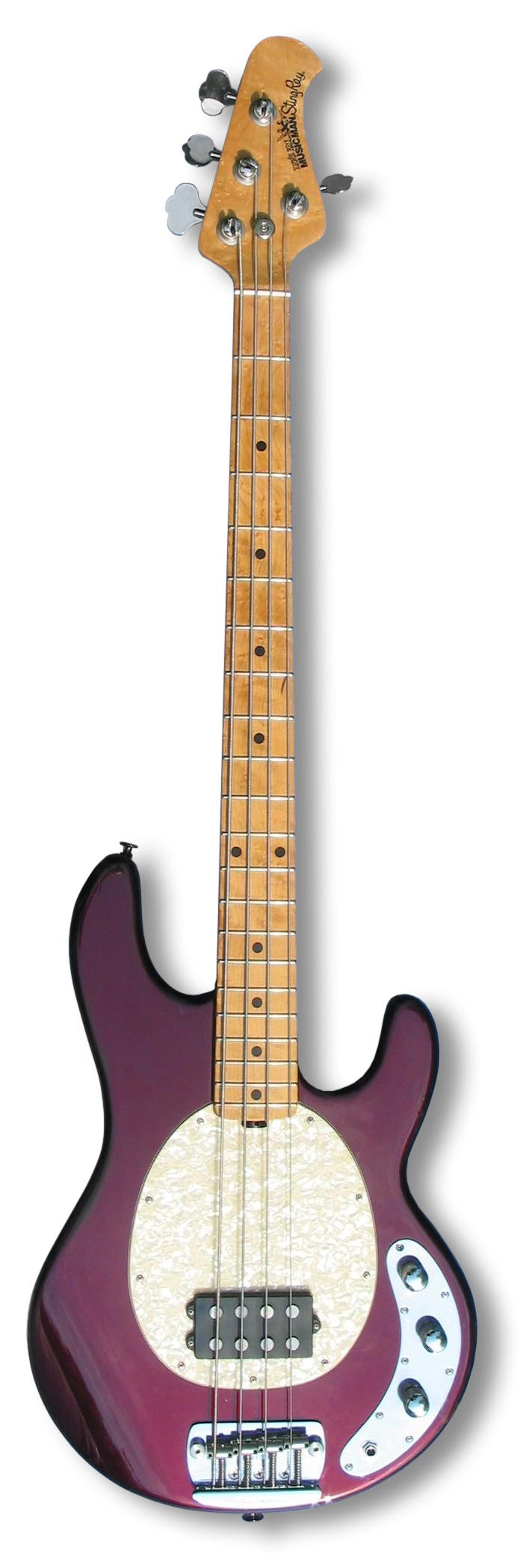
Photo: Th. Ott / Wikimedia Commons / CC BY-SA 3.0 Music Man
StingRay
1976
Leo Fender wanted a wide, bright bass. Louis Johnson hit it with his thumb, and funk had its sound.

Photo: Infrahertzz / Wikimedia Commons / CC BY-SA 3.0 Fender
Precision Bass
1951
Leo’s bass let the player at the back be heard. You know their lines by heart. You mostly don’t know their names.
- Send a picture
Aria Pro II
SB-1000
1978
A Japanese through-neck with six clicks of tone, for bass players who didn’t want a Fender or a Gibson.