Audiovox
736
The bass player always had to drive alone. So, around 1936, Paul Tutmarc made a bass that fit in the car.
The Audiovox 736 is a four-string electric bass from Seattle: black walnut through the neck, an ebony board with frets, one horseshoe pickup, one knob, and you held it like a guitar. Paul Tutmarc was selling it around 1936, about fifteen years before the Precision Bass. It isn't a Fender, and it isn't the upright he built first.
- Introduced
- 1936
- Type
- Solidbody electric bass
- Class
- Closed run
Have a photograph of this guitar? Send a picture
The short version
1930–31
The basement pickup
Paul Tutmarc and Art Stimson wind a horseshoe pickup in the basement and try it in a flat-top through a converted radio.
1933
A pine cello
His son's date for the first electric bass, a solid pine upright the size of a cello, with no frets.
1935
Pity him no more
On 17 February a Seattle paper writes up his electric bull fiddle, four feet tall instead of six.
c. 1936
The 736
The walnut bass, small, fretted, and held across the body, is on the market.
1937
The ads
The advertisements turn up that spring, with the bass at $65 and its amp extra.
c. 1950
Audiovox winds down
Tutmarc stops marketing Audiovox instruments around 1950.
1951
Fullerton
Leo Fender's Precision Bass arrives, and it's the one people will mean by an electric bass.
2018
Out from under the bed
A 736 bought by a Seattle teenager in 1947 comes up on eBay, listed by Tutmarc's grandson.
Side A
A1
Only enough room left for him to drive
Seattle. Paul Tutmarc has a band, and the band has a problem with the car.
His son Bud told it without any romance. The string bass went in the car, and "there was only enough room left for him to drive." Everybody else rode together. The bass player rode alone.
Tutmarc was a music teacher, a Hawaiian steel player, and a performer on KOMO radio, and he had already spent a winter in the basement winding pickups. In the winter of 1930–31, he and a partner, Art Stimson, made a horseshoe pickup and tried it in a flat-top through a converted radio. Lawyers took $300 off them to say a pickup alone wouldn't patent.
So he knew how to make a string loud without a big box behind it. The question was what to put the string on.
A2
Pity him no more
Bud's date for the first try is 1933: solid white pine, the size and shape of a cello, no frets, played standing up like a doghouse bass.
By February 1935 it was in the paper. The headline was "Pity Him No More – New Type Bull Fiddle Devised," and the instrument was four feet tall instead of six, a bull fiddle you could carry under your arm. The paper's description:
"A block of wood strung with bass-viol strings."
It was carved into a violin shape "for the sake of tradition," and you plucked it.
It was still an upright, and still too big to live with. It's also not the 736, though you'll see that headline put on the wrong instrument.
A3
Turn it sideways
The next one he laid down. Around 1936, the bass Tutmarc put on the market was 42 inches long, black walnut running all the way through the neck, with an ebony fingerboard, sixteen frets, a horseshoe pickup under a mirror-steel faceplate, and one volume knob. Four strings. You held it across your body like a guitar.
The frets are the part that matters. An upright player finds the note by ear and by feel. On this, the note was where the fret said it was, the same as on a guitar.
He built them in the basement of the family house in Seattle's Roosevelt District, then had a cabinetmaker take over the woodwork. It wasn't sold on its own. You needed the matching amp, the 936. The ads that turned up in the spring of 1937 put the bass at $65 and the amp at another $75. Other accounts print $75 for the bass, and $95 for the amp. One early ad ran in a Seattle high-school yearbook.
Flip the record · By the numbers
$65
The bass in the 1937 ads, by one count. Another account prints $75. The amp was extra.
30 5/16"
The scale. The Precision Bass, fifteen years on, is 34".
16
Frets, on an ebony board. The upright before it had none.
3 or 4
Survivors known in 2018, depending on who was counting. In 1999 the count was one.
Side B
B1
Gospel, Hawaiian, and country
One of the first people to play it on a bandstand was Lorraine Tutmarc, Paul's wife, in the family's Hawaiian band. The historian who dug the bass back up says "one of the first." A later writer calls her the first. Take your pick.
After that, the basses went to gospel, Hawaiian, and country players, and their names didn't make it into the history. How many went is its own argument. The same history says Tutmarc sold "numerous" of them to Northwest musicians and that "relatively few were sold." There was no national distribution. Audiovox wound down around 1950. Bud had a similar bass of his own by about 1947, the Serenader, but that's a different instrument.
B2
Fifteen years early
Then Fullerton took the job. Leo Fender's Precision Bass came out in 1951, with a 34-inch scale and a different body, and that's the one people mean when they say "electric bass."
Tutmarc wasn't a rock musician. In April 1972, looking back, he said:
"A lot of fathers and mothers probably would like to kill me."
And then: "If it hadn't been me, it would have been someone else." He died of cancer that September.
B3
Some sort of lap steel guitar
For a long time it looked as if nothing was left. In the mid-'90s a Seattle music historian came across one at a suburban swap meet, from a seller who thought it was "some sort of lap steel guitar." It was headed for the museum that's now the Museum of Pop Culture, and in 1999 it was written up as the only one left.
It wasn't. Another turned up at a guitar dealer in Nashville, who hadn't had one in more than forty years in the business. Another came out of an antique shop in Eugene, Oregon, in 2001. By 2018 the count was three or four, depending on who was counting.
One of them belonged to Dale McKnight. He bought it in Seattle in 1947, when he was a teenager. In 2018 he was 85, and the bass had been living under a bed in a mobile-home park in Snohomish County.
It fit.
The cast
The people, and the specific guitars, that made the legend.
c. 1936
Lorraine Tutmarc
Audiovox 736
Paul's wife, and one of the first people to perform with the bass, in the family's Hawaiian band. One writer calls her the first.
c. 1936
Paul Tutmarc
Audiovox 736, his own design
Seattle bandleader, Hawaiian steel player, radio performer, and teacher, who electrified instruments in his basement.
c. 1947
Bud Tutmarc
The Serenader, his own bass
Paul's son, who told the story of the bass in the car. Around 1947 he marketed a similar bass of his own, the Serenader. It isn't a 736.
1947
Dale McKnight
A walnut 736
Bought his as a teenager in Seattle and still had it at 85.
Liner notes
Specs, construction, rarity, value, and every source we used.
Four strings on a walnut neck-through, held like a guitar — Tutmarc’s Audiovox 736, the fretted electric bass Seattle was selling about 1936.
- Body
- Solid black walnut, neck-through. Vintage Guitar (February 2017): 42" overall. MoPOP object 1995.108.2 prints overall 95 7/8 × 25 3/8 × 4 1/2 in. (243.523 × 64.453 × 11.43 cm) and nut-to-bridge 77 in. (195.58 cm). Those fields do not describe a bass you can carry, and they do not match 42".
- Neck
- Neck-through black walnut (Vintage Guitar, February 2017). Not a bolt-on. Later woodwork was jobbed to cabinetmaker Emerald Baunsgard; the essay does not say the neck construction changed.
- Fingerboard
- Ebony. 16 frets (Vintage Guitar, February 2017).
- Scale
- 30 5/16" (Vintage Guitar, February 2017, calling it scale). The catalog figure dealers quote is overall length, not scale.
- Pickups
- One horseshoe. Vintage Guitar (February 2017) calls it a Tutmarc–Stimpson horseshoe. HistoryLink and the March 1999 essay spell the partner Arthur J. Stimson. Two spellings, one partner, one pickup.
- Hardware
- Mirror-steel faceplate on the bass in the February 2017 essay. MoPOP’s white example: chrome pickguard. Four strings, so four tuners; tuner model unpublished. Bridge unpublished beyond “it has one.”
- Electronics
- One volume knob. No tone control on the bass in the February 2017 description. Passive. The Model 936 is a separate amplifier, not this circuit.
- Finish
- Not one finish. MoPOP 1995.108.2 is white (Blecha/Meeker: white enamel), medium listed as walnut. Greg Tutmarc’s 2018 listing, via No Treble: the museum bass is the painted one; a private example and the McKnight bass are unpainted varnished wood, “the wood appears to be black walnut.”
- Nut
- Unpublished.
Open the full research fileConstruction details, the complete player record, production numbers, dated value estimates, and sources
The spec above is a Seattle Audiovox Model 736 Bass Fiddle (also Electronic Bass / Electric Bass Fiddle), marketed about 1936. No current model carries the name. The 1933 / February 1935 white-pine upright is a different, earlier instrument. Bud Tutmarc’s Serenader (about 1947) is a different bass. It is not a Precision Bass (Fender) and not an A-22 (Rickenbacker).
Construction
The job was getting the bass player back in the car. Seattle, not Fullerton.
Paul Tutmarc’s son Bud, quoted by Tim Fletcher in Bass Musician Magazine (17 February 2020), said it without romance. His father was a bandleader. The string bass went in the car and “there was only enough room left for him to drive.” Everyone else rode together. The bass player rode alone. That is the complaint the 736 answers. It is not what the first experiment looked like.
Bud’s date for the first try is 1933: “solid, soft white pine, the size and shape of a cello,” unfretted, played standing up like a doghouse. The newspaper is later, and it is still that upright. Peter Blecha, Vintage Guitar, March 1999: the Seattle Post-Intelligencer of 17 February 1935, headline “Pity Him No More – New Type Bull Fiddle Devised.” Tutmarc, music teacher and KOMO artist, with an electric bull-fiddle you could carry under your arm. The paper’s own size: four feet tall instead of six. “A block of wood strung with bass-viol strings,” carved into a violin shape “for the sake of tradition.” Plucked, not bowed. The 1999 essay calls it a one-off upright, and still too big to live with. The February 2017 essay’s caption puts that same “Pity Him No More” headline on the 736. In the 1999 account the pine cello is a separate instrument, not this model. HistoryLink (essay 7479, posted 18 September 2005) prints the 1935 feature, then the #736 as the next invention: horizontal, fretted, small.
Marketing of this bass is about 1936. The ads Blecha found are the following spring. Vintage Guitar, February 2017: he “initially marketed the instrument circa 1936.” The March 1999 essay: experiments ran on into ’36, and Audiovox “began advertising in the Spring of ’37.” Seattle Times, 6 March 2018: “marketed beginning in 1936,” with an early ad in a Seattle high-school yearbook. The school is not named. Greg Tutmarc’s 2018 eBay listing, quoted by No Treble and Ultimate Guitar, says his grandfather manufactured them “starting in 1936.” The 1936 date is that marketing year. It is not a catalog page dated New Year’s Day, it is not the spring 1937 advertisement, and it is not the 1935 upright. Museum of Pop Culture object 1995.108.2 is dated c. 1935 on the record and, in the same record, called “This 1936 Model 736.”
What he actually sold is the walnut one. Vintage Guitar, February 2017: 42" long, black walnut, neck-through, 30 5/16" scale, 16 frets, ebony board, horseshoe pickup, mirror-steel faceplate, one volume knob. Four strings. Held like a guitar. Blecha’s name is the #736 Electronic Bass, also the Electric Bass Fiddle. MoPOP’s label is Model 736 Bass Fiddle. The museum’s public dimensions on that same object do not agree with 42 inches, and they do not agree with a bass. Both sets of figures are given in the specs above.
The white bass and the walnut basses are not one finish story. MoPOP’s is white, chrome pickguard, a large brown plastic volume knob. Meeker’s sidebar in the February 2017 issue: white enamel, found in a shop, then the museum. Greg Tutmarc’s listing: that museum bass is the painted one; another private bass, and the McKnight bass, are varnished wood that “appears to be black walnut.”
Paul H. Tutmarc. HistoryLink’s dates are 1896–1972. The family was Minneapolis. He was in Seattle shipyards in 1917, then Aberdeen and Centralia, and back in Seattle in 1928. Hawaiian steel, tenor, KOMO, a teaching studio. Audiovox Manufacturing Company is the 1934 shop: Western Laboratories Building, 806 Pine Street, above Birkel Electrical Supply, down the block from the Paramount. The Times puts the bass in the basement of the Roosevelt District house, with the other instruments he electrified. There is a photograph of him at a band saw. Blecha, 2017: basement woodwork first, then cabinetmaker Emerald Baunsgard. Amp man Bob Wisner. Linen on the cabinets: Frank Galianese. The 936 is the amp you had to buy with it, not a part of the bass. March 1999: $75. February 2017, from a catalog of the era: originally $95, “18 watts of power at three percent distortion,” a 12" Jensen Concert speaker; the amp in that article has a later 10" Jensen Model A-12, in airplane linen, in a box.
The pickup fight is older than the bass, and it is not the bass. HistoryLink, from the son: winter 1930–31, Tutmarc and Arthur “Art” J. Stimson wound a horseshoe pickup in the basement and tried it in a flat-top through a converted radio. Lawyers took $300 and said a pickup alone would not patent. Stimson, in HistoryLink and the 1999 essay, is the man who turns up on Dobro’s 7 April 1933 application as assignor, for $600. Electro String was already selling in August 1932. Vintage Guitar 2017 spells him Art Stimpson and calls this bass’s pickup a Tutmarc–Stimpson horseshoe. Both spellings appear in print. HistoryLink also gives Tutmarc a later slanted split-pole humbucker on guitars. That is not the horseshoe on the 736. Rickenbacker’s A-22 is a 1932 cast-aluminum lap steel. Lyon & Healy, Vega, Dobro, Gibson, Rickenbacker, and Regal were, by Blecha’s 1999 account, already trying electric basses in the mid-’30s. Those were still tall, unfretted, and upright. Not this. HistoryLink’s line, which is Blecha’s, is that the 736 “can be considered the world’s first solid-body electric bass guitar.” The qualifier is the whole claim: fretted, solid, and held across the body. It is not a claim that nobody had electrified a bass before.
The money kept it in town. March 1999: the bass “a whopping $65,” and the 936 another $75. CelebrityAccess (10 March 2018) prints the bass at $75. HistoryLink holds two sales sentences open at once: “numerous” Electronic Bass Fiddles to Northwest musicians, and “relatively few were sold,” with no national distribution. No factory total was published. He kept marketing Audiovox until about 1950 (HistoryLink; the 2017 caption). MoPOP’s label says the company closed in 1950. The marriage to Lorraine ended in 1943. In 1944 he married Bonnie Buckingham, later Bonnie Guitar. That is a different story, and not a 736 credit. Around 1947 Bud Tutmarc marketed a similar bass as a Serenader, in the L.D. Heater Co. jobber catalog of 1948 (Blecha, March 1999). National wholesale is the Serenader’s claim. It is not a 736, and it is not a reason to move this model’s date.
Then Fullerton took the job. Leo Fender’s Precision Bass, 1951, is the one players mean. Blecha’s 2017 essay says “November of ’51.” The Precision Bass entry gives Fender’s October 1951 first commercial unit. About fifteen years after this marketing year either way, on a 34" scale, in a different body. Tutmarc was not a rock musician. HistoryLink, from an April 1972 interview it credits to Duncan: “A lot of fathers and mothers probably would like to kill me,” and then, “if it hadn’t been me, it would have been someone else.” Cancer, 23 September 1972.
Then and now: a Seattle 736, walnut through the neck, ebony, 16 frets, one horseshoe, one knob. Nothing to order. There has been no Audiovox reissue.
Players
Lorraine Tutmarc. The named one. Blecha, March 1999: “One of the first people to perform with the new bass” was his wife Lorraine, in the family band. Fletcher, Bass Musician Magazine (17 February 2020): the first recipient, in Paul’s Hawaiian band. The magazine runs a photograph of her on the #736 and credits iFPHC. No recording of her on the bass has been identified. Neither source settles her as the “first electric bass player.” Blecha’s line is “one of the first.” Fletcher’s headline is “might have been,” and his text is “first recipient.” Divorce 1943. Fletcher: she died in 1992.
Also known to play: no one else is named in the sources. Blecha, March 1999: other basses “sold to various gospel, Hawaiian, and country players.” No names in that sentence. Dale McKnight bought one in 1947 (Seattle Times). That is a purchase, not a gig. Bud’s Serenader is another brand. A later demonstration named in Greg Tutmarc’s listing is a video of a survivor, not a 1930s job.
Rarity
You cannot buy a new 736. Audiovox is not a maker with a 2026 price list. The lap steels still surface. This bass does not.
Nobody published a production total. HistoryLink’s “numerous” and “relatively few” are one paragraph, not a count. No serial series has been published.
Named instruments, not a census:
Blecha, March 1999, had one. A suburban swap meet. The seller thought it was “some sort of lap steel guitar.” The photo caption says discovered 1995. In that essay he called it the lone survivor, bound for the Experience Music Project, which opened in 2000.
Ward Meeker’s sidebar in the February 2017 issue already has more than one. A white-enameled bass surfaced in 1996 at Jake Sturgeon’s shop in Tukwila and stayed at EMP. MoPOP’s object number is 1995.108.2. Sources give both 1995 and 1996. A matching 936 reached the museum a couple of years after the bass. Another 736, with a 436 lap steel, turned up at Gruhn Guitars in Nashville. George Gruhn had not had one in forty-plus years of dealing. “Quickly sold.” No price in that piece. The bass in the 2017 photographs came out of an antique shop in Eugene, Oregon, in 2001. Its 936 took about twelve more years and showed up at Guitar Maniacs in Tacoma.
Seattle Times, 6 March 2018: Dale McKnight, then 85, bought his in 1947, a teenager in Seattle. It had lived under a bed in a Snohomish County mobile-home park. Grandson Greg Tutmarc was the seller on eBay (No Treble, quoting the listing). On the block that March.
Printed totals do not agree, and none of them is a factory number. March 1999: one known. Greg’s listing, No Treble (4 March 2018), Guitar World (7 March 2018), and Bass Musician (2020): three. The Times (6 March 2018) and CelebrityAccess (10 March 2018): four. The 1999 “lone” was already behind Meeker’s Gruhn and Eugene basses. The museum holding on a collection record is MoPOP 1995.108.2: white, medium walnut.
Value
Informal estimate, 27 October 2026. Not an appraisal.
Ask and sold prices are labeled below. One auction result is not a price guide. A Precision, a Serenader, an Audiovox lap steel, and a shop-built copy are not this bass. No 2024–2026 sold price turned up. Few sold prices are public.
New street. None. No Audiovox list, no factory reissue.
Used modern. No modern run, so no used-modern band.
Vintage / collectible. Period list, not 2026 money. The bass: $65 (Blecha, March 1999). The 936: $75 in that essay, $95 in the February 2017 catalog note. CelebrityAccess prints the bass at $75.
One named sale. eBay, the McKnight bass, sale reported 6 March 2018. CelebrityAccess, 10 March 2018: $23,850.09. Ultimate Guitar, reporting that day’s close, and the body of Guitar World (7 March 2018): $23,850. The Guitar World headline says $23,000. The headline is not the body. The Times, while bidding was open, prints a high bid of $20,000. No Treble on 4 March: bidding at $20,000, auction to end 6 March at 11:35 a.m. Eastern. Those $20,000 lines are not the close. Gruhn’s sale has no price in the 2017 essay. The MoPOP bass, the Eugene bass in that essay, and the Gruhn bass are not comparable sales. One eBay result is not a median.
See also
- fender-precision-bass — Fullerton, 1951, 34" scale; the bass that got the credit. Not this walnut 736
- rickenbacker-a-22 — 1932 cast-aluminum lap steel, horseshoe over the strings. Not a fretted bass
- fender-telecaster-bass — 1968 Fender look back at the 1951 slab Precision. Still not Seattle, still not a 736
Sources
- Vintage Guitar, Peter Blecha, Audiovox #736 (March 1999; online text) — 17 February 1935 Post-Intelligencer, “Pity Him No More”; pine upright, four feet, “block of wood”; experiments into 1936; ads spring 1937; Stimson and the Dobro application; Lorraine “one of the first”; gospel, Hawaiian, and country players unnamed; bass $65, 936 amp $75; firm around 1950; Serenader about 1947, L.D. Heater catalog 1948; mid-’30s catalog; swap meet, “some sort of lap steel guitar”; discovered 1995; then the lone known, for EMP
- Vintage Guitar, Peter Blecha, The Audiovox 736 Electric Bass and 936 Amp (February 2017; Ward Meeker sidebar) — marketed circa 1936; 42" overall; black walnut; neck-through; 30 5/16" scale; 16 frets; ebony; Tutmarc–Stimpson horseshoe; mirror-steel faceplate; one volume; basement, then Emerald Baunsgard; Wisner; Galianese; 936 at $95, 18 watts at 3 percent, 12" Jensen then a 10" A-12; caption puts the 1935 headline on the 736; Precision “November of ’51”; died 23 September 1972; products until about 1950; Sturgeon’s, Tukwila, 1996, white enamel, EMP; Gruhn, quickly sold; Eugene 2001; Guitar Maniacs, Tacoma
- HistoryLink, Peter Blecha, Tutmarc, Paul (1896–1972), and his Audiovox Electric Guitars (essay 7479, posted 18 September 2005) — 1896–1972; Minneapolis family; 1917, Aberdeen, Centralia, Seattle 1928; Stimson, winter 1930–31; $300 patent advice; Electro String August 1932; Dobro application 7 April 1933, Stimson assignor, $600; 1934 shop, 806 Pine; February 1935 upright; #736 as the next, horizontal and fretted; “numerous” and “relatively few,” no national distribution; about 1950; Lorraine, 1943; Bonnie Buckingham 1944; Duncan, April 1972; death from cancer 23 September 1972
- Museum of Pop Culture, Audiovox Model 736 Electric Bass Guitar, c. 1935, object 1995.108.2 — date c. 1935; description “This 1936 Model 736”; medium walnut; white, chrome pickguard, large brown plastic volume knob; published dimensions 95 7/8 × 25 3/8 × 4 1/2 in. and nut-to-bridge 77 in., figures that do not fit a bass you can carry; Audiovox closed in 1950 in that text; Paul Tutmarc 1896–1972
- Bass Musician Magazine, Tim Fletcher, The First Electric Bass Guitar Player (17 February 2020) — Bud on the car, and the 1933 pine cello, unfretted, vertical; by 1936 a horizontal four-string; Lorraine the first recipient; photo credit iFPHC; early 1937 ads, bass $65, 936 amp $75; March 2018 sale, “one of the three known,” $23,850; divorce 1943; Lorraine died 1992
- Seattle Times, On eBay: the world’s first electric bass guitar, made in Seattle — and forgotten (6 March 2018, updated 8 March 2018) — Roosevelt District basement; band-saw photograph; marketed beginning 1936; high-school yearbook ad, school unnamed; four known, as that paper counts them; Dale McKnight bought it in 1947 as a teenager; high bid $20,000 while the piece still said “right now”
- No Treble, Kevin Johnson, First Electric Bass Guitar, Audiovox #736, Up For Auction (4 March 2018) — Greg Tutmarc’s listing: three known; EMP painted, another varnished, this one varnished walnut; bought from the builder; original pickups; bidding $20,000; ends 6 March 2018, 11:35 a.m. Eastern; Blecha’s $65 / $75 and the unnamed gospel, Hawaiian, and country players
- Ultimate Guitar, Oldest Electric Bass Guitar in the World Was Sold Today on Ebay for $23,850 — close reported 6 March 2018 at $23,850; listing text “starting in 1936”; “one of only three”; black walnut on the varnished examples
- Guitar World, Jackson Maxwell, World’s Oldest Electric Bass Guitar Sells on Ebay for $23,000 (7 March 2018) — headline $23,000; body $23,850; three known, following the listing; Lorraine and the family band, via the 1936 account
- CelebrityAccess, World’s First Electric Bass Sold On EBay For $24k (10 March 2018) — hammer $23,850.09; four known, following the Times; bass “originally sold for $75,” against Blecha’s $65; McKnight, 1947; Greg’s listing on the painted museum bass and the varnished walnut
Keep digging
Guitars this one gets compared to, confused with, or descended from.
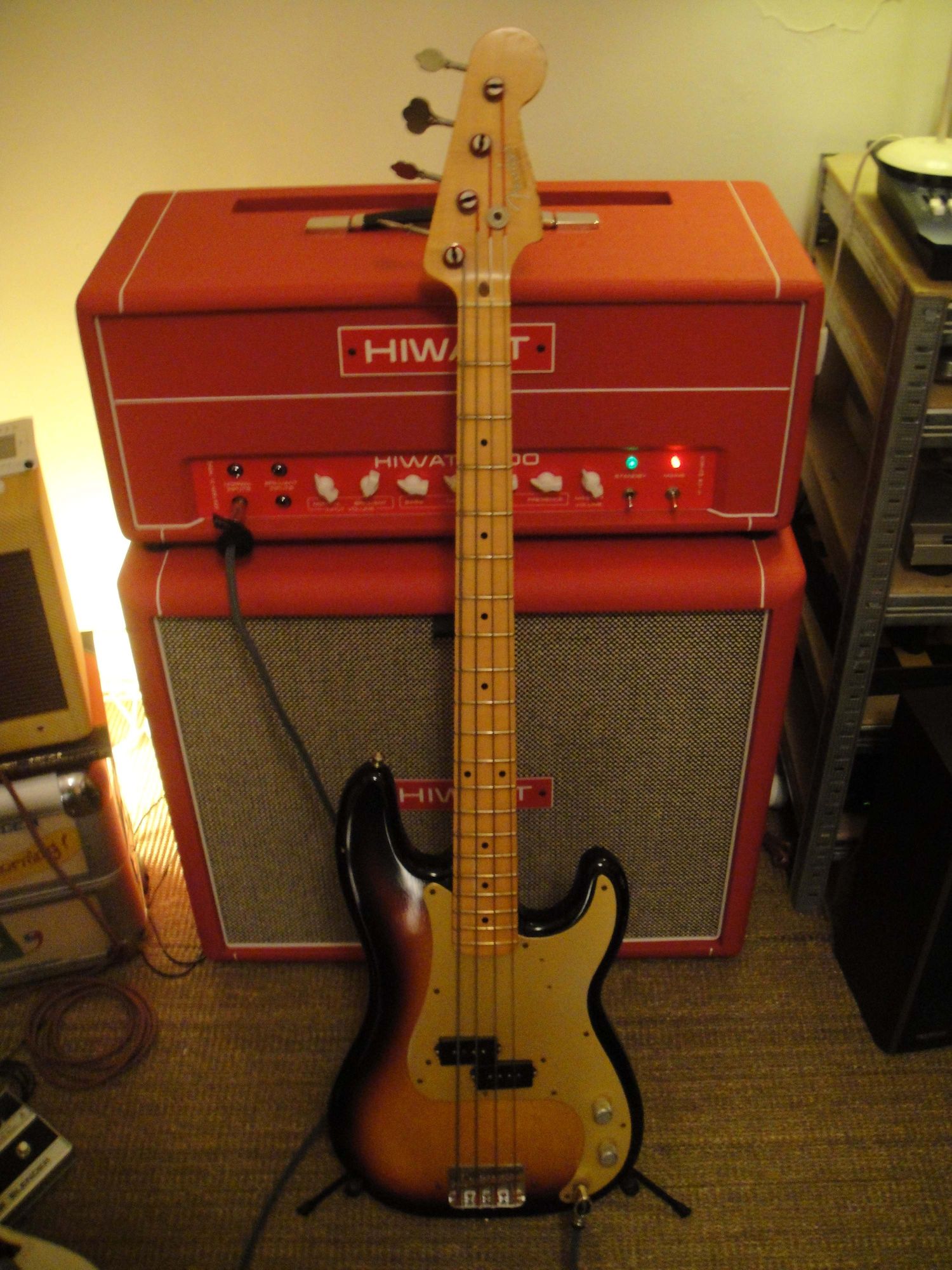
Photo: Infrahertzz / Wikimedia Commons / CC BY-SA 3.0 Fender
Precision Bass
1951
Leo’s bass let the player at the back be heard. You know their lines by heart. You mostly don’t know their names.
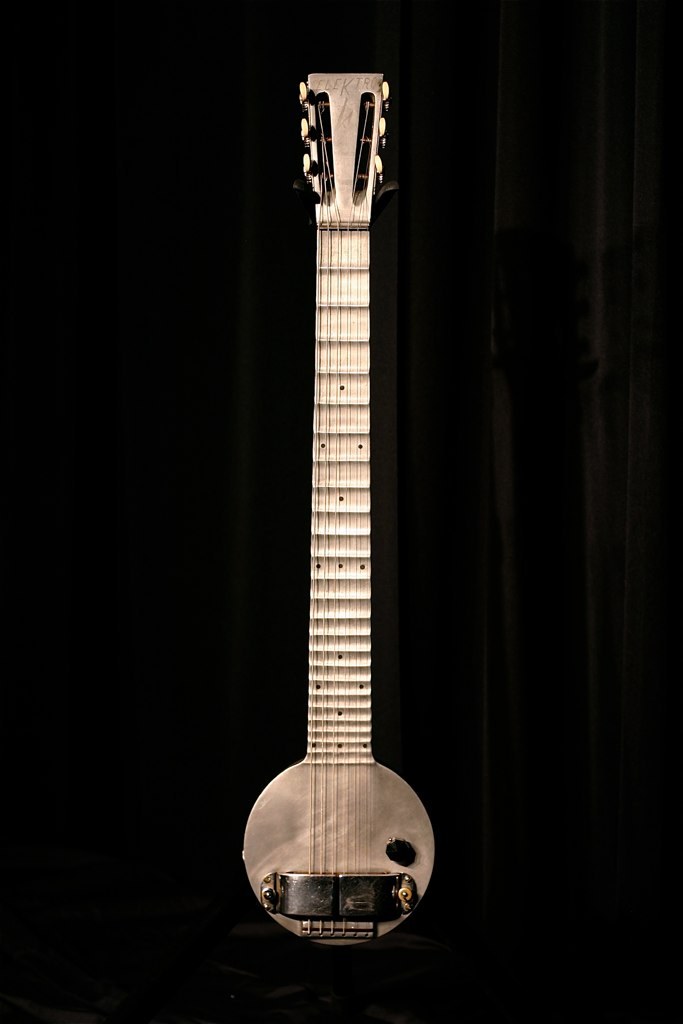
Photo: Museum of Making Music / Wikimedia Commons / CC BY 3.0 Rickenbacker
A-22 Frying Pan
1932
The first electric guitar you could buy looked like a frying pan. The patent office didn’t believe it worked.
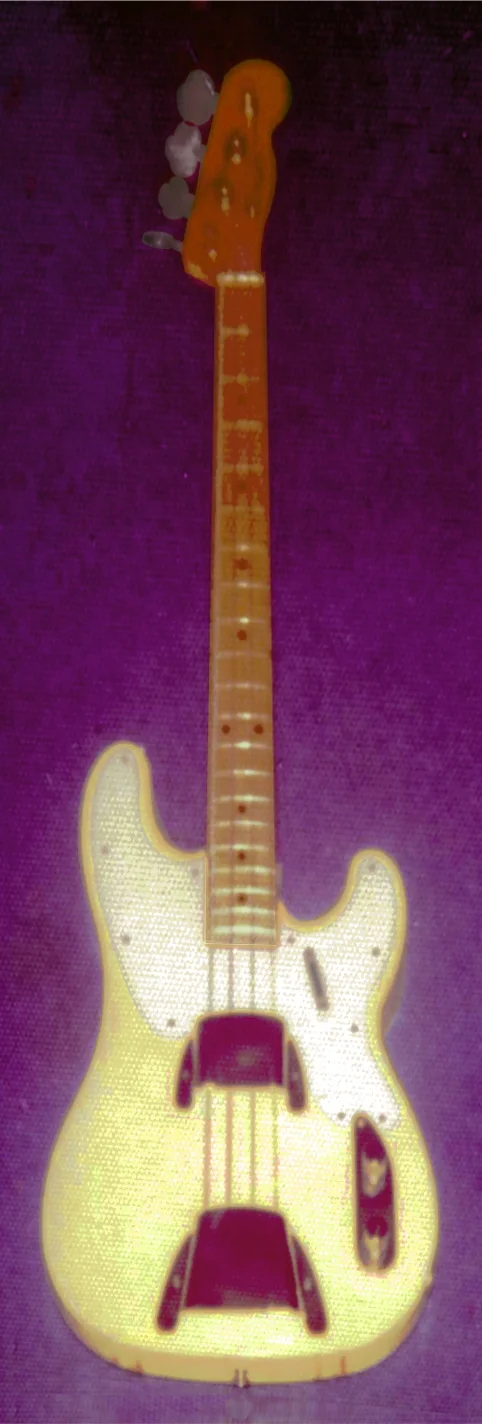
Photo: Fender_Telecaster_Bass_(c.1970s).jpg: -ted derivative work: Clusternote / Wikimedia Commons / CC BY 2.0 Fender
Telecaster Bass
1968
Fender’s first reissue was a bass it had already thrown away. George Porter Jr. found one covered in cobwebs.