F Bass
BN5
Half an inch longer than a Jazz Bass, so the low B sounds like a note instead of a rumble.
A five-string is only as good as its lowest string. In a building on McKinstry Street in Hamilton, Ontario, George Furlanetto and his son Marcel answered that with a vintage Jazz Bass idea, a stretched scale, and a preamp that does nothing until you ask it to.
- Introduced
- 1997
- Type
- Solidbody electric bass
- Class
- Production
Have a photograph of this guitar? Send a picture
The short version
1976
His own bench
George Furlanetto leaves Waddington's on John Street and builds his first electric guitar.
1978
The first bass
A fretted P/J with mahogany wings. Two or three were built. Not this outline.
1983
Alain Caron goes to five
George moves him off a 32-fret four-string and onto a five.
1986
McKinstry Street
A 5,000-square-foot shop in Hamilton. F Bass is still there.
1997
The first BN5 the shop dates
A turquoise nitro Studio with 20 frets. Not proof nothing came sooner.
2003
Colin Yong switches
Picks up a BN5 and uses nothing else after.
2007
Marcel joins
He'd built his first guitar and bass with his father at 16, in 2004.
2023
Fourteen months
The wait for a new F Bass, up from three months before COVID.
Side A
A1
The string nobody wants to hear
Every five-string player knows the problem. The low B is there, it's on the chart, and on a lot of basses it comes out as a kind of pressure in the room rather than a note.
Marcel Furlanetto put the BN5's answer in one sentence: "essentially our take on a vintage Fender Jazz Bass," with "a very transparent preamp," and a scale of 34.5 inches. That extra half inch, he said, gets you "a more musical low B without compromising the G and the D."
It's a small number. It's most of the point.
A2
A guitar shop first
George Furlanetto worked at Waddington's on John Street in Hamilton from 1969 to 1976, then went to his own bench. He built guitars first, six-strings, and then noticed there were too many people already making those. His first bass came in 1978. That was a fretted P/J with mahogany wings, two or three of them built, and nothing like this outline. Once he played bass himself, the ideas started coming.
In 1983 he moved Alain Caron off a 32-fret four-string and onto a five. Alain's own signature basses are their own line, chambered and stranger. The BN5 is the other branch: the plain bolt-on.
By 1986 the shop was a 5,000-square-foot building on McKinstry Street. It's still there.
A3
Stacks, not split-coils
George will date his pickups even when he won't date his basses. The early ones were split-coils in Jazz positions, his own winding, then Fralin. They were "phased out by the early '90s, when we evolved into single-coil stacks." On today's BN5 you pull the bridge volume knob and the stacks go hum-cancelling. Same pickups, less buzz.
The preamp works on the same idea of staying out of the way. George asked Gary Poplawski for a preamp that only boosts and can be bypassed. Leave the knobs at zero and it sounds like the passive bass. Pull the tone knob and it is the passive bass. A battery lasts about 500 hours.
Even the strings were part of it. "We developed these strings at the same time as the basses," George said.
It's a small number. It's most of the point.
Flip the record · By the numbers
34.5"
Scale length on the five. A Fender Jazz is 34.
~500
Hours on one nine-volt battery.
~200
Instruments a year from a team of about ten.
4,000+
Bass guitars out of the shop by 2023, every model together.
Side B
B1
The year it started
When the first BN5 left the shop is not clean. The earliest one F Bass itself dates is a 1997 Studio: swamp ash, turquoise nitro, 20 frets, stacks wired in series, nine pounds six ounces. A 1992 bass titled BN5 by a dealer turns out to be a neck-through with split-coils, which makes it a different animal. A bass magazine reviewed a BN5 in February 2000. A seller in July 2001 was describing a 22-fret bolt-on. So 1997 is the first year the shop puts its name to, not proof that nothing came sooner.
The details kept moving. The knobs were African blackwood for a while, and George said it doesn't split. Now they're knurled aluminum. The bodies were "pretty much all" ash by one reviewer's count, and George wanted ash for "the solidity of the bottom end." Alder is on the sheet now too.
B2
Ten people and a wait
In 2014 the BN5 was the shop's most popular model, built by a team "closer to 10" turning out "over 200" instruments a year. By 2023 it was ten employees, close to 200 a year, and more than 4,000 bass guitars out the door. Before COVID, the wait was three months. In early 2023 it was fourteen.
The horn is part of why people wait. The bass horn reaches out so first position sits closer when the bass is on a strap, and the treble horn curves away so you can get to the last frets, or play sitting down.
B3
Nothing else since
Colin Yong picked up a BN5 in 2003 and has "used no other axe since." Ryan Stasik plays BN5s with Umphrey's McGee and calls the BN "my signature sound." Neither one is talking about specs.
That's the sound of the half inch. You don't hear the extra tension. You hear the bottom note of the chord actually being a note, every night, on a bass built a few at a time in the same building in Hamilton.
Put this on
You’ve read about it. Now hear it. Here’s what this guitar sounds like, and what to listen for.
Mama Earth
He's named with a BN5 on this record, alongside a Warwick Star Bass. Two basses, one album, so you're hearing it some of the time.
Find it on YouTube (opens in a new tab)Roundabout (live at UMBowl X)
Ryan Stasik taking on Chris Squire's part with an F Bass five-string. The write-up doesn't say BN5. His own page says BN5s are his sound.
Watch it on YouTube (opens in a new tab)
The cast
The people, and the specific guitars, that made the legend.
George Furlanetto
Every BN5
Worked at Waddington's in Hamilton until 1976, built his first bass in 1978, and moved the shop to McKinstry Street in 1986.
Ryan Stasik
BN5s
Umphrey's McGee. "The BN is my signature sound," he says, without naming an album.
Colin Yong
BN5, since 2003
Theatre bassist. "Gravitated towards my F Bass BN5 in 2003 and have used no other axe since."
Étienne Mbappé
BN5 on Mama Earth (2017)
Played it alongside a Warwick on that record. He's said he plays "F Bass a lot," without always naming the model.
Maurizio Rolli
Buckeye-top BN5
Keeps it beside two of Alain Caron's signature six-strings.
Liner notes
Specs, construction, rarity, value, and every source we used.
A half-inch longer than a Jazz, so the low B has somewhere to speak — F Bass’s bolt-on five, not an Alain Caron and not a VF.
- Body
- Northern ash or alder. Double-cut, bass horn extended. No plastic guard on the sheet: shells and the backplate are grain-matched wood.
- Neck
- Bolt-on, 3-piece quarter-sawn maple. The sheet prints the wood, not the joint. Two-way truss, 4 mm wrench, on documented builds.
- Fingerboard
- Hardrock maple, 22 frets, compound 10"–16". Rosewood on #580423.
- Scale
- 34.5". The 4-string column is 34". iBass prints 876 mm. Mix flagged.
- Pickups
- Two F Bass stacked single-coils. Pull the bridge volume for hum-cancelling.
- Hardware
- Gotoh, 20:1. Aluminum Hipshot B. Spacing 19 mm (18 mm on the 6-string). Mix flagged.
- Electronics
- F Bass 9V, boost only: bass, mid, treble. Neck volume, bridge volume, tone. Tone pulls for passive. Flat at 0 matches the passive tone. About 500 hours.
- Finish
- Sunburst, transparent blue, green, red, brown burst; bursts and fades, plus others. Film unnamed on the sheet.
- Nut
- 45 mm (1 3/4"). Last fret 76 mm, no inch in that cell. Bone on the 1997 Studio and on #580423. Mix flagged.
Open the full research fileConstruction details, the complete player record, production numbers, dated value estimates, and sources
Current typical = BN5 (Hamilton), the 5-string column, fetched 8 October 2026. From $5,250 USD, gig bag in. Canadians: contact the shop. Mix flagged: inches beside millimetres, including iBass’s 876 mm. Maneri (March 2008–March 2014) measured nut 1.752" and radius 9–16". Do not average those with 45 mm or 10"–16", or 20 frets with 22. His card says bolt-on and pickguard n/a. The #580423 condition line mentions a pickguard. Deluxe, VF, and AC are other sheets.
Construction
The job was a Jazz-bass five whose B still sounded like a note. Marcel Furlanetto, iBass, 30 August 2017: “essentially our take on a vintage Fender Jazz Bass,” “a very transparent preamp,” 34.5 inches, “a more musical low B without compromising the G and the D.” The living sheet, five and six together, says that half inch keeps a musical “G & C.” Bass Gear, July 2014: the 34.5" “produces that extra bit of tension for clarity — most notably on the B string.” The bass horn is extended so first position sits closer on a strap. The treble horn curves out for the last frets, and for sitting down.
The shop is older. The Hamilton Spectator, 31 January 2023: Waddington’s on John Street, 1969–1976, then his own bench. Bass Musician, 2016: first electric guitar that year, first bass 1978. About page: the 5,000 sq ft shop on McKinstry Street, 1986. Still 16 McKinstry. Jedistar adds a 1978 partner, Froc Filipetti. The about page names George. Marcel told Bass Gear he built his first guitar and bass with his father in 2004, at 16. The about page says he joined in 2007. Keep both.
1978 is a fretted P/J with mahogany wings, not this outline. The 2018 auto-transcript with Alain Caron: two or three built, one back at that year’s show for a 40th anniversary. The reissue’s name is not in the transcript. The Spectator: six-strings first, too many people already making them, then basses, and ideas for the Fender once he played bass. Alain is the other line. Bass Musician: UZEB, 1982; in 1983 George moved him off a 32-fret four-string onto a five. A fretless signature, and a fretted one. The AC page: mid-1980s, semi-chambered maple, Canadian spruce, one handwound single-coil plus an RMC piezo, 28-fret Gabon ebony, from $7,250. Same transcript: first signature neck-through; a pink-cherry bolt-on was a try; the one that stayed is chambered, and he credits the bolt-on joint. That is the AC.
Strings will not date the BN5. The BN page: exposed-core, printed LaBella, “developed in tandem with our BN series,” mid-1980s. The AC page swaps in “our AC’s.” George, Bass Gear, spelling La Bella: “We developed these strings at the same time as the basses.”
Pickups he will date. Split-coils in Jazz positions, his winding, then Fralin, “phased out by the early ’90s, when we evolved into single-coil stacks.” Alain Caron BN6 replicas still took split-coils. Not this five. Jason Brown had wound the stacks “for over twenty years” by 2014. Bowlus calls them stacked humbuckers with a coil-tap, already on a push-pull. The sheet says stacked single-coils. Same pull. iBass: BN pickups, preamps, and knobs are local; Aguilar winds the VF. George asked Gary Poplawski at PEEQ for a bypassable boost-only preamp, flat at zero. Maneri’s card names PEEQ. The living page says discrete parts, built in Hamilton, and does not print the name.
The earliest BN5 the factory dates is the 1997 Studio, #710197. Swamp ash, nitro turquoise, 20 frets, bone nut 44 mm, last fret 74 mm, stacks “wired in series,” ebony knobs, 9 lb 6 oz. A 1992 Bass Shop card titled BN5 is a neck-through at 34", five-piece neck, split-coils, semi-parametric preamp, serial 042992. Not the 2014 neck-through option either. February 2000 Bass Player reviewed a BN5. A review. 1997 is the first BN5 F Bass dates, not proof nothing bolt-on left sooner. A July 2001 seller already describes a 22-fret bolt-on.
A 2008 BN5 was “up to current specs” in 2014: 22 frets, 10"–16", 1.75" nut, ash, maple, stacks, Hipshot B, Gotoh. Maneri: 9–16" and 1.752". Keep both. Knobs then were African blackwood. George said it doesn’t split. Now: knurled aluminum, ebony optional. Lab film was conversion varnish. The Studio is nitro. The sheet names neither. George, 2014, wanted ash for “the solidity of the bottom end.” Bowlus: “pretty much all” were ash. Alder is on the sheet. The 2009 review treated one-piece ash as an upgrade.
Deluxe is the other five. “After 3+ years,” no year on the page. FretSpot: since 2017. A Singapore shop, 30 September 2020, called one the first there. Humbuckers, three ways each, string-through, Hipshot A, from $6,750. VF: Aguilar P-60 and/or J-HC, 34" on a five, 21 frets, 9"–14", bent plate, from $4,750. The VF4-P was the first F Bass P, after 35+ years. Janek Gwizdala’s NAMM 2015 bass is a VF5-PJ. F Bass said so under the video.
Not a Fodera Monarch. Not a Ken Smith BSR. The years overlap. The instrument does not.
Classic vs current: 1997 Studio, nitro, 20 frets, stacks in series — against ash or alder, 22 frets, push-pull stacks, boost-only 9V, Hipshot B, from $5,250.
Players
Alain Caron’s records stay on the AC. A VF, a Deluxe, or a neck-through is a different order.
Ryan Stasik (Umphrey’s McGee). The factory’s player on this model: “my F Bass BN5’s,” “the BN is my signature sound.” No album named. No Treble, 2 June 2025: at UMBowl X, Yes’s “Roundabout,” “his F Bass 5-string.” That line does not print BN5. Keep both.
Colin Yong. He “gravitated towards my F Bass BN5 in 2003 and have used no other axe since.” Theatre. No record pinned.
Swaeli Mbappé. His page: round lows, clarity, “that unique F Bass sound.” No album pinned.
Also known, last and short. Anthony Wellington’s line is “BN Series,” not a pinned BN5; second bass in the Victor Wooten Band. Maurizio Rolli plays a buckeye-top BN5 beside an AC6 and an AC6 Classic. Étienne Mbappé told Rock At Night (2026) he plays “F Bass a lot,” plus an STR, a Fodera, and a Noguera — no model on that list. Guitar World (2021) does name an F-Bass BN5, with a Warwick Star Bass, on Mama Earth (2017). One record. Not the book. The Spectator says Tom Hamilton and Myron Dove “have an F Bass.” Bass Musician lists them with Marcus Miller and Mike Porcaro, no model. Leave those four off.
Rarity
You can order a new BN5. The bench is the constraint. The Spectator, January 2023: three months before COVID, 14 months then. No 2026 factory wait was printed. A dealer’s wait is not the shop’s.
No BN5 total exists in print. None invented. Bass Gear, 2014, called the BN5 the most popular model: a team “closer to 10,” “over 200” instruments a year. The Spectator, 2023: 10 employees, “close to 200” a year, $4,000 to $12,000, and “more than 4,000” bass guitars out of the shop. Company-wide, not a BN5 census. #710197 and #580423 are not a dating system. They do not count a model.
Thinner on purpose: a 20-fret nitro Studio; blackwood knobs, before aluminum; one-piece ash, an upgrade in the 2009 review. Deluxe, VF, and AC are other orders. Stasik’s BN5s and Yong’s 2003 bass are single objects, not a vintage census.
Value
Informal estimate, 8 October 2026. Not an appraisal.
Ask vs sold labeled. No celebrity hammer. No invented medians. Flag: thin sold-comp access. The product-page widget did not render a usable band, and a Past-30-days cell near $57 is not a sale. The guide below is printed on a listing whose bass was 18 mm, A-style. Not this 19 mm B-style table. The orders are still labeled BN5.
New street. BN5 from $5,250 USD, gig bag in. Left-handed +10%. Fretless BN +$1,000, and a different board. Adjacent, not averaged: BN4 $4,750, BN6 $6,250, VF5 $4,750, Deluxe 5 $6,750, AC5 $7,250. Older lists, not 2026 street: TalkBass, 17 July 2001, seller’s list $3,799, his discount $3,040, his ask $2,300 on a five-month-old bass; Bass Guitar Rocks, 18 December 2009, $3,750 / $3,910 as reviewed; Bass Gear, 2014, list $4,000, street $3,500 ($4,450 / $3,850 as tested).
Used modern. Reverb’s guide on that listing: $3,051–$4,687, 58 orders, Good to Mint. Named finals on the same page, not a fresh October book: 19 December 2025, Very Good, $3,350; 11 December 2025, Very Good, $2,700; 17 November 2025, Excellent, $4,160; 27 August 2025, Excellent, $4,000; 20 August 2025, Mint $4,800 and Excellent $4,300; 24 July 2025, Excellent, $4,200. Don’t average them. Asks on the brand page this pass sit higher: 2009 tobacco burst, Excellent, $5,499; 2016 ceruse, 2017 transparent blue, and 2019 black matte, each Mint at $6,799; another BN5, Excellent, $6,900. A 2022 buckeye, Very Good, $9,999, is a top. New 2026 Deluxes at $8,350 and $8,900 are the other sheet.
Vintage / collectible. No early-BN5 hammer isolated. The 2001 ask is 2001 money. The 1997 Studio and the 1992 neck-through are not comps for each other, and neither has a 2026 sold price here. The Bass Shop still titles that 1992 card BN5 and asks €7,918.95. Not a sale, not converted, not this bolt-on.
See also
- fender-jazz-bass — the vintage Jazz Marcel says this five is a take on; 34", not 34.5", and not Hamilton
- sadowsky-nyc-bass — the other working bolt-on with a boost-only preamp; New York, not this horn
- fodera-monarch — Brooklyn’s custom five-string shop; a butterfly, not a BN5
Sources
- F Bass, BN series — ash or alder; 3-piece maple; hardrock maple; 22 frets; 10"–16"; 34.5" (4-string 34"); 45 mm (1 3/4"); 76 mm at the last fret, no inch; 19 mm (18 mm on the 6); stacked singles; pull for hum-cancel; 9V boost-only, ~500 hours, flat at 0; Gotoh 20:1; Hipshot B; knurled aluminum; horn; grain-matched shells; from $5,250 USD; gig bag; left-hand +10%; fretless +$1,000; LaBella string sentence, mid-1980s; “G & C” on the shared 5-and-6 line; fetched 8 October 2026
- F Bass, 1997 BN5 Studio #710197 — nitro; 20 frets; bone nut 44 mm; last fret 74 mm; stacks wired in series; two-way truss, 4 mm; 9 lb 6 oz
- F Bass, 2023 BN5 #580423 — bone nut; 45 mm; 76 mm (3"); 34.5"; rosewood board; two-way truss; 9 lb 14 oz; condition line mentions a pickguard
- F Bass, About — founded 1978; McKinstry Street factory 1986, 5,000 sq ft; Marcel joined 2007
- F Bass, AC Signature — mid-1980s; semi-chambered maple, spruce, one handwound single-coil, RMC piezo, 28-fret Gabon ebony; from $7,250; same string sentence, “our AC’s”
- F Bass, VF series — Aguilar P-60 and/or J-HC; 34" on the five; 21 frets; 9"–14"; bent plate; from $4,750
- F Bass, Deluxe BN — “after 3+ years,” no calendar year; humbuckers splittable three ways; string-through; Hipshot A; Deluxe 5 from $6,750
- FretSpot, Deluxe copy — R&D “since 2017”
- Bassfreq Singapore, 30 September 2020 — “First ever F Bass BN5 Deluxe in Singapore”
- Bass Musician, George and Marcel Furlanetto, 2016 — 1976 own shop and first guitar; first bass 1978; UZEB 1982; Alain onto a five in 1983, fretless and a fretted; Miller, Hamilton, Porcaro, Dove named with no model
- Bass Gear, “Canadian Duo,” Tom Bowlus, 1 July 2014 (posted 9 April 2019) — bolt-on; BN5 most popular; 34.5" tension quote; 1.75" and 10"–16" as the sheet he read; split-coils out by the early ’90s; BN6 replicas; Jason Brown; PEEQ; La Bella; ash quote; blackwood knobs; neck-through option; closer to 10; over 200 a year; 2008 “up to current specs”; Marcel in 2004 at 16; VF4-P the first P
- Bass Gear, Bass Lab: F Bass BN5, Phil Maneri, same issue — March 2008–March 2014; bolt-on; pickguard n/a; nut 1.752"; radius 9–16"; double-action truss; PEEQ; conversion varnish; 10.06 lb; list $4,000 / street $3,500 ($4,450 / $3,850 as tested); 16 McKinstry
- iBass, F Bass BN5, 30 August 2017 — Jazz-bass quote, G and D; 876 mm (34.5"); local pickups vs Aguilar VF
- The Hamilton Spectator, Mark McNeil, 31 January 2023 — Waddington’s 1969–1976; 16 McKinstry; three months to 14 months; 10 employees; ~200 a year; $4,000–$12,000; more than 4,000 bass guitars; “has an F Bass,” no model; via Pipedot
- Jedistar, F Bass — Filipetti as co-founder, 1978; not on the factory about page
- George Furlanetto and Alain Caron, 2018 interview — fretted P/J, two or three built, one back for a 40th; first signature neck-through; pink-cherry bolt-on was a try; chambered bolt-on stayed; auto-transcript
- F Bass, NAMM 2015 video comment — Janek’s bass is a VF5-PJ with a rosewood top
- F Bass, Ryan Stasik — BN5s; “signature sound”; no album
- No Treble, UMBowl X, 2 June 2025 — F Bass 5-string on “Roundabout”; BN5 not printed
- F Bass, Colin Yong — BN5 since 2003
- F Bass, Swaeli Mbappé — BN5 quote; no album
- F Bass, Anthony Wellington — “BN Series”; Victor Wooten Band
- F Bass, Maurizio Rolli — buckeye BN5 plus AC6 and AC6 Classic
- Rock At Night, Étienne Mbappé, 2026 — “F Bass a lot”; STR, Fodera, Noguera; model unstated
- Guitar World, Étienne Mbappé, 24 February 2021 — F-Bass BN5 and a Warwick Star Bass II SC5 on Mama Earth (2017)
- TalkBass, FS: F Bass BN5, 17 July 2001 — list $3,799; seller’s discount $3,040; ask $2,300; five months old; 22-fret bolt-on; February 2000 Bass Player cited by the seller
- Bass Guitar Rocks, BN5 review, 18 December 2009 — $3,750 / $3,910 as reviewed; one-piece ash as an upgrade; February 2000 Bass Player, turquoise ceruse
- The Bass Shop, 1992 card titled BN5 — neck-through, 34", split-coils, semi-parametric preamp, serial 042992; euro ask, not a sale and not this table
- Reverb, sold BN5 listing and price guide — guide $3,051–$4,687, 58 orders; transactions through 19 December 2025; that bass is 18 mm / A-style; Past-30-days ~$57 cell is not a sale
- Reverb, F Bass brand — asks this pass: 2009 at $5,499; three Mints at $6,799; Excellent at $6,900; 2022 buckeye at $9,999; 2026 Deluxes at $8,350 and $8,900
- Reverb, F Bass BN5 product page — dollar widget did not render a usable band, 8 October 2026
Keep digging
Guitars this one gets compared to, confused with, or descended from.

Fender Jazz Bass from 1966 in Olympic white with the transition fingerboard (bindings and dot inlays). Photo by Th. Ott. Licensed under CC BY-SA 3.0. Via Wikimedia Commons. Fender
Jazz Bass
1960
Built for jazz players who mostly passed on it. Then bass players started using it to take the solo.
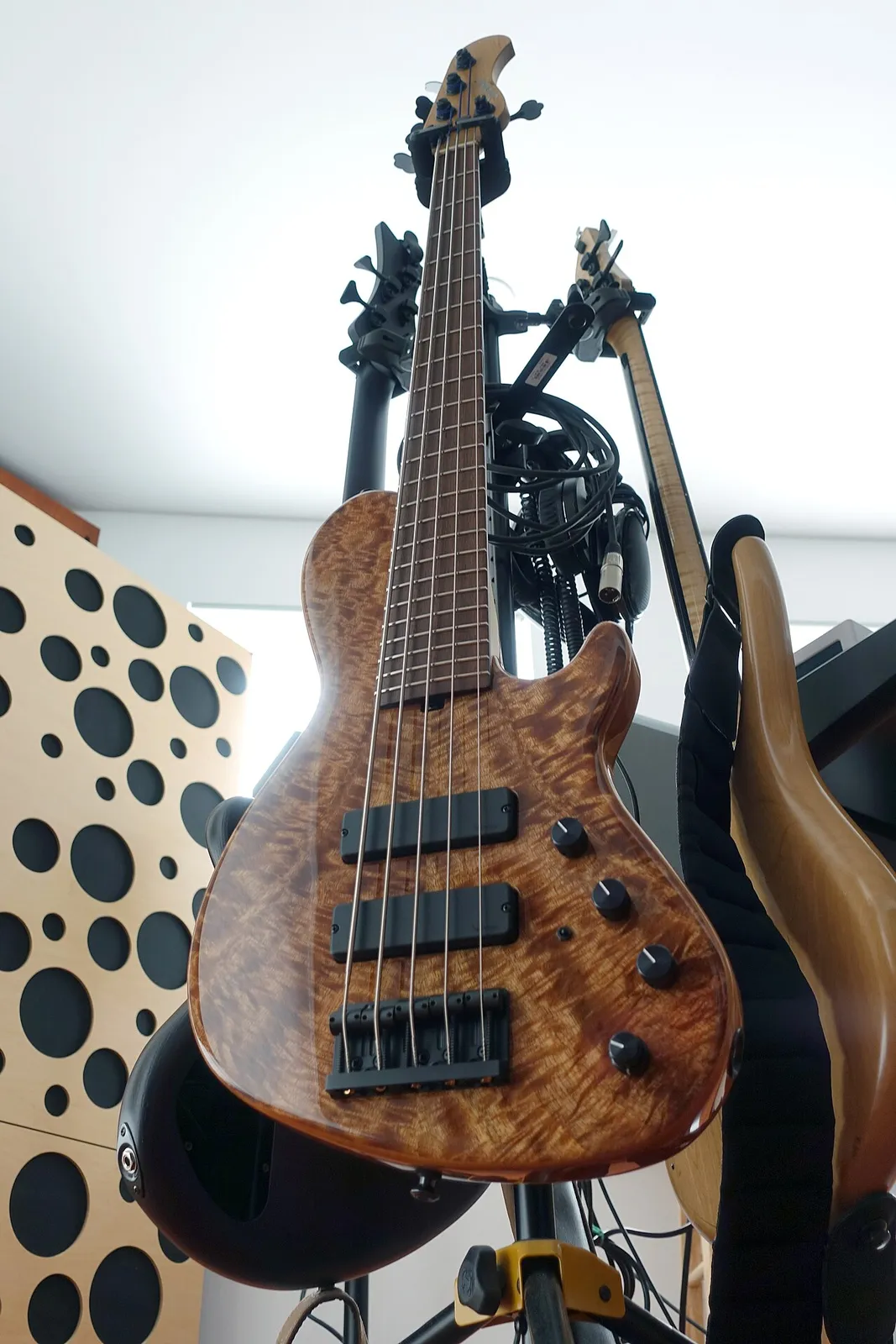
Photo: Nir Yaniv / Wikimedia Commons / CC BY-SA 4.0 Sadowsky
NYC Bass
1982
Built for the New York session bassist whose engineer wasn’t going to reset the board for him.
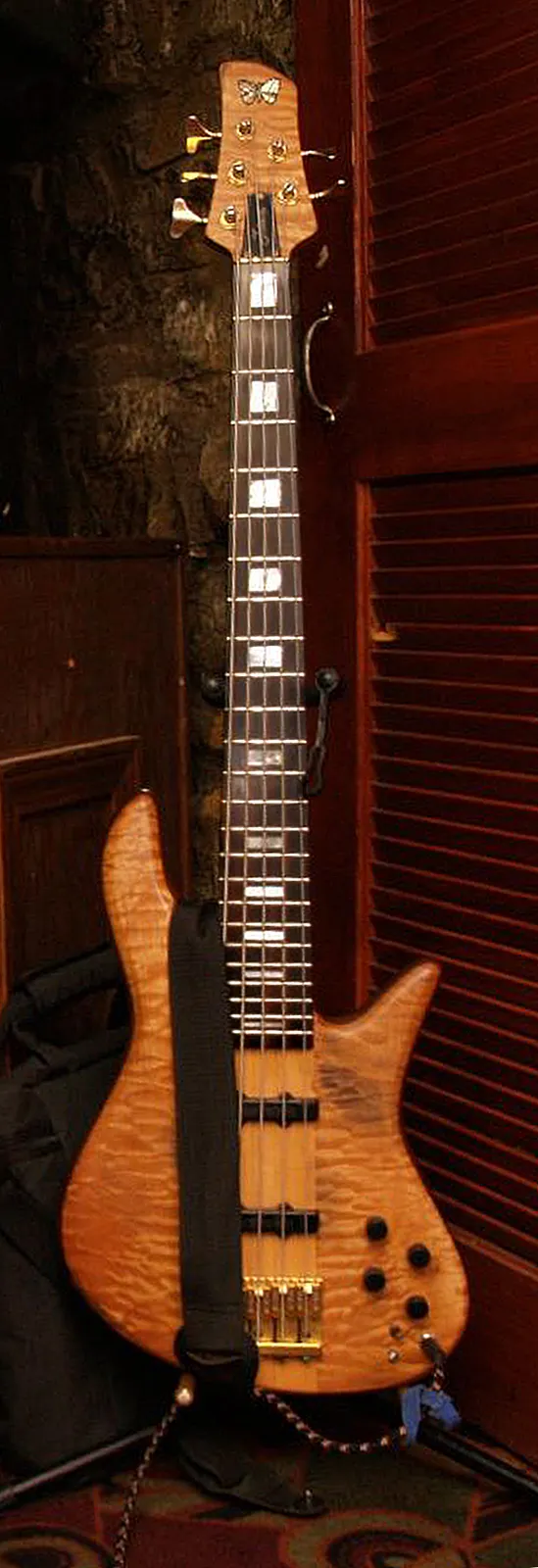
Photo: christina rutz / Wikimedia Commons / CC BY 3.0 Fodera
Monarch
1983
In 1983 a new Brooklyn shop brought a bass to a teenager’s session. It’s still Victor Wooten’s number one.