Ken Smith
BSR
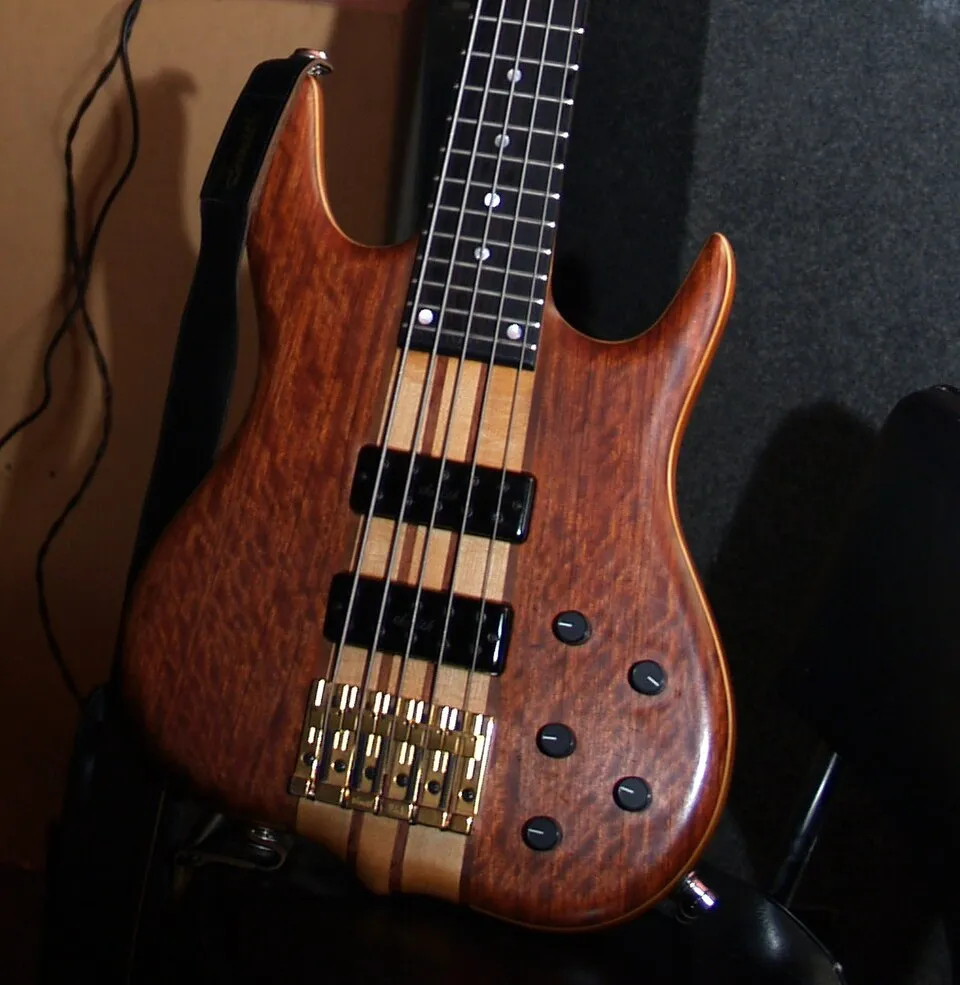
Ken Smith drew his first bass for playing sitting down. The BSR is the one he drew for standing up.
Stand up with a Ken Smith BT and you end up leaning on the strap. The BSR is the fix: same wood, same electronics, a longer horn, and a bass that hangs level. Its name took a year to catch up with it.
- Introduced
- 1996
- Type
- Solidbody electric bass
- Class
- Production
The short version
1978
A shop in New York
Founded 1978, first basses 1980, or handmade since 1979, depending who you ask. Keep all three.
1993
The BMT
The first shape Ken designed in Pennsylvania.
1996
The BSR begins
BMT on top, BT along the bottom. The first bolt-ons still say CR on the plate.
1997
The name arrives
The plates catch up a year later, and the neck-through is dated from here.
2004
Eighteen volts
The 18-volt preamp with a switch for each band.
2015
One cutaway
The first single-cut Smith is a BSR five-string. The company had been double-cut only.
2019
Woodwork to Baltimore
Kevin Brubaker’s shop builds. Ken still picks the wood and does the final setup.
2023
Back in Pennsylvania
The restart includes a BSR 4 bolt-on. Six-strings return in 2024.
Side A
A1
Body Shape Re-designed
December 2008, on Ken Smith’s own forum, the three letters get spelled out. BSR: Body Shape Re-designed. You’ll hear “Revised.” Close. Not the word.
The shape being re-designed was Ken’s own. He was a New York bass player before his name was a brand, and he drew his first outline for the way he played, sitting down. The BT is short and stout and wide, drawn for a player on a stool. Stand up and put it on a strap, and you find yourself leaning on it.
The BSR is longer and a little narrower. Same bass, different hang.
A2
Two hundred in New York
When the shop started depends who you ask: 1978, with the first basses in 1980, or handmade since 1979. Keep all three. Those New York basses aren’t this outline anyway. There were about two hundred of them, and many or most were carved by Vinnie Fodera, who went on to put his own name on basses. Not all of them. Ken is careful to say so.
The BT was the face of the shop for more than ten years before Ken drew anything else. Bolt-on versions of the old shape went out as the CR. In-house he called that “Crunch Resonator.” If you guessed Chuck Rainey, that was never the catalog name.
A3
BMT on top, BT on the bottom
By then the shop was in Pennsylvania. In 1993 Ken drew the BMT, the first shape he designed there. The BSR came a few years later, and he described it plainly: the BMT along the top, the BT along the bottom. The last BMTs, he wrote, were the first BSR Elites. If the paperwork says BMT, it’s a BMT.
His records put the start of the actual BSR at 1996. There were one-offs between the three names before that, and someone has called a bass 1995. Ken said he’d like to see it.
The name took a while too. Bolt-on BSRs started in 1996, and for the first year, he says, the plates still read CR. He wasn’t making the CR on the old shape anymore; he just hadn’t settled what to call the new one. The name came a year later, and the neck-through is dated from 1997. So a first-year bass stamped CR is not automatically the old outline. Look at the horn.
Same bass, different hang.
Flip the record · By the numbers
~200
New York basses before this shape existed. Many, not all, carved by Vinnie Fodera.
1996
The start of the actual BSR, by Ken’s own records. Somebody claims 1995.
1%
The share of walnut figured enough for a Black Tiger. Lumber, not a head count.
7,000
Instruments since 1979, every model together, by May 2023.
Side B
B1
He almost dropped the BT
Ken thought about retiring the old shape. Players told him not to. Both stayed.
Underneath, they’re the same bass. The wings are the same wood either way, glued to a neck-through or, on a bolt-on, to a tapered center block. Only the neck-through is carved heel-less, so your hand can walk up to the 24th fret without hitting a lump.
Do they sound different? Ken has answered both ways. On one thread they sound slightly different: similar mass of wood, one wider, one longer. On his video series he says the anatomy matches and they should sound about the same, and that the difference he means is the strap. Keep both.
Two players he names as wanting off the BT and onto the new shape are Al Turner and Melvin Lee Davis. Careful with Davis. The Smith he played on Coming to America came more than ten years before this outline. That one is not a BSR.
B2
What changed under the horn
The recipe kept moving. Early neck-throughs were oiled, with bubinga in the five-piece neck. A 2002 five-string from that era is oil, a mahogany core, maple and bubinga, quilted maple.
Today’s Elite is shedua instead of bubinga, with graphite bars and Ken’s dual truss rod, under catalyzed varnish and gold hardware. Two humbucking soapbars, each switchable between series, parallel, and single-coil. An 18-volt, three-band preamp, the kind with a little switch bank for each band, arrived in 2004, so a 1996 bass didn’t leave the shop with one. Pull the volume knob up and it goes passive.
Black Tiger is a wood, not a model. Only about one percent of the walnut is figured enough, and Ken cherry-picks the crotch and the flame. You could order it as a BSR or as a vintage BT.
B3
Baltimore and back
In February 2019 the woodwork moved to Kevin Brubaker’s shop outside Baltimore. Ken still picked the wood and still did the final setup. In May 2023 it came back to Pennsylvania. By then the shop counted seven thousand instruments since 1979. The restart was a CR4 and a BSR 4 bolt-on, then neck-through fours and fives. Six-strings came back in 2024.
Look at what’s on the shelf now: BSR Black Tiger, BSR White Tiger, BSR bolt-ons, and a BT4 Black Tiger right beside them. The sitting-down bass and the standing-up bass, still sold side by side. Same wood, same pickups, same knobs.
The only thing Ken changed was where the bass sits when you stand up and play.
The cast
The people, and the specific guitars, that made the legend.
Ken Smith
The BT, then the BSR
A New York player first, born 1951. He drew the BT for the way he played, sitting down, and the BSR for the strap.
Al Turner
BSR or BMT
One of the two players Ken says wanted off the BT and onto the new shape. His telling, not a track list.
Melvin Lee Davis
BSR or BMT
The other. His earlier Smith, the one on Coming to America, predates this shape by more than ten years.
Liner notes
Specs, construction, rarity, value, and every source we used.
A longer horn than the BT, so the bass hangs level on a strap — Ken Smith’s BSR, not the outline he designed sitting down, and not a Fodera.
- Body
- Offset double-cut, pointed lower bout, longer upper horn than the BT. Neck-through, heel-less. Exotic top and back, contrasting core. Maple/walnut is the Tiger Series.
- Neck
- 5-piece aged hardrock maple and shedua, graphite bars, Smith dual truss rod. A bolt-on is the other joint.
- Fingerboard
- Quartersawn Macassar ebony, pearl top and side dots, 24 frets. Radius unpublished on the factory sheet.
- Scale
- 34". No millimetres on that line. None invented.
- Pickups
- Two Smith humbucking soapbars. Series, parallel, or single-coil: a 3-way per pickup.
- Hardware
- Gold Smith, Dunlop flush-mount straplocks, solid-brass QSR bridge, Smith tuners. Bridge spacing, all-Smith sheet: 19 mm (3/4") on a 4, 18 mm (23/32") on a 5 or 6. Mix flagged.
- Electronics
- Smith B.M.T. 3-band, 18-volt, five knobs, side jack, 4-way DIP per band. Volume lifts for a passive bypass.
- Finish
- Catalyzed (“Conversion”) varnish on the current Elite sheet. Older cards: Dutch varnish, or catalyzed lacquer, over Stradivari Gold oil.
- Nut
- Scalloped brass, hand-fit. Fingerboard width at the nut: 4-string 1 9/16", 5-string 1 3/4", 6-string 2 1/8". Spacing at the nut is another column: 10 mm (13/32") on a 4, 9 mm (23/64") on a 5 or 6. Mix flagged.
Open the full research fileConstruction details, the complete player record, production numbers, dated value estimates, and sources
Current typical = BSR neck-through Elite (Perkasie), the sheet on BSR Black Tiger and BSR White Tiger, fetched 30 September 2026. Street, bag included: from $9,800 / $9,900 / $10,500 (4 / 5 / 6). A 4A top is +$400. A 5A, when they have it, +$1,000. Mix flagged: millimetres and inch fractions share a cell, and the scale stays in inches. Do not invent 864 mm. Do not average 19 mm with 18 mm. The bolt-on pages repeat this Elite table. That is not a bolt-on spec. A BT in the same woods is the old outline. BSR J, BSR ‘B’, and a KSD are other pickups or other factories. The all-Smith sheet also prints a 7-string block. These prices stop at six.
Construction
The job was a Smith you could wear. Ken drew the first outline for the way he played, sitting down. Stood up, you leaned on the strap. The BT is the wide one, short and stout. The BSR is longer, and a little narrower. Same bass, different hang.
He was a New York player before the name was a brand. Bass Gear (Terry Buddingh; first run 3 June 2015): born in New York, 1951. The Morning Call (9 October 1997): company founded in New York, 1978. Blue Book: opened 1978, first basses 1980. The about page says handmade since 1979. Keep all three. This plate does not start there.
Those New York basses are not this outline. Ken, on his forum: about 200 of them, many or most carved by Vinnie Fodera, not all. First Pennsylvania serial #201. The 1989 Japan bolt-on is the Burner. The USA bolt-on of the old shape is the CR. In-house he has called that “Crunch Resonator.” Chuck Rainey’s name was never the catalog name.
The second outline waited until the BT had been the face of the shop for more than ten years. Ken, 21 July 2010: the 1993 BMT was the first shape he designed in Pennsylvania. The BSR came a few years later, BMT on top, BT along the bottom. The last BMTs, he wrote, were the first BSR Elites. If the serial says BMT, it is a BMT. His records, 18 May 2011: 1996 is the start of the actual BSR. One-offs sat between the three names before that. He wanted to see the bass somebody called 1995. The letters, December 2008 on the same thread, are Body Shape Re-designed. “Revised” was close. It was not the word. This plate starts in 1996.
Ken’s Corner, episode 5 (3 June 2020), is the other half, and it is an auto-transcript. Bolt-ons started in 1996 on this body. He was still stamping them CR. The name was not settled, and he was no longer making the CR on the BT shape. For the first year, he says, the plates said CR. The name came a year later. Blue Book dates the BSR GN neck-through 1997–present. Keep 1996, the CR stamp, and 1997. A CR plate from that first year is not automatically the old outline.
He thought about dropping the BT. Players told him not to. Both stayed. The wings are the same wood either way, glued to the neck or, on a bolt-on, to a tapered center block. Only the neck-through is carved heel-less. The bolts are not in the way (Ken, 22 July 2010). On one thread they sound slightly different: similar mass of wood, the BT wider, the BSR longer. On episode 5 the anatomy matches and they should sound about the same. The difference he means there is the strap. Keep both.
The recipe moved under the horn. Blue Book’s GN line still reads oil, and bubinga in a five-piece neck. A Basschat owner’s 2002 BSR5GN is that bass: oil, mahogany core, maple and bubinga, quilted maple, 34", 24 frets. The living Elite sheet is shedua, not bubinga, and catalyzed conversion varnish. Gold. The 18-volt B.M.T. with a DIP switch per band is 2004 on Bass Gear’s list. A 1996 bass did not leave with it. Five-string is a low B. Six-string adds the high C. The set on the bench is the taper-core medium, .130 on the B.
Black Tiger is a wood, and it fits either outline. Factory page: figured walnut is about 1% of the lumber, and only a small number of Black Tigers can be made against the other models. Ken cherry-picks the crotch and the flame. You could order it as a BSR or as a vintage BT. White Tiger turns the sandwich over. The 1% is lumber. It is not a census.
October 2015. The first single-cut was a BSR5MS. Any neck-through could have the cut for $495. The company had been double-cut only. The table is the double-cut.
17 February 2019. Woodwork went to Kevin Brubaker, outside Baltimore. Ken still picked the wood and still did the final setup. Sprayed finishes replaced the old oil and varnish: matte, semi, high gloss. 13 May 2023: back in Pennsylvania. The company put the shop at 7,000 instruments since 1979, and told No Treble the restart was a CR4 and a BSR 4 bolt-on, then neck-through fours and fives, six-strings again in 2024. This pass the shelf shows BSR Black Tiger, BSR White Tiger, a BSR 5 bolt-on, and a BSR 6 bolt-on. The about page still says 3–5 months, on wood that was started one to three years ahead of the order.
Not a Burner, and not the BSR ‘B’ that replaced it. Factory archive: Burner 1989–1998, BSR ‘B’ 1998–2001, about 2,000 for the two series together, then stopped. J-style pickups on the ‘B’ fours and fives. Not a KSD. Episode 4 (26 May 2020): a license, Ken the designer, not the seller. Some of what they called Burners were this outline, later from China. Importing had already stopped. Not Perkasie.
Classic vs current: a 1996 BSR, possibly still stamped CR — against a living Elite. Shedua, graphite, ebony, soapbars, 18 volts, catalyzed varnish, from $9,800. Same horn.
Players
Do not hang Anthony Jackson’s six here. The wide-neck he got from Ken is 1981. Carl Thompson had already built him one. Do not hang John Patitucci’s. Ken: Chick called, the walnut six went sight unseen, and the model was a BT. Do not hang Stanley Clarke’s. The factory artist page is a BT Custom, about 1988.
Al Turner and Melvin Lee Davis are the names Ken puts on the new shape. Episode 5: they wanted off the BT, the BSR or the BMT. His telling. Not a track list.
Davis’s earlier Smith is the trap in the next sentence. Episode 9 (10 November 2020): he saw Jackson’s bass at NAMM — he puts it at 1982 or 1983 — the wait was months, and the bass Ken shipped off a cancelled order is the one on Coming to America. For Bass Players Only (12 August 2015) the meeting was 1984. Keep both. Either year is more than ten years before this outline. The favorite later, in that interview, was a seven he took with Bryan Ferry. The model is not named. On episode 9 the recent seven is the one he calls vintage-style. Vintage-style is the BT.
Turner’s letter, as posted 24 April 2007, uses a zebrawood six — “the first one Ken produced of its kind” — and a five. It never says BSR. The record stays off this page.
The company’s notable-artist list is a brand list. It is not a BSR credit.
Rarity
You can order a new BSR. The wait is the bench, about 3–5 months, not a closed book.
No BSR total was published. None invented. About 200 New York basses and serial #201 are the early shop, before this shape. Bass Gear: #6400 in late March 2015. The May 2023 post: 7,000 instruments since 1979. One sequence. It will not count an outline. The 2,000 is Burner plus BSR ‘B’, and that line ended in 2001.
Thinner than a new order: a first-year body still stamped CR; an oil-finished GN with bubinga, before the 2004 preamp; a Black Tiger, because of that 1%. A BSR from the Brubaker years, 2019–2023, is this shape off the other bench. A KSD in the same horn is a license.
Value
Informal estimate, 30 September 2026. Not an appraisal.
Ask vs sold labeled. No celebrity BSR hammer this pass. Jackson’s six and Patitucci’s BT are not comps. No invented medians. No Reverb Price Guide band. Flag: thin sold-comp access. The used-brand page came through search and did not render on a direct fetch.
New street. The Elite table, bag in: from $9,800 / $9,900 / $10,500. Figured tops add $400 or $1,000. Those same figures are pasted on the bolt-on pages. Not a bolt-on price. The January 2021 ‘M’ bolt-on sheet, $5,000 / $5,000 / $5,200 with a case, 404s on the shop now. A 2021 street. The $495 single-cut was 2015, on top of the bass. BSR ‘B’ streets of $1,400 / $1,500 / $1,625 are 1999–2001. The Morning Call’s $2,000–$5,000, before a dealer discount, is the whole 1997 catalog.
Used modern. Asks, not hammers. A 2002 BSR 5GN, Very Good: $7,250. On the brand page this pass: a 2015 BSR 5TNE Black Tiger Elite, Excellent, $9,000; a 2011 BSR6-TNE, Excellent, $9,849.49; a 2002 BSR4, zebrawood, $7,300 (from $7,700). Guitar Center has a used walnut BSR6 at $6,499.99. A left-handed 2007 BSR5J at $7,053.86 is the J. Not this table. Don’t average them.
Vintage / collectible. No 1996 hammer isolated. A 1997 USA BSR 5 bolt-on sold at $2,875, the listing nine years old. A 2015 5TNE listing ended at $5,799. Ended is not sold. A 2023 5TNE is marked sold, and the hammer is not on the page. Fodera-era BT fours asking $11,000 and $11,999 are New York, and the other shape.
See also
- fodera-monarch — Vinnie carved many of the New York Smiths; the butterfly is his later shop, not this horn
- sadowsky-nyc-bass — the other New York working bass, a bolt-on Jazz body; not a BSR
- tobias-classic — the other 1980s order-built neck-through; Hollywood, then Indonesia, not Perkasie
Sources
- Ken Smith, General specifications — 34", 24 frets, dual truss rod, scalloped brass nut, QSR bridge, soapbars, 18V B.M.T.; spacing and nut-end widths in mixed inch/mm, plus a 7-string block; fetched 30 September 2026
- Ken Smith, BSR Black Tiger — Elite sheet; from $9,800 / $9,900 / $10,500 with bag; 4A +$400, 5A +$1,000; maple/shedua, ebony, catalyzed varnish, gold
- Ken Smith, BSR White Tiger — same Elite table
- Ken Smith, Tiger Elite series — BSR Black Tiger, BSR White Tiger, BT4 Black Tiger
- Ken Smith, Bolt-on series — BSR 5, BSR 6, BT 5, BT 6; product pages repeat the Elite spec and prices
- Ken Smith, About — Perkasie; since 1979; 3–5 months; parts started 1–3 years ahead; volume-lift bypass; taper-core .130; gig bag in the kit
- Ken Smith forum, names and 1996 — Body Shape Re-designed; CR as Crunch Resonator; records show 1996; a claimed 1995; Burner at Morris, 1989
- Ken Smith forum, shapes — 1993 BMT; BSR a few years later; last BMTs were the first BSR Elites; heel-less only on the neck-through
- Ken Smith forum, New York totals — about 200 New York basses, many or most carved by Vinnie, not all; first PA serial #201
- Ken Smith forum, width against length — BT short and stout, BSR longer; shapes sound slightly different
- Ken Smith forum, Patitucci — walnut six; the model was a BT
- Ken’s Corner, episode 5, 3 June 2020 — Turner and Davis; 1996 bolt-ons still stamped CR; he did not drop the BT; auto-transcript
- Ken’s Corner, episode 9, 10 November 2020 — Davis, Jackson’s bass at NAMM, the cancelled-order Smith, Coming to America; a later seven called vintage-style
- Ken’s Corner, episode 4, 26 May 2020 — KSD licensed; some “Burners” were this outline; later China
- No Treble, single-cut, 4 October 2015 — first one a BSR5MS; +$495
- No Treble, Brubaker, 17 February 2019 — woodwork to Baltimore; Ken kept selection and final setup
- No Treble, back to Pennsylvania, 13 May 2023 — 7,000 since 1979; CR4 and BSR 4 bolt-on first; six-strings again in 2024
- Ken Smith, BSR “B” archive — Burner 1989–1998; BSR ‘B’ 1998–2001; about 2,000 combined; streets $1,400 / $1,500 / $1,625
- Ken Smith, Black Tiger — about 1% of the walnut figured; BSR or vintage BT
- Ken Smith, artist page — Clarke, BT Custom, circa 1988
- Blue Book, Ken Smith — 1978 / first basses 1980; BSR GN 1997–present, oil, bubinga; BSR J 1997–2010
- Bass Gear, Terry Buddingh — originally 3 June 2015; born 1951; #6400, late March of that year; 18-volt DIP circuit, 2004
- The Morning Call, 9 October 1997 — founded 1978; list $2,000–$5,000 before discount, company-wide
- Basschat, 2002 BSR5GN — oil, mahogany core, maple/bubinga, 34", 24 frets
- For Bass Players Only, Melvin Lee Davis, 12 August 2015 — NAMM 1984; seven-string with Bryan Ferry, model unstated
- Ken’s Corner, Al Turner letter, 24 April 2007 — zebrawood six, “first one of its kind”; not named BSR
- Reverb, 2002 BSR 5GN — Very Good ask $7,250
- Reverb, used Ken Smith — asks this pass: 2015 5TNE $9,000; 2011 BSR6-TNE $9,849.49; 2002 BSR4 $7,300; BSR5J $7,053.86; direct fetch did not render
- Reverb, 1997 BSR 5 bolt-on — sold $2,875; listed nine years ago
- Reverb, 2015 BSR 5TNE, ended — ended at $5,799
- Reverb, 2023 BSR 5TNE — marked sold; hammer unpublished
- Guitar Center, used BSR6 — ask $6,499.99
- Ken Smith, M-series, January 2021 — $5,000 / $5,000 / $5,200; URL 404s on the current shop
Keep digging
Guitars this one gets compared to, confused with, or descended from.
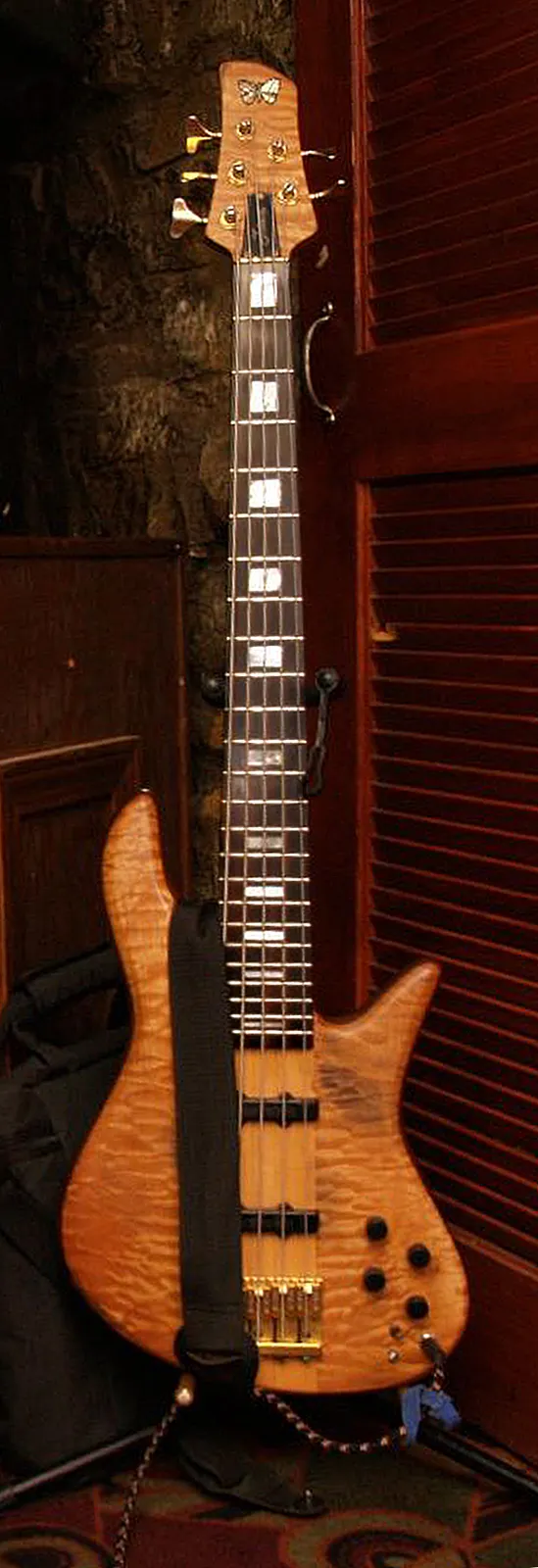
Photo: christina rutz / Wikimedia Commons / CC BY 3.0 Fodera
Monarch
1983
In 1983 a new Brooklyn shop brought a bass to a teenager’s session. It’s still Victor Wooten’s number one.
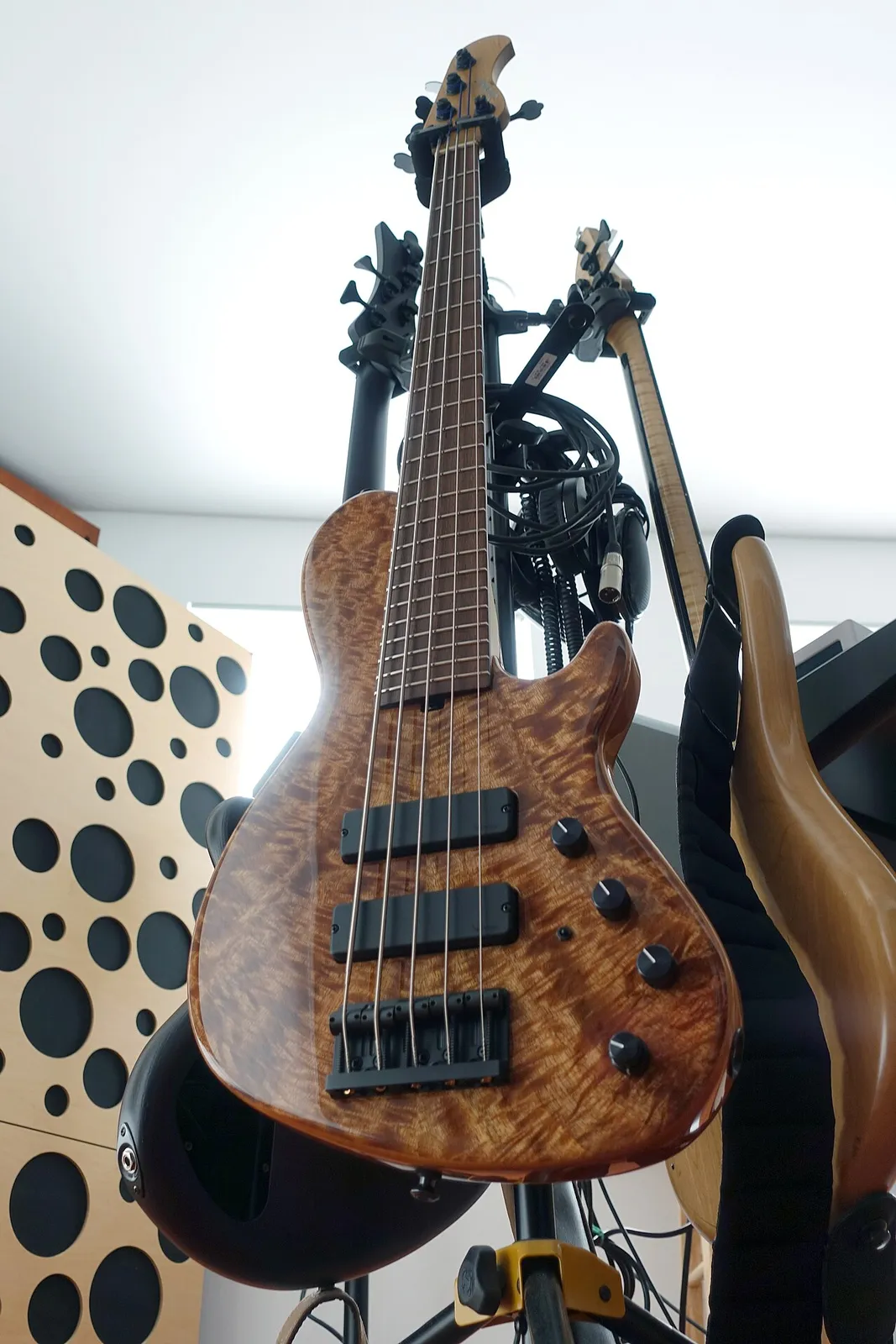
Photo: Nir Yaniv / Wikimedia Commons / CC BY-SA 4.0 Sadowsky
NYC Bass
1982
Built for the New York session bassist whose engineer wasn’t going to reset the board for him.
- Send a picture
Tobias
Classic
1986
You didn’t take a Tobias Classic off a wall. You ordered one from a Hollywood shop, and you waited.