Fender
Bronco Bass
The Bronco started as Fender’s beginner guitar. The name survived on a beginner’s bass.
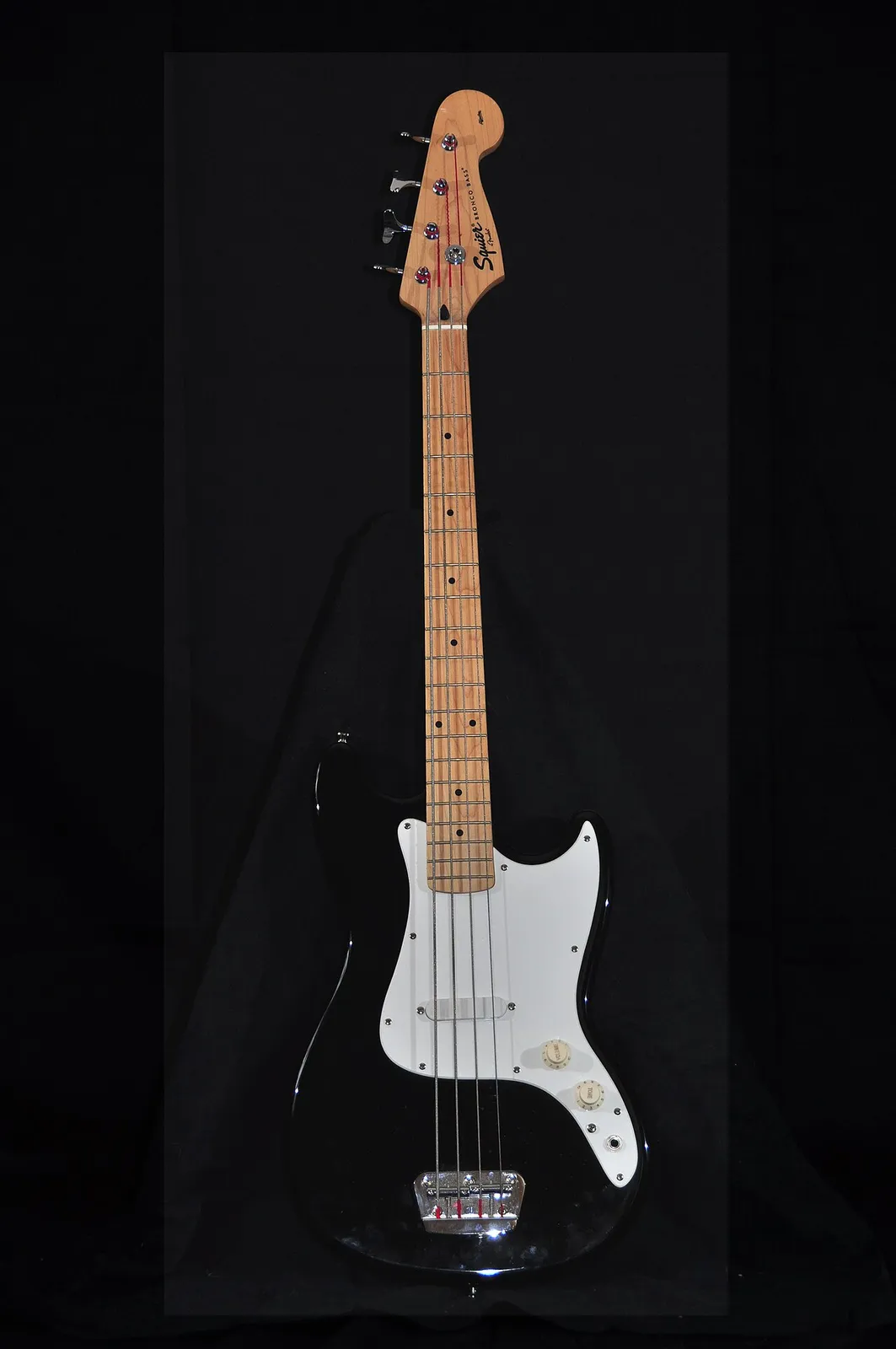
August 1, 2003. A Squier dealer price list, page after page of model numbers. Some lines are stamped “New!” One that isn’t reads “Bronco Bass, maple”: agathis, 30-inch scale, one single-coil, black or Torino Red.
- Introduced
- 2003
- Type
- Solidbody electric bass
- Class
- Production
The short version
1967
The Bronco guitar
Mid-year. A student six-string on the Mustang body, sold at first with a little Bronco amp.
1971
Musicmaster Bass
A student bass with one six-pole Stratocaster pickup under a cover. The Bronco Bass copies the idea.
1981
End of the guitar
The six-string Bronco leaves the catalog. The Musicmaster Bass ends around the same time.
2003
On the price list
Squier’s August sheet lists the Bronco Bass at $248.99. Some listings start it in 1998.
2006
The penguin
Squier and Sanrio put Badtz-Maru on a black Bronco, pickguard and all.
2023
Sonic
The Bullet line becomes Sonic. Poplar body, four saddles, new colors.
Side A
A1
A pony for the first-timers
The first Bronco wasn’t a bass. It was a guitar, and it was for somebody who had never owned one.
Fender worked on it from 1964 and put it out in mid-1967: a Mustang body and neck, a 24-inch scale, one pickup, and a steel vibrato that no other Fender used. At first it came with a little Bronco amp. It was the whole starter kit. It stayed in the catalog until 1981.
Then it went away, and the name went with it. Nobody built a Bronco Bass in Fullerton. There isn’t a vintage one to go looking for.
A2
No “New!” on the page
The name came back on a price list. Squier’s sheet for August 1, 2003 has a “Bronco Bass, maple”: a solid agathis body, 19 frets, a 30-inch scale, one single-coil. Black or Torino Red. U.S. retail was $248.99.
Other lines on that page are stamped “New!” This one isn’t. The sheet doesn’t say Affinity, either, though the bass is usually filed that way. Some listings start the model in 1998. No earlier price list has turned up to prove it. So it’s 1998 or 2003, and the paperwork only reaches back to 2003.
A3
A Strat pickup, moved to the middle
The body is the Mustang’s: Fender’s offset double-cut student shape, 30-inch scale, 19 frets. That’s four inches shorter than a Precision, so the frets sit closer together and a smaller hand can reach them.
The electronics come from somewhere else. In 1971 Fender made the Musicmaster Bass, another student model, with one six-pole Stratocaster pickup under a plastic cover. The Bronco Bass took that recipe. It put the pickup in the middle position on the Mustang body, not back by the bridge where the old Bronco guitar had its one pickup. The bridge had two saddles, each carrying a pair of strings.
There isn’t much to learn on it, which is the point of a first bass. One volume, one tone, no switch.
It isn’t a Mustang Bass, which has a split-coil pickup and a metal plate. It isn’t a Precision. The name is a Fender name from 1967. The bass is a Squier from the 2000s.
Flip the record · By the numbers
30″
Scale length. Four inches shorter than a Precision.
1
Pickup. One volume, one tone, no switch.
$248.99
U.S. retail on Squier’s August 2003 price list.
2 → 4
Saddles. The first bridge paired the strings up. The Sonic gives each its own.
Side B
B1
The penguin guard
At some point, and nobody has put a year on it, the Bronco moved down a rung into Squier’s Bullet series. The Affinity name came off the headstock. It was still black or Torino Red.
In 2006 it got the strangest version it’s ever had. Squier and Sanrio made a black Bronco with the cartoon penguin Badtz-Maru as the pickguard, a black pickup cover, and no control plate. It was meant to get young players started. That one was basswood, not agathis. Same 30-inch scale, same 19 frets, same single pickup.
It stayed in the catalog until about 2009. It’s the one Bronco you can pick out of a photograph.
The penguin was the whole change.
B2
Sonic, and four saddles
In 2023 the Bullet line became Sonic, and the Bronco came along. Launch price was $209.99.
The bodies went to poplar with maple necks. Torino Red went away, and Tahitian Coral and a white came in. The Y-shaped tuners became clover ones. The two-saddle bridge became a four-saddle one, so each string can finally be set on its own. The black one got an Indian laurel fingerboard with pearloid dots. There were exclusives, too: Ultraviolet online with a black guard and cover, a California Blue for one chain of stores, and a lime green online in 2024.
Today Fender’s own selector shows four colors: Black and Daphne Blue on laurel, Tahitian Coral and Arctic White on maple. They’re built in Indonesia, or China and Indonesia, depending on who you ask.
B3
Nobody on the record
Go looking for the Bronco Bass on a famous record and you won’t find one. No album, no interview, and no serial number ties a recording bassist to it. Mikey Way gets mixed in sometimes. His signature is a Squier Mustang, and his first bass was a Squier P-Bass.
The Bronco doesn’t need him. It was never meant for the guy on the record. It’s for the one who hasn’t played a note yet.
In September 2026, Fender’s own site was sold out in all four colors. The shops still had them. The name started on somebody’s first guitar in 1967, and it’s on somebody’s first bass now.
The cast
The people, and the specific guitars, that made the legend.
2006
Badtz-Maru
2006 Squier Badtz-Maru Bronco Bass
Sanrio’s penguin, cut into the pickguard of a black Bronco. The one Bronco you can identify from a photograph.
Mikey Way
Squier Mustang signature, not a Bronco
My Chemical Romance. He wanted “a Mustang, with a humbucker, and a competition stripe.” His first bass was a Squier P-Bass. Don’t hang his records here.
Liner notes
Specs, construction, rarity, value, and every source we used.
The Bronco name survived on a 30-inch Squier with one single-coil — a student bass, not the 1967 guitar, and not a Mustang Bass.
- Body
- Poplar; gloss polyurethane; double-cut “Bronco Bass” shape
- Neck
- Bolt-on maple, “C”; satin urethane; 4-bolt Squier plate
- Fingerboard
- Indian laurel, pearloid dots (Black, Daphne Blue) or maple, black dots (Tahitian Coral, Arctic White); 9.5" (241 mm) radius; 19 narrow-tall frets
- Scale
- 30" (762 mm)
- Pickups
- One ceramic single-coil (Fender lists it as the neck pickup)
- Hardware
- 4-saddle hardtail; sealed die-cast tuners; chrome; 1-ply white pickguard
- Electronics
- Master volume, master tone
- Finish
- Gloss polyurethane body; satin urethane neck
- Nut
- Synthetic bone, 1.5" (38.1 mm)
Open the full research fileConstruction details, the complete player record, production numbers, dated value estimates, and sources
Current Squier Sonic Bronco Bass (Fender.com, 25 September 2026: $259.99, Black / Tahitian Coral / Arctic White / Daphne Blue all sold out). Headstock says Squier, not a Fender USA bass. 2003 price-list spec was agathis, two colors, and is not this table. Not a Mustang Bass, not a 34" Precision or Jazz, not a Bass VI, not the 1967 Bronco guitar. Mixed inch/mm flagged.
Construction
The job was a short four-string a shop could hand a beginner. Fender already had that body. It did not already have this bass.
The outline is the Mustang student bass: offset double-cut, 30" scale, 19 frets. Wikipedia files the Bronco Bass as a variant on that body and neck. The name is the other 1960s object. The Fender Bronco guitar — Tony Bacon, via Wikipedia — was a student six-string from mid-1967 to 1981, Mustang body and neck, one pickup, 24" scale, worked on from 1964, sold at first with a little Bronco amp. Wikipedia calls the tremolo a steel vibrato that appeared only on that guitar. Same article, last line: the Bronco name “is continued only in the Squier-branded Bronco Bass.” There is no Fullerton Bronco Bass in that 1967–81 run. A tremolo, or a pickup in the guitar’s bridge spot, is the wrong instrument. So is a Strat, a Tele, or a Jaguar. The body is the student offset. This plate is the bass.
What the circuit copies is the Musicmaster Bass, not the Mustang Bass. Wikipedia: Musicmaster Bass, 1971, student model, one single-coil that was a six-pole Stratocaster pickup under a plastic cover, production ending around 1981 with the Bullet Bass. Squier’s 1997 Musicmaster reissue used a four-pole pickup and lasted about a year. The Bronco Bass, same article: one six-pole Stratocaster pickup under a cover, set in the middle Mustang position rather than the bridge position of the Bronco guitar; one-piece pickguard; two saddles, each taking a pair of strings. Wikipedia calls that bridge “a string through style, rather than the Mustang’s through body design.” Current Fender does not say string-through-body. Don’t straighten the sentence into a ferrule count nobody published.
The earliest factory sheet in hand is Squier’s, August 1, 2003. Model 031-0902, “Bronco Bass, maple.” Solid agathis, 19 frets, 30" scale, one single-coil. U.S. retail $248.99. Colors 506 Black and 558 Torino Red. It is not stamped “New!” on that page, unlike other lines on the same list. Wikipedia calls 2003 the Affinity release and cites this sheet. The sheet itself prints “Bronco Bass,” not the word Affinity. 031-0902 sits near Affinity P Bass 031-0400 and near Bullet numbers. The prefix does not settle the series. Reverb’s Affinity model page prints years 1998–2026. No pre-2003 Squier price list turned up this pass. Keep 1998 and 2003. This plate starts at 2003 because that is the document. $248.99 is 2003 money, not 2026 street.
Then the name moved down Squier’s ladder. Wikipedia: into the Bullet series at some point, Affinity gone from the headstock, still black or Torino Red. No year on that move. Don’t invent one.
2006, Badtz-Maru. Wikipedia: Squier and Sanrio, black Affinity Bronco, penguin-shaped pickguard, black pickup cover, no control plate. Total Guitar, via MusicRadar (5 November 2007): based on the Affinity Bronco, basswood — not the 2003 agathis line, and not current poplar — 30", 19 frets, “Special Design” single-coil, volume and tone, no thumb rest. Reverb files the cartoon bass as 2006–2009. Keep the wood split. It is a finish and a guard, not a different scale.
2023, Sonic. MusicRadar (Rob Laing, 4 April 2023): Bullet becomes Sonic; a Bronco bass is in the new range; launch £189.99 / $209.99; poplar bodies and maple necks for the series. Wikipedia: Torino Red out; Tahitian Coral and Olympic White in; clover tuners for the old Y-shaped ones; a four-saddle bridge for the two-saddle; Ultraviolet as an online exclusive with a black guard and cover; a Guitar Center California Blue exclusive; lime green as a second online exclusive in 2024. Wikipedia’s board split: black gets Indian laurel and pearloid dots; Tahitian Coral and Olympic White keep maple and black dots, and “the black finish is the only version with a laurel fingerboard.” The live Fender page this pass disagrees on that last clause. Black and Daphne Blue are Indian laurel with pearloid dots. Tahitian Coral and Arctic White are maple with black dots. Olympic White is not the name on the current selector. Ultraviolet, lime, and California Blue are not on it either. Keep Wikipedia’s exclusives. Don’t pretend the four colors in the cart are the whole history.
Country is mixed the same way. Cream City Music, Dave’s Guitar Shop, and Mann’s Music print Indonesia on current Sonics. Reverb’s Sonic page prints China and Indonesia for 2023–2026. The 2003 list doesn’t say. Don’t average a factory.
Classic against current: 2003 agathis, Black and Torino Red, one single-coil, the two-saddle bridge Wikipedia describes — against a 2026 poplar Sonic, ceramic single-coil, four saddles, four colors on the Fender selector, still a Squier catalog bass. Fender.com is sold out on all four this pass. Dealers are not.
Players
The Badtz-Maru is the named object. Total Guitar, 5 November 2007: Sanrio and Fender, a black bass meant to get young players started, the penguin as the pickguard. Not a track credit. It is the one Bronco a photograph identifies without a serial. A stock black Sonic is not that bass.
Do not recruit the Mustang Bass article’s player list. Weymouth, Meldal-Johnsen, Wyman, Dirnt — not this instrument. Mikey Way is the mash. MusicRadar, 28 February 2013: the signature is a Squier Mustang, and what he wanted was “a Mustang, with a humbucker, and a competition stripe.” Same interview: his first bass was a Squier P-Bass. Not a Bronco. Don’t hang a My Chemical Romance album on this plate.
No album, interview, or named serial tying a recording bassist to a Bronco Bass turned up this pass. None invented.
Also known to play: nothing sourced.
Rarity
You can buy a new Sonic if a dealer still has one. Fender.com does not, this pass. Guitar Center’s black still ships. That is a catalog student bass, not a scarce one.
Squier has not published Bronco Bass shipping totals. None invented. Serial prefixes date a factory and a rough era. They don’t count a year. That is why a first-year census is unknown, not the chapter. There is no 1967 Fullerton Bronco Bass to be rare. The six-string Bronco is a different instrument, and it is not in this catalog.
What is actually thinner: an August 2003-list bass you can show is still agathis, with the two-saddle bridge; a complete Badtz-Maru with the penguin guard uncut. Reverb’s guide treats that cartoon run as its own market (52 Good–Mint orders). Early two-saddle Affinity and Bullet examples are the other thin slice. A modded one with a Precision pickup in the cover is a different circuit. It is not a census of the stock bass.
Value
Informal estimate, 25 September 2026. Not an appraisal.
Asking prices are not sold prices. A four-saddle poplar Sonic is not a 2003 agathis bass and not a Badtz-Maru. There is no vintage Fullerton Bronco Bass to price. The 1967–81 Bronco guitar is not a comp. Artist Mustangs are not comps. The direct Reverb price-guide URL did not render dollar widgets this pass. Sonic and Badtz-Maru figures below are from Reverb’s indexed guides. Flag: thin sold-comp access on Affinity and Bullet — no clean U.S. dollar band rendered.
New street. Fender.com Sonic $259.99, sold out on Black, Tahitian Coral, Arctic White, and Daphne Blue. Guitar Center black $259.99, shipping in stock. zZounds black laurel and Arctic White maple $259.99. Sweetwater’s black reviews page lists $259.99. Named asks under that tag: Dave’s Guitar Shop, new black, Indonesia, $240.99; Reverb (Instrumentpro) $233.99 from $259.99. UK Fender £185, sold out. Mann’s Music £185, RRP £209.99, in stock. MusicRadar’s 4 April 2023 launch was £189.99 / $209.99 — a 2023 street, not this tag. August 1, 2003 U.S. retail $248.99 is 2003 money. Music Makers lists a new Affinity at $269.99. Different series name on the headstock. Don’t average it into the Sonic.
Used modern. Reverb’s indexed Sonic guide: Good–Mint $121–$188, 139 orders. Named solds in that same widget, not a midpoint: Mint $229.49 (25 October 2025), Mint $214.99 (12 November 2025), Mint $204.84 (14 November 2025), Mint $204.24 (1 December 2025), Mint $200 (7 November 2025), Excellent $176 (17 November 2025), Excellent $176 (21 November 2025). A separate indexed listing printed an estimated used band of $184–$212. Don’t average that band with the 139-order range, and don’t average either with a new $259.99 tag. No clean Affinity or Bullet sold band this pass.
Vintage / collectible. Not this name, not in the 1960s. Inside the name, the cartoon bass is the one with its own money. Reverb, Badtz-Maru 2006–2009, Good–Mint: $577–$952, 52 orders. Named 2026 solds in that widget: Excellent $800 (2 September 2026), Excellent $725 (23 August 2026), Good $730 (9 July 2026), Good $500 (25 April 2026). An Excellent $1,095 (5 October 2025) sits above the printed band. A Very Good ask this pass: $700. That is a penguin guard, not a black Sonic, and not a 2003 agathis bass.
See also
- Mustang Bass — 1966 30" student bass; split-coil and a metal plate, not this single-coil
- Mustang — 1964 six-string. The body family, not a bass
- Precision Bass — 34" four-string. The scale and the pickup this bass is not
Sources
- Squier price list, 1 August 2003 (guitar-compare.com PDF) — model 031-0902 Bronco Bass; agathis; 19 frets; 30"; one single-coil; Black and Torino Red; U.S. retail $248.99; not marked New; Affinity P Bass 031-0400 on the same sheet
- Wikipedia, Fender Mustang Bass (Bronco Bass section) — 2003 Affinity, citing that price list; six-pole Strat pickup under a cover; middle position; two saddles; Bullet move undated; 2006 Badtz-Maru; 2023 Sonic; board and exclusive-color claims. Notable-players list is Mustang, not Bronco
- Wikipedia, Fender Bronco — guitar, mid-1967–1981 (Bacon); 24" scale; one pickup; steel vibrato; name continued only on the Squier Bronco Bass
- Wikipedia, Fender Musicmaster Bass (same Mustang Bass article) — 1971; six-pole Strat pickup under a cover; ~1981 end; 1997 Squier reissue, four-pole, about one year
- Fender: Squier Sonic Bronco Bass — current spec and variant boards; poplar; 30" (762 mm); 9.5" (241 mm); 1.5" (38.1 mm); ceramic single-coil; 4-saddle; $259.99; four colors sold out this pass
- Fender UK: Squier Sonic Bronco Bass — £185; sold out this pass
- MusicRadar, Rob Laing, 4 April 2023 — Bullet becomes Sonic; Bronco bass in the range; £189.99 / $209.99; poplar, maple
- MusicRadar / Total Guitar, Squier Badtz-Maru Bass, 5 November 2007 — Affinity Bronco basis; basswood; 30"; 19 frets; special-design single-coil; volume and tone; no thumb rest; Sanrio
- Reverb: Squier Affinity Bronco Bass — year field 1998–2026; China and Indonesia; poplar in the spec table; Music Makers new ask $269.99; U.S. sold-band widget did not render
- Reverb: Squier Sonic Bronco Bass — 2023–2026; China and Indonesia; poplar; Instrumentpro new $233.99 from $259.99. Direct price-guide URL did not render dollars
- Reverb indexed Sonic price guide (listing widget, this pass) — Good–Mint $121–$188, 139 orders; named late-2025 solds; separate used estimate $184–$212
- Reverb: Squier Badtz-Maru Bronco Bass 2006–2009 — Good–Mint $577–$952, 52 orders; named 2025–26 solds; Very Good ask $700
- Guitar Center: Sonic Bronco Bass, black — $259.99; shipping in stock; poplar; laurel; 30" (762 mm); ceramic single-coil; 4-saddle
- zZounds: Sonic Bronco, laurel, black — $259.99; poplar; 19 narrow-tall; 9.5" (241 mm); 1.5" (38.1 mm) synthetic bone; pearloid on laurel, black dot on maple
- Sweetwater reviews: Sonic Bronco, black — listed $259.99; poplar; laurel; ceramic single-coil
- Dave’s Guitar Shop: Sonic Bronco, black — new ask $240.99; Indonesia; poplar; 7.4 lb on this example, not a factory weight
- Cream City Music: Sonic Bronco, black — $259.99; Indonesia; poplar; laurel; 4-saddle; .045–.105
- Mann’s Music: Sonic Bronco — £185, RRP £209.99, in stock; Indonesia; poplar; laurel; 1.5" (38.1 mm)
- MusicRadar: Mikey Way, 28 February 2013 — signature is a Squier Mustang, not a Bronco; first bass a Squier P-Bass
Keep digging
Guitars this one gets compared to, confused with, or descended from.
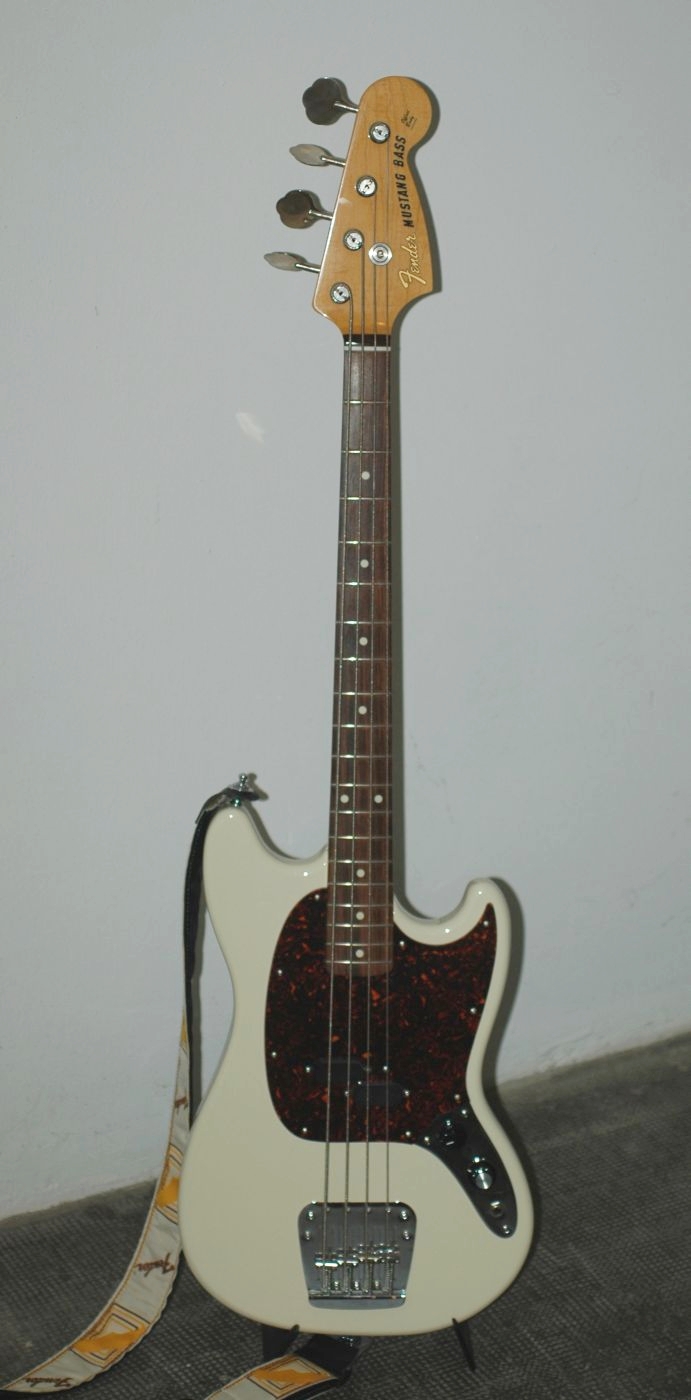
E-Bass Fender Mustang, shortscale 30". Photo by Joachim Hensel-Losch. Licensed under CC BY 2.5 (also offered as CC BY-SA 3.0). Via Wikimedia Commons. Fender
Mustang Bass
1966
Leo Fender’s last bass for Fender was a short, cheap student model. That was the whole idea.
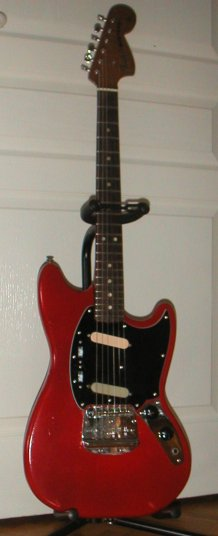
Photograph of a Fender Mustang of 1968. Photo by Alban Dericbourg. Licensed under CC BY-SA 3.0. Via Wikimedia Commons. Fender
Mustang
1964
Fender’s 1964 student guitar. It was built to be outgrown, and a lot of people never bothered.

Photo: Infrahertzz / Wikimedia Commons / CC BY-SA 3.0 Fender
Precision Bass
1951
Leo’s bass let the player at the back be heard. You know their lines by heart. You mostly don’t know their names.