Carl Thompson
Piccolo
Stanley Clarke asked for a bass an octave up. Carl Thompson delivered it at three in the morning.
1974, New York. A jazz guitarist who fixes other people’s instruments has built about eight instruments. Stanley Clarke, who has been bringing him fret jobs, asks for something new: a bass tuned E-A-D-G, an octave higher.
- Introduced
- 1974
- Type
- Solidbody electric bass (piccolo bass)
- Class
- Production
Have a photograph of this guitar? Send a picture
The short version
1967
New York
Carl Thompson, a jazz guitarist from Pennsylvania, moves to the city and ends up in Dan Armstrong’s shop.
1973
Ron Carter, higher up
An acoustic piccolo bass on Blues Farm. A different instrument, and a year earlier.
1974
The first piccolo
34 inches, walnut, ebony. Clarke can’t wait, and it’s delivered at 3 a.m.
1976
School Days
June. The melody on “Quiet Afternoon” is the Thompson piccolo, over an Alembic.
1976
The Bob cut
Bob Babbitt orders one after Clarke talks it up. Carl recuts the body to sit on the thigh and keeps the shape.
1977
Headstock repair
March. The first piccolo gets fixed. Its replacement, a 32-inch, already exists.
1989
Les Claypool
He and Carl meet. Claypool’s walnut Thompson started life as a piccolo and now has a whammy bar.
2024
Orders paused
A post in Carl’s name says he isn’t taking more until he catches up.
Side A
A1
Fret jobs, then a strange request
Carl Thompson was a jazz guitarist, born in Pitcairn, Pennsylvania, in 1939. He came to New York in 1967 and ended up in Dan Armstrong’s shop, fixing other people’s instruments.
What bothered him about a Fender bass was balance. The neck came straight out, and the bass didn’t sit. He played a borrowed Bob Cranshaw Fender for three nights, and then he tried to build one of his own. The first, in 1974, still looked like a Jazz Bass. An ebony half-moon at the heel started life as a botched mortise and became the way he set the neck angle.
Stanley Clarke was already a customer, for fret jobs on an EB-2 and then Alembics. In 1974, the year he “made the big-time,” he came in and asked for a bass tuned an octave up. Carl had built about eight instruments.
Clarke couldn’t wait. Carl delivered it at three in the morning.
A2
Mostly the strings
Picture the bottom four strings of a guitar, E-A-D-G, on a bass: bass scale, bass technique, bass player’s hands. That’s the piccolo. It isn’t a Bass VI, which is six strings an octave below a guitar. It isn’t a tenor bass either, which Clarke also played, tuned up a fourth.
The first one was 34 inches, walnut, with an ebony board and a bone nut. Carl assumed the hard part would be building it. He had a theory about pulling the headstock back. It turned out, in his words, “it was mainly the strings that made the difference.” John D’Addario Sr. sent gauges. Carl tuned them up from underneath the bench, so if one broke it wouldn’t hit him.
Clarke wanted it fretless. Without frets it sounded weak, so frets went on.
Whose idea was it? Depends who you ask. Most tellings have Clarke walking in with it. One account says the idea “originally came from” Thompson. Ron Carter was already playing a higher-tuned acoustic piccolo on Blues Farm in 1973. Clarke, on stage, called Carl “a very great bass maker” who made the first piccolo bass.
A3
Quiet Afternoon
June 1976, School Days. On “Quiet Afternoon,” Clarke plays ordinary bass on an Alembic, then overdubs the melody on top with the 34-inch Thompson. That high, singing line is the piccolo. It sits right where a guitar would, but it phrases like a bass player.
Then the long one got hurt. Clarke broke the headstock, it wouldn’t be ready, and Carl finished a 32-inch bass he was already working on, recut the nut, and sold him that. The dates on the shop’s own site don’t line up neatly: the 32-inch carries a June 1976 date, and the headstock repair on the first one is dated March 1977. Both stand.
“Stanley put my name on the back of that album and it kind of turned my life around.”
Flip the record · By the numbers
3 a.m.
When Carl delivered the first piccolo. Clarke couldn’t wait.
1 octave
Above a regular bass. E-A-D-G, the bottom four strings of a guitar, at bass scale.
34″ / 32″
Clarke’s two Thompson piccolos. The long one broke; the short one replaced it.
~10
Instruments a year from the shop since 1974. All of them, not just piccolos.
Side B
B1
An ugly bass and a Bob cut
After School Days, people wanted one. Bob Babbitt ordered his because Clarke had talked it up. Carl recut the body to sit on the thigh, and kept that shape from then on: the “Bob” cut. Craig Nelson got one of what Carl called “a few more.”
Then there’s the walnut one Les Claypool found at Leo’s in Oakland. The way that story is told, it starts with “Man, that sure is an ugly bass.” He tested it on “Roundabout,” found it easy, and his mother lent him the rest of the money. It was “originally a piccolo bass and now sports a whammy bar.” Carl, who met Claypool in 1989, called it a “converted 4-string piccolo” from ten or twelve years before. The shop’s gallery calls it a 1976-style bass likely completed in 1980. Keep both.
B2
His name on the back of the album
Thompson never sold a Piccolo model. The shop builds custom basses, about ten a year since 1974, and the word piccolo is still in the list of styles. In October 2024, a post in Carl’s name said he wasn’t taking more orders until he caught up.
Even the first one isn’t a piccolo anymore. Carl refurbished it later and converted it to standard tuning. Claypool’s has a tremolo. Babbitt’s was recut, and a later owner had it refretted.
But the record is still the record. Put on “Quiet Afternoon.” That high line over the Alembic is the bass Carl handed over at three in the morning.
Put this on
You’ve read about it. Now hear it. Here’s what this guitar sounds like, and what to listen for.
Quiet Afternoon
From School Days. The melody is the 34-inch Thompson piccolo, overdubbed on top of an Alembic playing ordinary bass. Listen for the high, singing line sitting where a guitar would.
Find it on YouTube (opens in a new tab)
The cast
The people, and the specific guitars, that made the legend.
1974
Stanley Clarke
The first piccolo (34″), then a 32″
Asked for it, played it on School Days, and later told a crowd Carl “made the first piccolo bass.” He also had an Alembic piccolo, which is not this bass.
Les Claypool
Walnut Thompson, piccolo turned whammy bass
Found it at Leo’s in Oakland. Carl called it a “converted 4-string piccolo.” The dates on it don’t agree.
1976
Bob Babbitt
1976 mahogany piccolo
Ordered it because Clarke had talked up the School Days piccolo. His body shape became the “Bob” cut.
Craig Nelson
A Thompson piccolo
One of the studio players who got one of the “few more.” His doubleneck is a different instrument.
1973
Ron Carter
Acoustic piccolo bass, not this one
Already playing a higher-tuned bass on Blues Farm. Not a Thompson electric.
Liner notes
Specs, construction, rarity, value, and every source we used.
Four strings, E-A-D-G an octave above a bass — Carl Thompson’s piccolo, built because Stanley Clarke asked, not an Alembic and not a Bass VI.
- Body
- Walnut. One bass, serial 9-74.
- Neck
- Custom. Neck wood is not on the gallery card.
- Fingerboard
- Ebony, 26 frets on the gallery card
- Scale
- 34"
- Pickups
- One wood-covered DeArmond, made for old Harmony guitars, as built
- Hardware
- Ebony bridge as built. A Badass went on later. Tuners on the card are the refurb set.
- Electronics
- 1974 switching unpublished. Refurb: passive Kent Armstrong H4BE-3B, volume, tone, on / 100 nF / off — and standard tuning, not piccolo.
- Finish
- Walnut body. Oil is the shop habit by 1985 and on the current models page, not a line on this card.
- Nut
- Bone, 1.5"
Open the full research fileConstruction details, the complete player record, production numbers, dated value estimates, and sources
Classic living example = 1974 serial 9-74, the first piccolo, as the shop gallery describes the build. That card also says Carl later refurbished it and converted it to standard tuning. No current Piccolo SKU. Models page, fetched 28 September 2026: Semi-Frills bolt-on or Full-Frills set neck, oil, scales 32, 36, or 38" only, prices on request. 34" is not on that menu. Clarke’s other one, 6-11-76, is 32", Schaller 404, Leo Quan Badass; wood, frets, and nut unpublished. A cherry fretless on the same gallery is 30", Carl’s description. Do not average 30 / 32 / 34. Inches only. No millimetres published. None invented. Gallery weight 3601 g / 7.93 lb on 9-74 is the same pair printed on serial 2-5-80. Mixed units, and duplicated. Omitted.
Construction
The job was guitar pitches in a bass player’s hands. Stanley Clarke wanted E-A-D-G an octave above a bass — the bottom four of a guitar — and he wanted to keep bass scale and bass technique. Tony Bacon and Barry Moorhouse, The Bass Book: almost a guitar with two strings missing, and still a high-tuned bass, because a bassist asked for it and played it like one. Not a Bass VI. That is six strings an octave below guitar, on 30". Not a tenor bass. Clarke used those too, up a fourth to A-D-G-C. Different tuning.
Thompson was a jazz guitarist fixing other people’s instruments. Wikipedia: born 5 February 1939, Pitcairn, Pennsylvania; New York in 1967; Dan Armstrong’s shop; first instrument 1974. The partner is Joel Frutkin in Guitar Player (March 1985) and The Bass Book, and Joel Lutkin in Sound International (June 1979). Keep both. What he thought was wrong with a Fender was balance: the neck came straight out, and the bass didn’t sit. Allegro (27 October 2000): three nights on a borrowed Bob Cranshaw Fender, then he tried to build one. Sound International: first bass 1974, and it still looked like a Jazz. The ebony half-moon at the heel started as a botched mortise. It became how he set the neck angle.
Clarke was already in the shop for fret jobs, an EB-2 and then Alembics (The Bass Book). He came in the year he “made the big-time,” after about eight instruments, and asked for a bass tuned up an octave. The gallery’s ninth of that year is 9-74: 34", walnut, ebony, 1.5" bone nut. The player page: he couldn’t wait, and Carl delivered it at three in the morning. Who had the idea is not one sentence. Factory page, Guitar Player, The Bass Book, and Allegro all have Clarke walking in with it. Wikipedia’s piccolo article also says the idea “originally came from” Thompson, and that Ron Carter was already on a higher tuning — earliest cited recording, the acoustic piccolo on Blues Farm (1973). Clarke on stage, quoted by Wikipedia: Carl “made the first piccolo bass.” Carter’s 1973 record is not this Brooklyn electric. This plate starts in 1974.
Carl thought the piccolo was a building problem. It was mostly strings. Guitar Player: “it was mainly the strings that made the difference.” He had a theory about pulling the headstock back. John D’Addario Sr. sent gauges. Sound International: Carl under the bench, turning keys, so a break wouldn’t hit him. Clarke wanted it fretless. Without frets the sound was weak, so frets went on. The card reads 26 frets. That is the card now, not proof it left fretless or fretted on day one.
Then the 34" got hurt. Player page: Clarke broke the headstock, it would not be ready, and Carl finished a 32" he was already on, recut the nut, and Clarke bought it. That one is 6-11-76. The gallery dates a headstock repair on 9-74 to March 1977, then a later refurb into standard tuning. A June 1976 serial and a March 1977 repair are both on the site. Don’t make them one afternoon.
School Days is the record. Bacon: June 1976. On “Quiet Afternoon” the melody is the 34" Thompson, overdubbed over an Alembic four-string playing ordinary bass. The factory page puts a “Quiet Afternoon” video under 6-11-76. The studio track and the video are not the same object. Thompson: “Stanley put my name on the back of that album and it kind of turned my life around.”
Serial 10-2-76, Bob Babbitt’s, is the shape change: 34", 29 frets, mahogany, ordered just after the move to Brooklyn. Carl recut the body to his thigh — the “Bob” cut — and kept that cut. A later owner had the frets taken to 24. Early boards had run to 29; by 1985 Carl was usually stopping at 24. Guitar Player: “a few more” piccolos after Clarke’s pair, Craig Nelson among the studio players. Nelson’s doubleneck, gallery 11-30-84, is not the piccolo. International Musician (February 1985) already has Clarke on an Alembic piccolo and a Thompson piccolo. The Alembic stays off this table.
The site does not sell a Piccolo model. Homepage: custom only, the word still in the style list, about ten instruments a year since 1974. The order sheet is two frill levels and 32 / 36 / 38". Prices on request.
Players
Do not put an Alembic on this plate, including Clarke’s own Alembic piccolo. Do not put the Rainbow Bass, a six-string, or a Motown Precision here. A high Clarke line is not automatically this tuning. Tenor is a fourth up. This is an octave.
Stanley Clarke. The two the factory says he is known for. 9-74, the 34", three in the morning. 6-11-76, the 32", after the break. Bacon pins the June 1976 “Quiet Afternoon” melody on the 34", Alembic underneath. Bass Player (February 1996) calls the first “the world’s first piccolo bass.” By February 1985 Phil Bashe’s list is both makers’ piccolos, plus Ken Smith customs. Later albums are not automatically this bass. Wikipedia’s stage line: “a very great bass maker,” and he made the first.
Les Claypool (Primus). Karl Coryat, on the factory site: Leo’s in Oakland, the shape from I Want to Play for Ya. “Man, that sure is an ugly bass.” “Roundabout” was the test. It was easy, and his mother lent the rest. Factory page: 9-9-80, 32", walnut and mahogany, Schaller 10/404 when it left, then an EMG-35DC, a BTS preamp, a 1980s Kahler, and a June 1993 headstock repair with maple signed by Geddy Lee. Coryat: “originally a piccolo bass and now sports a whammy bar.” Carl, Bass Frontiers: a “converted 4-string piccolo,” about ten or twelve years before they met in 1989. The gallery says “a 1976 style bass likely completed on 9-9-80.” The spare, 2-14-09, is the site’s 2009 “1976 Replica.” Keep 1976, 9-9-80, and 2009. The Rainbow, 2-5-91, is a fretless six — “Jerry Was a Race Car Driver” is that bass, not the walnut. 11-8-2001 is another piccolo, fretless, canary and stained poplar, two EMG-Js. No titles for it here.
Bob Babbitt. He ordered 10-2-76 because Clarke had talked up the School Days piccolo. The gallery does not move his earlier Motown sessions onto this bass.
Also, short: Craig Nelson, a piccolo, not the doubleneck. Basil Farrington, gallery 52677 (1977). Serial 1-5-78 only has Steve Friedman’s story that Clarke ordered it and never collected it. Not on the factory Clarke page.
Rarity
There is no Piccolo price list. Every Thompson is one bass. The homepage’s “about ten” a year, and Sound International’s “about four a month” and “over 200” by 1979, are the whole shop. Guitar Player’s “a few more” piccolos is the only piccolo count in print, and it isn’t a number. None invented.
Serials are dates, shared across whatever he finished. They date a bass. They don’t count a model. That is why the total is unknown.
The models page still says contact Aaron. A 12 October 2024 post on carl_thompson_guitars, in Carl’s name, says he is not taking more orders until he catches up, and names Joe at MBJ and Pete Hilton. Keep both. A paused list is not a 1974 walnut bass.
Thinner than “a Thompson”: a piccolo still strung as one. 9-74 was converted to standard tuning. Claypool’s walnut wears a tremolo. Babbitt’s was recut, then refretted for someone else. Those basses are unique. They are not the next one.
Value
Informal estimate, 28 September 2026. Not an appraisal.
Ask vs sold labeled. Celebrity basses are not-comps. No invented medians. Wikipedia’s unsourced “about $5,500” is not used.
New street. No Piccolo price. Models page: prices on request. The October 2024 post: new orders paused. For-sale page this pass: serial 4-7-95, a 36" lined fretless with one EMG, $10,000. A Carl Thompson. Not a piccolo.
Used modern. No Reverb Price Guide band for a Thompson piccolo. Flag: thin sold-comp access. Open brand-page asks the same day were other customs: a 2005 four-string at $18,999, a 2005 38" six-string fretless at $26,000. Don’t average those in.
Vintage / collectible. Named ended ask, not a hammer: 9-74, Very Good, $16,000, listing ended, “8 years ago” when fetched this pass. The seller says Carl restrung it standard. One object. Not a confirmed sale. Babbitt’s 10-2-76 shows sold, listed about ten years ago; the dollar was not on the page. Omit it. Different bass, 1974 shop money: serial 0274, first one sold, $200 to Erv Manning. Sound International says the piccolo cost more because it was the first, and prints no figure. Clarke’s pair and Claypool’s walnut don’t price the next one.
See also
- alembic-series-i — the “Quiet Afternoon” rhythm part is an Alembic, and Clarke later kept an Alembic piccolo too. Not this four-string
- fender-bass-vi — six strings, 30", an octave below guitar. The opposite job
- fender-jazz-bass — he thought Fender necks sat too straight, and the first Thompson still looked like a Jazz. Not a piccolo
Sources
- Carl Thompson, Stanley Clarke — 1974; 9-74 at 34"; 3 a.m. delivery; headstock break; 6-11-76 at 32"; “Quiet Afternoon” video under the 32"
- Carl Thompson gallery, 4-string basses 1974–1989 — 9-74 walnut, ebony, 1.5" bone nut, 26 frets, DeArmond, ebony bridge then Badass, March 1977 repair, standard-tuning refurb, Kent Armstrong; 3601 g / 7.93 lb also printed on 2-5-80; 6-11-76 Schaller 404 and Badass; 10-2-76 Babbitt, Bob cut, mahogany, 29 frets then 24; 30" cherry; 52677; 1-5-78 Friedman story; 0274 at $200 in 1974; “1976 style… likely completed on 9-9-80”
- The Bass Book, Bacon and Moorhouse, on ctbasses.com — about eight instruments; octave-up E-A-D-G; 34" then 32"; School Days, June 1976, “Quiet Afternoon” on the 34" over an Alembic; liner-note quote; tenor as a separate tuning
- Guitar Player, Tom Mulhern, March 1985 — strings, not headstock angle; D’Addario; fretless then frets; 34" to 32"; “a few more,” including Craig Nelson; 24 frets usual; oil; ebony heel; Joel Frutkin
- Sound International, Colin Hodgkinson, June 1979 — four a month; over 200 basses; piccolo expensive, no dollar; Joel Lutkin; first bass 1974
- Carl Thompson homepage — about ten a year since 1974; custom only; piccolo still named as a style
- Carl Thompson, Models — Semi-Frills / Full-Frills; 32, 36, 38"; prices on request; fetched 28 September 2026
- Carl Thompson, For Sale — 4-7-95, 36" lined fretless, $10,000; not a piccolo
- Carl Thompson, Les Claypool — 9-9-80; EMG-35DC and Kahler; June 1993; 11-8-2001 fretless piccolo; 2-14-09 replica, 2009
- Karl Coryat, excerpt — Leo’s, Oakland; “ugly bass”; “Roundabout”; originally a piccolo, later a whammy
- Bass Frontiers, on the Rainbow Bass — met Les 1989; “converted 4-string piccolo”; Rainbow is not this bass
- Allegro, Joy Portugal, 27 October 2000 — Cranshaw Fender; School Days credit
- Bass Player, Michael DuClos, February 1996 — “world’s first piccolo bass”
- Wikipedia, Carl Thompson (luthier) — bio dates; Clarke’s stage line. The page’s $5,500 is unsourced and unused
- Wikipedia, Piccolo bass — Carter, Blues Farm 1973; idea “originally came from” Thompson
- International Musician, Phil Bashe, February 1985 — Alembic piccolo and Carl Thompson piccolo both in the rig; Ken Smith separate
- Reverb, ended 9-74 listing — ask $16,000; ended; not a confirmed hammer
- Reverb, Babbitt 1976 piccolo — sold; price not shown this pass
- Reverb, Carl Thompson brand — other-model asks, 28 September 2026
- Instagram, carl_thompson_guitars, 12 October 2024 — not taking more orders; MBJ and Hilton
Keep digging
Guitars this one gets compared to, confused with, or descended from.
- Send a picture
Alembic
Series I
1972
The sound wizards behind the Grateful Dead got tired of noisy pickups, so they built bass players a better one.
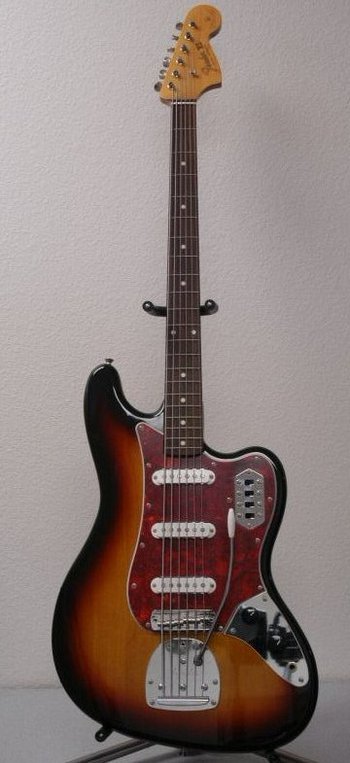
Photo: Blackyde / Wikimedia Commons / CC BY-SA 3.0 Fender
Bass VI
1961
Six strings, an octave down. It’s what a guitar player picks up when somebody hands them the bass part.

Fender Jazz Bass from 1966 in Olympic white with the transition fingerboard (bindings and dot inlays). Photo by Th. Ott. Licensed under CC BY-SA 3.0. Via Wikimedia Commons. Fender
Jazz Bass
1960
Built for jazz players who mostly passed on it. Then bass players started using it to take the solo.