Aria Pro II
SB-1000
A Japanese through-neck with six clicks of tone, for bass players who didn’t want a Fender or a Gibson.
Birmingham, 1980. A young bass player named John Taylor walks into Jones and Crossland on Queensway. He wants off his cheap Hondo, and he doesn’t want what everybody else has either. On the wall are two Aria basses.
- Introduced
- 1978
- Type
- Solidbody bass
- Class
- Production
Have a photograph of this guitar? Send a picture
The short version
1975
Aria Pro II
Aria starts a line for professional players at the Matsumoku factory, with Nobuaki Hayashi designing.
1978
Super Bass
The SB-1000 arrives at the top of Aria’s bass ladder, neck-through with an active filter.
1980
Queensway
John Taylor finds Aria basses on a Birmingham shop wall. Jack Bruce is on one around the same time.
1985
Cliff Burton signs up
Metallica’s bassist endorses Aria and plays an SB-1000 on tour before his signature Black ’n Gold.
1986
The Matsumoku years end
The original factory run winds down. Singer takes over the factory in 1987.
2001
Last time out
Taylor plays an Aria on Duran Duran’s reunion tour, his last.
Side A
A1
Two Arias on the wall
In 1980 John Taylor was a bass player in Birmingham with a cheap Hondo and a clear idea of what he didn’t want next. He didn’t want the Fender or the Gibson that everybody else had. He walked into Jones and Crossland on Queensway, and on the wall were two Aria Pro IIs.
One had two pickups and active electronics. The other had one pickup, passive, and cost about half as much. He took the cheap one. Later he’d be playing the top of the line, the SB-1000, on stage and in the videos, in one of the biggest bands in the world.
He climbed the ladder one rung at a time. The bass line on “Girls on Film” was cut on a single-pickup SB-700, played with two fingers on Rotosound strings, which surprises people who assume it’s the famous one. The 1000 came after, for the stage and the videos.
Neither of those first two said Fender or Gibson on the headstock. That was enough to start with.
A2
The top of the ladder
Aria started as an importer, and the Aria Pro II line came along around 1975 for professional players, built at the Matsumoku factory in Matsumoto with Nobuaki Hayashi designing. His anglicized name, H. Noble, turns up stamped on some early headstocks.
SB stands for Super Bass, and in 1978 Aria built a ladder of them. At the bottom, a bolt-on. Then a passive neck-through, then a two-pickup. At the top, the SB-1000: one pickup, and a neck that runs the whole length of the body in stripes of maple and walnut. There’s no heel where the neck meets the body, so the high frets are as easy to reach as the low ones.
It’s heavy, too. Plenty of the old ones come in around eleven pounds. Your shoulder will remember it.
A3
Six clicks
The pickup is only half the story. The other half is what Aria called the B.B. Circuit. The signal gets boosted inside the bass, then runs through a six-position switch that clicks from dull to bright, each stop a different filter. Flip the bypass and you’re back to something close to passive. The early ones ran on two batteries, eighteen volts, which tells you how seriously Aria took that circuit.
That kind of onboard filter was what California boutique players were paying Alembic money for. Aria put it on a Japanese bass you could find on the wall of a shop in Birmingham.
Six clicks, from dull to bright. That was the whole pitch, and it was a good one.
Flip the record · By the numbers
6
Positions on the tone selector, clicking from dull to bright.
24
Frets, all reachable on a neck that runs through the body with no heel.
18V
What the early active circuit ran on. Two batteries.
1978–86
The original run at the Matsumoku factory in Japan.
Side B
B1
One summer with Metallica
Cliff Burton took an Aria endorsement in 1985 and played an SB-1000 first. It was his bass on the road, and at the Day on the Green show in Oakland on 31 August 1985, it was still the 1000. Two weeks later, in Germany, he was on the signature Black ’n Gold, and that’s the bass on Master of Puppets.
Be careful at the counter here. Kill ’Em All and several tracks on Ride the Lightning are Burton’s Rickenbacker, not an Aria. The SB-1000 had him for a season, not a catalog.
Jack Bruce played an Aria SB around 1980, on the Jack Bruce & Friends tour and on German TV’s Rockpalast. His has a different fret count from a standard 1000, so call it an SB and leave it there. Marcus Miller and Will Lee turn up in Aria’s own list of B.B. Circuit players too.
B2
Still on the wall
The Matsumoku run lasted from 1978 to 1986. Singer took over the factory in 1987, and the originals stopped. Later ones picked up a different headstock, a seven-ply neck, ebony instead of jacaranda, and a body tapered so the headstock doesn’t dive. It still has one dual-coil and the same six-position switch.
John Taylor last took an Aria on tour in 2001, playing “Save a Prayer” on the reunion dates. A later signature refresh “just didn’t work out.” He’s said a Peavey felt closer to his old Aria than a new SB did.
That’s the part nobody can reissue. You can order a new SB-1000 from Japan today, and it’ll click through the same six sounds. But what mattered started on a shop wall in Birmingham in 1980, the day a young bass player decided he didn’t have to play what everybody else played.
Put this on
You’ve read about it. Now hear it. Here’s what this guitar sounds like, and what to listen for.
Live at Day on the Green, Oakland
31 August 1985. Cliff Burton is still on his SB-1000 here. Two weeks later, at Loreley, he’s on the Black ’n Gold, the bass on Master of Puppets.
Watch it on YouTube (opens in a new tab)
The cast
The people, and the specific guitars, that made the legend.
1980s
John Taylor
SB-1000
Duran Duran. Started on the cheaper single-pickup Arias, then lived with the SB-1000 on stage and in the videos.
1985
Cliff Burton
SB-1000
Metallica. Played it on tour in 1985 before his Black ’n Gold. Kill ’Em All is a Rickenbacker, not this.
1980
Jack Bruce
Aria Pro II SB bass
Played an SB on the Jack Bruce & Friends tour, including Rockpalast.
1975
Nobuaki Hayashi
Designer
The man behind Aria Pro II at Matsumoku. His anglicized stamp, H. Noble, turns up on some early headstocks.
Liner notes
Specs, construction, rarity, value, and every source we used.
Through-neck maple and walnut, one MB dual-coil, and a six-position BB filter — Aria’s 1978 Super Bass, not a Precision, not the bolt-on SB-600, and not Burton’s Black ’n Gold.
- Body
- Ash wings, Super Balanced taper (thinner toward the cutaway). Offset double-cut.
- Neck
- Through-neck maple/walnut, 7-ply; heel-less cutaway. Not a bolt-on.
- Fingerboard
- Ebony, 240 mm R (9.5"), 24 frets, dots
- Scale
- 864 mm (34")
- Pickups
- One Aria MB-1E dual-coil
- Hardware
- Gold. Gotoh GB707 tuners; Gotoh J510BO-4 tailpiece; brass nut
- Electronics
- Volume, tone, 6-position Attack Mode Selector (B.B. Circuit), bypass, battery LED
- Finish
- OAK (Oak), PR (Paduak Red), SBK (See-Through Black), BK (Black)
- Nut
- Brass, 40 mm
Open the full research fileConstruction details, the complete player record, production numbers, dated value estimates, and sources
Current typical = Japan SB-1000 (Arai & Co.; ariaguitars.com SB-1000 PR, fetched 18 September 2026). Factory millimetres with inch equivalents as printed. Mix flagged. Do not average 864 mm with vintage dealer 860 mm. SB-600 / SB-700 are the passive / bolt-on siblings. SB-900 is two pickups. SB-800 is the bolt-on of this through-neck. SB Black ’n Gold (1983 catalog; later reissue) is a passive MB-V, not this table. SB-CLB is the 2013 / 2026 Cliff Burton signature. SB-1000JT is John Taylor’s later signature. SB-1000B, SB-1000B/2B (Bartolini), and SB-1000-RI are other SKUs. Fretless was catalog on the original, not this table. No Fender SKU.
Construction
The job was a Japanese through-neck that already had the active filter California boutique players were paying Alembic money for. Matsumoto, 1978. Not a Fender Precision (fender-precision-bass). Not a Jazz Bass (fender-jazz-bass). Not Burton’s later Black ’n Gold. Same badge as the PE guitars. Different object.
Shiro Arai’s company starts as an importer. Vintage Guitar (Michael Wright, PE-R80, January 2014 / August 2024): 1953. MIJ Guitar Guide prints 1955, Nagoya. Keep both. Classical from 1964. Electrics branded Aria, Aria Diamond, Diamond from 1966. Wright: Aria Pro II arrives with Nobuaki Hayashi at Matsumoku, circa 1975. Bassprofessor (Frank Zimmermann): Pro II founded 1975 for professional models; PE-1500 1976. The SB-1000 is the bass that followed.
SB is Super Bass. Matsumoku.org’s Super Bass series sheet and the 1978 Prototype catalog (AriaProAxes: Prototype Line Vol. IIX, SB-1000 on p. 10) put it at the top of a ladder: bolt-on SB-600, passive through-neck SB-700, two-pickup SB-900, then this one. Current factory copy still dates the launch to 1978. Rex and the Bass: original Matsumoku run 1978–1986. TalkBass chronology: Matsumoku SB era from late 1978 through March/April 1986. Wright: Singer took the factory 1987; instruments gone by 1989. Keep 1978, 1986, and 1987. This plate starts in 1978.
What left Matsumoku is neck-through. Catalog (matsumoku.org, circa 1977–80 incarnations): five-ply maple/walnut “Transmit” neck, brass nut and bridge, jacaranda board, 24 frets, ash body, a single MB-1 dual-coil, volume, tone, six-position tone selector, active Noise Killer. Fretless in the same catalog. Natural or Oak. Headstocks on the first ones read The Aria Pro II — Rex’s tell for early production versus later logos. WorthPoint on the replacement preamp: 1978–80 “batwing” circuit, then a 10-pin board from 1980. Bassprofessor: 1978 serials put month in the first two digits and year in the third; during 1979 the year moves to the first digit. Hayashi’s anglicized H. Noble stamp sits on some of those heads. Wright ties the same name to the PE Prototypes. Same designer, this bass.
The circuit is the reason it isn’t just a pretty through-neck. Factory still calls it the B.B. Circuit: the pickup’s signal, amplified, then a six-position low-pass that clicks from dull to bright. Bypass dumps you back toward passive. Early examples run 18V (Rex; Audiofanzine on a 1980). Current Japan pages print volume, tone, the six-position Attack Mode Selector, bypass, and a battery LED. They do not reprint the vintage voltage here. Don’t invent it.
Then the instrument changed in the catalog and on the line. Later Matsumoku examples pick up the bookend headstock. Dealers split five-ply against seven-ply on vintage necks; the 1978 sheet is five-ply, the living Japan spec is seven. Current factory: ebony, not jacaranda; 40 mm brass nut against vintage measured 1 3/4" (Mike & Mike’s, 1981) and 1 25/32" / 45.5 mm (Gearlord, 1981). Mix flagged. Do not average. Gotoh GB707 and J510BO-4 replace the old Quick-Hook brass. Super Balanced Body is the living taper: thicker at the butt, thinner toward the cutaway, so the head doesn’t dive. Vintage weight on named examples: Rex 10 lb 8 oz; Gearlord 11 lb; Zimmermann 5.1 kg fretted / 5.3 kg fretless. Current dealer examples print 9.3–9.4 lb and 4.14–4.55 kg. Named objects. Not a census.
Not an Alembic Series I (alembic-series-i). Rohnert Park sandwich, dummy coil, outboard supply. This is Matsumoto ash and one Japanese dual-coil. SB Black ’n Gold is 1983 (Aria Japan): passive MB-V, dual-sound mini-switch. Other object.
Classic vs current: 1978–86 Matsumoku Super Bass — five-ply Transmit neck, jacaranda, brass Quick-Hook, Noise Killer, batwing then bookend — against the living Japan SB-1000: seven-ply, ebony, 864 mm, Gotoh, Super Balanced taper, four catalog colors, gig bag. Same silhouette. Same six clicks. Other factory.
Players
Do not hang a Precision or a Jazz Bass on this plate. Do not steal Kill ’Em All or Ride the Lightning — those are a Rickenbacker 4001 (rickenbacker-4003 is the living deluxe of that family, not Burton’s 4001). Do not flatten every Aria SB onto this through-neck.
John Taylor (Duran Duran). The bass people mean when they say the video. He did not start here. London Bass Show, 2 March 2014, reading In the Pleasure Groove: Birmingham, 1980, Jones and Crossland on Queensway; he wanted off a cheap Hondo and off the Fender/Gibson monopoly. Two Arias on the wall — the 1200, two pickups, active, six-volt batteries in his telling, and the 600, single pickup, passive, about half the price. He took the 600. Guitar World (Bass Player staff, 8 February 2025): “Girls on Film” cut on a single-pickup Aria SB-700, two fingers, Rotosound, DI and a miked amp. That studio bass is the 700. The 1000 is the one he lived with on stage and in the clips. Guitar World (1 February 2022): last used an Aria on the 2001 reunion tour, “Save a Prayer”; a later signature refresh “just didn’t work out.” He found the Peavey Cirrus closer to the old Aria than a new SB felt in his hands. SB-1000JT is a later SKU. Not this table.
Cliff Burton (Metallica). Wikipedia, citing Mixdown’s Gear Rundown (Will Brewster, 6 March 2025): 1985 Aria endorsement; he played an SB-1000 first, then the signature SB Black ’n Gold, which is the bass on Master of Puppets. Kill ’Em All (1983) and several Ride the Lightning (1984) tracks stay on the 1979 Burgundyglo 4001. WhichBass: SB-1000 on the Head That Does Not Bang tour; Day on the Green, 31 August 1985, still the 1000; Loreley, 14 September 1985, Black ’n Gold I. Keep the split. The 2013 / 2026 SB-CLB is a tribute SKU. Not his guitar.
Jack Bruce. Manufacturer copy and Zimmermann put him on the SB-1000 around 1980. Sotheby’s Rock & Pop, 2015, lot 23, is more careful: “Aria Pro II SB Bass Guitar in natural finish, 1980,” serial 088047, five-piece through-neck, “The Aria Pro II” transfer, twenty-two frets in the lot text, Jack Bruce and Friends tour, Rockpalast. This table is 24 frets. Keep the Sotheby’s object as an SB bass from that tour. Do not mash it onto a street 1000.
Also known to play stays short. Aria Japan’s BB-circuit copy names Marcus Miller, Will Lee, Jack Bruce, John Taylor. Rudy Sarzo is on the same manufacturer list; at Norman’s Rare Guitars he recalled a Whitesnake-era Aria endorsement and stuffing Olympic pickups into those basses. No Quiet Riot Metal Health tape pinned here. Sami Yaffa is a tertiary list. Billy Gould’s Integra is another Aria. None invented.
Rarity
You can order a new SB-1000 from Japan this pass. Bass Central, Bass Direct, and Arai’s own SB-1000 PR page are living carts. Custom-color and signature runs (SB-CLB 2026, limited) are not vintage rare.
Aria does not publish SB-1000 unit totals. None invented. Matsumoku serials date a bass. They don’t count a year. That is why a first-year census is unknown, not the chapter.
What is actually thinner: 1978 first-year examples; batwing / “The Aria Pro II” heads; complete originals with the Noise Killer un-gutted; catalog fretless. Burton’s Black ’n Gold and Taylor’s photographed stage 1000s are unique objects. They are not a vintage SB-1000.
Value
Informal estimate, 18 September 2026. Not an appraisal.
Ask vs sold labeled. Celebrity lots are not-comps. No invented medians or factory counts. Period list unpublished here.
New street. Japan factory list on SB-1000 PR: ¥275,000 tax-in with bag (Arai; Chuya; Watanabe). Named Japan street this pass, not a midpoint: Watanabe ¥220,000; Yamano ¥216,000; Chuya ¥198,000. US dealer: Bass Central $2,799 (Oak / Black / Paduak Red, some on-order into November 2026). Ish Guitars NAMM 2026 demo was the same $2,799 less $100. UK: Bass Direct Paduak Red £1,949. Australia: Guitar Exchange See-Thru Black $3,144 against RRP $3,699. SB-CLB is a different cart: Bass Central $1,999; No Treble NAMM street about $2,000.
Used modern. Named asks, not a 2026 hammer: 2024 Paduak Red Mint $2,200 (was $2,600). No clean Reverb Price Guide band isolated this pass. Flag: thin sold-comp access. Don’t invent a midpoint.
Vintage / collectible. Named asks this pass, not hammers: 1980 Matsumoku Very Good $1,795; 1980–85 See-through Black Very Good $2,500; 1985 metallic blue Very Good $2,283; 1985 Matsumoku signed by Billy Sheehan Excellent $2,365 (was $2,911); 1980 batwing Excellent $1,968 (was $2,214). Named older: Mike & Mike’s 1981 Excellent ask $2,299.99 (listing ended). Gearlord 1981 with a replacement Noise Killer sold at $799 — upgraded electronics, not a clean original. Yahoo Japan named hammers, 2026, not a series: 1980 Matsumoku ¥95,000; working SB-1000 ¥128,000; unused OAK ¥198,000. Zimmermann’s “EUR 1,500 upwards” is an older magazine floor, not 2026 street. Jack Bruce’s Sotheby’s 2015 SB bass (estimate £3,000–£5,000; Equipboard reports hammer £3,750) is celebrity, not a comp.
See also
- alembic-series-i — the California active through-neck this Matsumoto Super Bass was answering
- yamaha-bb-2000 — 1978 Japan through-neck, same year, reverse-P plus blade, not this filter
- rickenbacker-4003 — the living deluxe of Burton’s other bass; Kill ’Em All is not an SB-1000
Sources
- Aria Japan, SB-1000 PR — current Japan spec; ash Super Balanced body; maple/walnut through-neck; ebony; 24F; 864 mm; MB-1E; volume / tone / 6-position Attack Mode / bypass / battery LED; Gotoh GB707; brass nut; Gotoh J510BO; gold; Paduak Red; ¥275,000 tax-in w/bag; BB circuit copy names Marcus Miller, Will Lee, Jack Bruce, John Taylor
- Aria Japan, SB-Black'n Gold — 1983 catalog model; later reissue; alder Super Balanced; 7-ply maple/walnut; rosewood; 24F; 40 mm; 864 mm; MB-V passive; dual-sound mini-switch; 生産終了
- AriaProAxes, Aria Pro catalogs — 1978 Prototype Line Vol. IIX: SB-1000 p. 10; SB-900 / SB-700 p. 11
- matsumoku.org, Aria Pro II SB Super Bass Series — circa 1977–80 SB-1000: 5-ply maple/walnut Transmit neck; brass nut and bridge; jacaranda; 24 fret; ash; MB-1; volume, tone, 6-position tone sel; active Noise Killer; fretless available; Natural or Oak
- Vintage Guitar, Michael Wright, Aria Pro II PE-R80 (January 2014 / August 2024) — Arai 1953; classical 1964; electrics 1966; Hayashi / Aria Pro II circa 1975; Matsumoku, Matsumoto; H. Noble; Singer 1987; instruments gone by 1989
- MIJ Guitar Guide, Aria Pro II — Arai & Co. 1955 Nagoya; Aria Pro II name 1975; Matsumoku until 1987
- BassMuseum, Frank Zimmermann, Aria Pro II SB-1000 fretted & fretless — SB = Super Bass; 1978 launch at Matsumoku; Pro II 1975; PE-1500 1976; 1981 pair (January fretted / March fretless); 1978 vs 1979 serial scheme; 5.1 / 5.3 kg; Jack Bruce Rockpalast; Taylor / Girls on Film; EUR 1,500+ older floor
- Wikipedia, Cliff Burton — 1985 Aria endorsement; SB1000 then SB Black n' Gold on Master of Puppets; 4001 on Kill 'Em All and several Ride the Lightning tracks; 2013 signature with family / Metallica approval
- Mixdown, Will Brewster, Gear Rundown: Cliff Burton, 6 March 2025 — cited on the Wikipedia equipment section for the SB-1000 / Black n' Gold split
- Guitar World, John Taylor, “Girls on Film,” 8 February 2025 — studio bass is Aria SB-700; two fingers; Rotosound
- Guitar World, John Taylor, 1 February 2022 — last Aria on 2001 reunion, “Save a Prayer”; later signature refresh did not work out; Peavey Cirrus
- John Taylor, London Bass Show masterclass, 2 March 2014 — In the Pleasure Groove: Jones and Crossland, Birmingham, 1980; SB-1200 vs SB-600
- Sotheby’s, Rock & Pop 2015, lot 23, Jack Bruce — 1980 Aria Pro II SB bass, serial 088047; 22 frets in the lot text; Jack Bruce and Friends / Rockpalast; estimate £3,000–£5,000
- Rex and the Bass, 1980 Aria Pro II SB-1000, 3 May 2012 — “The” Aria Pro II logo; Matsumoku 1978–1986; 5-ply maple/walnut; ~11 lb typical, this one 10 lb 8 oz; ~1.75" nut; MB humbucker, 18V, six-position, coil tap; no front LED on early examples
- Bass Central, Aria Pro II SB-1000 — current US street $2,799; 7-ply; ebony; 240 mm R (9.5"); 40 mm; 864 mm (34"); MB-1E; Gotoh; gig bag; 9.4 lb named example
- Bass Direct, Aria SB 1000 Paduak Red — UK £1,949; Japan; manufacturer 1978 copy
- Guitar World, “Honors Cliff Burton…,” Phil Weller, 21 January 2026 — SB-CLB 2026 reissue of the 2013 signature
- No Treble, Cliff Burton SB-CLB, 24 January 2026 — 2013 Black ’n Gold I replica; 2026 street about $2,000; April ship
- Chuya, Aria Pro II SB-1000 OAK — maker list ¥275,000 tax-in; street ¥198,000
- Watanabe, SB-1000 OAK — list ¥275,000; street ¥220,000
- Audiofanzine, ARIA Pro II SB1000 (Matsumoku mon amour), 30 September 2017 — 1980 example; 18V / two batteries; 7-ply maple/walnut on that bass
- TalkBass, Aria Pro II SB 1200 information — Matsumoku SB era late 1978 to March/April 1986; factory closed (Singer), not earthquake/fire
- WhichBass, Cliff Burton bass rig — SB-1000 on Head That Does Not Bang; Day on the Green 31 August 1985; Loreley 14 September 1985 Black n Gold I
- Mike & Mike’s Guitar Bar, 1981 SB-1000 (Reverb) — 34" scale; brass nut 1 3/4"; 10 lb; jacaranda; ask $2,299.99, listing ended
- GEARLORD, 1981 SB-1000 — 860 mm scale; nut 1 25/32" (45.5 mm); 11 lb; replacement Noise Killer; sold $799 on Reverb
- WorthPoint, SB-1000 BB Noisekiller pre-amp — 1978–80 batwing circuit vs 1980-on 10-pin
- Norman’s Rare Guitars, Rudy Sarzo — Whitesnake-era Aria endorsement; Olympic pickups in those basses
- Ish Guitars, SB-1000 See-Through Black NAMM demo — 2025; 9.3 lb; $2,799 less $100 demo
- Guitar Exchange Australia, SB-1000 See-Thru Black — $3,144; RRP $3,699
- Yamano / Digimart, SB-1000 OAK — 2026; 4.14 kg; list ¥275,000; street ¥216,000
- Equipboard, Aria Pro II SB-1000 — Jack Bruce Sotheby’s 2015 reported hammer £3,750
Keep digging
Guitars this one gets compared to, confused with, or descended from.
- Send a picture
Alembic
Series I
1972
The sound wizards behind the Grateful Dead got tired of noisy pickups, so they built bass players a better one.
- Send a picture
Yamaha
BB-2000
1978
Andy Rourke’s main bass was a Precision. For the funky stuff, he picked up a Yamaha.
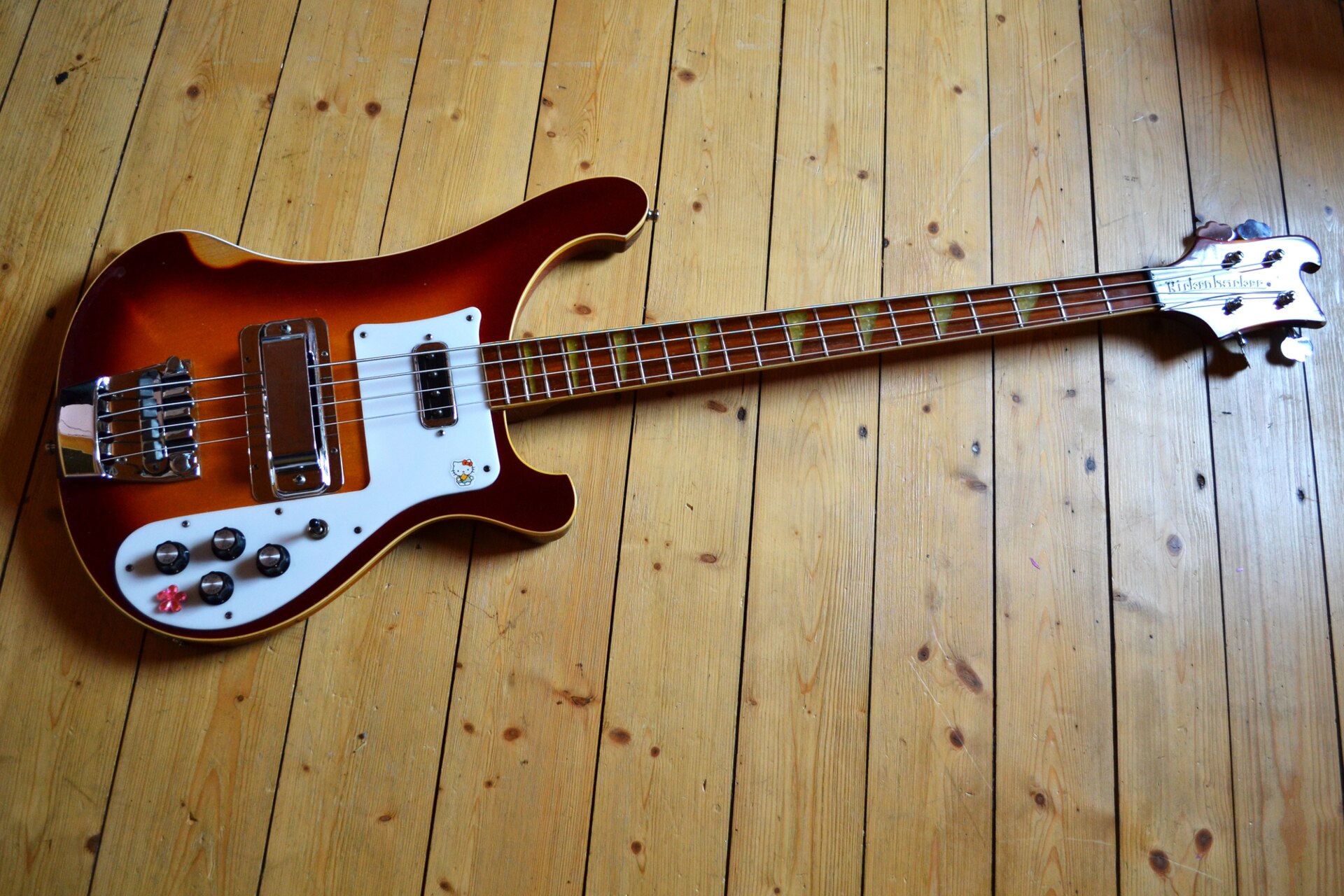
Rickenbacker 4003 (33 1/4" scale). Photo by DeLerkim. Licensed under CC BY-SA 2.0. Via Wikimedia Commons. Rickenbacker
4003
1980
Rickenbacker’s first answer to players’ new strings was to void the warranty. The 4003 was the better answer.