Modulus
Quantum
An aerospace engineer looked at Phil Lesh’s bass and decided the problem was the wood.
A Grateful Dead show, 1974, or 1976 if you go by the company’s own catalog. Geoff Gould works on carbon-fiber dish antennas for spacecraft. He’s looking at Phil Lesh’s hot-rodded Alembic and wondering what it would be like made of something else.
- Introduced
- 1978
- Type
- Solidbody bass (bolt-on graphite neck)
- Class
- Production
Have a photograph of this guitar? Send a picture
The short version
1974
A Dead show
Gould sees Lesh’s Alembic and starts thinking about carbon fiber. The company’s catalog dates the idea to 1976.
1977
NAMM prototypes
Carbon-fiber necks at the January show. Early neck-throughs go to Stanley Clarke and John McVie.
1978
Modulus Graphite
The company starts building, necks for other makers first, and files for its neck patent in January.
1996
The bolt-on Quantum
One price guide starts the Quantum 4 here. An owners’ thread reads one bass as 1988. The factory never printed a birthday.
1995–96
Gould leaves
The founder goes in 1995 or 1996, depending who tells it. Rich Lasner comes in after.
2013
Chapter 7
December 20. Modulus goes bankrupt.
2015
Back on the bench
January 22. New owners, the Modulus Graphite name, and Joe Perman building two to four instruments a month.
2026
Four a month
Still made to order, alder and satin, on a 35-inch neck.
Side A
A1
A problem made of wood
A Grateful Dead show in 1974. Or 1976, if you go by the company’s own catalog, which puts the “what if” two years later. Either way, Geoff Gould was an aerospace engineer who worked on carbon-fiber dish antennas, including the ones on Voyager I. The catalog would later call him a “rocket scientist.”
He was looking at Phil Lesh’s hot-rodded Alembic, and at the wood in it.
Wood moves. A neck bows with the weather and the string tension, and wood soaks up some of what the string is doing. Gould thought about something lighter, and stiffer, and the same every day. What he wanted was a neck that stayed put.
A2
Before there was a Quantum
What came first wasn’t this bass. Two carbon-fiber neck-throughs went out early, one to Stanley Clarke and one to John McVie. Prototypes showed up at the January 1977 NAMM show. Lesh, the catalog says, played one of the first carbon-fiber-necked basses.
Modulus Graphite started building in 1978, with Gould and Jerry Dorsch, and it made necks for other builders before it made whole instruments. The company’s brochure says the neck was “introduced in 1978 as the world’s first graphite bass neck.” That’s their sentence. They filed for the patent in January 1978, and the paperwork and the histories don’t even agree on whose names belong on it.
When the first complete Quantum shipped depends on who you ask. One price guide starts the Quantum 4 in 1996. An owners’ forum thread reads one bass as a 1988. The factory never printed a birthday, so this page doesn’t either.
A3
A thousand ladies dancing
The neck is a shell, D-shaped, laid up by hand in dozens of layers and cured in an autoclave. The open weave you see on the outside has a name, KLD, which the company says stands for “a thousand (k) ladies dancing.” Early on there was no truss rod at all. Owners of 1996 and 1997 Quantum 5s say theirs have none. By 2004 there’s a two-way rod in the catalog. Nobody dates the switch.
Bolt it to a contoured alder double-cut and you have a Quantum. For years that body wore a figured maple top. Now it’s satin, and the fancy top costs extra.
The number that matters is 35. The Quantum’s scale is an inch longer than a Fender’s, and that inch is what makes a low B string sound like a note instead of a flap. Modulus claimed its five- and six-strings were “the first truly viable” ones with a clear low B. Also their sentence. A tester for Bass Player in 1997 put it better: the Quantum 5 was like “playing one big string.”
A tester said the Quantum 5 was like “playing one big string.”
The Flea bass uses the same neck, at 34 inches and 22 frets. It’s a Flea, not a Quantum.
Flip the record · By the numbers
35″
Quantum scale length. The Flea bass wears the same neck at 34.
$1,800
What Alex Webster ordered his first Quantum 5 for in 1996. The Spector he’d wanted was around $3,000.
0
Truss rods in the 1996 and 1997 Quantum 5s owners describe. The rod came later.
4
Basses a month from the shop today, every model together.
Side B
B1
$1,800, and a Spector he didn’t buy
In 1996 Alex Webster was making Vile with Cannibal Corpse, the band’s first album tuned down to B-flat. For the five-string songs he rented a USA Spector at a Tampa shop, and afterward that was the bass he wanted, “somewhere in the $3,000 range.” He ordered a black Modulus five-string for $1,800 instead.
He remembers that one on Gallery of Suicide, Bloodthirst, and Live Cannibalism, “if my memory serves me correctly.” A second one, from about 1997, with no truss rod, is on Gore Obsessed. He sold the third, which had a wooden fingerboard. The fourth has a rod, and he hadn’t recorded with it yet.
Oteil Burbridge doesn’t hedge. “The green Modulus Quantum 6 I used on the first ARU record is the one I made my name on,” he said. Dave Schools had a Quantum 6 fretted and another fretless in Widespread Panic. Stefan Lessard toured with a fretless Quantum 5 among his Flea basses.
B2
Four a month
Gould left in 1995 or 1996. Rich Lasner came in after. A wood-sided neck, the Genesis, joined the line in 1996, and the catalog called the Quantum the brighter one. Then on December 20, 2013, the company filed for Chapter 7.
It didn’t stay gone. On January 22, 2015, a bass shop announced that the rights had been bought, the name was Modulus Graphite again, and Joe Perman was building two to four instruments a month in the USA. Today the shop says four a month, every model included.
The Quantum on the order page now is alder, satin, a phenolic fingerboard, EMG pickups, a truss rod, and that 35-inch carbon neck. Webster ordered his first one thirty years ago, then three more. Burbridge made his name on a green one. The neck is still doing what Gould wanted at that Dead show: staying where you left it.
Put this on
You’ve read about it. Now hear it. Here’s what this guitar sounds like, and what to listen for.
The first Aquarium Rescue Unit record
Oteil Burbridge’s green Quantum 6, the bass he says he made his name on. He doesn’t date the record, so neither do we.
Find it on YouTube (opens in a new tab)Gallery of Suicide
Alex Webster remembers his first Quantum 5, the black one he ordered in 1996, on this record, “if my memory serves me correctly.” Bloodthirst and Live Cannibalism too.
Find it on YouTube (opens in a new tab)Gore Obsessed
Webster’s second Quantum 5, from about 1997. No truss rod in that neck.
Find it on YouTube (opens in a new tab)
The cast
The people, and the specific guitars, that made the legend.
Oteil Burbridge
Green Quantum 6
Aquarium Rescue Unit. “The green Modulus Quantum 6 I used on the first ARU record is the one I made my name on.” Later came a signature OB-1 and a six-string Joe Perman built in the shape of an ankh.
1996
Alex Webster
Black Quantum 5s
Cannibal Corpse. Four of them over the years. The third, with a wooden board, he sold. The fourth has a truss rod.
2006
Dave Schools
Quantum 6, fretted and fretless
Widespread Panic. Both on his gear list in 2006, strung with a .126 on the bottom. The company put him on the Quantum page of its 2004 catalog.
2005
Stefan Lessard
Fretless Quantum 5
His fretless on the 2005 tour, beside three Flea basses. The Fleas wear the same neck, but they aren’t Quantums.
Phil Lesh
One of the first carbon-fiber-necked basses
Grateful Dead. The bass that started the idea was his Alembic. He’s part of the prototype story, not a catalog Quantum.
Liner notes
Specs, construction, rarity, value, and every source we used.
A hand-laid carbon neck bolted to alder, 35 inches and 24 frets — Modulus’s Quantum, not the neck-through TBX, and not the Flea bass.
- Body
- Contoured double-cutaway alder. Satin on the current card. Figured tops are options.
- Neck
- Bolt-on carbon-fiber shell, hand-laid, “D” section. Bi-directional relief rod. Not neck-through.
- Fingerboard
- Phenolic, compound radius, 24 frets, side dots. Wood boards are options. Radii unpublished.
- Scale
- 35". Optional 34" with 26 frets. No scale millimetres on the factory card.
- Pickups
- EMG soapbars through an EMG preamp (2020 manual). Same current page also prints a 3-band in the feature list and a 2-band as what is included. Keep both.
- Hardware
- Gotoh GB70, 20:1. Hipshot A-style bridge. Black, chrome, or gold.
- Electronics
- 2020 manual’s usual four knobs: volume, blend, bass, treble. A stacked mid is the other layout. Voltage unpublished in that manual.
- Finish
- Satin body and neck. 2020 manual: polyurethane. Gloss neck and transparent colors are upgrades on the current card.
- Nut
- Q4: 1.60" at the nut, 2.40" at the 24th fret. Bridge spacing on that same card: 0.75" (19 mm). Material unpublished. Mix flagged.
Open the full research fileConstruction details, the complete player record, production numbers, dated value estimates, and sources
Classic living example = current Quantum 4, bolt-on, Planet Bass (Maple Grove on the 2020 manual). Indexed factory card, 28 September 2026; a direct fetch that day returned 429. Q5, QW5-19, QW5-21, Q6 are the other counts on that card. TBX is neck-through. Flea / Funk Unlimited and Vintage J wear this neck at 34". Genesis is the 1996 wood-sided neck. Not a Status. Not an Alembic. Not a Steinberger. Mix flagged: bridge spacing 0.75" (19 mm), 0.67" (17 mm), 0.85" (21.5 mm) beside inch widths. Do not convert 35" or 1.60". Do not average a Q4’s 19 mm with a Q5’s 17 mm, or the 2004 catalog’s one QW5 row with the later 19 mm and 21.5 mm wides.
Construction
The job was a neck that would stay put. Wood bows. Wood swallows notes. The Dead show was 1974: Phil Lesh’s hot-rodded Alembic, and a thought about something lighter (Wikipedia; Vintage Guitar, Michael Wright, on the same night, and on sustain and stability rather than weight). He was an aerospace engineer. Vintage Guitar: carbon-fiber dish antennae, Voyager I among them. The 2004 catalog says “rocket scientist,” “carbon fiber designer on the Voyager probe,” and dates the “what if” to 1976. Keep 1974 and 1976.
Modulus’s 2003 brochure puts the name on the neck, not on a finished bass: “INTRODUCED IN 1978 AS THE WORLD’S FIRST graphite bass neck.” “World’s first” is the brochure. The patent is U.S. 4,145,948, filed 12 January 1978, granted 27 March 1979, assignee Modulus Graphite Products. Google Patents lists the inventor as Warwick A. Turner. Vintage Guitar says Gould and Rick Turner. Keep both. Do not merge the names.
What they built first was not this bolt-on. Vintage Guitar: two carbon-fiber neck-throughs, one to Stanley Clarke, one to John McVie, then prototypes at January 1977 NAMM. Wikipedia: one prototype at a 1977 show, McVie bought it after. The 2004 catalog: Lesh “played one of the first carbon fiber-necked basses.” None of those sentences is a catalog Quantum. This plate’s year is the company’s 1978 for the neck design. It is not the year a complete Quantum bass shipped.
The 2020 manual: Modulus Graphite began building in 1978. Wikipedia: Gould and Jerry Dorsch; Dorsch later went to Graphite Guitar Systems. Necks for other builders first, then whole instruments. Blue Book’s public list: SPi Standard 1995–96, Q4 1996–present, and from 1996 the neck-throughs were custom-order only. TalkBass reads serial 880676 as a 1988 Quantum 4, and puts the SPi heel joint in the very early 1990s. That thread and Blue Book do not agree. An eBass owner says Gould built him a through-neck in 1988. Not this table. Do not crown 1988 or 1995 as a birthday the factory never printed.
The neck is a “D”-shaped shell, dozens of layers, hand-laid, not an automated wrap (2003 brochure; 2020 manual). Wikipedia calls the early necks hollow. The manual says shell. The 2004 catalog adds the autoclave, and by then a two-way relief rod. Owners’ 1996 and 1997 Q5s have no rod (TalkBass). Webster’s second Quantum 5, about 1997, has no rod; a later one does. The 2004 catalog already lists the rod. Nobody here dates the changeover. The 2020 manual: hex key under the board, a dead spot at neutral. Not a Status spine. Not graphite bars in a maple neck.
Under it, a contoured double-cut alder, bolted on. The 2004 catalog describes that body with a 3A maple top, two EMG soapbars, volume, blend, bass, treble, 35", 24 frets. The 2012 brochure makes the figured top an upcharge, phenolic the no-charge board, satin and the transparents no charge. The indexed current card prints satin as standard and charges for exotic tops and transparent color. Same outline. The top left the sentence.
35" is why the five- and six-string work. The 2003 brochure claims they were among the first at that length, and “the first truly viable” 5s and 6s with a clear low B. Their sentence. Bass Player, January 1997, quoted there: one tester thought the Quantum 5 was like “playing one big string.” The Flea bass is 34", 22 frets, and it wears this neck. So does the Vintage J. A custom Flea 5 at 35" is still a Flea.
KLD is the open weave on the outside, “a thousand (k) ladies dancing.” The 2012 brochure: a trademark for over 25 years. The current page still prints that line. Don’t turn it into a start year.
TBX is neck-through, same 35" and 24 frets. 2012 brochure: rerelease in 2010, the fancy wood and the pickup choice included. Premier Guitar at NAMM, February 2012: “about midway through 2011.” Keep both. Wikipedia’s pre-2000 TBX counts are a rumour. Omitted.
Gould left in 1995 (Vintage Guitar) or 1996 (Wikipedia). The patent record shows a license to Modulus Guitars, LLC on 12 February 1996. Not the same event. Rich Lasner came in after (Vintage Guitar). 2004 letterhead: Modulus Guitars, Novato. Genesis, 1996, is carbon plus tone wood. The catalog says a Quantum runs brighter and a Genesis warmer. Different neck.
Then it stopped. Wikipedia: Chapter 7, 20 December 2013. Cimperman, Planet Bass, 22 January 2015: rights acquired, the name Modulus Graphite again, Joe Perman building, 2–4 instruments a month, USA. The 2020 manual’s address is Maple Grove. The welcome still says the Bay Area. The indexed order block says 4 a month, and the TBX page says it too. Shop rate. Not a Q4 census. Not the 2015 figure.
Classic vs current: a Gould-era bolt-on, no rod, often a maple top, against a living Q4 — alder, satin, phenolic, rod, EMG, 35", $4,899 where the indexed card starts. The TBX is a different bass.
Players
Lesh, McVie, and Clarke are the prototype story. Flea’s bass wears this neck and is still a Flea. A name on the Modulus poster is not a Quantum credit.
Oteil Burbridge. Guitar World (Andrew Daly, 8 January 2024), from the Bass Player interview: “The green Modulus Quantum 6 I used on the first ARU record is the one I made my name on.” He does not date that record here. Same interview: a signature OB-1, semi-hollow, and later a six-string Joe Perman built as an ankh. Bass Magazine (Chris Jisi) still lists an “O-Teal” green Quantum semi-hollow 6 beside a Dire Wolf, two Sandbergs, and a Fodera. The ARU bass, the OB-1, and that semi-hollow are not shown to be one object. The ankh is not this table.
Alex Webster (Cannibal Corpse). His notes, read on Granville Guitars, 9 February 2019. Vile, 1996, first album in B-flat. Five-string songs: a USA Spector rented at Thoroughbred in Tampa, the one he wanted afterward “somewhere in the $3,000 range.” Four-string songs on that record: a Fender P. He ordered a black Modulus five-string for $1,800. The original, at home, is the one he remembers on Gallery of Suicide, Bloodthirst, and Live Cannibalism — “if my memory serves me correctly.” The second, no rod, about 1997, is Gore Obsessed. A third, wooden board, around 2001 or 2002, he sold. The fourth Quantum 5, with a rod, sometime in the 2000s, he had not recorded. Not the Spector. Not the P.
Dave Schools (Widespread Panic). Bass Player, July 2006, gear list as quoted on TalkBass: Quantum Q6, fretted and fretless, GHS .035–.126. The 2004 catalog photographs him on the Quantum page. No song here is pinned to a serial.
Stefan Lessard. Bass Player, September 2005, Brian Fox: on that tour a Flea 4, a custom 35" Flea 5, a sparkle Flea 4, or a fretless Quantum 5. The Quantum is the fretless. Bass Magazine, 2024: “my Modulus fretless,” model unnamed. Don’t upgrade it.
A Genesis is not one of these. A TBX is not one of these.
Rarity
You can still order one. The indexed card says 4 basses a month, Planet Bass the only counter, and the TBX page repeats the sentence. Cimperman’s 2015 restart was 2–4 a month, every model. Neither is a lifetime, and neither is a Q4 total. Modulus has not published one. None invented. Serial 880676 dates one bass if you trust that thread. It does not count a year.
What is thinner: a bolt-on from before the rod; a bass from before Gould left (1995 or 1996, depending on the source); the gap between 20 December 2013 and 22 January 2015. Blue Book’s SPi Standard is a two-year code, 1995–96, not a headcount. Early TBX basses are the other model.
Copies exist. TalkBass, October 2020, called a green “Quantum 5” on Reverb a counterfeit and pointed at the same shape on AliExpress. Oteil’s green six and Webster’s black five have no auction figure here. They are not a used Quantum.
Value
Informal estimate, 28 September 2026. Not an appraisal.
Ask vs sold labeled. Celebrity instruments are not-comps. No invented medians. No clean Reverb Price Guide band this pass. Flag: thin sold-comp access. A direct fetch of the factory Quantum page returned 429 the same day; the street figure below is the indexed page text.
New street. Indexed factory card: starting at $4,899.00, Planet Bass the only counter named there. 2012 brochure: Q4 $4,349, Q5 $4,549, QW5-19, QW5-21, and Q6 $4,749, 2-band included, 3-band $50. 1 January 2004: Q4 $3,699, Q5 $3,899, Q6 $4,099, one QW5 $4,099. Webster’s $1,800 in 1996, against a Spector around $3,000, is one order. The TBX is the other list: indexed start $7,299.00; 2012 Q5TBX $8,199. Not a Quantum dollar.
Used. A 1991 six-string is not a 2020 semi-hollow. Named asks on Reverb’s Modulus browse, 28 September 2026, not sold prices: 2006 Q5, burl, Excellent, $4,000; 2001 Q5, quilt, Very Good, with case, $3,159.99; 1997 six-string, Excellent, $3,240 (was $3,600); 1991 six-string, Excellent, $4,261.56 (was $5,479.15); 2020 semi-hollow, Excellent, $4,383.32. Do not average them. A Blue Book deals line at $9,450 is a TBX. Webster’s original and Oteil’s ARU six have no price here.
See also
- alembic-series-i — Turner’s shop built the prototype necks with Gould; the Series I is not this bolt-on
- status-series-ii — British graphite spine and wood wings; not a Modulus, and not this neck
- spector-ns-2 — the USA five-string Webster rented for Vile before he ordered the Quantum
Sources
- Modulus, Quantum — indexed 28 September 2026; direct fetch 429 that day. Alder, satin, 35" bolt-on, 24 frets, phenolic, rod, Gotoh GB70, Hipshot A-style, EMG; Q4 1.60" / 2.40" / 19 mm and the other string counts; 2-band included vs 3-band in the feature list; starting at $4,899 street; 4 basses a month; Planet Bass only. KLD sentence still on the page
- Modulus, Quantum TBX — indexed the same day. Neck-through; starting at $7,299 street; the “4 basses per month” sentence repeated, so it is a shop rate
- Modulus Quantum owner’s manual, ©2020 — company “began building” 1978; Quantum neck a “D” shell, dozens of layers; phenolic standard, Chechen optional; EMG soapbar and EMG preamp; polyurethane; four-knob volume/blend/bass/treble, or stacked mid; Q4–Q6 specs with 0.75" (19 mm) and the other mixed pairs; 35"; gauges 45-65-85-105 and the 5- and 6-string sets; Maple Grove address on the back page, Bay Area in the welcome
- Modulus Quantum brochure, Jedistar’s 2003 copy — “Introduced in 1978” as the graphite bass neck; hand layup, dozens of layers; 35" Quantum vs 34" Flea and Vintage J; Bass Player, January 1997, “playing one big string”; Novato address
- Modulus catalog, effective 1 January 2004 — 1976 / Voyager line; Lesh “one of the first”; hand layup and autoclave; KLD; two-way relief; Genesis neck system 1996; Quantum alder with 3A maple top, EMG soapbars, 35", 24 frets; Q4 $3,699 through QW5 $4,099; Flea bass 34", 22 frets; Novato; Schools on the Quantum page; “prefer a Modulus” is not a Quantum credit
- Modulus brochure, Jedistar’s 2012 copy — bolt-on Quantum standard features; Q4 $4,349, Q5 $4,549, wides and Q6 $4,749; EMG BTS 2-band included, 3-band $50; transparents no charge; TBX rerelease 2010, Q5TBX $8,199; KLD “over 25 years”
- U.S. Patent 4,145,948 — filed 12 January 1978, granted 27 March 1979; inventor listed as Warwick A. Turner; assignee Modulus Graphite Products; 12 February 1996 license to Modulus Guitars, LLC
- Vintage Guitar, Michael Wright, Flight 6 Monocoque — September 2021 issue. 1974 Dead show; Voyager dishes; Clarke and McVie neck-throughs; January 1977 NAMM; patent “the following year,” Gould and Rick Turner in VG’s telling; Gould left 1995; Lasner; Chapter 7 late 2013; Joe Perman
- Wikipedia, Modulus Guitars — founded 1978; Gould and Dorsch; 1974 show; 1977 trade show and McVie; Gould left 1996; Chapter 7 on 20 December 2013. Player list and the TBX production rumour are unsourced there and unused here. SPi defined as the integrated bolt-on
- Blue Book of Guitar Values, Modulus Quantum series — Q4 1996–present; SPi Standard 1995–96; neck-through on custom order from 1996. Prices behind the book’s wall, not used
- Planet Bass, Tony Cimperman, 22 January 2015 — December 2013 bankruptcy; rights acquired; name Modulus Graphite; Joe Perman; 2–4 instruments a month; USA; orders through Planet Bass
- Guitar World, Andrew Daly, 8 January 2024 — Oteil: green Quantum 6 on the first ARU record; OB-1 semi-hollow signature; Perman ankh six-string
- Bass Magazine, Oteil Burbridge: Five-String Foray — Chris Jisi gear box: “O-Teal” green Quantum semi-hollow 6-string still listed, beside Dire Wolf, Sandberg, Fodera
- Granville Guitars, 9 February 2019 — Webster’s notes on the Quantum 5s: Vile 1996, Thoroughbred, $1,800, the Spector rental, the albums, the rod and the wooden-board bass
- TalkBass, Dave Schools gear list — quotes Bass Player, July 2006: Quantum Q6 fretted and fretless, GHS .035–.126
- DMBTabs, quoting Bass Player, September 2005 — Brian Fox: Lessard’s tour basses, fretless Quantum 5 beside the Flea basses, including a custom 35" Flea 5
- Bass Magazine, Stefan Lessard, 18 March 2024 — “my Modulus fretless,” model not named
- TalkBass, Modulus Quantum 4 question — serial 880676; thread reads it as a 1988 Quantum 4; SPi dated there to the very early 1990s
- TalkBass, old necks vs new — 1996 and 1997 Q5s with no truss rod
- eBass, Quantum 5 Special fretless — owner: Gould built the through-neck in 1988. Not the bolt-on table
- Premier Guitar, NAMM 2012, Q5TBX — booth: TBX re-released about midway through 2011
- TalkBass, fake Quantum 5 — October 2020; a listed “Quantum 5” called a copy; AliExpress
- Reverb, Modulus active basses — asks retrieved 28 September 2026, not sold prices: 2006 Q5 $4,000; 2001 Q5 $3,159.99; 1997 Q6 $3,240 (was $3,600); 1991 Q6 $4,261.56 (was $5,479.15); 2020 semi-hollow $4,383.32
Keep digging
Guitars this one gets compared to, confused with, or descended from.
- Send a picture
Alembic
Series I
1972
The sound wizards behind the Grateful Dead got tired of noisy pickups, so they built bass players a better one.
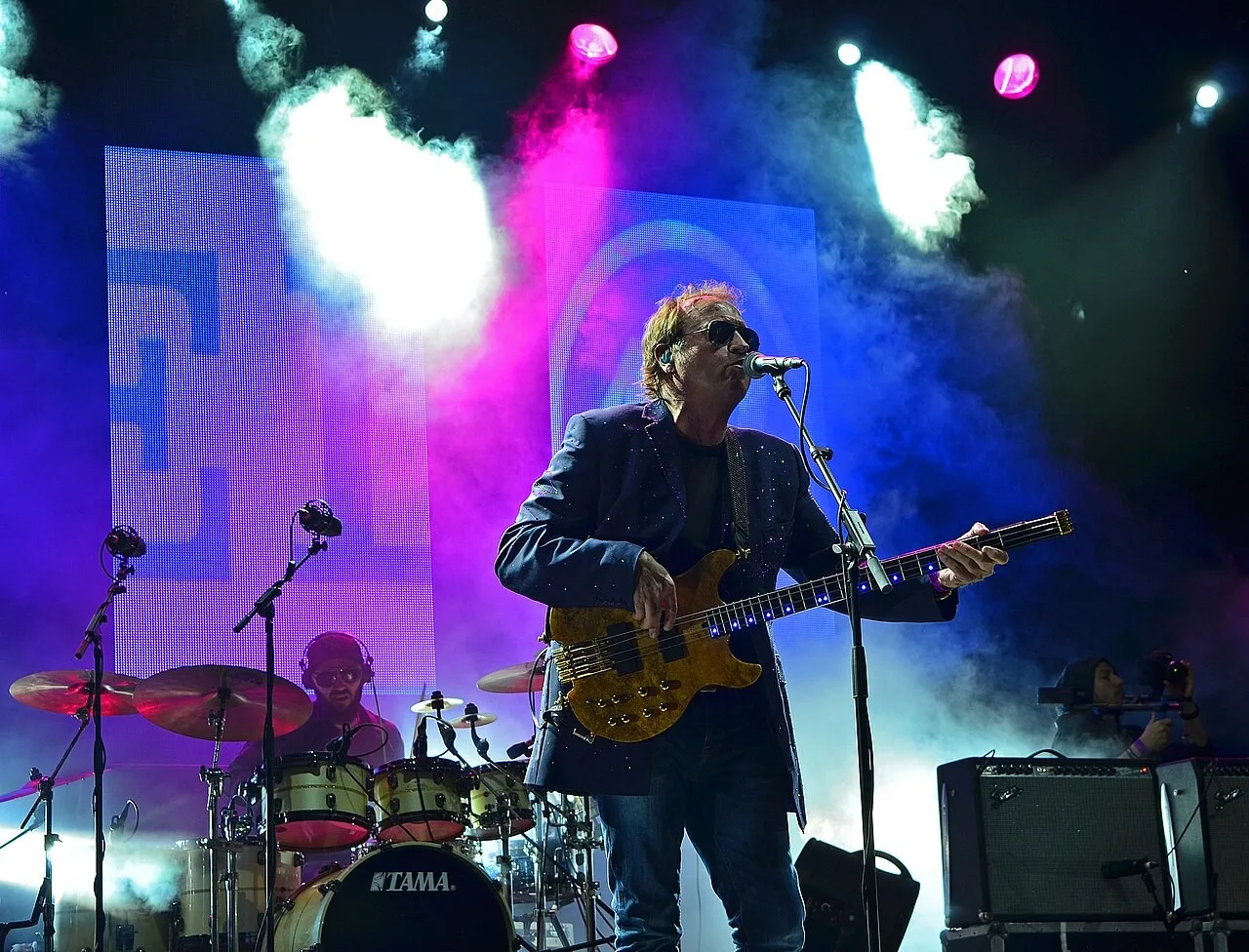
Photo: Andrew Hurley from Wallasey, England, United Kingdom / Wikimedia Commons / CC BY-SA 2.0 Status
Series II
1984
Rob Green looked at a room full of expensive basses and said he could build a better one. Then he did.
- Send a picture
Spector
NS-2
1979
It started with a man looking for a belt sander. Sting found his lying on the stage before soundcheck.