 Guitaripedia
Conklin
Sidewinder
Low B to high F on one neck. Then the customers asked for more strings, and the shop said yes.
Springfield, Missouri, 1992. Bill Conklin's small custom shop puts a seven-string bass on an offset body and calls it the Sidewinder. Players come back for eights and nines, and eventually an eleven.
- Introduced
- 1992
- Type
- Solidbody electric bass
- Class
- Production
Have a photograph of this guitar? Send a picture
The short version
1981
Woodshop
Senior year of high school. Bill Conklin's first guitar is shaped like a machine gun.
1983–84
Conklin, at 20
The company starts in Lebanon, Missouri, mostly repairs. The first year depends who you ask.
1988
Springfield
He marries, moves to Springfield, and opens a shop for building his own instruments.
1992
The Sidewinder 7
A seven-string bass, low B to high F, with stereo panning and a parametric EQ.
After 1992
Eight, nine, eleven
Custom extended-range basses for Bill Dickens and others, including a nine billed as the world's first.
1997
Groove Tools
A Korean line, made with Jack Westheimer and checked again in the U.S.
2001
Two at the bench
Phil Goschy leaves and Mike Apperson starts. The shop stays two people.
2021
29 October
Bill Conklin dies at home, aged 58. The shop keeps building.
Side A
A1
A machine gun in woodshop
1981, senior year of high school. Bill Conklin builds his first guitar in woodshop, and it's shaped like a machine gun. His first bass was a Kay.
By 20 he had a company, in Lebanon, Missouri. Whether that was 1983 or '84 depends who you ask; he said '84, and his birthday says he turned 20 in 1983. Either way it was mostly repairs at first. Refinishes, pickups, vibratos, and custom orders when they came.
In 1988 he married, moved to Springfield, and opened a shop aimed at building. From then on it was his own instruments only. Four years later came a bass with seven strings.
A2
Low B to high F
The Sidewinder came out in 1992 as a seven-string, tuned in fourths from low B to high F. It's an offset double-cut on a 34-inch scale, and the first ones came with stereo panning, pickup splitting, a parametric EQ, and a board that could run up to three octaves.
Why a high F? Conklin's catalog thought of the bass as several instruments on one neck: contra below the E, the regular bass in the middle, tenor range above that, piccolo an octave up. The high F was so a chord would sit right under your hand. This was a bass for people who wanted to play more than the root.
The neck was maple and purpleheart, which, the catalog said, made graphite unnecessary. It bolted on, but he carved the heel so it would feel like a neck-through. And the side dots have the best little story in the build. He set the markers so they hung over the edge of the board. Sand them flush and you get a dot on top and a dot on the side from the same piece.
A3
Hundreds and hundreds
The seven didn't stay the top. The catalog's line was "hundreds and hundreds" of custom 7-, 8- and 9-string basses since 1992, in fourths from low F# up to high F or high Bb. An eight adds an F# below the B or a Bb above the F. Then an 11-string, because customers asked for one.
The name on the extended-range story is Bill Dickens, and even the start is split. Sources differ: Dickens (For Bass Players Only, 22 November 2010) says he picked the bass back up in '92 and found Conklin at Summer NAMM in Nashville around then — "the Bill Dickens signature model bass by Groove Tools was born. After that one came the 7-string and then the 9-string." Conklin, in Bass Musician, dated their work together to 1998.
What Conklin did claim was the nine: "the world's first 9-string bass tuned from low F# to high Bb." Look closely at the catalog page, though. Dickens is on that nine, but the caption never calls it a Sidewinder. The next caption does, on a Melted Top Sidewinder 7 with piezo and magnetic pickups.
How heavy is all that wood? The old catalog called the body seemingly weightless. A player who gigged his seven in 2003 called it quite heavy, and well balanced. A nine a dealer listed as Edo Castro's comes in around ten and a half pounds. Pick your witness.
Flip the record · By the numbers
7
Strings on the 1992 Sidewinder, low B to high F
11
Strings on the biggest Conklin basses, built because customers asked
34"
Standard scale, from the first seven to today's order sheet
12–15
Instruments a year from the whole shop in 2018
Side B
B1
The same outline, cheaper
Not everybody wants a custom nine. The New Century basses, Club, Tour and Session, put the same outline in fours through sevens and, in the catalog's words, "limited the options and lowered the prices." The Session wore a Melted Top of maple, purpleheart and walnut and ended in 2010.
Then came the Korean line, Groove Tools by Conklin, made with Jack Westheimer and checked again in the U.S. Rocco Prestia's co-designed four, the GTRP-4, sits on the Sidewinder body: bird's-eye maple pickguard, P/J pickups, 21 frets, 2001 to 2005. Conklin said the two of them worked together for years, and he never named the model he watched in Prestia's hands. A Groove Tools bass is a Korean bass. The Springfield customs are another thing.
In one of his interviews Conklin was excited about the Sidewinder 4 and 5 Classic, the same body with retro styling. The short-scale headless Bugout uses this outline too, and it's another model.
B2
Two people on five acres
It was never a factory. The bench in the old catalog photo is Bill and Phil Goschy. Phil left in 2001 and Mike Apperson started the same year. In 2018 the shop made 12 to 15 instruments a year, on five acres at the house in west Springfield.
Bill Conklin died at home on 29 October 2021. He was 58.
In August 2022 Teresa Conklin posted that they were still building. The order sheet is still up. It lists the Sidewinder body, the 34-inch scale, and every string count from four to nine, and the wait is nine to twelve months. Somewhere a player is still asking for one more string, and the shop is still saying yes.
The cast
The people, and the specific guitars, that made the legend.
1992
Bill Conklin
Builder
Started out on repairs and refinishes. Designed the Sidewinder and built extended-range basses until his death in 2021.
1992 or 1998
Bill Dickens
A Groove Tools signature, then custom sevens and a nine
His nine is billed as the world's first 9-string bass, low F# to high Bb. The catalog caption on it doesn't say Sidewinder. He dates the start to 1992; Conklin said 1998.
2001–05
Rocco Prestia
Groove Tools GTRP-4, on the Sidewinder body
A co-designed four built in Korea, bird's-eye maple pickguard. Not a Springfield custom.
2003
Edo Castro
A 2003 nine, by a seller's description
A dealer listed it as a Sidewinder built for him, tuned F# to Bb, about 10 1/2 pounds.
2001
Mike Apperson
Builder
At the bench with Bill from 2001, about sixteen years by Bill's count when he was 53.
Liner notes
Specs, construction, rarity, value, and every source we used.
Low B to a high F on a 34-inch seven — Conklin’s Sidewinder, the Springfield bass that kept adding strings.
- Body
- Offset double-cut. Sidewinder is a no-charge body on the current custom sheet. Solid woods at no charge include alder, cherry, swamp ash, and walnut. Blue Book’s Club is cherry or swamp ash.
- Neck
- Bolt-on, no charge. 3-piece maple is the standard on a 4. 7-piece maple and purpleheart is the standard on a 7, 8, or 9. Neck-through is +$800. The 1990s catalog: double expanding truss rods, and a maple/purpleheart neck it says needs no graphite.
- Fingerboard
- Bubinga, katalox, purpleheart, or quartersawn maple, no charge. Off-sides dots, no charge. 21, 22, or 24 frets, no charge; 36 frets are +$500. Wider boards can be limited to fours and fives. Radius unpublished.
- Scale
- 34" standard, no charge (current sheet and the 1990s catalog; inches only). Also 35", 32", and 30", no charge. Multi-scale 32–35 is +$300.
- Pickups
- A menu, all no charge: Bartolini, Delano, Lundgren, EMG, Seymour Duncan, DiMarzio, Fishman Fluence, Lace, Nordstrand, Aguilar. Six strings and up, the sheet says, may be only some of those brands. Club, in Blue Book: two Seymour Duncan soapbars.
- Hardware
- Hipshot A bridge, no charge, or individual saddles (ABM or Hipshot), also no charge. Gotoh, Hipshot, or Schaller tuners, no charge. Chrome, black, gold, or satin chrome. The 1990s catalog offers narrow or wide spacing and prints no measurement. A sold 36-fret seven’s listing prints 17 mm.
- Electronics
- Passive is no charge. A preamp is extra: Bartolini NTMB or Delano Sonar $200, EMG BQS $200, Aguilar OBP $250, Michael Pope Flex Core $370. Blue Book’s 1992 seven: stereo panning, pickup splitting, onboard parametric EQ.
- Finish
- Satin, no charge. Gloss +$300. Cellophane colors are on the sheet. Blue Book’s Club and Tour: hand-rubbed oil or Clearcoat.
- Nut
- Width and material unpublished on the current sheet and in the 1990s catalog.
Open the full research fileConstruction details, the complete player record, production numbers, dated value estimates, and sources
The specs above are a Sidewinder-body bass on Conklin’s custom order sheet, fetched 29 October 2026: the no-charge choices, not one frozen guitar. The 1992 seven is the bass the name started on. A Club, a Tour, or a Session is a New Century bass on this outline. A Groove Tools is the Korean line. A Sidewinder guitar is a different instrument; the sheet’s recommended scale for a six or a seven is 25.5".
Construction
The job was range. A bass you could slap, chord, and take below E, from a shop that was still one man’s customs.
The company is older than the name, and the first year is two years. The memorial page dates the founding to 1983, in Lebanon, Missouri. Bill, in the Bass Musician interview, says he started Conklin in ’84. The same interview dates Bartolini and EMG “since our start in 1984.” No Treble, Blue Book, and the Springfield Business Journal (12 March 2018) also print 1984. Vintage Guitar (Ward Meeker, February 2022) says he started at just 20. The memorial gives his birth as 4 February 1963, so that age is 1983.
Repairs came first. Vintage Guitar: at 20 he took custom orders and still did refinishes, pickups, and vibratos. In 1988 he married, moved to Springfield, and opened a shop aimed at building. No Treble puts that year on the switch to original instruments only. Blue Book’s “built in Springfield, MO since 1984” folds the move into the founding. His first guitar, he says, was a machine-gun shape in high-school woodshop, senior year 1981. His first bass was a Kay.
Earlier Conklins are other instruments. Blue Book: the Quick Co-Necked Double Neck, then the Boomerang, the Elec-trick, and the Shadow. Melted Tops — different woods joined, not a bookmatch — are 1991. The Mobile Electric Upright is 1995.
The seven is 1992. The maker’s catalog, copyright 1991, 1993, 1995, and 1998, says it twice: the introduction, and the release, of the sidewinding 7-string bass in 1992. Blue Book agrees. Tuning there is low B to high F, with stereo panning, pickup splitting, a parametric EQ, and up to a three-octave board. The catalog’s picture is wider than one tuning: contra below E, standard bass, tenor normally A to C, piccolo an octave above E to G, and the high F so a chord sits under the hand. 34". Narrow or wide spacing, no measurement printed. Maple and purpleheart, which that catalog says makes graphite unnecessary. A contoured bolt-on heel Bill says was meant to feel like a neck-through. Off-sides dots: the marker hangs over the edge, and sanding it flush makes a top dot and a side dot. His words. Neither account describes a Sidewinder from before 1992.
The strings kept coming. Same catalog: “hundreds and hundreds” of custom 7-, 8-, and 9-string basses since 1992, in fourths from low F# to high F or high Bb. An eight adds an F# below B, or a high Bb above F. Vintage Guitar and No Treble both add an 11-string, from what customers asked for. The order sheet of 29 October 2026 prices a 4 through a 9. It does not price an 11.
Fanned frets in that catalog are on a pair of 8-string guitars, licensed by Novax: longer on the bass side, up to a high A on the treble side. Not this bass. The living bass sheet sells multi-scale as 32" to 35" for $300. The Wiggle Stick, when Bill was 53, was a headless multi-scale five he was planning. Another model.
The outline then left the one-off seven. The same book’s New Century series “limited the options and lowered the prices.” Blue Book files two versions it still calls current, and one gone. Club: cherry or swamp ash, bolt-on, 24-fret rosewood or purpleheart, Gotoh, two Seymour Duncan soapbars, volume, blend, tone, 34". Tour: a figured-maple pickguard. Session: a Melted Top of maple, purpleheart, and walnut, natural only, discontinued 2010. Fours through sevens. Cellophane blue, green, purple, red, or natural, in oil or Clearcoat, a Grundorf case in the price. That “current” is Blue Book’s filing. It is not the 2026 shelf.
The import is another factory. No Treble: a line with Jack Westheimer, Groove Tools by Conklin. Blue Book: Korea, checked again in the U.S., series header 1997–present, and the GT-4, GT-7, and the Dickens GTBD-7 discontinued in 2005. The GTRP-4, 2001–05, is the one it calls a Sidewinder body.
Late in the interview he was jazzed about the Sidewinder 4 and 5 Classic: retro styling, modern refinements. Bass Musician’s Bugout review describes the Classics as this body with that older look. The Bugout itself is a 32" headless five, alder, on the Sidewinder body, and another model. The shelf checked 29 October 2026 still lists Classics. Those titles do not say Sidewinder.
The bench stayed two people. The catalog photo is Bill and Phil Goschy. Vintage & Rare: Phil left in 2001, and Mike Apperson started that year. Bill, at 53, counts about sixteen years with Mike. The Journal, 2018: 12–15 instruments a year, on five acres at the house in west Springfield, 2017 revenue $120,000, and of late $120,000–$150,000. He died at home on 29 October 2021. He was 58. Teresa Conklin, TalkBass, 10 August 2022: they were still building. The order sheet is still up. 9–12 months. A limited lifetime warranty on the workmanship, for as long as you own it.
A 2003 TalkBass player called his seven quite heavy, and well balanced, at 34". The old catalog calls the body seemingly weightless. No factory weight was published. A nine listed as Edo Castro’s prints about 10 1/2 lbs. One bass.
A 1992 seven — low B to high F, parametric EQ, maple and purpleheart, 34" — against the living sheet. Bolt-on, satin, passive unless you pay. The prices are below. Same outline.
Players
Bill Dickens is the name on the extended-range story, and the start is split. For Bass Players Only, 22 November 2010: he picked the bass back up in ’92, found Bill Conklin at Summer NAMM in Nashville around then, and “the Bill Dickens signature model bass by Groove Tools was born. After that one came the 7-string and then the 9-string.” Conklin, in Bass Musician, dates the work to 1998. The signature seven, the BD-7, is what he calls a fixture of extended-range bass. The same answer: custom extended-range basses for Dickens, “including the world’s first 9-string bass tuned from low F# to high Bb.” The two starts stay. 1992 is Dickens. 1998 is Conklin.
The catalog spread that tells the Sidewinder story shows him on that nine. The caption says “the world’s first 9-string bass,” and “Bill’s Custom Basses feature stereo panning, parametric EQ and a 12-volt power supply.” It does not print the word Sidewinder on that sentence. The next caption does, on a different instrument: a Melted Top Sidewinder 7, piezo and magnetic. Blue Book’s GTBD-7 is the Korean signature, swamp-ash wings, a curly-maple top, Bartolini “Bill Dickens” pickups, a parametric selector, discontinued 2005. A Groove Tools seven is not the Springfield custom.
The same spread names two more basses and does not call them Sidewinders in the sentences. A quilted-maple five for Danny DeMorales, with Wayne Newton. A Melted Top six for Kieth Nelson — the catalog’s spelling — with Diana Ross and Donna Summer.
Rocco Prestia is the body-style trap. Conklin says they worked together for years and that he watched “your unique instrument” in Prestia’s hands. He does not name the model. The model Blue Book names is the GTRP-4, co-designed, 2001–05, Sidewinder body, a bird’s-eye maple pickguard, Bartolini P/J pickups, 21 frets. Korea.
A Cream City listing, also on Reverb, is a 2003 nine it calls a Sidewinder custom-made for Edo Castro. Seller’s description: maple and purpleheart neck, figured purpleheart board, 24 frets, two truss rods and two graphite rods, Gotoh tuners, a 3" graphite nut, about 4 1/4" wide at the 12th, 34", tuned F# B E A D G C F Bb, dragonwood back, figured purpleheart top, Bartolini, about 10 1/2 lbs. A listing. Not an interview.
The Springfield Business Journal’s 2018 profile names Steve Vai, Gene Simmons, the lead guitarists for Alabama and Heart, and Tanya Tucker’s bassist. No model. No Treble’s signature list — Shaun Munday, Jozef Bobula, Jason Everett, Ron Pacheco — is a brand list. Everett’s OM, in No Treble’s own bass-of-the-week note, is another bass.
Rarity
You can order a new one. The wait is the bench, 9–12 months, not a closed book. The shelf Classics are the other way in: a few finished basses, titled Classic, on a body the Bugout review treats as this outline.
No Sidewinder total has been published. “Hundreds and hundreds” is the catalog’s phrase for custom 7s, 8s, and 9s together, in a book last copyrighted 1998. It is not a 2026 census, and it is not fours and fives. The 12–15 a year is the whole shop in 2018. Two people. One sequence of instruments will not count an outline.
Thinner than a new order: a seven from the first years of the name; an 11-string, because the living sheet stops at nine; a Session Melted Top, the version Blue Book ends in 2010; a 36-fret neck, the three-octave option Blue Book mentioned and the sheet now prices at $500. A Novax-fanned eight in that catalog is a guitar. A Groove Tools seven is Korea, and Blue Book ends those models in 2005.
Value
Informal estimate, 29 October 2026. Not an appraisal.
Prices below are asking prices unless marked sold. No celebrity Sidewinder auction turned up. Dickens’s nine and Prestia’s GTRP-4 are not comparable sales. Few sold prices are public.
New street. One sheet, not a discount. Custom basses, Sidewinder body included: $4,200 / $4,600 / $5,000 / $5,400 / $5,800 / $6,200 (4 through 9). Neck-through +$800. Multi-scale +$300. Gloss +$300. A Melted Top, standard 3- and 5-piece patterns, +$1,500. A bag or a hardshell case is in the price. The in-stock Classics sit under that, and the titles do not say Sidewinder: a Faux 4 at $3,298, a Classic 421 at $3,387 and another at $2,898, a Classics Tour 5 at $3,698, each plus shipping. The Journal’s $2,500–$3,000 up to $10,000–$12,000 is the whole 2018 catalog, not this sheet.
Used modern. Asks, checked 29 October 2026. A 1998 custom seven, walnut, Bartolini and a piezo, asking $3,095, down from $8,999, listed about a year. A 2009 eight, neck-through, Delano and a Bartolini 3-band, asking $12,500, the listing about seven years old and still up. Guitar-list’s Reverb offers, on a page dated 7 October 2026, showed a mid-1990s Sidewinder asking $8,500. Asks.
Vintage / collectible. No 1992 hammer turned up. A 36-fret USA seven, ziricote top, shows sold at $3,875; the listing was already about nine years old. A Century Series Tour seven the seller calls a 2004 20th-anniversary bass, Sidewinder body, swamp ash, shows sold at $3,510. The anniversary label is the seller’s. Groove Tools sevens are the other market. On that 7 October feed the asks ran about $899 to $1,345. Korea, and not this bench.
See also
- ken-smith-bsr — the other American extended-range custom, longer horn, Perkasie; not this Springfield outline
- fodera-monarch — Brooklyn’s bolt-on butterfly; Vinnie had carved for Ken Smith, not for this shop
- dingwall-combustion — the fanned-fret five that put Novax fans on a production bass; not a Sidewinder
Sources
- Conklin catalog (jedistar PDF) — copyright 1991, 1993, 1995, 1998; Sidewinder 7 introduced 1992; 34"; narrow or wide spacing; maple/purpleheart, no graphite; “hundreds and hundreds” of 7s, 8s, and 9s; low F# to high F or Bb; Novax fans on 8-string guitars; Dickens on the world’s first 9-string; DeMorales; Kieth Nelson; no CNC in that book; Springfield
- Blue Book, Conklin — customs from 1984; Melted Tops 1991; Sidewinder 7 in 1992, low B to high F, panning, splitting, parametric EQ, up to a three-octave board; Springfield “since 1984”; M.E.U. 1995
- Blue Book, New Century basses — Club, Tour, Session; Session discontinued 2010; 34"; Duncan soapbars; 4- through 7-string; oil or Clearcoat
- Blue Book, Groove Tools — Korea; series header 1997–present; GT-4, GT-7, and GTBD-7 discontinued 2005; GTRP-4, 2001–05, Sidewinder body, Prestia
- Conklin, custom shop — Sidewinder body no charge; 4–9 string prices; 34" standard; multi-scale 32–35 at $300; 36 frets $500; neck-through $800; pickup and preamp menu; 9–12 months; fetched 29 October 2026
- Conklin, standard models — in-stock Classics, $2,898 to $3,698 plus shipping; titles do not say Sidewinder; fetched 29 October 2026
- Conklin, memorial — born 4 February 1963; founded 1983 in Lebanon; died 29 October 2021, age 58; multi-string and multiscale
- Vintage Guitar, Ward Meeker, February 2022 — started the company at 20; Springfield shop in 1988; extended-range basses of 7, 8, 9, and 11 strings; died 29 October, age 58
- No Treble, 29 October 2021 — company in 1984; originals only from 1988; 7, 8, 9, and 11; Jack Westheimer and Groove Tools; signature artists, models unnamed
- Bass Musician, Bill Conklin interview — started in ’84; Dickens since 1998; world’s first 9-string, low F# to high Bb; Prestia, model unnamed; Sidewinder 4 and 5 Classics; off-sides dots; carved heel; age 53; Apperson about 16 years; first guitar 1981
- For Bass Players Only, Bill Dickens, 22 November 2010 — met Conklin around 1992 at Summer NAMM, Nashville; Groove Tools signature, then a 7, then a 9
- Springfield Business Journal, 12 March 2018 — founded 1984; 12–15 a year; two employees; 2017 revenue $120,000; streets $2,500–$3,000 up to $10,000–$12,000; players named, no model
- Vintage & Rare, builder bio — Springfield shop 1988; Phil Goschy left 2001; Mike Apperson started 2001
- TalkBass, Teresa Conklin, 10 August 2022 — the shop still building
- Bass Musician, Bugout review — 32" headless on the Sidewinder body; Classics described as that body with retro styling
- TalkBass, Sidewinder 7, 2 March 2003 — one seven, 34", called quite heavy
- Guitar-list, Sidewinder bass offers — Reverb asks dated 7 October 2026: mid-1990s Sidewinder $8,500; Groove Tools sevens about $899–$1,345
- Reverb, 1998 custom seven — ask $3,095, from $8,999; checked 29 October 2026
- Reverb, 2009 Sidewinder 8 — ask $12,500; listing about seven years old
- Reverb, 36-fret seven, sold — sold at $3,875; listing about nine years old; seller prints 17 mm spacing
- Reverb, 2004 Tour seven, sold — sold at $3,510; seller’s 20th-anniversary label; Sidewinder body
- Cream City Music, 2003 nine — listing copy: custom for Edo Castro; 34"; 3" nut; about 4 1/4" at the 12th; about 10 1/2 lbs
- No Treble, Conklin OM, 15 August 2016 — Jason Everett’s OM, a different bass
Keep digging
Guitars this one gets compared to, confused with, or descended from.
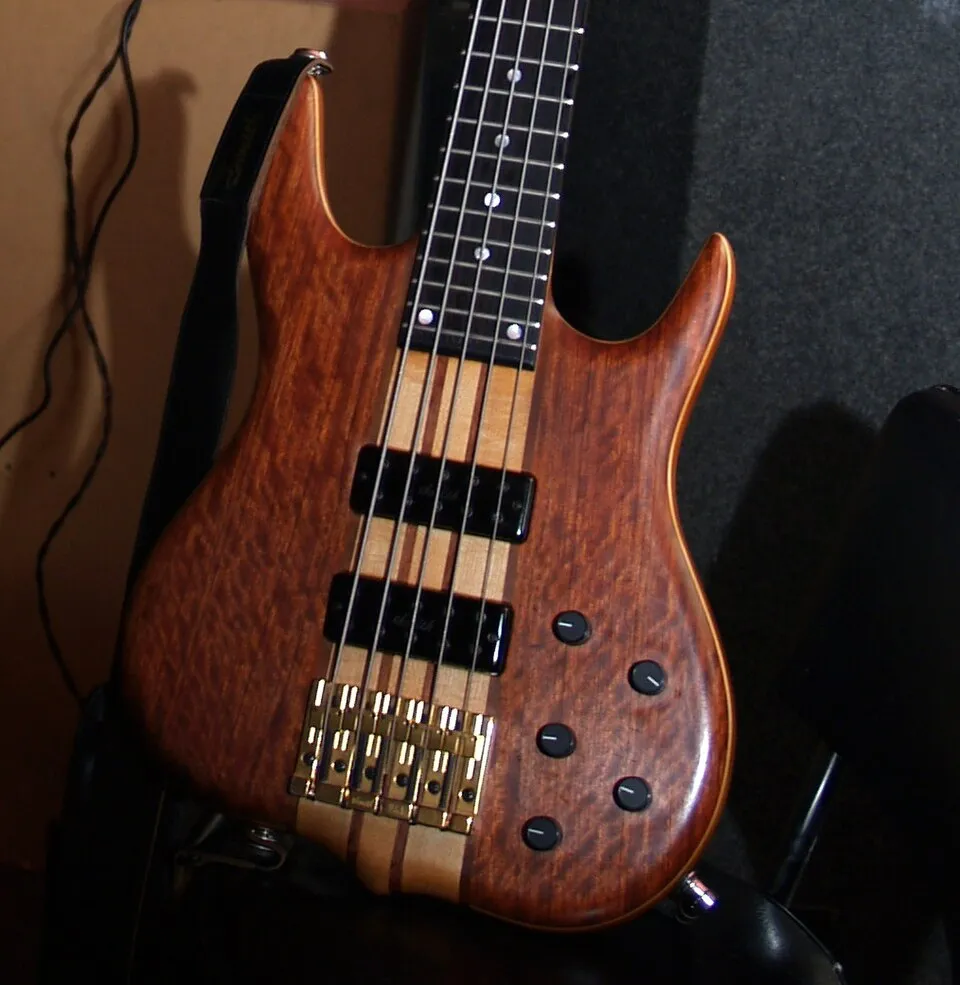
Photo: christina rutz / Wikimedia Commons / CC BY 2.0 Ken Smith
BSR
1996
Ken Smith drew his first bass for playing sitting down. The BSR is the one he drew for standing up.
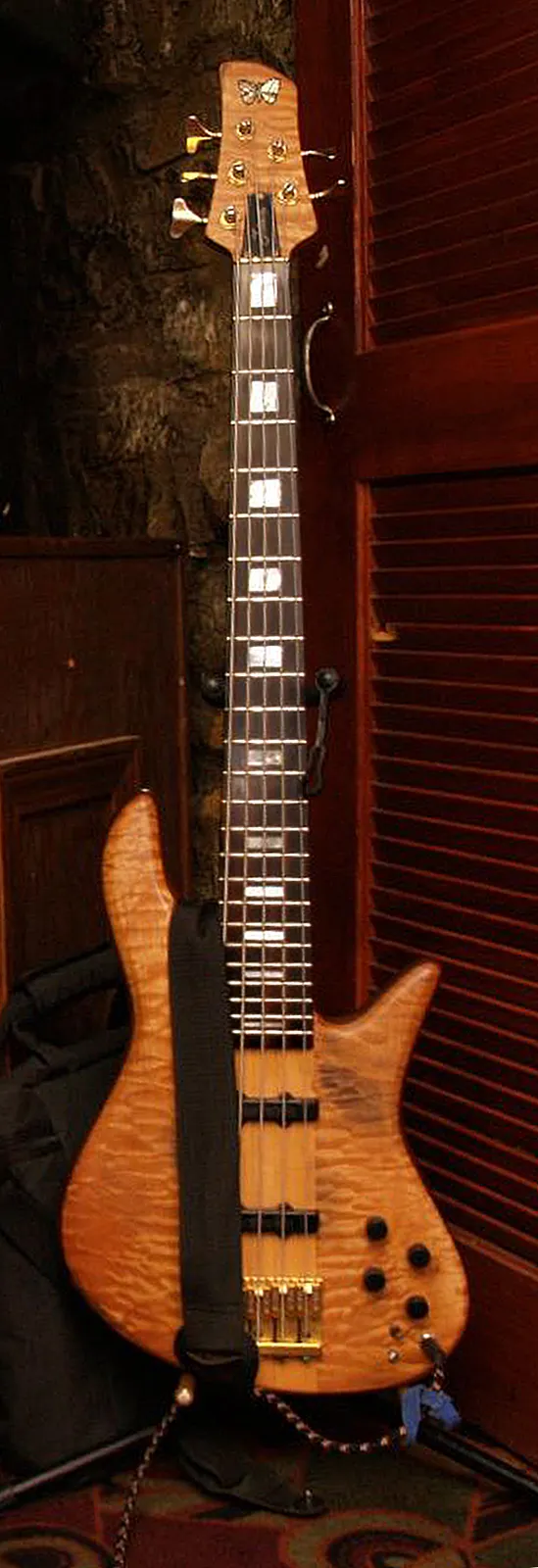
Photo: christina rutz / Wikimedia Commons / CC BY 3.0 Fodera
Monarch
1983
In 1983 a new Brooklyn shop brought a bass to a teenager’s session. It’s still Victor Wooten’s number one.
- Send a picture
Dingwall
Combustion
2009
Built to get a small bass shop through a recession. Then the pros started touring on the cheap one.