Sandberg
California
Six bolts, a zero fret, a knob that pulls. About four of every five Sandbergs are this bass.
It started in a cowshed near Wolfsburg, built by a man who trained on pianos. The California looks like a Fender from across the room. Up close, it's the bass a small German shop decided working players actually needed.
- Introduced
- 2000
- Type
- Solidbody electric bass
- Class
- Production
Have a photograph of this guitar? Send a picture
The short version
1986
The cowshed
Holger Stonjek and Gerd Gorzelke start on a street called Am Sandberg. A dealer says 1987. Keep both.
1997
Oliver Riedel signs on
The Rammstein bassist's first year with the company. A relationship date, not a California's.
2000
The California
Fifteen years before 2015, by one count. Ten years before 2011, by Holger's. So 2000 or 2001.
2009
A gift in Frankfurt
Ida Nielsen gets her first Sandberg, a year before she joins Prince's band.
2015
California II
Slimmer body, deeper cutaway, lighter tuners. Same six bolts.
2021
Méndez gets one
Opeth's bassist gets a passive TT signature. He's said around 2018. Keep both.
2022
Two tour basses for Ukraine
Riedel's signed pair, original body shape, goes up for auction.
2024
Eighty percent
Holger says about 80% of what the shop builds is California.
Side A
A1
A cowshed on Am Sandberg
Holger Stonjek's new book calls the start a cowshed. It was near Wolfsburg, on a street called Am Sandberg, in the village of Ehmen. The street gave the company its name. The year is 1986, which the headstocks still say. A dealer prints 1987. Keep both.
Holger hadn't come up through guitars. He was apprenticed as a piano maker at Schimmel in Braunschweig. The shop later moved to Braunschweig too, and that's where the California is built.
The first bodies were his own designs. Several models came after. Then, around the turn of the century, the shop settled on the one that would carry it: a bass that does the job of a Fender without being one.
A2
Not a Jazz, not a P
From across a club, a California looks like something from Fullerton. The T bodies take on the Jazz Bass's job, two skinny single coils. The V bodies take the Precision's, with a split-coil. Then you look closer.
Six bolts hold the neck on, in metal ferrules, where Fender uses four. The four dots at the heel are the logo, and they started as four strings. There are 22 frets, plus a zero fret in front of a graphite nut. That zero fret is the quiet trick: your open strings ring off a fret just like your fretted notes do, so an open E doesn't sound like a different instrument from the E above it. The nut just holds the strings in place.
When it started depends who you ask. In 2011 Holger said they'd been developing the California "since 10 years." A reviewer who owned one said in 2015 they'd been building it "for 15 years already." That's 2001 or 2000. Nobody has turned up a catalog to settle it.
A3
Pull the knob
The other half of why it stuck is under the control plate. A two-band active preamp, with a volume knob that pulls up to go passive. Pull it, and the treble knob doesn't go dead. It turns into an ordinary passive tone control.
If you've ever had a battery die halfway through a set, you know why that matters. Pull the knob and keep playing.
Who built the preamp depends who you ask, too. Sandberg calls it its own two-band. One reviewer in 2020 described it as built by Glockenklang and modified for Sandberg. Both can be true. The working trick is the same either way.
Pull the knob and keep playing.
Flip the record · By the numbers
6
Bolts at the neck joint, in metal ferrules. A Fender bass has four.
~80%
The California's share of everything the shop builds, by Holger's 2024 count.
320 → 160 g
Tuner weight at the headstock, before and after the 2015 redesign.
100
Hours a Masterpiece spends on a vibration machine, Ida Nielsen says.
Side B
B1
Older on purpose
Some Californias look like they've been through thirty years of stages the day they ship. That's a shop process, not an accident. Soft Aged is the light version. Hardcore Aged gets the stage wear, yellowed varnish, and oxidized nickel. The Masterpiece goes further, with aged hardware and an aged fingerboard, and then it gets shaken. Ida Nielsen says a Masterpiece gets "a hundred hours on a vibration machine."
Her first Sandberg was one of those, at the Frankfurt Musikmesse in 2009, with a P-style pickup. Holger had already sold it to a shop in Vienna. He got it back and gave it to her. "This was before I started playing with Prince," she said. She joined his band the next year. Her own signature, a California TM, came in 2016.
B2
The 2015 cut
In 2015 the shop redrew its own bass. California II has a slimmer body, a deeper treble cutaway, and a slimmer headstock. The new aluminum tuners cut the weight hanging off the end of the neck from 320 grams to 160. One player who owned both weighed a first-generation swamp-ash TT at about 4.2 kilos and the new swamp ash at about 3.6.
Hang one on a strap for a two-hour set and you'll feel the difference before you hear one.
Everything that made it a California stayed. Six bolts. Zero fret. The knob that pulls. A first-generation body sits a little closer to the Jazz outline; a new one looks a little more like Sandberg. Same bass underneath.
B3
Thirteen years of stage
Oliver Riedel has been with Sandberg since 1997. His signature is a California VM: aged alder, a split-coil and a humbucker, active or passive. In 2022 he put two signed tour basses up for auction to raise money for Ukraine. Both were the original California shape, and the company said they'd been "used in countless stage shows around the world for over 13 years."
Martín Méndez spent the early Opeth years on Fender Jazz Basses. He came to Sandberg later, spent two days in the Braunschweig workshop in 2019, and got a passive TT signature with the pickups moved closer to the bridge. The company announced it in 2021; he remembers the signature as around 2018.
By 2024 the shop had about 25 people turning out about forty instruments a week. Holger told a room in Prague how much of that was one model: "80% our production is California."
The cowshed is a book title now. The bass it was built for is most of what they make.
The cast
The people, and the specific guitars, that made the legend.
Holger Stonjek
Every California
Apprenticed as a piano maker in Braunschweig, then started Sandberg in a cowshed. The first body shapes were his own.
Oliver Riedel
California VM signature
With Sandberg since 1997. His signature is aged alder with a split-coil and a humbucker; two signed tour basses in the original shape went to auction for Ukraine in 2022.
Ida Nielsen
California TM signature (2016)
Her first Sandberg came in 2009, before Prince. The signature came in 2016, with a thumb rest and fluorescent side dots.
Martín Méndez
California TT Passive signature
Played Fender Jazz Basses from the start of Opeth, then Sandbergs. His signature moves the two pickups closer to the bridge.
Liner notes
Specs, construction, rarity, value, and every source we used.
Six bolts, a zero fret, and a preamp you can pull — Braunschweig’s working bolt-on, not a Precision and not a Jazz Bass.
- Body
- European ash (matt) or alder (aged / highgloss); double-cut T silhouette. California II from 2015.
- Neck
- Bolt-on Canadian hard-rock maple, 6 screws. C profile. Factory thickness at 1st fret 21 mm.
- Fingerboard
- Rosewood, maple, or pao ferro typical; 22 frets plus a zero fret. Factory radius 14". Mix flagged.
- Scale
- 34" (864 mm). Also offered as 35". Mix flagged.
- Pickups
- Two Delano JMVC FE/M2 J-style single-coils (TT).
- Hardware
- Sandberg bridge (adjustable spacing 18.5–20 mm) and Sandberg tuners. Mix flagged.
- Electronics
- Sandberg 2-band, active/passive (volume push/pull); blend; treble; bass. Treble remains a passive tone control with the preamp down.
- Finish
- Matt, aged (Soft / Hardcore), highgloss, rarewood. Hardcore Aged Masterpiece adds vibration treatment.
- Nut
- Graphite, with zero fret. Factory zero-fret width 39.3 mm. Thomann: 39.4 mm (1.55"). Friedland (TM): 1.5". Mix flagged.
Open the full research fileConstruction details, the complete player record, production numbers, dated value estimates, and sources
Current typical = California TT 4-string (Braunschweig; California II body from 2015). Factory: two Delano J coils, Sandberg 2-band, 6-bolt, 34", 22 + zero fret. VS (split-coil), VM (split-coil + M-style humbucker), and TM (J + M-style humbucker, coil-split) are series variants, not this table. Electra is Korea wood, German assembly. Terrabass is a different model. California ST / DC are guitars, 2010. Not a Jazz Bass (fender-jazz-bass). Not a Precision Bass (fender-precision-bass). Mixed inch/mm flagged on factory 34" (864 mm) and millimetre nut / spacing against Friedland’s 1.5" and 14". Do not flatten 39.3 / 39.4 / 1.5.
Construction
The job was a Fender-shaped bass a working player could take to a gig without resetting the board for a boutique oddity. Split-coil or two skinny coils. A preamp you could pull. Six screws instead of four. Holger Stonjek’s shop, not Fullerton.
Sandberg Guitars starts 1986. German Wikipedia: Holger and Gerd Gorzelke, first workshop on Am Sandberg in Ehmen, near Wolfsburg; the street named the company. Holger was apprenticed as a piano maker at Wilhelm Schimmel in Braunschweig. Headstocks still stamp “German Quality since 1986.” Session.de’s dealer copy prints 1987. Keep both. This plate is not the company year. The shop later sat in Braunschweig — Heinz-Scheer-Straße 2, 38126, on the privacy page. Holger’s 2026 book The Face of Bass calls the start a cowshed.
The first shapes were his own. Premier Guitar, Montreal Guitar Show 2011: Holger on the mid-1980s first body and typical headstock, then “several different models,” then “we developed this California bass since 10 years.” That is ≈2001 from a July 2011 tape. BassTheWorld (Gregor Fris, 14 April 2015): “they’re building California for 15 years already.” That is ≈2000. No factory catalog-introduction year located this pass. Keep 2000 and 2001. This plate starts in 2000.
What you get is a bolt-on 34-inch bass with a graphite nut and a zero fret in front of it. Friedland (Guitar World / Bass Player, 8 January 2020): the zero fret makes open strings speak like fretted notes; the nut is a string holder. Twenty-two medium frets, PLEK’d on the Bonedo 2015 TM 4. Six countersunk bolts in metal ferrules — the four dots at the heel are the logo, originally four strings (Bonedo). Sandberg hardware: a full-contact bridge with per-saddle height, intonation, and spacing; open-gear tuners, later the Super Light aircraft-aluminum set. Bonedo: tuner mass at the headstock cut from 320 g to 160 g on that facelift.
Electronics are the other half of why the bass stuck. Factory TT: two Delano JMVC FE/M2 coils and a Sandberg 2-band with push/pull volume. Friedland on a TM: preamp “built by Glockenklang and modified for Sandberg”; treble ±18 dB @ 8 kHz, bass ±14 dB @ 40 Hz. Pull the volume and you are passive; the treble knob stays a tone control. That is the working trick. Keep factory “Sandberg 2-band” and Friedland’s Glockenklang credit. Do not flatten them.
Not a Jazz Bass. Offset Fullerton, 20 frets, no zero fret, 1960 (fender-jazz-bass). This is Braunschweig, 22 + zero, six bolts, active/passive. T-series bodies borrow the J job. They are not that guitar. Not a Precision Bass. Split-coil from 1957, four screws, 20 frets (fender-precision-bass). V-series bodies borrow the P job. VS is one split-coil; VM adds an M-style humbucker. Neither is a Fender SKU.
Series variants live here as context. TT: two J coils — this table. TM: J plus M-style humbucker, coil-split; Friedland’s review bass. VS: one split-coil. VM: split-coil plus power humbucker — Oliver Riedel’s signature layout. Passive TT and VS exist. SuperLight, the 30" Lionel, and Grand Dark (35", Darkglass, about 2016) are adjacent. Electra (Musikmesse 2012, No Treble): basswood, Korea woodwork, German assembly and QC — not this table.
Then the instrument changed. 2015, Musikmesse: California II. Bonedo (27 July 2015): slimmer body, deeper treble cutaway, slimmer headstock, aluminum tuners and control plate. Gregor Fris, same year: first-gen swamp-ash TT about 4.2 kg; new swamp-ash about 3.6 kg; European ash nearer 4.1 kg. His own 2011 TT4 Masterpiece is the old outline. Gitarre & Bass (February 2016) on the VM: more Sandberg in the silhouette “since the beginning of the year.” Factory pickguards for TT/TM II are specified “from 2015 until today.” Classic vs current: a first-gen T-body, closer to the J outline, against a living California II TT 4-string — same 6-bolt, same zero fret, same slug.
Aged finishes are a shop process, not a relic Fender. Friedland: Soft Aged, Hardcore Aged (thirty-year stage wear, yellowed varnish, oxidized nickel), Hardcore Aged Masterpiece with “strongly aged” hardware, board aging, and vibration treatment. Ida Nielsen (MusicRadar, 2 August 2018): a Masterpiece “get[s] a hundred hours on a vibration machine.” Do not invent a 2003 start date for the process.
German Wikipedia, citing a September 2019 snapshot: 23 people, about 1,500 instruments a year, of which 200 guitars; 40% exported. Holger, Prague clinic 2024: 25 people, about 40 instruments a week, “80% our production is California.” Company-wide rates. Not a California census.
Players
Do not hang a 1960 Jazz Bass or a 1957 Precision on this plate. Do not recruit a Terrabass, an Electra, or a California ST guitar as if it were this bass. Do not flatten Sehnsucht or Blackwater Park onto a California that was not there.
Oliver Riedel (Rammstein). The German face of the bass. Factory: working with Sandberg since 1997. That is the relationship year, not a California serial — Terrabass and a Plasmabass sit in the older kit list (Wikipedia). The living signature is a California VM 4-string: alder, special Hardcore Aged, ebony, matched head, Black Label split-coil plus power humbucker, 2-band active/passive. Factory, May 2022: two personally signed tour basses, “used in countless stage shows around the world for over 13 years,” original California body shape, auctioned for Ukraine. Those objects are first-gen outlines. They are not a 1994 Herzeleid bass. Early Rammstein kit (Wikipedia): Music Man StingRay; ESP Eclipse bass on the Sehnsucht tour. Keep the split.
Ida Nielsen (Prince / 3rd Eye Girl). MusicRadar (Joel McIver, 2 August 2018): first Sandberg at Musikmesse Frankfurt 2009 — a Hardcore Aged Masterpiece, P-style pickup. Holger had sold it to a Vienna shop; he got it back and gifted it. “This was before I started playing with Prince.” She joined New Power Generation in 2010. Signature, workshop 2016: California TM, Jazz-style neck pickup plus M-style humbucker further back than a StingRay, Asian-silk pickguard, fluorescent side dots, thumb rest, vibration treatment. Plectrumelectrum (2014) is 3rd Eye Girl with Prince. The signature is 2016. Do not stamp the Paisley Park years onto that TM SKU. The 2009 Masterpiece is the Prince-era identity instrument.
Martín Méndez (Opeth). Factory (14 January 2021): California TT Passive signature, Delano JMVC pair set closer to the bridge than a stock TT, 6-bolt, 34" four-string / 35" five-string, vibration treatment. Factory workshop note (28 November 2019): two days in Braunschweig; he had already been using Sandbergs live and in the studio. Bass Musician Magazine (15 January 2026): Fender Jazz Basses from the start of Opeth; Sandbergs later; signature “around 2018.” Blackwater Park (2001) is not this bass.
Also known to play stays short. German Wikipedia’s artist list: Markus Grosskopf (Helloween, California TM); Torsten Scholz (Beatsteaks, California TSBS — Premier Guitar, Musikmesse 2012, passive, string-through, post-office yellow). Ken Taylor is a Basic signature. He is not this table.
Rarity
You can order a new California from Braunschweig. TT, TM, VS, VM, SuperLight, Nighthawk, signatures, and Hardcore Aged all coexist on the configurator. Custom colours and Masterpiece aging are the limited current line. They are not vintage-scarce. Electra is another factory on a related silhouette. It is not a California.
Sandberg does not publish California unit totals. None invented. Serials date a bass. They do not count a model. Wikipedia’s 1,500 instruments a year (2019) and Holger’s 40 a week (2024, ~80% California) are shop rates, not a census.
What is actually thinner: first-gen T/V bodies before the 2015 California II cut; complete Hardcore Aged Masterpiece examples; Riedel’s original-shape tour pair. Those two auction basses are unique objects. They are not a vintage California.
Value
Informal estimate, 8 October 2026. Not an appraisal.
Ask vs sold labeled. Celebrity lots are not-comps. No invented medians or factory counts. Reverb Price Guide exists on California TT 4; the dollar widget did not print a clean band this pass. Flag: thin sold-comp access.
New street. Named German carts (Thomann, fetched 8 October 2026), gig bag in: California II TT 4 matt black €1,999; TM4 Blackburst maple €1,799 (related cart on the TT 4 BK page); TM5 rosewood natural €1,899; Hardcore Aged TT4 tobacco €2,499 / Roquefort Blue €2,549; VM 4 ebony black €2,499 (comparison cart). Named US dealer asks, not hammers: Chicago Music Exchange California TT 4 matte Greenburst $2,675; Bass Central SuperLight TT-4 from $2,499. Friedland’s 2020 street: stock $2,150, as-tested Hardcore Aged TM $2,760. No Treble (January 2021): Méndez signature $2,319–$2,759; 35th Anniversary Supreme $3,859 / $3,999. MusicRadar (2017): Ida Nielsen signature £2,199 / €2,322. Do not average a matt TT with a Masterpiece.
Used modern. Named 2026 marketplace asks, not hammers: California VS Passive 4 Excellent $1,650; VS Active 4 Excellent $1,750 (dropped from $1,950); TM4 sunburst Very Good $1,950; 2016 TM-4 Hardcore Aged Creme Very Good $2,116.38. A Hardcore Aged TM5 Mint $2,950 (dropped from $3,950) is one five-string. Do not average it with the four-string asks. Electra trades lower; it is another factory.
Vintage / collectible. First-gen Californias sit in the same used band when they trade at all; no separate 2000/2001 hammer isolated this pass. Riedel’s 2022 tour pair is celebrity, not a street tape. Later signatures are new SKUs, not vintage comps.
See also
- fender-jazz-bass — the 1960 Fullerton T-silhouette this Braunschweig bolt-on is not
- fender-precision-bass — the 1957 split-coil V-job; California VS is not that guitar
- warwick-thumb — neighbor German bass; hidden neck-through, not this 6-bolt
Sources
- Sandberg, California T series — TT: 6-bolt Canadian hard-rock maple; 22 frets or fretless; 34"/35"; two Delano JMVC FE/M2; Sandberg 2-band active/passive; 14" radius; zero-fret width 39.3 mm / 44.6 mm (4-/5-string); thickness 21 mm; 22nd-fret width 63.9 mm; bridge spacing 18.5–20 mm; matt ash / aged or highgloss alder
- Sandberg, California V series — VS active: one Sandberg split-coil, 2-band active/passive; VM and signatures as adjacent
- Sandberg, California Oliver Riedel — VM 4-string signature: alder, special Hardcore Aged, ebony, Black Label split-coil + power humbucker, 2-band, 34", 14", 39.3 mm
- Sandberg, Oliver Riedel is auctioning his basses for Ukraine, 30 May 2022 — working together since 1997; two signed tour basses, 13+ years on stage, original California body shape
- Sandberg, WE PROUDLY ANNOUNCE: Martin Mendez Signature Bass, 14 January 2021 — California T passive; Delano JMVC closer to the bridge; 34"/35"; vibration treatment
- Sandberg, Signature Bass Martin Mendez, 28 November 2019 — two days in the Braunschweig workshop; already using Sandbergs live and in studio
- Sandberg, 35th Anniversary California Supreme, 2 February 2021 — company 35th; chambered European alder, quilted maple, roasted neck, Delano X-Tender, 3-band
- Sandberg, privacy / imprint — Holger Stonjek, Heinz-Scheer Str. 2, D-38126 Braunschweig
- Wikipedia (de), Sandberg Guitars — founded 1986, Holger Stonjek and Gerd Gorzelke; Am Sandberg, Ehmen; Schimmel apprenticeship; ~1,500 instruments / 200 guitars / 23 staff / 40% export (Sept 2019); California T and V series; guitars from spring 2010; artist list (Riedel, Nielsen, Méndez, Grosskopf, Scholz)
- Guitar World / Bass Player, Ed Friedland, Sandberg California TM Bass review, 8 January 2020 — V = Precision-based, T = Jazz Bass territory; 6-bolt; 34"/35"; 1.5" nut; 14" radius; 22 frets; graphite + zero fret; Delano Hybrid; Glockenklang/Sandberg ±18 dB @ 8 kHz / ±14 dB @ 40 Hz; Soft / Hardcore / Masterpiece aging; street $2,150 stock / $2,760 as tested; 9.5 lb; 28 years as a European brand
- Bonedo, Oliver Poschmann, Sandberg California TM 4 Test, 27 July 2015 — Musikmesse 2015 California II; company 1986; 3.5 kg alder TM 4; six bolts in ferrules; four-dot logo; aluminum tuners 320 g → 160 g; 22 medium + zero fret; PLEK; Glockenklang-era 2-band; treble as passive tone; Thomann €1,899
- BassTheWorld, Sandberg California — The 2015 Update Explained, 14 April 2015 — “building California for 15 years already”; deeper cutaway, lighter body
- BassTheWorld, INTRODUCING: The SANDBERG BassTheWorld BASS, 22 July 2022 — Gregor Fris TT4 Masterpiece custom 2011, 4.2 kg; 2015 redesign; new swamp ash 3.6 kg; European ash ~4.1 kg
- Premier Guitar, Montreal Guitar Show '11 — Sandberg, 15 July 2011 — Holger: mid-1980s first shape; California “since 10 years”
- Premier Guitar, Musikmesse '12 — Electra VS4 & California TSBS, 12 April 2012 — Electra first offshore, German assembly; TSBS = Torsten Scholz / Beatsteaks, passive, string-through, post-office yellow
- No Treble, Sandberg Introduces Electra Vs 4 Bass at Musikmesse, 18 March 2012 — Korea wood/routing/varnish; German assembly and QC; ~$899
- No Treble, Sandberg Guitars Launches Martin Mendez Signature Bass, 22 January 2021 — TT Passive base; $2,319–$2,759
- No Treble, Sandberg Guitars Unveils 35th Anniversary California Supreme Bass, 14 February 2021 — $3,859 / $3,999; 6-bolt; 34"; Delano X-Tender; 3-band 160/900/480 Hz
- Bass Magazine, Sandberg Guitars Release 35th Anniversary California Supreme Basses, 3 February 2021 — 35 years; push/pull passive; treble as passive blend
- MusicRadar, Joel McIver, Ida Nielsen interview, 2 August 2018 — Musikmesse 2009 Masterpiece; 100 hours vibration; gift from Vienna; Prince from 2010; signature workshop 2016; Plectrumelectrum 2014
- MusicRadar, Joel McIver, Sandberg California Ida Nielsen review, 17 September 2017 — £2,199 / €2,322
- MusicRadar, Jonathan Horsley, Martín Méndez signature, 18 January 2021 — California TT Passive template; Delano JMVC closer to the bridge
- Bass Musician Magazine, Karen Beishuizen, Martín Méndez, 15 January 2026 — Fender Jazz from the start of Opeth; Sandbergs later; signature around 2018
- Bass Musician Magazine, Rammstein Bassist Auctioning Basses for Ukraine, 30 May 2022 — 13+ years on stage; original California body shape
- Wikipedia, Oliver Riedel — Sandberg California PM; Terrabass; StingRay early; ESP Eclipse bass on Sehnsucht tour
- Gitarre & Bass, California VM review, February 2016 — California II silhouette from the beginning of the year; 34"/864 mm; 22 + zero; nut 44.00 mm on that 5-string; ~€1,565
- Thomann, Sandberg California II TT 4 BK — €1,999; 864 mm (34"); 39.4 mm (1.55"); 22 frets; related TM4 BKB MN cart €1,799; fetched 8 October 2026
- Thomann, Sandberg California II TT4 RW TBS HCA — Hardcore Aged tobacco €2,499
- Thomann, Sandberg California II TT4 RW RFB HCA — Hardcore Aged Roquefort Blue €2,549
- Thomann, Sandberg California II TM5 RW NT — €1,899; available since August 2015
- Thomann, Sandberg California II TM2 MBKB — comparison cart: California II VM 4 EB Black €2,499
- Bass Central, Sandberg TT — SuperLight TT-4 from $2,499
- Reverb Price Guide, Sandberg California TT 4 — 14" radius; 6-bolt; dollar widget did not print a clean band this pass
- Reverb, used Sandberg marketplace — named 2026 asks cited in Value
- Chicago Music Exchange, Sandberg California TT Matte Greenburst — new ask $2,675
- TalkBass / No Treble, California GRAND DARK, June 2019 — series launched three years earlier (~2016); 35" ; Darkglass 3-band; 40-piece orange; ~$2,200
- Holger Stonjek, Prague bass clinic, June 2024 — founded 1986; 25 people; ~40 instruments a week; ~80% California
- Sandberg, ‘The Face Of Bass’ book, 24 April 2026 — “From a cowshed to a global company”; 40 years
- session.de, Sandberg brand — dealer copy founding 1987; California as classic designs vs Basic / Panther / Custom
Keep digging
Guitars this one gets compared to, confused with, or descended from.

Fender Jazz Bass from 1966 in Olympic white with the transition fingerboard (bindings and dot inlays). Photo by Th. Ott. Licensed under CC BY-SA 3.0. Via Wikimedia Commons. Fender
Jazz Bass
1960
Built for jazz players who mostly passed on it. Then bass players started using it to take the solo.

Photo: Infrahertzz / Wikimedia Commons / CC BY-SA 3.0 Fender
Precision Bass
1951
Leo’s bass let the player at the back be heard. You know their lines by heart. You mostly don’t know their names.
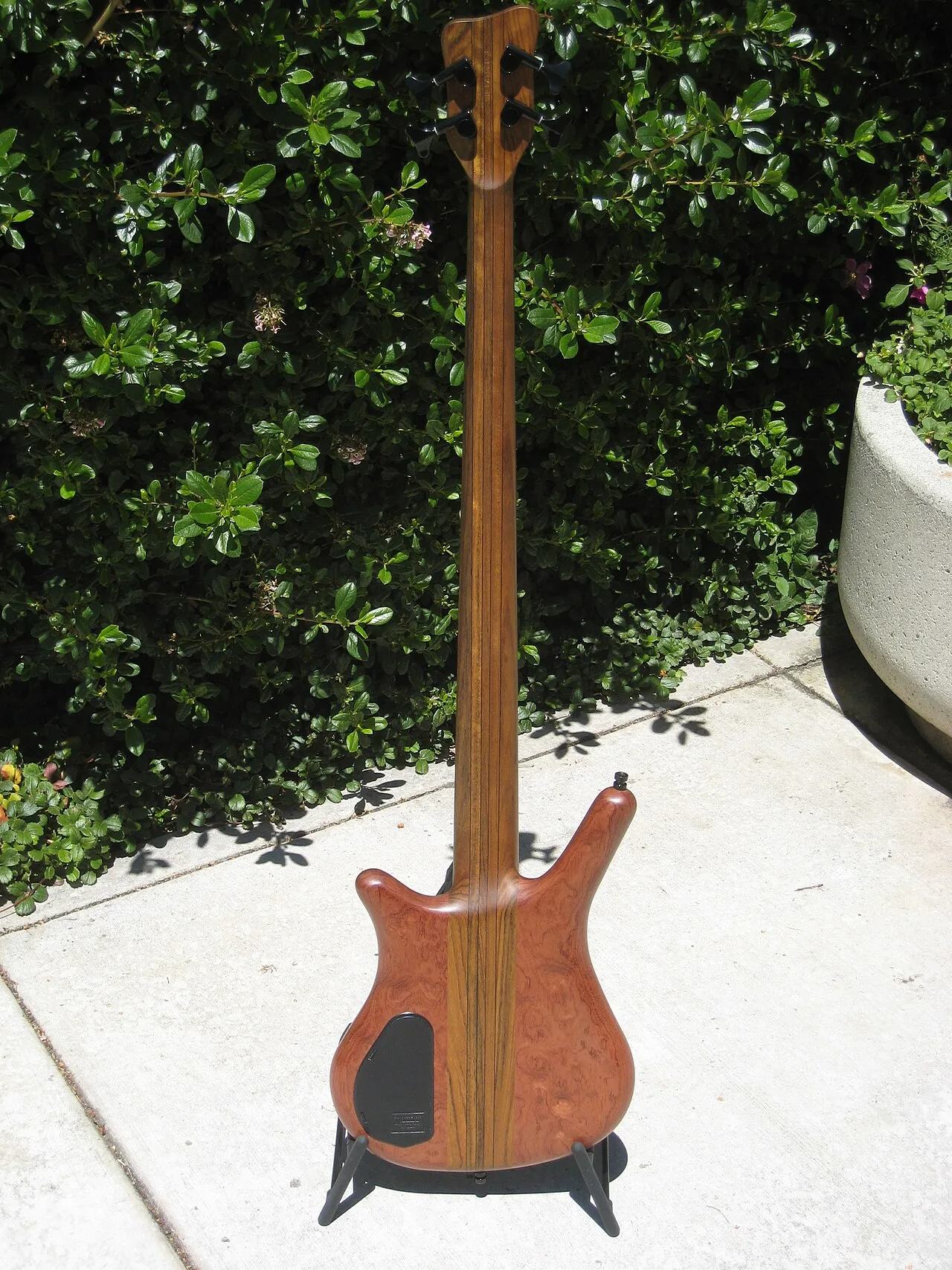
Photo: Ethan Prater from San Bruno, CA, USA / Wikimedia Commons / CC BY 2.0 Warwick
Thumb
1985
Named for one funk player’s thumb, fixed by Jack Bruce’s complaint, and the bass Bruce said he’d quit without.