Fender
Bass V
Fender’s first five-string added the extra string on top. John Paul Jones called it the ugliest bass in the world.
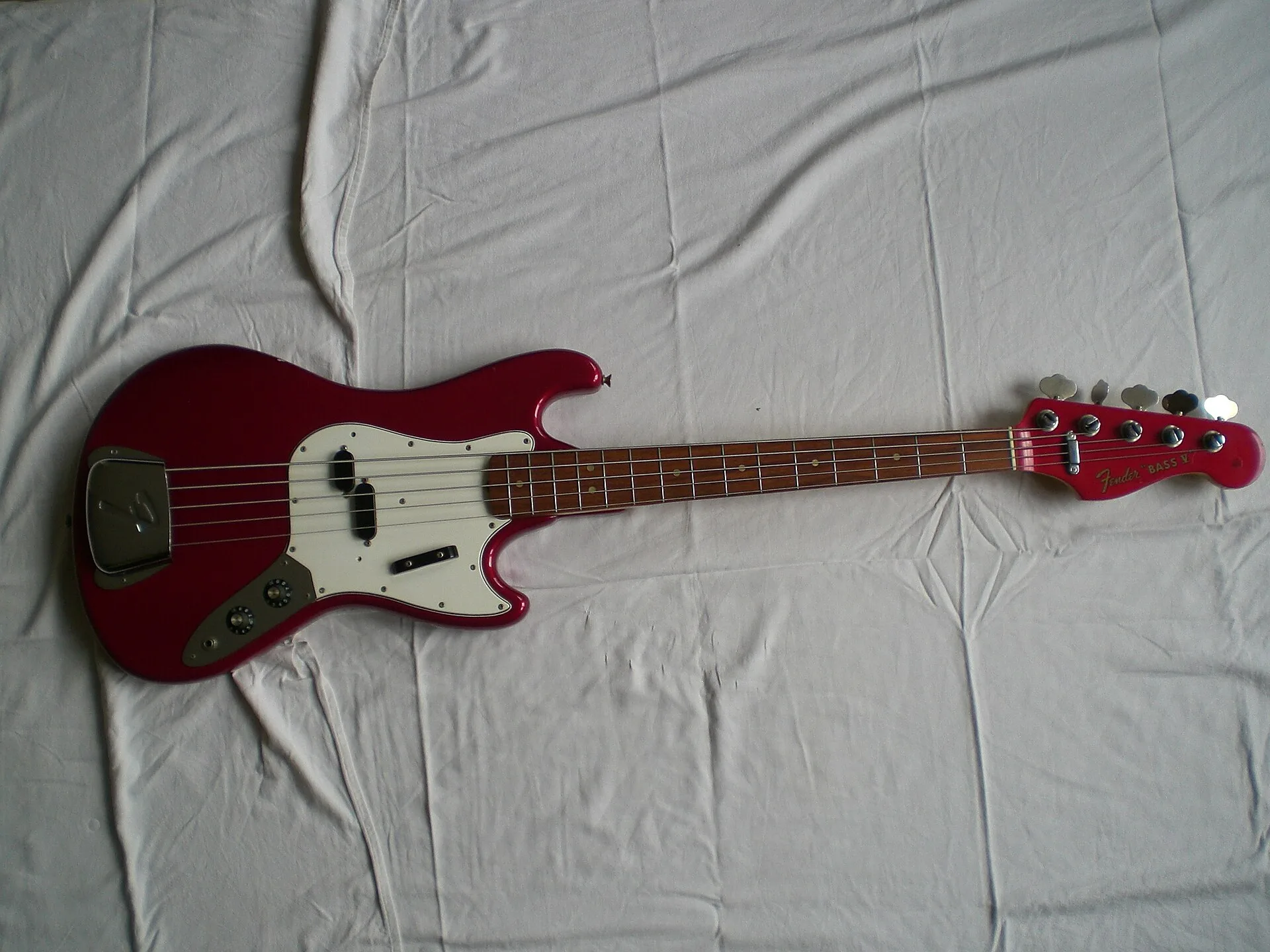
In 1965 Fender gave bassists a fifth string, a high C, so they wouldn’t have to climb the neck. It had 15 frets and a long stretch of bare body, and only about 200 were made. One of them went on tour with Led Zeppelin.
- Introduced
- 1965
- Type
- Solidbody electric bass
- Class
- Closed run
The short version
1951
The Precision
Fender’s first bass, late in the year. The Jazz follows in 1960 and the six-string Bass VI in 1961.
1965
The fourth Fender bass
The Bass V appears the year CBS buys Fender. Whether it was a Leo design or a CBS one depends who you ask.
1966
Blocks and binding
About a year in, the dots give way to block inlays and a bound neck. A maple board follows as an option.
1969
Last catalog
The May 1969 price list is the last to show it, at $359.50 in sunburst.
1970
Gone
Discontinued in 1970 or 1971, the first Fender bass to go. Leftover bodies end up on a guitar called the Swinger.
1973
On the road
John Paul Jones takes a 1967 Bass V on Led Zeppelin’s tour.
Side A
A1
Climbing the neck
Picture a bassist in 1965 reading a chart. The part keeps going up, past where a four-string is comfortable, and the only way to chase it is up the neck.
Fender’s answer was the Bass V. It was the company’s fourth bass, after the Precision, the Jazz, and the six-string Bass VI. It’s often called the first five-string bass guitar. And the fifth string didn’t go where you’d expect it now. It went on top.
The tuning is E-A-D-G-C. Fender’s own catalog put it this way: “The added fifth string is a high C, allowing faster technique with the lower frets and five additional notes at the top.”
A2
Fifteen frets and a lot of body
There was a catch, and you can see it from across the room. The scale is 34 inches, the same as a Precision or a Jazz. But the neck has only 15 frets. The board stops, and then there’s a long run of bare body out to the bridge. The whole bass is about three inches longer than a Precision. One writer calls the gap awkward. That’s polite.
The board stops, and then there’s a long run of bare body out to the bridge.
Did the extra string even raise the ceiling? The catalog promised five more notes at the top. Count the frets, though, and the highest note lands about where a 20-fret Precision’s already does. One reckoning puts it at E♭, another at E. Either way, what the high C really bought you was the same notes in fewer moves.
A3
Leo’s or CBS’s
The Bass V turned up in 1965, the same year CBS bought Fender. Whose idea it was is a real argument. One history says Leo and his people developed it before the sale. One book calls it “a typical pre-CBS design,” arriving “just as the torch was being passed to CBS.” Another book says “the new management introduced” it. Even the people who studied it call its development “sketchy at best.” Keep both.
The body is alder, offset and contoured like a Jazz, drawn longer and slimmer so the short neck still balances. The headstock is the Fender shape, stretched for a fifth key.
Flip the record · By the numbers
15
Frets. A Precision has 20.
E-A-D-G-C
The tuning. The fifth string is a high C, not a low B.
about 200
How many were made, by the usual estimate. Nobody published a count.
$359.50
Sunburst list price in May 1969. Blonde or custom was $377.00.
Side B
B1
Five strings in a four-string nut
Under the strings sits one split pickup: two poles for E and A, three for D, G, and C. The strings go through the body to five saddles, with a foam mute under the bridge cover. The cover still wears the Jazz Bass’s Flying F.
Here’s where players split. The nut is about the width of a Precision’s, and it carries five strings instead of four. One reviewer found the spacing comfortable. Many others found it narrow and didn’t stick with the bass. Both reports stand.
The neck changed under it. Dots and no binding at first, then blocks and a bound neck about a year in, then a maple board as an option. Sunburst was the catalog finish, with custom colors offered. A Candy Apple Red one with a matching headstock is rare, and the headstock is rarer than the color.
B2
About two hundred
The 1969 catalog was the last to show it: $359.50 in sunburst in May 1969, the same as the Bass VI. Then it was gone, in 1970 or 1971, the first Fender bass ever discontinued. The number people quote is about 200. It’s an estimate, not a ledger. Leftover bodies went onto a guitar called the Swinger.
James Jamerson owned one and may have tried it in the studio. Nobody has pinned it to a record.
John Paul Jones did better than that. He took a 1967 Bass V on Led Zeppelin’s 1973 tour, tuned E to C, and played it on “Over the Hills and Far Away,” “Heartbreaker,” and “The Song Remains the Same.” Fifteen frets and all. Years later he called it “the ugliest bass guitar in the world.”
B3
The other direction
Fender never brought it back. Look up a Bass V on Fender’s site today and you get an American Professional Precision Bass V or Jazz Bass V, with 20 frets and the extra string at the bottom, a low B. The name made it. The high C didn’t.
But in 1973 the ugliest bass in the world went out on tour with Led Zeppelin, playing the high notes the easy way.
Put this on
You’ve read about it. Now hear it. Here’s what this guitar sounds like, and what to listen for.
Over the Hills and Far Away (live, 1973)
Jones played his 1967 Bass V on this one on the 1973 tour. Find a live version from that year, not the studio record. That’s the 15-fret bass with the high C.
Find it on YouTube (opens in a new tab)Heartbreaker (live, 1973)
Another of the three songs the Bass V covered on the road in 1973. It’s the 1973 tour that ties it to the Bass V, not the studio record.
Find it on YouTube (opens in a new tab)The Song Remains the Same (live, 1973)
The third song named for the Bass V on the 1973 tour. Which night is which bass isn’t logged, so treat any one recording as a likely, not a certainty.
Find it on YouTube (opens in a new tab)
The cast
The people, and the specific guitars, that made the legend.
1973
John Paul Jones
1967 Bass V, tuned E to C
Of Led Zeppelin. Used on “Over the Hills and Far Away,” “Heartbreaker,” and “The Song Remains the Same” on the 1973 tour. Called it “the ugliest bass guitar in the world.”
James Jamerson
Bass V
Owned one and may have experimented with it in the studio. No Motown record is pinned to it. His famous basslines are the Precision.
2006
Phil Jones
Bass V, re-strung with a low B
Owner of the bass in a 2006 magazine review. It had lost its pickup cover and gained flatwounds and a low B, which is a later idea, not Fender’s.
Liner notes
Specs, construction, rarity, value, and every source we used.
Five strings tuned E-A-D-G-C, 15 frets, and a 34-inch scale — Fender’s Bass V, not a low-B five-string and not the Bass VI.
- Body
- Alder; offset double-cut, contoured; longer and slimmer than a Precision
- Neck
- Bolt-on maple, four-bolt plate. Unbound at introduction; bound about a year later
- Fingerboard
- Rosewood veneer, 15 frets. Pearloid dots, then blocks. A maple board becomes an option
- Scale
- 34". Millimetres unpublished
- Pickups
- One split-coil. Two poles for E and A; three for D, G, and C
- Hardware
- Five saddles; string-through body; chrome bridge and pickup covers; foam mute; retainer on D, G, and C
- Electronics
- Master volume, master tone
- Finish
- Shaded sunburst, or a custom color
- Nut
- Two measured 1965s straddle 1¾". Five strings in a four-string width. Millimetres unpublished
Open the full research fileConstruction details, the complete player record, production numbers, dated value estimates, and sources
Classic living example = a Fullerton Bass V, tuned E-A-D-G-C. No current Bass V. American Professional Precision Bass V and Jazz Bass V are modern low-B fives, 20 frets, not this table. Not a Precision, Jazz, Mustang Bass, Telecaster Bass, or Bass VI. Not a Strat, a Tele, or an offset guitar. No Gibson SKUs. Mixed inch/mm flagged: 34", the nut, and “three inches longer than a Precision” are inches only. Millimetres unpublished. Two 1965s weighed 9.70 lb and 9.80 lb; one auction bass was 3.47 kg. Not a factory weight. Do not average the nut readings.
Construction
The job was a fifth string for notes a reading bassist was already chasing up the neck. Not a lower B. Not a guitar.
Fender already had three basses. Vintage Guitar (Willie G. Moseley, August 2007): Precision, late 1951; Jazz, 1960; Bass VI, 1961. The Bass V was the fourth. Wikipedia and Reverb News call it the world’s first five-string bass guitar. Moseley calls it the original one. Tuning is E-A-D-G-C, the extra string above G. The 1969 catalog, via Vintage Guitar and Bass: “The added fifth string is a high C, allowing faster technique with the lower frets and five additional notes at the top.” Wikipedia reads the ceiling the other way: the top note is still the E♭ of a 20-fret Precision or Jazz, so this is not an extended-range bass. Bass Player (Dave Pomeroy, March 2006) prints that top note as E, “just like on a Precision or Jazz Bass.” Keep the catalog’s five extra notes, Wikipedia’s E♭, and Pomeroy’s E.
The scale stayed 34", the same as a Precision or a Jazz. The Bass VI is 30". Fifteen frets is what moved. The board stops, then a long run of body out to the bridge. Moseley calls the gap awkward. Pomeroy, on Phil Jones’s bass: the whole instrument is three inches longer than a Precision. Reverb News (10 February 2023) repeats the three inches. Overall length, not a second scale. No factory drawing of those three inches was in hand, and no millimetres for scale, nut, or that extra length. Flagged above.
The plate year is 1965 because that is the launch the sources share, not because the drawing-board story is settled. Moseley: developed pre-CBS by Leo and associates, made from 1965 to ’70. Klaus Blasquiz, The Fender Bass, p. 26, quoted by Fretted Americana: it “made its appearance” in 1965, “just as the torch was being passed to CBS,” and it was “a typical pre-CBS design.” Jim Roberts, How the Fender Bass Changed the World, p. 69, on that same page: after the January 1965 sale to CBS, “the new management introduced” it. Pomeroy: introduced in 1965, not long after the sale, and the development history is “sketchy at best.” No production neck from before 1965 turned up this pass. One Olympic White that Fretted Americana calls early carries plate 600073 and Stackpole pots coded October 1965. A 1965 Candy Apple Red sold in 2025 had pots from the 42nd week of 1965. Those date the launch. They are not a silent prototype year.
Alder, offset, contoured, stretched beside a Precision or a Jazz. Moseley: the usual contours, drawn slimmer so the short neck still balances. The 1969 catalog says an “off-set” waist. Fretted Americana, on a 1965: asymmetrical double-cut, contoured on the back and the lower bout, four-bolt maple neck. Headstock is the Fender silhouette, lengthened for a fifth key. That Olympic White reads gold “Fender BASS V,” with “Offset Contour Body” on the ball. A retainer holds D, G, and C. Not a Strat, a Tele, or a Jazzmaster.
One split-coil, three descriptions. Moseley: a split-oval, kin to the Electric XII pickup from about the same moment, the other way around — E and A on the bass half, D, G, and C on the treble. Blasquiz: two poles and three, a Jazz-style plate, volume and tone. Pomeroy: it looks like a Precision split and behaves more like the later Mustang Bass pickup. He found the spacing comfortable. Wikipedia says many players did not: narrow spacing, and a body they would not live with. Both reports stand. Nobody published a string-to-string figure. Blasquiz sets the nut next to a Precision’s 1¾". Fretted Americana’s two 1965s sit just under that and just over. Five strings in a four-string nut. Do not average them.
Five individual saddles, strings through the body, ferrules countersunk, a foam mute under the bridge cover. Moseley: the cover is shaped more like a Precision’s and still wears the Jazz’s Flying F. Early photos show a handrest over the pickup. Wikipedia: chromed bridge and pickup covers from the start. Pomeroy’s review bass had lost the pickup cover and been re-strung low B, with flatwounds. Later setup. Factory string is the high C.
The neck does not sit still. Moseley: rosewood dots first; about a year in, blocks and binding, alongside the Jazz, the Bass VI, the Jazzmaster, the Electric XII, and the Jaguar. MusicRadar (Roger Newell, 24 July 2012): unbound, then around 1966 bound with blocks, a maple board a year later. Reverb: blocks from mid-1966. Blasquiz is finer: white binding and large markers in 1966; maple cap, black binding, large markers in 1967; in 1970, one-piece maple or a rosewood cap, white binding, large markers. The 1969 catalog still says rosewood. Sunburst is the catalog finish; custom colors were offered. Moseley, on Candy Apple Red with a matching headstock: rare, and the head rarer than the color.
That 1969 Lovin’ Care book is the last to show it. Vintage Guitar and Bass, page 7: May 1969, sunburst $359.50, blonde or custom $377.00, the same tags as the Bass VI. 1969 money. No 1965 list price turned up. None invented. Moseley: first Fender bass discontinued, gone in 1970. Pomeroy: about 200 or so, out in 1970. Wikipedia and Reverb News: about 200, out in 1971. Blasquiz: last catalogue line in 1969, gone in 1971. Reverb’s year field prints 1965–1971 and its overview prints 1965–1970. Keep 1969, 1970, and 1971. “About 200” is their estimate, not a ledger.
Leftover bodies became the Swinger / Musiclander, Moseley’s parts guitar for what was left on the floor. Wikipedia names the Swinger. A guitar, not this bass. Moseley in 2007 already had no reissue. Fender’s site this pass, under the name, returns an American Professional Precision Bass V and a Jazz Bass V — low B, 20 frets. Wikipedia’s 2016 Squier Gary Jarman Signature took the outline, not this pickup, this neck, or this tuning.
Classic against anything you can order: alder, 34", 15 frets, high C, one split-coil. Then nothing.
Players
A Precision, a Jazz, a Bass VI, or a modern low-B “V” is a different bass. So is Jamerson’s Funk Machine. That one is the Precision.
John Paul Jones — a 1967 Bass V, on the road with Led Zeppelin in 1973. Guitar World (Nick Wells, 15 December 2022): tuned E to C, and used, 15 frets and all, on “Over the Hills and Far Away,” “Heartbreaker,” and “The Song Remains the Same.” In a 2012 interview with Dave Lewis he called it “the ugliest bass guitar in the world.” The bass he is known for is still the 1962 Jazz, serial 74242, bought in 1963. The same piece’s other instruments — a 1952 Precision, a Gibson EB-1, a Hagström eight-string, the Alembics — stay off this plate. A Reverb title that says “as played by John Paul Jones” is a seller’s line, not the 1967.
James Jamerson. Roberts, p. 69: he owned a Bass V and may have experimented with it in the studio. Pomeroy names the same pair, Jamerson and Jones, and says the records are hard to pin. No Motown master is attached here. The songs people mean by Jamerson stay on the Precision plate.
Wikipedia’s owner list also names Fred Turner and Walter Becker. No interview, serial, or album credit for a Fender Bass V under either name turned up this pass. Do not hang Bachman-Turner Overdrive or Steely Dan on this bass. Vintage Guitar’s 2022 note on Becker’s basses names a 1958 Precision, a Bass VI, and a Jim Crawford custom. Not this model.
Also known to play: nothing further sourced.
Rarity
You cannot order a new Bass V. There is no reissue generation under the vintage one. The five-strings in Fender’s current book are other models.
Fender published no Bass V shipping total. None invented. The number that circulates is about 200 — Pomeroy, Wikipedia, Reverb News — and the year it stops is 1970 or 1971, with a last catalog line in 1969. Neck-plate serials were shared across the factory. They date a bass. They do not count a year. That is why a first-year census is unknown, not the chapter.
What is actually thinner: a 1965 unbound dot-board; a custom color, matching headstock especially; a bass that still has both covers and the mute. Jones’s 1967, and any bass that was Jamerson’s, are single objects. They are not “a vintage Bass V.” A Swinger on a leftover body is a different instrument.
Value
Informal estimate, 19 October 2026. Not an appraisal.
Asking prices are not sold prices. “About 200” is not a factory count. A low-B restring is still this bass. Artist instruments sit outside the ranges. Reverb’s 1965–1971 guide printed “used estimate unavailable” this pass. No Good–Mint band. Do not average the sold rows into a midpoint.
New street. None under this name. Fender.com this pass lists an American Professional Precision Bass V at $1,949.99, and its search results list an American Professional Jazz Bass V at $1,999.99. Low-B catalogs. Not comps. May 1969 list was $359.50 sunburst and $377.00 blonde or custom. That is 1969 money.
Used modern. Nothing to price. No reissue in Moseley’s 2007 account, and none on the 2026 Fender search under this name.
Vintage / collectible. Reverb’s sold table on the 1965–1971 page, not a printed band: Excellent $3,100 (17 November 2022), Very Good $5,499 (18 March 2023), Excellent $6,250 (25 March 2023), Excellent $3,250 (24 July 2024), Very Good $3,750 (11 October 2024), Very Good $4,930 (19 December 2024), Very Good $4,500 (14 July 2025). Asks on that page this pass sit higher: a 1970 sunburst, Very Good, $5,364.27 (cut from $7,675.31); a 1966 Excellent titled “as played by John Paul Jones,” $6,479.95 (from $7,199.95) — the title is not his bass; a 1966 Very Good $7,500; a 1967 sunburst, Very Good, $8,000; a 1966 Candy Apple Red, Very Good, $9,224.46. Do not average those asks with the sold rows. Gardiner Houlgate, December 2025: a 1965 Candy Apple Red, pots from the 42nd week of 1965, bridge cover missing, sold for £2,700 against an estimate of £3,000–£4,000. Pounds. Not a dollar comp. Jones’s 1967 is one object. Not a comp.
See also
- Precision Bass — 1951, 34", 20 frets, four strings. The scale this shares, and the neck it was trying not to climb
- Jazz Bass — 1960 offset four-string. Some of the hardware. Not five strings, and not 15 frets
- Bass VI — 1961, six strings, 30", an octave below guitar. The other odd Fender bass. Not this one
Sources
- *Vintage Guitar*: The Fender Bass V (Willie G. Moseley, August 2007 issue; posted 2010) — pre-CBS development; made 1965–70; fourth Fender bass after Precision, Jazz, and Bass VI; high C; 15 frets; 34" against the VI’s 30"; dots then, about a year later, blocks and binding; alder; split-oval pickup, E/A vs D/G/C, reverse of the Electric XII; string-through, five saddles, foam mute, Flying F bridge cover; first Fender bass discontinued, 1970; surplus bodies into the Swinger / Musiclander; no reissue as of 2007
- *Bass Player*: Retro-Rama, Dave Pomeroy, March 2006 (archive) — introduced 1965, after the CBS sale; 15 frets; highest note printed as E; about 200, discontinued 1970; three inches longer than a Precision; 34"; string-through; spacing “comfortable”; Phil Jones’s example re-strung low B; Jamerson and Jones owned one; records hard to pin
- Wikipedia, Fender Bass V — 1965–1971; “world’s first five-string”; high C; same top note E♭ as a 20-fret four-string; chrome covers; narrow spacing; about 200, discontinued 1971; Swinger bodies; 2016 Squier Gary Jarman, body influenced by this outline; owner list includes Jamerson, Jones, Turner, Becker
- 1969 Fender catalog, Bass V copy (Vintage Guitar and Bass) — high C; “five additional notes at the top”; split pickup; volume and tone; rosewood; offset waist; sunburst or custom color
- 1969 Fender catalog, page 7 prices (Vintage Guitar and Bass) — last catalog to include the Bass V; May 1969, sunburst $359.50, blonde/custom $377.00, same as the Bass VI
- MusicRadar: Cool and classic basses, Roger Newell, 24 July 2012 — 34"; unbound, then around 1966 bound with blocks; maple option a year later; John Paul Jones
- Reverb News: Find of the Week, 10 February 2023 — 1965, then this 1966; high C not low B; three inches longer than a Precision; 15 frets; about 200, discontinued 1971; alder, maple, rosewood, split-coil
- Reverb: Fender Bass V 1965–1971 — year field 1965–1971; overview production 1965–1970; blocks from mid-1966; used estimate unavailable this pass; sold table and asks cited in Value
- Fretted Americana: 1965 Olympic White Bass V — 9.80 lb; nut just under 1¾"; 34"; 15 frets; unbound dots; alder; plate 600073; Stackpole pots October 1965
- Fretted Americana: 1965 Candy Apple Red Bass V — 9.70 lb; nut just over 1¾"; quotes Blasquiz, The Fender Bass, p. 26, and Roberts, How the Fender Bass Changed the World, p. 69
- *Guitar World*: John Paul Jones’s basses, Nick Wells, 15 December 2022 — 1967 Bass V, E to C, 1973 tour, three named songs; “ugliest bass guitar in the world” (Dave Lewis, 2012); Jazz 74242 bought 1963
- *Vintage Guitar*: Fretprints, Walter Becker, 2022 — his named basses are a 1958 Precision, a Bass VI, and a Jim Crawford custom. Not a Bass V
- Fender: American Professional Precision Bass V — current low-B five-string, $1,949.99 this pass. Not the 1965 model
- Fender search: “Fender Bass V” — no vintage Bass V reissue; American Professional Jazz Bass V listed at $1,999.99
- Gardiner Houlgate: 1965 Candy Apple Red, December 2025 — pots, 42nd week of 1965; 3.47 kg; bridge cover missing; estimate £3,000–£4,000; sold £2,700
Keep digging
Guitars this one gets compared to, confused with, or descended from.
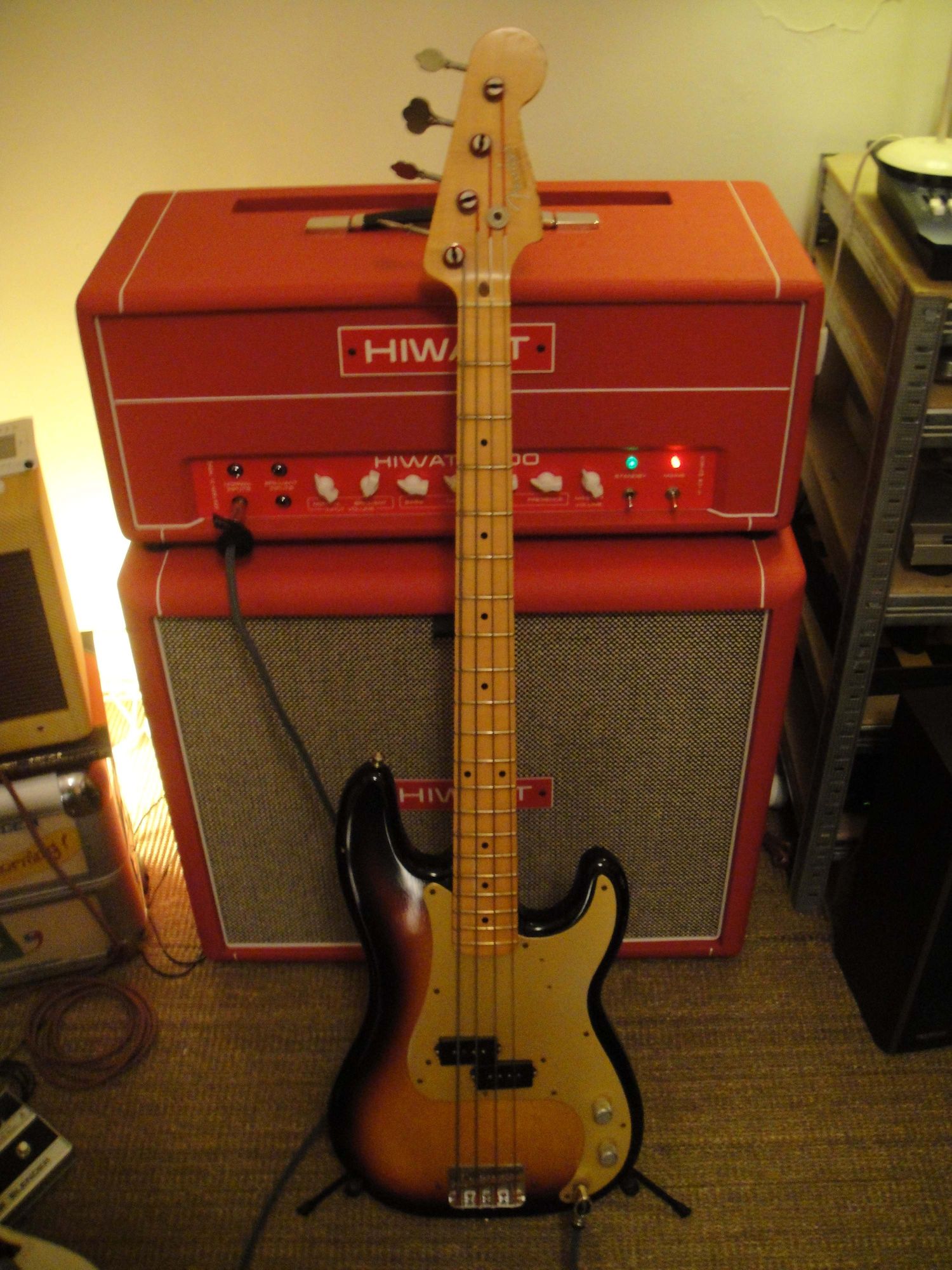
Photo: Infrahertzz / Wikimedia Commons / CC BY-SA 3.0 Fender
Precision Bass
1951
Leo’s bass let the player at the back be heard. You know their lines by heart. You mostly don’t know their names.
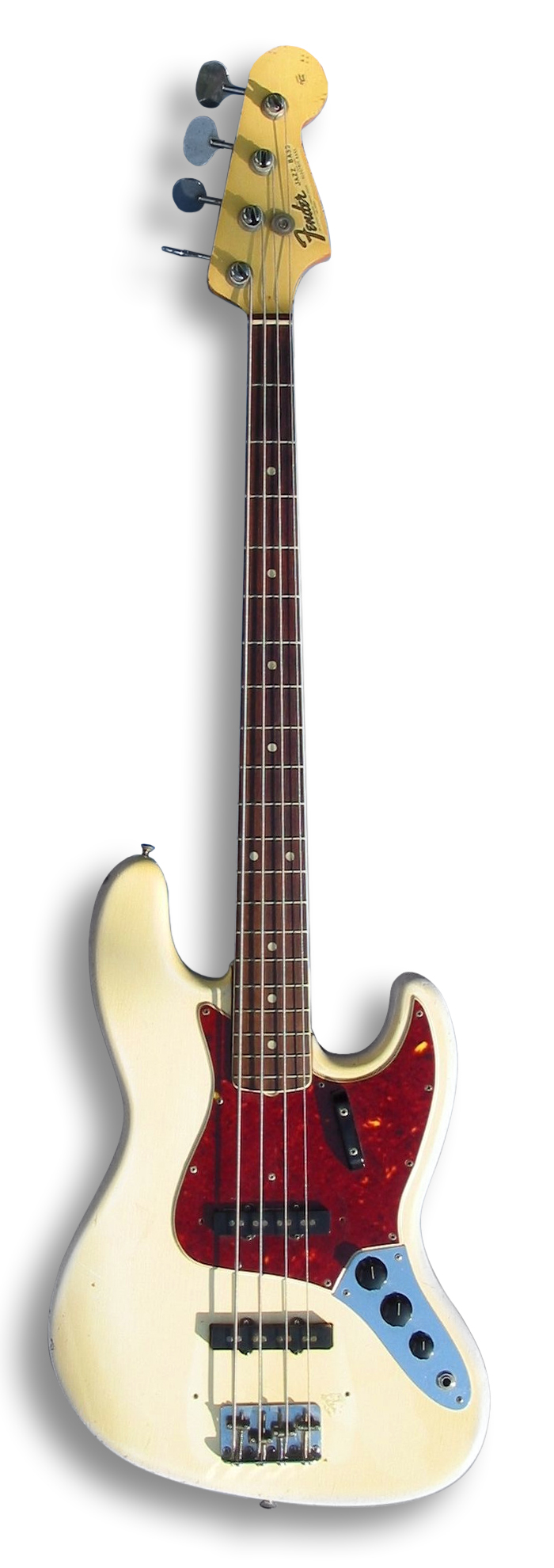
Fender Jazz Bass from 1966 in Olympic white with the transition fingerboard (bindings and dot inlays). Photo by Th. Ott. Licensed under CC BY-SA 3.0. Via Wikimedia Commons. Fender
Jazz Bass
1960
Built for jazz players who mostly passed on it. Then bass players started using it to take the solo.
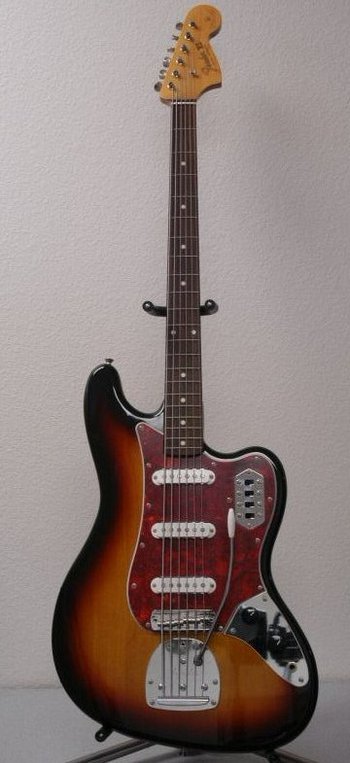
Photo: Blackyde / Wikimedia Commons / CC BY-SA 3.0 Fender
Bass VI
1961
Six strings, an octave down. It’s what a guitar player picks up when somebody hands them the bass part.