Fender
Kingman
Fender built a dreadnought the only way it knew: screw the neck on and run a broomstick through it.
In 1963 the folk boom wanted acoustics, and the company that made the Stratocaster had never designed one. So a German carver built Fender a flat-top that was put together like a Fender, with a bar of aircraft aluminum inside where a glued neck joint would have been.
- Introduced
- 1963
- Type
- Flat-top steel-string acoustic
- Class
- Production
Have a photograph of this guitar? Send a picture
The short version
1962
Rossmeisl arrives
Roger Rossmeisl, late of Rickenbacker, goes to work for Leo Fender.
1963
The King
In the summer, the King, Concert, Classic, and Folk debut, Fender’s first acoustics of its own.
1964
Anaheim
In January the work moves from Fullerton to Missile Way in Anaheim.
1965
CBS
CBS takes over Fender early in the year.
1966
Kingman
In the summer the King is renamed. Some accounts say 1965–66.
1967
Clambake
Elvis Presley films with a Fender acoustic in March. Which one is still argued.
1971
The end
The U.S. flat-tops, Kingman included, are gone by late 1971. Or around 1970, depending who you ask.
Side A
A1
Leo hires a carver
In 1962 Roger Rossmeisl was in Fullerton, and in the version Fender tells, he walked up to Leo and said he was going to start. Leo hired him on the spot. In another telling, Rossmeisl came to Leo with an idea for acoustics with bolt-on necks and quit Rickenbacker to build them. Either way, he got the job.
He was an odd fit, and a good one. Born in Graslitz in 1927, he had come to America in the early fifties, done a short stint at Gibson, and then gone to Rickenbacker, where he drew the Capri, the cresting-wave body, and the 4001 bass. His habit was the German carve, a dished rim around the top of a guitar. The King's top doesn't have it.
Fender didn't have a real acoustic of its own. Radio-Tel had sold inexpensive ones in the late 1940s, and a few Harmony-built guitars had worn the badge. Nobody at Fender had designed one.
A2
Summer 1963
The folk boom was on, and in the summer of 1963 Fender showed four flat-tops at once: the King, the Concert, the Classic, and the short-lived Folk. The King was the top of the book, a dreadnought, the shape everyone already knew from Martin.
It was nothing like a Martin inside. A Martin's neck is glued into a dovetail in the body. The King's neck was bolted on with screws and a neck plate, like a Stratocaster, and the headstock was a Strat's, six tuners in a row. The pickguard was screwed to the top. The bridge on the early guitars had six adjustable saddles, like an electric's.
Fender people built acoustics the way they built everything else. Screw it together, and you can take it apart.
A3
The broomstick
Inside the body, a one-inch rod of aircraft aluminum runs parallel to the strings. Fender called it a broomstick stabilizer. Others called it a tone bar.
It wasn't in the first drawing. The earliest guitars, a couple hundred or 200 to 300 depending who you ask, went out without it. Then the rod went in, and it stayed. Whatever you call it, one historian says it did little to the sound. Its job was to stand in for the heel and the dovetail that a bolt-on neck doesn't have.
The top was solid spruce, the back and sides mahogany unless you paid for something else. The catalog offered Brazilian rosewood, Indian rosewood, zebrawood, or vermilion. In December 1965 the King listed for $267 to $365.
Flip the record · By the numbers
1"
The aircraft-aluminum rod running inside the body, parallel to the strings.
200–300
Early guitars built before the rod went in. Or “a couple hundred,” in Fender’s count.
$267–$365
The King’s list price range in December 1965.
25.5"
Scale length. Same as a Stratocaster.
Side B
B1
A new name on the same box
In January 1964 the work moved from Fullerton to Missile Way in Anaheim. Early in 1965 CBS bought Fender, and after that, there wasn't much new thinking about acoustics.
In the summer of 1966 Fender dropped the Classic and changed one word on the King's peghead. It became the Kingman. Some sources put the rename in 1965 or 1966; the company says summer 1966. Same guitar either way. The colors opened up with the name, or within a couple of years of it: sunburst, black, Antigua, custom colors.
That same summer came Wildwood, beech dyed by injection while the tree was still alive. Fender says it was based on the Kingman. The dyed beech went onto Kingmans, and onto a separate acoustic called the Wildwood, numbered I through VI. Keep that straight, because it matters for the next part.
B2
Which guitar did Elvis play?
In March 1967 Elvis Presley filmed Clambake with a Fender acoustic. Fender calls it his Kingman. When it made an Elvis Kingman signature in 2012, it called that guitar "an evocation of the freewheeling Fender acoustic that Elvis Presley wielded" in the film.
Frame by frame, it looks like something else: in two scenes, a Wildwood VI. A March 1967 publicity still does show a Kingman, in Wildwood dye. So it's a Kingman in the ads, a Wildwood VI on screen, and a Kingman in Wildwood in the still. Pick whichever you like, but don't tell anyone it's settled.
Buck Owens is the other trap. The red, white, and blue guitar people picture him with is a Harmony. One account says he turned up on television with a natural Fender King. No Bakersfield record is tied to a Kingman.
B3
Gone by '71
The U.S. flat-tops were gone by late 1971, or around 1970, depending who you ask. Rossmeisl went home to Germany in the early seventies and died in 1979, at 52.
The name came back, more than once, on guitars without the rod inside. They aren't this one.
This one you can spot from across the room by its Strat headstock. Inside it is the bar of aluminum: the answer a company of electric-guitar builders gave to a problem Martin solved with a dovetail and glue.
The cast
The people, and the specific guitars, that made the legend.
1963
Roger Rossmeisl
Designer
Born in Graslitz in 1927, known for the German carve, and the man behind Rickenbacker’s Capri and 4001 before he came to Fender.
1962
Leo Fender
Hired the man who drew it
In one telling, Rossmeisl told Leo he was going to start, and Leo hired him on the spot.
1967
Elvis Presley
A Fender acoustic in Clambake
Fender calls it his Kingman. A frame-by-frame look says it’s a Wildwood VI. A publicity still from that March shows a Kingman in Wildwood dye.
Buck Owens
Maybe a natural Fender King, on TV
One account has him on television with a natural King. His red, white, and blue guitar was a Harmony.
Liner notes
Specs, construction, rarity, value, and every source we used.
A dreadnought with a bolt-on maple neck and an aluminum rod through the body — Fender’s King, renamed Kingman, not a Martin and not a Strat.
- Body
- Dreadnought flat-top. Solid spruce top; mahogany back and sides on the standard King (Blue Book). Lower bout 15.625" — inches only; no millimetres printed for that width. Catalog options: Brazilian rosewood, Indian rosewood, zebrawood, or vermilion (Wright, Vintage Guitar, Nov. 2007; Blue Book).
- Neck
- Bolt-on maple, neck plate, six-in-line head. The joint is screws, not a dovetailed heel.
- Fingerboard
- Bound rosewood, pearl dots, 21 frets (Blue Book on the King; Kingman “similar”). Blocks turn up on some Kingmans. The Wildwood acoustic’s board is blocks (Blue Book). No factory radius published.
- Scale
- 25.5" (Blue Book; guitar-list; Scottymoore on the King). Watanabe printed 647.7 mm on a guitar they date 1967. GuitarPoint printed 650 mm on a guitar they call a 1965 Kingman. Mix flagged. Do not average.
- Pickups
- None. A DeArmond is on some guitars after the fact. Not this row.
- Hardware
- Rosewood bridge, six adjustable saddles (Scottymoore on the early line; Cream City on one Kingman). Pickguard screwed to the top (Fender; Wright). Six-on-a-side tuners; the brand follows the rest of Fender’s hardware.
- Electronics
- None
- Finish
- King: natural (Blue Book). Kingman: natural or sunburst; Wright adds sunburst, Antigua, black, and custom colors with the 1966 name. Blue Book pins maple, rosewood, or vermilion backs, plus black, custom colors, and Antigua, to 1968.
- Nut
- No single factory width. Cream City measured 1 5/8" on one zebrawood guitar they date 1965. Watanabe printed 42 mm on the 1967 above. Mix flagged. Do not average.
Open the full research fileConstruction details, the complete player record, production numbers, dated value estimates, and sources
Classic living example = the 1963–71 USA King / Kingman: bolt-on dreadnought, spruce over mahogany unless the catalog wood says otherwise, aluminum rod inside. YAML introduced: 1963 is the summer 1963 launch as the King (Fender). The headstock name Kingman is summer 1966 (Fender; Wright). Wikipedia’s body and Scottymoore say 1965–66. Keep both. Concert, Classic, and the short-lived Folk are the other 1963 boxes. Shenandoah is the 12-string. Wildwood I–VI is its own catalog guitar on this shape. Kingman Bass is a current 4-string. The California Vintage King, Kingman SCE / ASCE, the 2012 Elvis Kingman, the 2014 Kingman Pro, and the 2024 Buck Owens Kingman are later instruments. Not this table. Standalone. Not under Strat, Tele, or any live family. No Gibson SKUs. Mixed inch/mm flagged. Do not average 25.5" / 647.7 mm / 650 mm, or 1 5/8" / 42 mm.
Construction
The job was a Fender for the folk boom. A dreadnought, a neck bolted on, six tuners in a row. Not a dovetailed Martin. Not a Tele. Not an offset.
Roger Rossmeisl arrived in 1962. Fender, quoting Richard Smith: already in Fullerton, he told Leo he was going to start, and Leo hired him on the spot. Wright: he approached Leo about bolt-neck acoustics and quit Rickenbacker. Keep both. Born 1927 in Graslitz, son of Wenzel (Wright). Emigrated 1952 (Wright) or 1953 (Fender). A short Gibson stay — Wright says about a year, and that Ted McCarty remembered a cruise-ship Hawaiian gig after it — then Rickenbacker: Capri, the cresting-wave body, the 4001. The German carve is his other habit. This top does not have it.
Fender: the King, Concert, Classic, and short-lived Folk debuted in summer 1963. Bolt-on necks, Stratocaster heads, pickguards screwed to the top. The King was the top of that book, the dreadnought (Wright; Blue Book). This plate’s year is that summer. The peghead still said King.
Two earlier claims sit next to that debut, and neither is this guitar. Fender: Radio-Tel sold inexpensive acoustics in the late 1940s, and a Fender-name acoustic waited more than a decade. Wright and Blue Book: a few Harmony-built guitars wore the badge before Rossmeisl. The 1963 four are the first acoustics Fender designed and built.
The rod was a fix, not the first drawing. Fender: apart from a couple hundred very early guitars, a 1" aircraft-aluminum rod ran front to back, parallel to the strings. Wright: the first 200 to 300 or so had none. Keep both. They describe the pre-rod guitars, not a year total. Fender calls the rod a broomstick stabilizer. Wikipedia calls it a tone bar. Wright: little effect on the sound; it stands in for the heel and the dovetail a bolt-on does not have. One Reverb listing called a 1963–64 top X-braced. One guitar. The catalogued oddity is the rod.
Fullerton first, 500 S. Raymond Ave. In January 1964 the work moved to 1560–1580 Missile Way, Anaheim (Fender).
The rename. Summer 1966, the Classic was dropped and the King became the Kingman (Fender; Wright: “In ’66”). Wikipedia’s lead says re-introduced in 1966; its body says 1965–66. Scottymoore: 1965/66. Blue Book: King through 1966, Kingman 1966–1971. Burrluck: the name was first used in 1966. Keep summer 1966, and keep 1965–66 beside it. Same box. Different word on the peghead.
The siblings are another width or another head. Palomino, December 1964. Malibu and Newporter, April 1965. Shenandoah and Villager, July 1965 (Fender). Concert is the other 1963 dreadnought-style box, 15.375" against the King’s 15.625" (Blue Book). Wright: triple binding on the King, single-ply on the Palomino. No Gibson SKUs.
Wildwood, summer 1966, is dye injected into living beech, “based on the Kingman,” half a dozen colors (Fender) — and also its own model. Wright: the same beech went onto Kingmans, Coronados, and guitars named Wildwood. Blue Book’s Wildwood acoustic, 1966–1971, is beech and blocks. Scottymoore: 1967 numerals I–VI; by 1968 the literature listed three colors and re-sequenced them. His color key is marked “likely.” Do not print it. Antigua on a Kingman is still a Kingman (Wright; Blue Book, 1968). A Wildwood VI is the other catalog guitar.
CBS took over in early 1965. Fender: little new acoustic thinking after that, Wildwood aside. Redondo, summer 1968. Japanese F-series, summer 1969. The U.S. flat-tops, Kingman included, were gone by late 1971 (Fender) or around 1970 (Wright). Keep both. Rossmeisl went back to Germany in the early 1970s and died in 1979 at 52.
Later names are not this table. The 2015 ASCE is not bolt-on: 643 mm (25.3"), nut 42.7 mm, £549 (MusicRadar). The 2014 U.S. Kingman Pro is a bolt-on without the rod in Gerken’s description — 25.625" scale, 1.7" nut, 10" radius, street $2,600 (Premier Guitar); guitarsite.com prints MSRP $3,250. No millimetres on those Pro figures. Do not convert. California Vintage King, fender.com this pass: the King name, ovangkol, 25.5", list $949.99, sold out. Session prints 648 mm for that 25.5"; Kley Zemer prints 64.77 cm. Mix flagged. Buck Owens Kingman: $729.99 on Fender, sold out — a 2024 color guitar, not a broomstick. Kingman Bass: 30.3" (770 mm), four strings.
Not a Strat, not a Tele, not a Coronado, not a Thinline. The Thinline is the Rossmeisl Fender that stayed. Standalone. No Gibson SKUs.
Players
Do not hang a Martin, a J-45, a Harmony, or a Coronado on this plate. Do not move a Wildwood VI onto a Kingman headstock because the body dye matches. Fender’s acoustic history names Johnny Cash, George Jones, Buck Owens, Tex Ritter, Wanda Jackson, Charley Pride, Ray Davies, Robbie Robertson, and Elvis as people who used Fender acoustics. That sentence is the whole line. It is not a Kingman serial.
Elvis Presley — Clambake, filmed March 1967. Fender’s history calls it his Kingman, and the 5 January 2012 Elvis Kingman press release calls the signature “an evocation of the freewheeling Fender acoustic that Elvis Presley wielded” in the film. Guitar World’s same-day report: MSRP $599.99. Scottymoore, looking at the frames: two scenes show a Wildwood VI, the separate 1967 catalog guitar. A March 1967 publicity still is a Kingman with Wildwood dye. Double Trouble promo photos from the same season show a headstock that appears to read Kingman; Scottymoore: that guitar was not in the film. Clambake also puts a classical guitar in his hands. Keep the film guitar as Scottymoore’s Wildwood VI, Fender’s marketing as Kingman, and the still as a Kingman in Wildwood. The 2012 signature is laminated “Wildwood-style” sides, 20 frets, a Viking bridge (Fender). Not a 1967 bolt-on. Not a comp.
Buck Owens is the other trap. Guitar World, 22 October 2024: the red, white, and blue guitar tied to his image, and to Hee Haw, is a Harmony H169. The Kingman Fender shipped that week “looks to recreate the vibe” of that Harmony. Launch price in that piece: $699. Fender’s own page, fetched this pass at $729.99 and sold out, calls him one of Fender’s first acoustic artists and says he played red, white, and blue guitars. It does not say those guitars were Kingmans. Sweetwater’s product copy says television footage often shows him with a natural-finish Fender King. Keep the Harmony (Guitar World) and the natural King (Sweetwater). Do not put Bakersfield records on a Kingman.
Van Stoneman’s Fender, the one the company gave him as an endorsee in 1967, is a Wildwood II (Scottymoore). He had been playing a Gibson J-50 with a DeArmond. Off this plate.
Also known to play stays the Fender list above, and only as Fender acoustics. Charley Pride’s documented Fender is a Coronado, on that plate. No Kingman session log is published here for Cash, Davies, Robertson, or Jackson.
Rarity
You cannot buy a new bolt-on Kingman. The U.S. flat-top book closed by late 1971 (Fender) or around 1970 (Wright). Guitars that reuse the name are other joints. They are not a 1966 Kingman.
Fender published no King or Kingman totals. None invented. Wikipedia: a sequential plate on the back, and the numbers varied too widely to be a clock. A plate dates one guitar. It does not count a year. That is why a first-year census is unknown.
The “couple hundred” (Fender) and “200 to 300” (Wright) are only the guitars without the rod. Not a 1963 total. Do not merge them.
What is actually thinner: a peghead that still says King; Brazilian, Indian rosewood, zebrawood, or vermilion backs; Antigua and the custom colors; a Wildwood acoustic whose dye is still the point (Fender: they never really caught on). Mahogany, natural or sunburst, is the Kingman you are more likely to meet. Elvis’s film guitar and any one plate are single objects. They are not a vintage Kingman.
Value
Informal estimate, 22 October 2026. Not an appraisal.
Ask is not sold. Do not average a King, a Kingman, a Wildwood, and a signature, and do not paste Strat or D-18 bands onto this bolt-on. December 1965 list, still the King (Vintage Guitar and Bass): $267–$365, with Concert $242–$340, Palomino $195, Malibu $155, Newporter $115 on the same page. Which wood was which dollar is not printed. Period money. Scottymoore’s Fender-page table spans Kingman MSRP $280–$394 and labels the years 1965–1971, which fights the summer 1966 rename. A span, not a sticker.
New street. None for the bolt-on. California Vintage King $949.99, sold out on fender.com — the King name, not this guitar. Buck Owens Kingman $699 (Guitar World, 22 Oct. 2024); Fender’s page $729.99, sold out. Kingman Bass, another cart, zZounds $579.99. Kingman Pro street $2,600 (Premier Guitar, Feb. 2014) against MSRP $3,250. Elvis Kingman MSRP $599.99 (Jan. 2012). ASCE £549 (Sept. 2015). Not 2026 prices for a broomstick dreadnought.
Used modern. SCE, ASCE, the Elvis signature, and the Pro are other guitars. Named asks, not hammers: a Kingman SCE at $449 (Blue Book’s for-sale scrape); one 2012 Elvis signature at $1,095 (guitar-list). Do not fold them into a 1967.
Vintage / collectible. Reverb’s 1966–1971 Kingman dollar widget was empty this pass. Flag: no order-counted band. Named asks: Garrett Park, a 1966, $1,200; Gary’s, a 1967 with a DeArmond, $2,995 / £2,581.61 on the Reverb UK listing. A sunburst tagged 1968–71 asked at $2,175 (guitar-list) and $2,500 (a listing on the Vintage Guitar and Bass catalog page). Do not average. That same page asks $15,000 for a 1963 King, plate 0061. One object. Not a sold Kingman.
See also
- fender-coronado — Rossmeisl’s 1966 hollow electric; DeArmond coils and no aluminum rod; not this flat-top
- martin-d-18 — spruce and mahogany dreadnought, dovetailed; the guitar this bolt-on was built to stand next to
- fender-telecaster-thinline — the Rossmeisl Fender that stayed; a Tele slab with one f-hole, not an acoustic
Sources
- Fender, History of Fender’s Acoustic Guitars (Jeff Owens) — Rossmeisl early 1962, Smith hiring story; King, Concert, Classic, Folk, summer 1963; bolt-on, Strat head, screwed pickguard; a couple hundred early guitars, then 1" aircraft-aluminum rod; Raymond Ave., then Missile Way, January 1964; Palomino December 1964; Malibu and Newporter April 1965; Shenandoah and Villager July 1965; Classic dropped and King renamed Kingman, summer 1966; Wildwood summer 1966, based on the Kingman, half a dozen dyed-beech colors; all U.S. flat-tops including Kingman discontinued by late 1971; Rossmeisl dies 1979 at 52; Elvis Kingman 2012 tied to Clambake; player list is Fender acoustics generally; Radio-Tel late 1940s
- Vintage Guitar, Michael Wright, Fender Palomino (Nov. 2007) — 1962 approach to Leo; King, Concert, Classic, Folk in 1963; first 200–300 without the rod; King the top model, Brazilian, Indian rosewood, zebrawood, or vermilion; renamed Kingman in 1966, with sunburst, Antigua, black, custom colors; triple binding on the King; Wildwood dye on Kingman, Coronado, and a Wildwood model; line ended around 1970; Harmony-badged acoustics before this line; born 1927 Graslitz, emigrated 1952, died 1979 at 52
- Wikipedia, Fender King — 1963 introduction, citing Forrest White; re-introduced 1966 as Kingman; body text 1965–66 rename; discontinued 1971; bolt-on; tone bar / broomstick; sequential back-plate numbers that vary too widely to date; Brazilian rosewood; Sitka in the infobox only
- Blue Book, Fender acoustic 1963–1970 models — King 1963–66: spruce, mahogany, bolt-on maple, 21-fret bound rosewood, pearl dots, 25.5" scale, 15.625" width, aluminum rod; exotic-wood options; Kingman 1966–1971, “similar to the King,” natural or sunburst, 1968 maple/rosewood/vermilion plus black, custom colors, Antigua. The Kingman feature widget’s set-neck mahogany line contradicts that description and is not followed. Wildwood acoustic 1966–1971, beech, blocks. Harmony-built Fender badges before 1963. Concert width 15.375"
- Blue Book, Kingman (first version) for-sale scrape — same 1966–1971 description; a Kingman SCE ask at $449 among unrelated bass listings
- guitar-list, Fender King — 1963–1966, renamed Kingman; 25.5" scale; 15.625" width; spruce, mahogany, rosewood board, dots, 21 frets, bolt-on. User price-survey dollars not used
- Vintage Guitar and Bass, 1965/66 catalog page 5 — December 1965 prices: King $267–$365, Concert $242–$340, Palomino $195, Malibu $155, Newporter $115; affiliate asks on that page include a 1968–71 sunburst at $2,500 and a 1963 King, plate 0061, at $15,000. Asks, not hammers
- guitar-list, Kingman offers — asks, not hammers: 2012 Elvis signature $1,095; a 1968–71 sunburst $2,175
- Watanabe, Kyoto, 1967 Kingman — one guitar: nut 42 mm, scale 647.7 mm. Not a factory sheet
- GuitarPoint, Kingman they call 1965 — one guitar: scale 650 mm; their 1965 rename date is the contested year, not followed over Fender’s summer 1966
- Reverb, 1963–64 King — one seller: top is X-braced. One guitar
- guitarsite.com, Kingman Pro Custom Bolt-On — MSRP $3,250; 25.625" scale, 1.7" nut, 10" radius. 2013 seller write-up, not a 2026 list
- Session, California Vintage King — prints 25.5" as 648 mm
- Kley Zemer, California Vintage King — prints 25.5" as 64.77 cm. Do not average with 648 mm
- Scottymoore, 1967 Fender Wildwood — the Clambake guitar — King 25.5", maple neck, rosewood board, mahogany, solid spruce, renamed Kingman 1965/66; film frames are a Wildwood VI; March 1967 still is a Kingman with Wildwood; Double Trouble promo is not the film guitar; 1967 numerals I–VI and a “likely” color key; 1968 literature lists three colors; Van Stoneman’s 1967 endorsee guitar is a Wildwood II, previously a J-50; his MSRP span $280–$394 labeled 1965–1971
- Premier Guitar, Fender introduces the Elvis Kingman (6 Jan. 2012) — Fender press copy: Clambake, Wildwood-style finish, spruce, scalloped X, laminated sides, 20-fret rosewood, blocks, bone nut, Viking bridge
- Guitar World, NAMM 2012 Elvis Kingman (5 Jan. 2012) — MSRP $599.99
- Guitar World, Buck Owens signature guitars (Matt Owen, 22 Oct. 2024) — Harmony H169 is the red/white/blue Hee Haw guitar; Kingman recreates that vibe; $699 at announcement; Tele $1,999
- Fender, Buck Owens Kingman — limited edition; “one of Fender’s first acoustic artists”; red, white, and blue; solid spruce, solid mahogany; 25.5" scale; list $729.99, sold out this pass. Does not identify the Hee Haw guitar as a Kingman
- Sweetwater, Buck Owens Kingman — product copy: a natural-finish Fender King on television. Contests Guitar World’s Harmony
- Fender, California Vintage King — list $949.99, sold out this pass; Sitka, ovangkol, 25.5", Performance X. Not a Kingman and not a rod
- Premier Guitar, Fender Kingman Pro (Teja Gerken, 13 Feb. 2014) — U.S. bolt-on, not a strict reissue of the 1963–71 guitars; Sitka, red-spruce X, mahogany; 25.625" scale, 1.7" nut, 10" radius; street $2,600
- MusicRadar, Fender Kingman ASCE (Dave Burrluck, 21 Sept. 2015) — name first used 1966; this one is not bolt-on; 643 mm (25.3"); nut 42.7 mm; £549
- Cream City Music, Kingman they date 1965 — one guitar: zebrawood, blocks, 1 5/8" nut, 25 1/2" scale, adjustable barrel saddles, 6 lbs 2.7 oz. Not a factory spec sheet
- Reverb, Fender Kingman 1966–1971 — years 1966–1971; bolt-on; 21 frets; spruce, mahogany standard, exotic backs listed; price-guide dollar widget empty this pass
- Garrett Park Guitars, 1966 Kingman — ask $1,200; serial 22448
- Gary’s Classic Guitars, 1967 Kingman — ask $2,995; DeArmond, blocks, flamed maple neck
- Fender, Kingman Bass — current 4-string; Newporter-style body; 30.3" (770 mm); not this guitar
- zZounds, Kingman Bass — bass street snapshot $579.99
Keep digging
Guitars this one gets compared to, confused with, or descended from.
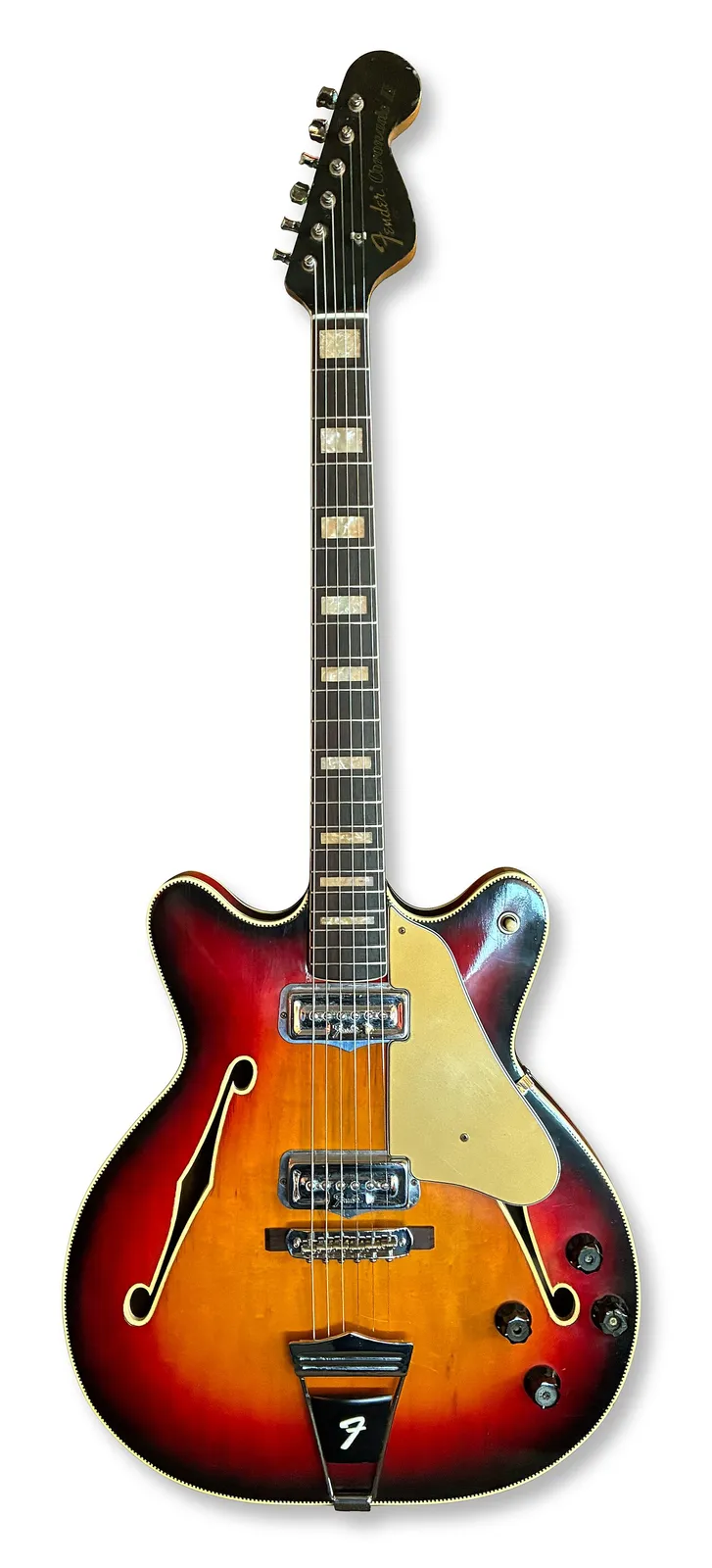
Photo: Auge=mit / Wikimedia Commons / CC BY-SA 4.0 Fender
Coronado
1966
Fender built it to stand next to a 335. It became the guitar nobody else at the gig has.
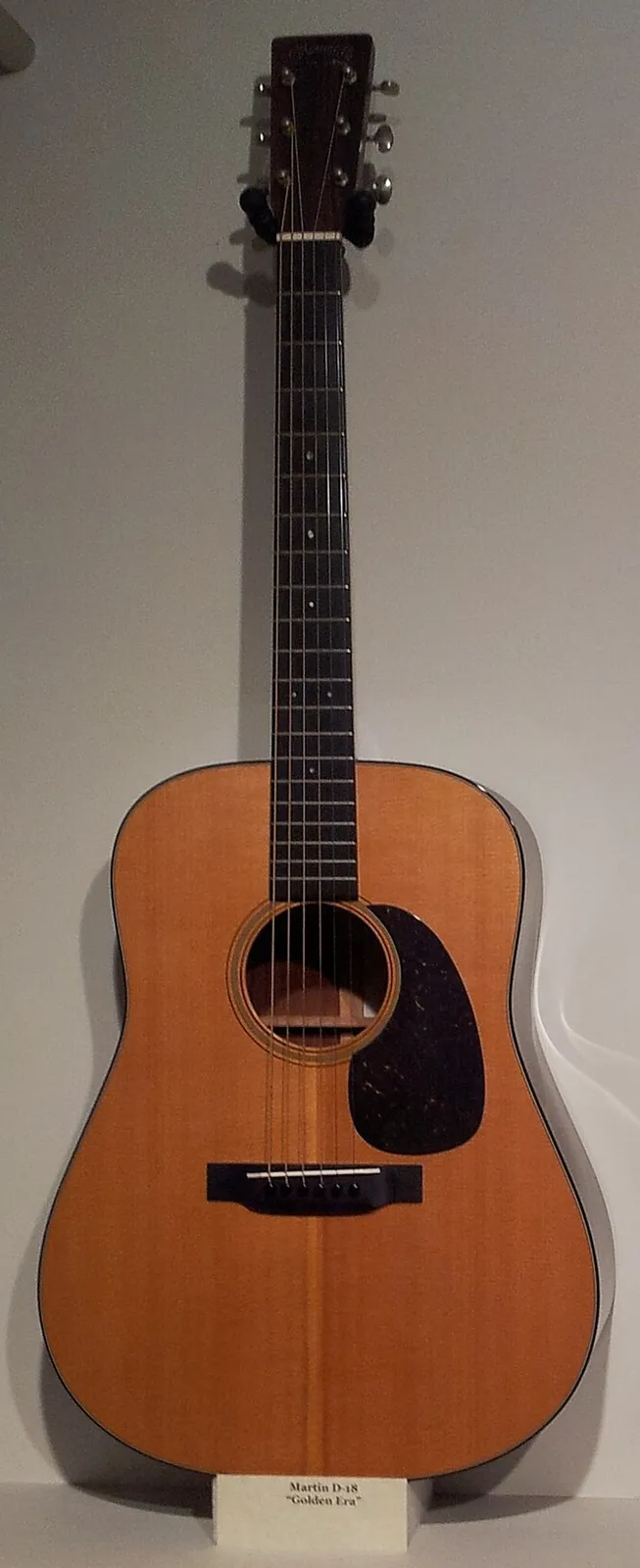
Photo: doryfour / Wikimedia Commons / CC BY-SA 2.0 Martin
D-18
1931
Elvis traded his D-18 up for a leather-covered D-28. The plain one had already been there for the Sun records.
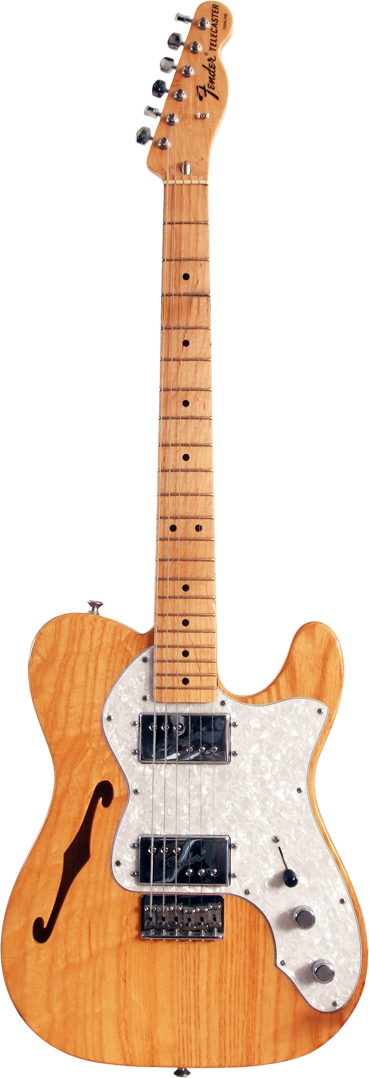
A Fender '72 Telecaster Thinline electric guitar. Photo by Matt Eason. Licensed under CC BY 3.0. Via Wikimedia Commons. Fender
Telecaster Thinline
1968
Fender hollowed out the Telecaster to take the weight off your shoulder. Tab Benoit has carried his since 1992.