Framus
Star Bass
Built so bass players could leave the upright at home. Bill Wyman held it upright anyway.
In 1956 a Bavarian factory showed a small, light, hollow electric bass with a guitar player’s scale, pitched as a way out of hauling a double bass. It became the first electric bass in Britain, then the one the Rolling Stones took on the road.
- Introduced
- 1956
- Type
- Hollowbody electric bass
- Class
- Production
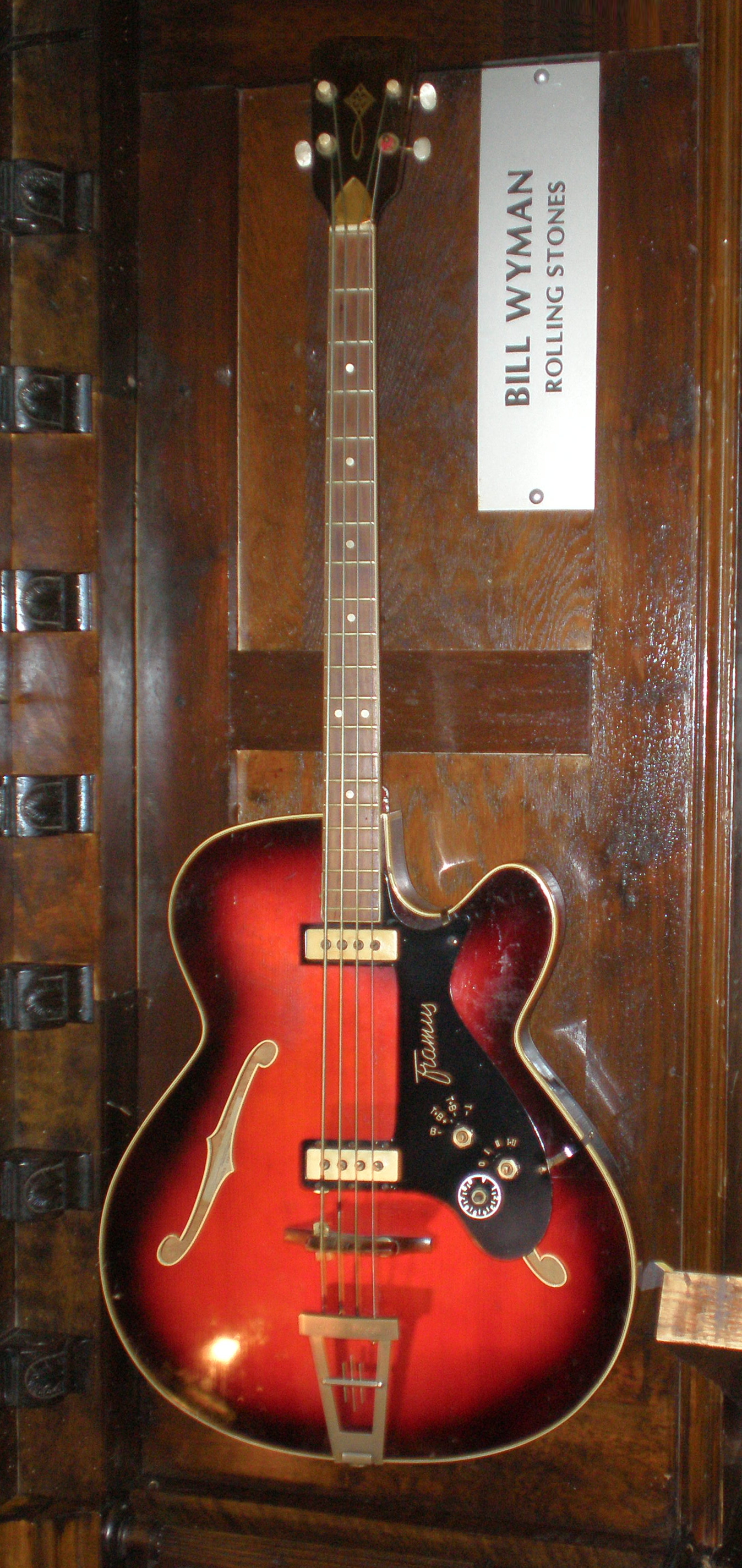
The short version
1956
Frankfurt
Framus presents the Star Bass at the Frankfurt trade show. Its one-pickup 5/149 is built from this year.
1958
Jet Harris
Tony Crombie buys Harris a Framus Star bass, and it goes into the Vipers, then Cliff Richard’s Drifters.
1959
The neck breaks
Harris’s Framus is wrecked in a dressing room. The importers give him a Fender Precision.
1960s
The 5/150
The two-pickup Star Bass becomes the common one, with a sharp or a rounded cutaway.
1963–64
Wyman
Bill Wyman starts on a 5/150 with the Stones. By 1964 he has a three-year Star Bass deal with Dallas of London.
1965
The Humbug
Wyman plays a striped 5/150 De Luxe on Thank Your Lucky Stars in January.
1975
Bankruptcy
Framus goes under in Bubenreuth, in 1975 or later in the decade. Its archives go with it.
2012
A Korean reissue
A Framus Vintage 5/150 appears at NAMM, made in Korea.
Side A
A1
A bass you could carry
The pitch, at the Frankfurt music fair in 1956, was freedom from transport.
If you played bass then, you mostly played a double bass, and you carried it. Framus, from Bubenreuth in Bavaria, brought a different idea: a small, light, semi-acoustic electric bass with a pointed cutaway, its pickup on a plate, and a scale short enough that a guitar player could pick it up and play. It was called the Star Bass.
It was meant to make the job smaller. It ended up making a rock star look small.
A2
Britain’s first
The first person in Britain known to play an electric bass played one of these.
Jet Harris got his from Tony Crombie, who bought him a hollow-bodied Framus Star bass imported from West Germany. Harris took it into the Vipers, then into Cliff Richard’s Drifters, the band that became the Shadows. His had the sharper, Florentine cutaway, with two volumes and two tones mounted right in the scratchplate. In Britain they often wore a Besson name on that plate.
There’s a photograph of Harris with it at Abbey Road, at the session for “Living Doll.” The caption and the text around it don’t agree on the year, 1958 or 1959. Keep both.
Then, in 1959, the neck got wrecked in a dressing room. The importers gave Harris a Fender Precision, one of the first in Britain. That was the end of his Framus years.
A3
Pickups on a plate
Here’s what you were holding.
A laminated hollow body with two f-holes, a single cutaway, a bound rosewood board, and a zero fret. Around 30 inches of scale, where a Fender bass runs 34. And the electronics: both pickups and the pots riding on a metal pickguard with the Framus logo.
The numbers matter. The 5/149, built from 1956, typically had one pickup. The 5/150 had two, with either a sharp or a rounded cutaway, and it’s the one people mean. The factory’s own dates for it overlap: one example around 1958, the model “since the beginning of the 1960s.” Don’t flatten them.
The short scale is the point. It plays more like a guitar. What it sounded like, Wyman can tell you himself.
Flip the record · By the numbers
30"
The scale on most of them, against a Fender’s 34. A few measure 30½.
5/150
The two-pickup Star Bass. The 5/149 is its one-pickup sister.
3
Years in Wyman’s 1964 Star Bass deal.
Side B
B1
The bass with the narrow neck
Bill Wyman had built a fretless bass at home. When he went looking for something for the road, the Framus Star basses were the answer:
“They were the only ones in the shop with necks as narrow as my fretless. And the boys liked the sound of them onstage; they cut through, but were still boomy.”
His own was a 5/150 in Black Rose Sunburst, with two pickups on a black metal guard and a white Framus logo. He says he used it with the Rolling Stones, in concerts and recording sessions, from 1963 to 1965. Others date his first Framus with the Stones to 1964, the year he signed a three-year Star Bass deal with Dallas of London. Keep both.
Which records it’s on is harder. One account puts his homemade fretless on nearly every Stones studio record. His own says the Framus was in the sessions too. So no single Stones track gets pinned to the Star Bass here. The Framus was the one he took out.
In January 1965 he played a striped 5/150 De Luxe on Thank Your Lucky Stars. He called it the Humbug, because the stripes looked like the candy. In 1965 and 1966 he was on a one-pickup 5/149 as well.
B2
Later, the plate went
Framus kept changing it. The metal plate went, the pickups moved into the body, the finishes got louder, and the bass lost a lot of what made it appealing.
The factory in Bubenreuth went under in 1975, or later in the decade, depending on who you ask. The company archives were lost in the bankruptcy, which is why nobody can tell you how many were made. The name came back in 1995 under Warwick, and in 2012 a Framus Vintage 5/150 appeared, made in Korea. Warwick also builds a Star Bass II, but that’s a 34-inch Warwick, not this bass.
B3
Standing it up
The Star Bass was big on Wyman. It looked so large on him that he couldn’t reach out along the neck, so he held it upright instead.
That became the look. The big-bodied Star Bass even picked up a nickname after him: the “stone bass.”
A bass made so nobody would have to carry an upright again, and the man who made it famous stood it on end.
Put this on
You’ve read about it. Now hear it. Here’s what this guitar sounds like, and what to listen for.
Living Doll
Jet Harris is photographed with his Framus Star bass at the Abbey Road session for this one. The photo is the tie, not a track credit.
Find it on YouTube (opens in a new tab)
The cast
The people, and the specific guitars, that made the legend.
1963
Bill Wyman
5/150 Star Bass in Black Rose Sunburst, then a 1965 5/149
Used the 5/150 with the Stones on stage and in sessions from 1963 to 1965, by his own account. Held it upright because he couldn’t reach along the neck.
1958
Jet Harris
A Framus Star bass from West Germany
The first known musician in Britain to play an electric bass. Played it with the Drifters until the neck was wrecked in 1959.
1958
Tony Crombie
Bought Harris his Framus
Bought Harris the hollow Framus that made him the first known electric bassist in Britain.
1960s
Brian “Licorice” Locking
A Framus bass
Named among the early British players of Framus basses, with Heinz Burt of the Tornados.
Liner notes
Specs, construction, rarity, value, and every source we used.
A laminated hollow, pickups on a metal plate, and a neck thin enough for Wyman — Framus’s Star Bass, not a Höfner violin, and not Warwick’s Star Bass II.
- Body
- Arched laminated hollow, single cutaway — sharp (Florentine) or rounded (Venetian). Two f-holes. Willie’s 1960 5/150: 17" hollow. Guitar Harbor’s listed early 5/150: 43 cm wide, 5 cm deep. Mix flagged. Do not average. Do not invent millimetres for 17".
- Neck
- Laminated on Wyman’s 5/150 (his archive) and on GuitarPoint’s 1965. Maple on Cream City, GuitarPoint, and Vintage & Rare’s 1970. GuitarPoint and Vintage & Rare: bolt-on. Cream City shimmed the heel. Zero fret on Wyman’s, Cream City, Vintage & Rare. Guitar Harbor’s listed early 5/150: no truss rod. 2012 Korean Vintage: set mahogany. Mix flagged.
- Fingerboard
- Bound rosewood, pearl dots, 20 frets (GuitarPoint; Cream City; Vintage & Rare). Zero fret typical on 1960s examples.
- Scale
- Cream City, Imperial Vintage (1966), Vintage & Rare 1970, and the 2012 reissue: 30". The reissue also prints 762 mm. Guitar Harbor’s listed early 5/150: 760 mm. Willie’s 1960: 30.5". Mix flagged. Do not average. Do not convert 30.5". Not Fender 34".
- Pickups
- Two Framus single-coils, P-90-style on GuitarPoint and Vintage & Rare. Early and Wyman examples: both coils and the pots on a metal pickguard. MusicRadar: later, the plate went and the pickups sat in the body.
- Hardware
- Adjustable bridge; trapeze. Archive: tailpiece with “Star Bass” engraving. Wyman’s serial 63930: non-engraved Star-Bass tailpiece; changed tuners. 2+2.
- Electronics
- Passive. Wyman and Cream City: everything on the metal guard. Cream City: dual on/off, dual volume, master tone. GuitarPoint 1965: two pickup switches, two volumes, two tones.
- Finish
- Archive 5/150: brown shaded, black rose, red, black, New Line (wooden stripes). Wyman’s 63930: Black Rose Sunburst.
- Nut
- Cream City 1 3/8". Imperial 1966 1.40". Guitar Harbor’s listed early 5/150 36.3 mm. Mix flagged. Do not average. Do not invent millimetres for 1 3/8" / 1.40".
Open the full research fileConstruction details, the complete player record, production numbers, dated value estimates, and sources
Classic living example = 1960s Bubenreuth 5/150 Star Bass, the two-pickup hollow Bill Wyman took on the road. 5/149 is the one-pickup sister, built since 1956. 5/151 TV-Starbass and 5/152 Golden TV are other numbers. Atlantik (5/140 / 5/143 / 5/144) is the ES-shape thinline. The 2012 Korean Vintage 5/150 is a Framus-badged reissue, now on Warwick’s discontinued Vintage features page — not this table. Warwick Star Bass II is a 34-inch Warwick, not a Framus. No current Framus 5/150 on shop.warwick.de this pass. Standalone. No Gibson SKUs. Mixed inch/mm flagged. Do not invent millimetres for 17", 30.5", 1 3/8", or 1.40".
Construction
The job was a bass a guitar player could carry. Hollow. Short. Pickups on a metal plate. A scale you could treat like a guitar. Bubenreuth, not Fullerton, and not Höfner’s violin shop.
Framus-vintage.de’s thinline history: a small, light, semi-acoustic electric bass with a pointy cutaway, a pickup plate, and a scale that made it playable for guitar players — presented at the Frankfurt music trade show in 1956. The pitch was to free the upright player of transport. Warwick’s 2012 Vintage catalog compresses the launch as “late 1950s.” Keep both. YAML introduced: 1956 is that Frankfurt show, not a claim that every later 5/150 left the same week.
The number split is the next trap. Archive 5/149: built since 1956, arched laminated body, single sharp cutaway, rosewood board, “Star Bass” tailpiece, typically one pickup; one dated example 1959, run into the mid-1960s. Archive 5/150: built since the beginning of the 1960s, sharp or rounded cutaway, two pickups typical, until the end of the 1960s. The same archive dates one 5/150 ca. 1958, another 1960, and the 5/150 Star Bass de Luxe “built since 1956” with a 1962 example. Keep 1956, ca. 1958, and “beginning 60s.” Do not flatten 5/149 onto 5/150.
What you get on a 1960s 5/150 is a wide laminated hollow with two f-holes, a bound rosewood board, a zero fret, and the electronics riding a metal pickguard with the Framus logo. Willie’s 1960: 17" across, 30.5" scale. Cream City: maple neck, 30", nut 1 3/8", 6 lb 8 oz. Imperial’s 1966: 30", nut 1.40", 6 lb 6 oz. Guitar Harbor’s listed early 5/150 (seller: 1956 or 1957, after asking Framus): 760 mm, nut 36.3 mm, 43 cm / 5 cm, 2.53 kg, no truss rod. Mix flagged. Do not average. Do not treat that seller year as a factory first-year census.
Cutaway is not one silhouette. MusicRadar (Roger Newell, 27 March 2012): Jet Harris’s early basses had the sharper Florentine edge and two volumes and two tones in the scratchplate; the more rounded Venetian cutaway is the one Wyman championed. The archive lets 5/150 wear either. Wyman, Guitar World (20 October 2023, from Bass Player May 1998): the Star basses “were the only ones in the shop with necks as narrow as my fretless. And the boys liked the sound of them onstage; they cut through, but were still boomy.” Then a smaller Framus, “shaped like a Les Paul bass,” natural with striped wood. That smaller one is not automatically a 5/150. UK pieces often wear a Besson or Ariston name on the chrome plate.
Later, MusicRadar: the scratchplate went, pickups went into the body, “super finishes,” and the bass lost much of its appeal. 5/151 TV-Starbass is a different outline — archive example February 1967 (67 B), double-cut, asymmetric soundholes. 5/152 Golden TV is another number. Atlantik is the ES-shape. The rare Akkerman bass of the 1970s only resembled the early Star. They are not this plate.
Fred Wilfer’s Bubenreuth factory went under in the mid-1970s (Wikipedia 1975; Framus-vintage.de “late 1970s”). Wikipedia: the company archives were lost in the bankruptcy. Hans-Peter Wilfer revived the name in 1995 under Warwick in Markneukirchen. That revival’s hollow guitar is the Tennessee (framus-tennessee). This bass is the older one.
2012 NAMM: Framus Vintage 5/150 Star Bass, made in Korea (Warwick Vintage PDF; Audiofanzine). Set mahogany, laminated maple top and sides, AAA flamed maple back, 30" (762 mm), 20 medium-jumbo, chrome metal guard, Black Rose High Polish, 2.9 kg. No Treble (16 April 2012): MSRP $1,880. Warwick’s discontinued Vintage features page still prints that spec (fetched 22 October 2026). shop.warwick.de’s living Vintage Series this pass is Hootenanny acoustics, not a Star Bass. You cannot order a new Framus 5/150 from the shop.
Not Warwick Star Bass II. Warwick’s own copy: “a reissue of the venerable classic Framus Star Bass,” then a 34-inch set-neck with MEC coils and a flamed-maple stick. Living Warwick, other brand, other scale. Off this plate.
Not a Höfner 500/1 (hofner-500-1). Violin, no f-holes, 30" German hollow of a different shop. McCartney’s, not Wyman’s. Not a Precision. Not an EB-3. Not the Vox Bill Wyman Bass of 1965. Not Wyman’s homemade fretless Dallas Tuxedo. Not the Tennessee.
Players
Do not hang the Dallas Tuxedo, a Vox Bill Wyman Bass, a Höfner violin, a Warwick Star Bass II, or a Tennessee here. Do not recruit Lennon’s Hootenanny. Guitar Player puts the Dallas Tuxedo on nearly every Stones studio record except Some Girls; Wyman’s own 5/150 card still says concerts and recording sessions, 1963–1965. Keep both. Do not pin a named studio side onto the Star Bass from this pass. The Star Bass is the one he took out.
Bill Wyman — 5/150 serial 63930, and the 5/149 that followed. Identity instrument for this plate. His site: early-1960s Framus Star Bass model 5/150, Black Rose Sunburst, serial 63930, laminated sharp-cutaway hollow, factory label in an f-hole, bound board, zero fret, two pickups and the electronics on a black metal pickguard with a white Framus logo, non-engraved Star-Bass tailpiece, changed tuners. “According to Wyman, he used this bass with the Rolling Stones in concerts and recording sessions from 1963 to 1965.” Guitar Player (13 February 2026) captions a 1964 shot of the Star Bass F5/150 as “the first Framus model he played with the Rolling Stones,” Thank Your Lucky Stars in Birmingham 30 January 1965 with a 5/150 Star Bass De Luxe he called the Humbug because the stripes looked like the candy, and a Ready Steady Go! rehearsal in London 26 February 1965. Keep 1963–1965 and 1964. Framus-vintage.de and Wikipedia: 1964, three-year sponsorship with Dallas Ltd., London. Mid-sixties he mostly played the big-body plate-pickup Star Bass, “mostly with a round, but occasionally with the pointy cutaway”; that silhouette was called “stone bass.” A 1965 5/149, serial 22603, gold sunburst, one neck pickup on the metal guard: Julien’s 2020 lot text says he purchased it in 1965. Julien’s later Played, Worn, & Torn note (2026): a 1965 5/149 in black rose sunburst is the kind he used for Stones concerts and recordings in 1965 and 1966. Keep 5/150 for 1963–65 and 5/149 for 1965–66. Wyman’s own notes, via Julien’s: the Star Bass looked so large he held it upright because he could not reach out along the neck — the stance that became the look. Artist-owned — not a comps tape.
Jet Harris. The British one before Wyman. Guitar World (Tom Poak, 18 March 2023): Tony Crombie bought him a hollow-bodied Framus Star bass; Harris became “the first known musician in the UK to play an electric bass.” The Times (19 March 2011): a Framus Star bass imported from West Germany, into the Vipers, then Cliff Richard’s Drifters. MusicRadar: Florentine cutaway, two volumes and two tones in the scratchplate, on many early Drifters and Shadows tracks. Guitar World caption: Harris, then of the Drifters, with a Framus Star bass and Besson scratchplate, recording Cliff Richard’s Living Doll at Abbey Road, 28 April 1958. The same article’s prose dates Living Doll 1959. Keep both. Wikipedia (Jet Harris): in 1959 the neck of his Framus was wrecked in a dressing room; the importers gave him a Fender Precision, one of the first in Britain. The Framus years stop there.
Also known to play stays short. The Guitar Collection’s unrestored Besson Ariston Star Bass is “identical to the first bass used by Jet Harris, Brian ‘Licorice’ Locking … and Heinz Burt of The Tornados.” Wikipedia’s Framus page names Harris, Locking, Brian Gregg, Heinz Burt, and Wyman among early British players of Framus basses — Framus basses, not a pinned 5/150 for Gregg. Equipboard’s Palmer / Hart / Pons / Scott credits are photo claims without a named session here. Leave those off.
Rarity
You cannot buy a new Framus 5/150 from Markneukirchen or Bubenreuth this pass. The Korean Vintage reissue sits on a discontinued features page. Warwick Star Bass II is a different bass. They are not a 1960s 5/150.
Framus did not publish Star Bass unit totals. Wikipedia: the archives were lost in the bankruptcy. None invented. Labels and “tested-by” stamps date a guitar. They don’t count a year. That is why a first-year census is unknown, not the chapter.
What is actually thinner: early plate-pickup examples with no truss rod; complete two-pickup 5/150s with the metal guard un-stripped; New Line / Humbug stripe finishes; Wyman-owned serials. A 5/149 is not a 5/150. A 2012 Korean Vintage is not a Bubenreuth original. Wyman’s 63930 is one object.
Value
Informal estimate, 22 October 2026. Not an appraisal.
Ask vs sold labeled. Celebrity lots are not-comps. No invented medians or factory counts. A Höfner 500/1 is not a Star Bass comparable. A Warwick Star Bass II is not a 1960s 5/150 comparable. No Treble’s $1,880 MSRP is 2012 Korean money, not a 2026 cart.
New street. None under Framus 5/150 this pass. Factory Vintage features page is discontinued; shop.warwick.de has no Star Bass family this pass (fetched 22 October 2026). Historical list, not 2026 street: No Treble, 16 April 2012, Vintage 5/150 MSRP $1,880.
Used modern. The 2012 Korean Vintage trades used when it appears. Named older ask, listing ended: Imperial Vintage reissue $695 (listed seven years ago). Audiofanzine’s $800 “market value” is marked outdated on that page. Do not average those with Bubenreuth originals.
Vintage / collectible. No clean Reverb Price Guide band isolated on 5/150 this pass. Flag: thin sold-comp access. Named dealer asks, not hammers: Willie’s 1960 5/150 $1,350 (in stock, fetched 22 October 2026); GuitarPoint 1965 5/150 ended ask $1,750.84; Imperial / Gbase 1966 $995. Named solds, not a series: Omega Auctions, 25 April 2023, 5/150 serial 17961 (tested 64D) £500 hammer; Gardiner Houlgate, 10 June 2025, poor 1960s 5/150 with a neck reset £160 hammer. Do not average those asks with those hammers. Artist-owned, not a comps tape: Julien’s, 11 September 2020, Wyman’s 5/150 63930 — the lot page prints US$100,000 (7 bids); Goldmine and Rolling Stone Australia print $51,200 for the same early-1960s 5/150. Keep both. Same sale: Wyman’s 1965 5/149 gold sunburst $25,600 (Goldmine). Those are one man’s basses.
See also
- hofner-500-1 — the other German hollow bass of the British Invasion; violin body, no f-holes, McCartney’s, not this Star Bass
- fender-precision-bass — Leo’s 34-inch bolt-on; the bass Harris moved to after the Framus broke, and the one this hollow short-scale is not
- framus-tennessee — Markneukirchen’s later Framus hollow guitar; not a Star Bass, and not Wyman’s
Sources
- Framus-vintage.de, Thinline basses — Star Bass presented Frankfurt 1956; guitar-player scale; Jet Harris; early-sixties bigger body nicknamed Stone Bass after Wyman; 5/149, 5/150, 5/151, 5/152, Atlantik, Akkerman listed
- Framus-vintage.de, 5/149 Star Bass — built since 1956; arched laminated, sharp cutaway; rosewood; Star Bass tailpiece; one-pickup example dated 1959; mid-60s end
- Framus-vintage.de, 5/150 Star Bass — built since the beginning 60s; sharp or rounded cutaway; one example dates ca. 1958; end of the 60s
- Framus-vintage.de, 5/150.1 — black rose; 2 PU; dates 1960
- Framus-vintage.de, 5/150 Star Bass de Luxe — built since 1956; New Line stripes; 2 PU; dates 1962
- Framus-vintage.de, 5/151 TV-Starbass — February 1967 (67 B); double-cut; asymmetric soundholes
- Framus-vintage.de, History — 1946 / Bubenreuth 1954 / Pretzfeld 1966; Wyman 1964 three-year Star Bass deal; late-1970s bankruptcy; 1995 Warwick revival
- Framus-vintage.de, Bill Wyman (archived 24 Sept 2015) — Dallas Ltd. 1964; mid-sixties plate-pickup big body, round or pointy; “stone bass”
- Bill Wyman, Framus Star Bass 5/150 Black Rose Sunburst — serial 63930; laminated sharp-cutaway hollow; two pickups on black metal guard; 1963–1965 concerts and sessions
- Wikipedia, Framus — 1946 / 1975 close / 1995 revival; 5/150 played by Wyman; early-1960s UK imports; Harris, Locking, Gregg, Heinz Burt, Wyman; 1964 three-year deal; archives lost
- Wikipedia, Jet Harris — Crombie Framus 1958; 1959 neck wrecked; Precision from the importers
- Guitar World, Tom Poak, Jet Harris (18 March 2023) — Crombie bought a Framus Star; first known UK electric bass; Abbey Road Living Doll caption 28 April 1958, Besson plate; prose dates Living Doll 1959; Precision 1959
- The Times, Jet Harris (19 March 2011) — Framus Star bass from West Germany; Vipers then Drifters; Living Doll
- MusicRadar, Roger Newell, Framus Star Bass 5/150 (27 March 2012) — Harris Florentine / two-and-two in the plate; Wyman Venetian; also 5/149 one-pickup; later body-mounted pickups; Warwick Vintage 5/150
- Guitar World / Bass Player, Nick Wells, Wyman fretless (20 October 2023) — Star basses for the road, necks as narrow as the fretless; smaller striped Les Paul-shaped Framus; Vox Bill Wyman Bass 1965 not liked
- Guitar Player, Christopher Scapelliti (13 February 2026) — 1964 F5/150 first Framus with the Stones; Thank Your Lucky Stars 30 Jan 1965, 5/150 De Luxe Humbug; Ready Steady Go! 26 Feb 1965; Dallas Tuxedo is the studio bass
- Julien’s Auctions, Lot 9, 11 September 2020 — 5/150 serial 63930; 1963–1965; sold US$100,000 (7 bids); estimate $80,000–$120,000
- Goldmine, Wyman archive auction (14 September 2020) — 1965 5/149 gold sunburst $25,600; early-1960s 5/150 $51,200
- Rolling Stone Australia, Wyman auction (15 September 2020) — Sixties Framus Star bass $51,200
- Julien’s, Played, Worn, & Torn (2026) — 1965 5/149 used 1965 and 1966; Wyman on holding the Star Bass upright
- No Treble, Kevin Johnson (16 April 2012) — Vintage 5/150 reissue specs; 30" (762 mm); 2.9 kg; MSRP $1,880
- Warwick, Vintage catalog PDF — late 1950s launch copy; Made in Korea; 30" (762 mm); Music Inc. NAMM 2012 Top 50; Premier Guitar Editors’ Pick
- Warwick, Discontinued Vintage 5/150 features — set mahogany; 30" (762 mm); 20 medium jumbo; 2.9 kg; Black Rose High Polish (fetched 22 October 2026)
- Warwick shop, Framus Vintage Series — living Vintage Series is Hootenanny, not Star Bass (fetched 22 October 2026)
- Warwick shop, Masterbuilt Star Bass — Star Bass II as Warwick reissue of the Framus Star Bass; 34" (864 mm)
- Willie’s Guitars, 1960 5/150 — 17" hollow; 30.5" scale; ask $1,350 (fetched 22 October 2026)
- Cream City Music, 5/150 — maple neck; 30"; 1 3/8" nut; zero fret; 6 lb 8 oz; heel shimmed
- Imperial Vintage / Gbase, 1966 5/150 — 30"; 1.40" nut; 6 lb 6 oz; ask $995
- Vintage & Rare, 1970 5/150 (Hendrix Guitars) — laminated maple; bolt-on; bound rosewood, 20 frets, zero fret; 30"
- Reverb, GuitarPoint 1965 5/150 — laminated bolt-on neck; 20 frets; two P-90-style; ended ask $1,750.84
- Reverb, Guitar Harbor 1956/57 5/150 — seller: Framus-dated 1956 or 1957; no truss rod; 760 mm; nut 36.3 mm; 43 cm / 5 cm; 2.53 kg
- Omega Auctions, 25 April 2023, Lot 64 — 5/150 serial 17961, tested 64D; £500 hammer
- Gardiner Houlgate, 10 June 2025, Lot 432 — 1960s 5/150; neck reset; 2.52 kg; £160 hammer
- The Guitar Collection, Bass Files #15 — unrestored Besson Ariston Star Bass; identical to the first bass used by Harris, Locking, Heinz Burt
- Worthpoint / Julien’s, 5/149 gold sunburst — 1965 5/149 serial 22603; purchased 1965; one neck pickup on the metal guard
- Reverb, Guitar Harbor early 5/150 listing — seller: 1956 or 1957 after asking Framus; no truss rod; 760 mm; nut 36.3 mm; 43 cm / 5 cm; 2.53 kg
- Audiofanzine, Vintage 5/150 — NAMM 2012 intro; no retailers this pass; $800 market value marked outdated
- Reverb, Imperial Vintage 5/150 reissue — Korean reissue; ended ask $695; listed seven years ago
Keep digging
Guitars this one gets compared to, confused with, or descended from.
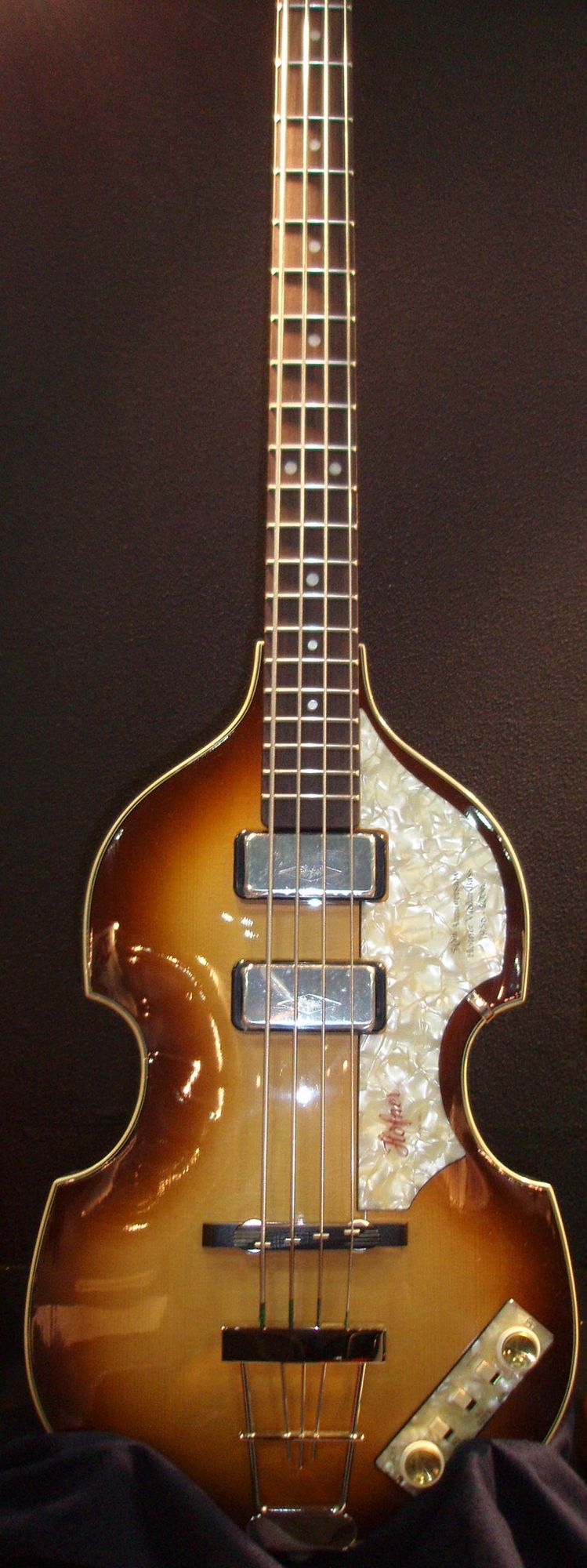
Höfner 500/1 Anniversary RH, equal to a ’61 Cavern Bass layout. Photo by CasinoKat. Licensed under CC BY-SA 3.0. Via Wikimedia Commons. Höfner
500/1
1956
McCartney bought the bass he could afford in Hamburg. It was stolen in 1972, and it came home in 2024.
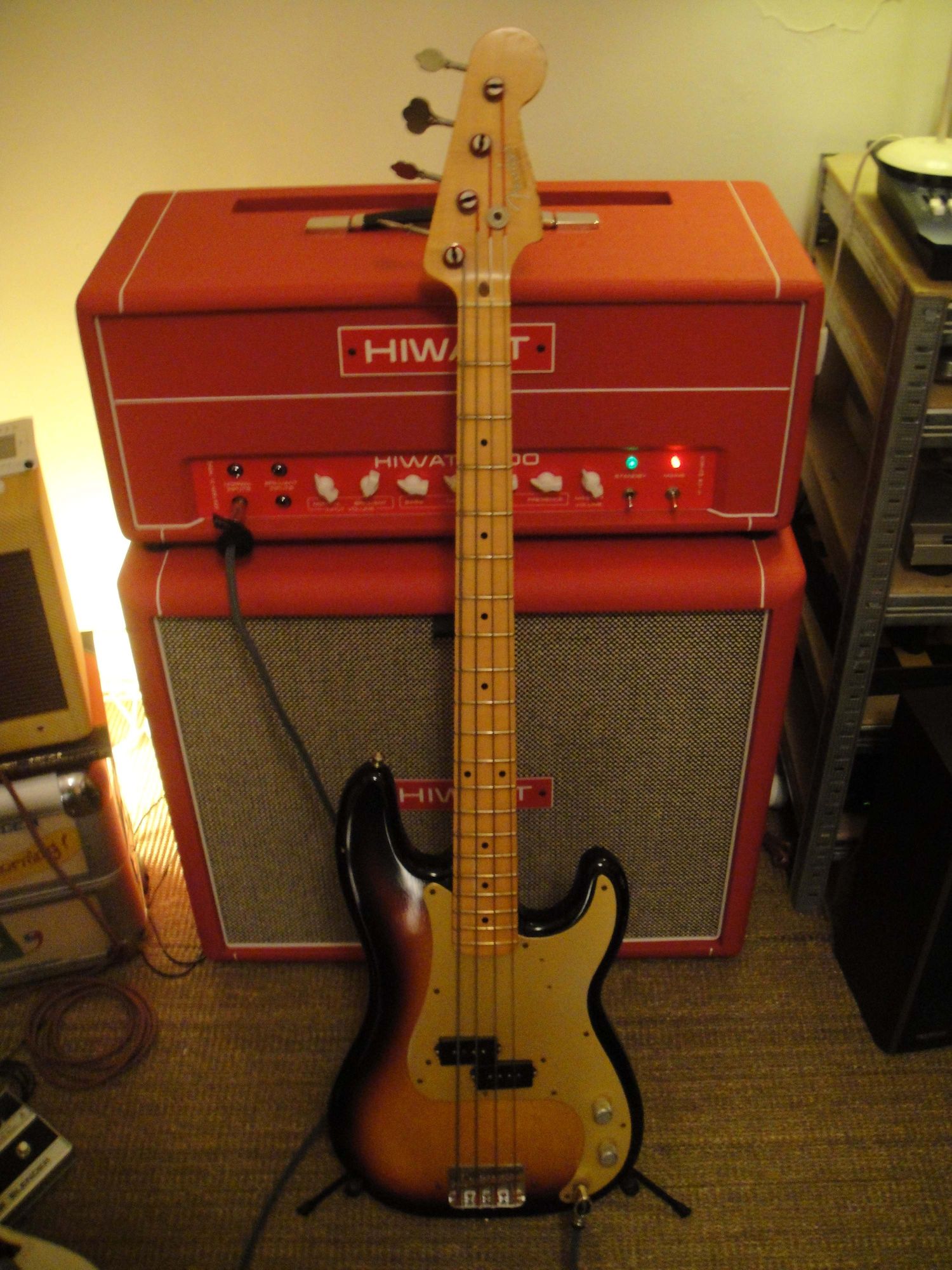
Photo: Infrahertzz / Wikimedia Commons / CC BY-SA 3.0 Fender
Precision Bass
1951
Leo’s bass let the player at the back be heard. You know their lines by heart. You mostly don’t know their names.
- Send a picture
Framus
Tennessee
2000
A German hollowbody built to take a hot rock pickup. One player said that’s when everything made sense.