Hagstrom
H8
Eight strings, four notes, and one bass player who suddenly sounded like two.
In 1967 a Swedish factory put a second, lighter string an octave above every string on a short-scale bass and sold it as the first eight-string you could buy off a shelf. Noel Redding took one into the sessions for Axis: Bold as Love. Within three years the Swedish run was over.
- Introduced
- 1967
- Type
- Solidbody electric bass
- Class
- Production
Have a photograph of this guitar? Send a picture
The short version
1966
A prototype, maybe
One account has an idea passed to the American importer and a prototype tried in Sweden and the US. Others start in 1967.
1967
Into production
The H8 goes on sale. In America it’s the F-800. Noel Redding plays one on Axis: Bold as Love.
1968
MacArthur Park
Joe Osborn’s eight-string is on Richard Harris’s hit, number 2 on the Hot 100 that June.
1969
The Swedish run ends
The last batches leave Sweden. Some of them were turned into four-strings first.
1970
John Paul Jones
Jones takes up an H8 and keeps it through 1976. An Alembic comes after.
1979
Top of the Pops
Lemmy Kilmister plays a sunburst H8 on BBC television.
2018
The H8-II
Hagstrom’s reissue of the 1967 bass is in reviewers’ hands, built in China.
Side A
A1
Two bass players in one
In 1967, the Jimi Hendrix Experience was making its second album, and Noel Redding had a bass with too many strings.
How he got it depends who’s telling it. One version has Redding buying it in America on tour that year. Another has a Hagstrom rep finding him on a tour of Sweden. Either way, the bass is on Axis: Bold as Love: “Spanish Castle Magic,” “You’ve Got Me Floating,” “Little Miss Lover.”
Here’s the trick. Above each ordinary bass string sits a lighter one, tuned an octave up, the way a twelve-string pairs its courses. You fret the pair as one note. The low string gives you the floor. The high one gives you a second player, an octave above, who never misses a note.
That sounds like a gift. On some songs it is.
A2
Three stories, no footnote
Nobody agrees on whose idea it was.
Karl-Erik Hagström’s version, as it’s been passed along, is that an American visitor put the idea in front of the American retailer Unicord, Ernie Briefel there liked it, and a prototype was tried in Sweden and America in 1966. Hagstrom’s own sheet for the reissue says the American distributor brought the idea in 1967. A third story credits a player named Eric Krackow, who built a prototype from a modified four-string, and with Steve Wittels took it to Sid Hack of Univox in 1967. Hack ordered a trial of 500.
Don’t merge them. Three stories, and none of them has a clean footnote.
What they share is the year it went on sale: 1967. Home name H8, American name F-800, short-scale, double-cut, two single-coils with their poles spread wide for the extra string. The factory calls it the world’s first eight-string bass. Its own reissue sheet adds that Rickenbacker was already building a few to order, so Hagstrom was first to put one in series. That’s the claim people can live with.
A3
The sixth one made
Hagstrom says Jimi Hendrix owned the sixth H8 off the line and played it on sessions for years. John Paul Jones put it more simply:
“I remember Hendrix used one.”
The eight-string is on Hendrix’s BBC recordings, the Alexis Korner show, “Hoochie Coochie Man” included. It’s on some of the Curtis Knight and the Squires tracks. And it’s in the promo film for “Burning of the Midnight Lamp,” as a prop. Somebody holding it on camera doesn’t make it the bass on that record.
Joe Osborn took one into the studio for Richard Harris’s “MacArthur Park.” It went to number 2 on the Hot 100 in June 1968. Andy Kulberg of the Blues Project and Danny McCulloch of Eric Burdon and the Animals played them too.
Flip the record · By the numbers
2,199–2,249
Swedish H8s, 1967 to 1969. The counts don’t agree, so keep both.
4
Saddles on the original bridge. For eight strings.
6th
The H8 Hagstrom says Jimi Hendrix owned.
#2
Where “MacArthur Park,” with Joe Osborn’s eight-string, peaked in June 1968.
Side B
B1
Four saddles for eight strings
Then people tried to keep one in tune.
The original bridge had four adjustable saddles. Eight strings, four saddles. You can set the intonation for the heavy string or the light one, not both. Jol Dantzig, later of Hamer, remembered an eight coming into the shop with a bowed neck and four saddles, the intonation already gone, and went off to draw an eight-saddle bridge. That drawing became a different bass.
The rest of it won’t sit still either. Birch on some, mahogany on others. The scale is around 30 inches, but no two measurements agree, so call it short and leave it there.
Sales fell off. In the later batches, Hagstrom turned some of the eights into four-strings by blocking the extra holes with black plastic plates. Between 1967 and 1969 the Swedish shop built somewhere around 2,199 or 2,249 of them, depending on whose count you trust, and then it stopped.
B2
“I’m not playing to that”
Which is why John Paul Jones is the best part of the story.
He took up an H8 in 1970 and kept it through 1976. A Swedish bass, two pickups, short scale. He called it noisy. When Jimmy Page saw the eight-string rig, his answer was:
“I’m not playing to that.”
Jones played to it. On “Achilles Last Stand,” his line is “The 8-string bass!” He doesn’t name the maker in that sentence. But he was on the Hagstrom through 1976, and the Alembic that replaced it came after that record.
Lemmy Kilmister turned up on Top of the Pops in 1979 with a sunburst one. The story he told was that he got it while roadie-ing for Hendrix. That one stays his.
B3
Back on the shelf
The bass came back as the H8-II, which Hagstrom calls a reissue of the 1967 bass. By 2018 it was in reviewers’ hands, built in China: mahogany, a maple neck, two humbuckers, and the strings running through the body.
The 1967 one is still the one people mean. A short Swedish bass with two single-coils and a bridge that couldn’t quite cope, and a run that was over by 1969.
Jones didn’t put his down. He was still doubling every note in 1976, and the eight-string is the line he named on “Achilles Last Stand.”
Put this on
You’ve read about it. Now hear it. Here’s what this guitar sounds like, and what to listen for.
Spanish Castle Magic
The track Hagstrom itself points to. Redding’s H8 is on Axis. Listen for the bass line that seems to have a ghost an octave above it.
Find it on YouTube (opens in a new tab)You’ve Got Me Floating
One of the three Axis tracks the Redding eight-string story names, with “Little Miss Lover.”
Find it on YouTube (opens in a new tab)MacArthur Park
Joe Osborn on the eight-string, in the studio. The bottom of a seven-minute record, doubled.
Find it on YouTube (opens in a new tab)Achilles Last Stand
Jones called his line here “the 8-string bass!” He doesn’t name the maker; by the dates, he was still on the Hagstrom, with the Alembic after this record.
Find it on YouTube (opens in a new tab)
The cast
The people, and the specific guitars, that made the legend.
1967
Noel Redding
An H8, or possibly more than one, from 1967
The Experience bass people mean. On Axis: Bold as Love and on stage. In the “Burning of the Midnight Lamp” promo it’s a prop.
1960s
Jimi Hendrix
The sixth H8 made, by Hagstrom’s account
John Paul Jones remembered that “Hendrix used one.” Eight-string bass turns up on his BBC set, including “Hoochie Coochie Man.”
1970
John Paul Jones
Hagstrom H8, 1970 to 1976
Called it noisy. Kept it anyway, until the Alembic.
1968
Joe Osborn
An H8 in the studio
Played it on Richard Harris’s “MacArthur Park.”
1979
Lemmy Kilmister
A sunburst H8
Played it on Top of the Pops. He said he was given it while roadie-ing for Hendrix. That’s his story.
Liner notes
Specs, construction, rarity, value, and every source we used.
Four courses tuned in octaves on a short-scale double-cut — Hagstrom’s H8, not a twelve-string guitar and not a Rickenbacker.
- Body
- Mahogany, double-cut, the 1967 outline
- Neck
- Bolt-on hard Canadian maple, “C”, H-Expander, multi-ply binding
- Fingerboard
- Resinator, 15" radius, 21 medium jumbo, pearloid dots. Mix flagged.
- Scale
- 30.75" (781 mm)
- Pickups
- Two Hagstrom DynaRail humbuckers, push/pull coil-split
- Hardware
- String-through adjustable bridge; four 22:1 and four 18:1
- Electronics
- Volume with push/pull; kill switch; sliders for neck, bridge, tone, and mute
- Finish
- Gloss; Tobacco Sunburst, Black Gloss, Wild Cherry Transparent
- Nut
- GraphTech Black Tusq XL, 40 mm. Mix flagged.
Open the full research fileConstruction details, the complete player record, production numbers, dated value estimates, and sources
Current typical = Hagstrom H8-II (RetroScape), hagstromguitars.com, fetched 22 October 2026. Factory mixed inch/mm flagged. No millimetres invented for the 15" radius. Thomann prints the 40 mm nut as 1,57". The 1967–69 H8 / US F-800 is not this table: birch or mahogany, rosewood, two single-coils, Van Ghent keys, a four-saddle top-load. Scale on that bass is argued below. Do not average. F-400 is the four-string solid in the same 1968 US book. Coronado IV there is another bass. Not Viking. Not Swede. Not an Alembic. Not a Framus 5/153-8. Not a Rickenbacker 4001/8. No Gibson SKUs.
Construction
The job was a four-string part that could sound like two players. A lighter string sits above each bass string, an octave up, the way a twelve-string pairs its courses. You play the pair as one note. Hagstrom’s brochures, via Wikipedia’s H8 article, also offered a major third, a perfect fifth, and a major seventh. Vintage Guitar and Bass says fifths, or any other interval. Not a guitar. Not an octave pedal.
Who brought the idea is three stories, and none of them has a clean footnote. Wikipedia’s H8 article — no inline citations — says, according to Karl-Erik Hagström, that an American visitor put it in front of US retailer Unicord, Ernie Briefel liked it, and a prototype was tried in Sweden and in America in 1966. Mass production the next year. The factory’s H8-II sheet dates the distributor’s idea to 1967, not 1966, and says Rickenbacker was already building custom-order eights, so Hagstrom was first to serial-produce one. Wikipedia’s eight-string article, which has asked for citations since 2015, credits Eric Krackow: he played with Al Kooper’s Aristo-Cats, built a prototype from a modified four-string, and in 1967 he and Steve Wittels took it to Sid Hack of Univox. That page calls Univox the company that imported Hagstrom. Hack ordered a trial of 500. Then, the same page, 2,249 basses from 1967 through 1969. Don’t fold Krackow’s 1967 visit into Briefel’s 1966 call. The factory sheet only says “the US distributor,” in 1967.
The plate year is 1967 because that is the launch the sources share. Vintage Guitar and Bass: available 1967–69. Their note on the 1968 Unicord catalog: the solid-body F-800 debuted in 1967 and makes its first catalogue appearance in that book. US name F-800. Home name H8. UK ads ran through Rosetti.
“First” stays attributed. The factory history page: “the world’s first 8-string bass.” The current product page: the first brand to mass-produce one. Vintage Guitar and Bass: the first eight-string bass, full stop. RetroFret: the only production eight-string of the decade, and a very few Rickenbacker customs. Bonedo (Rainer Wind, 27 July 2018): the first eight-string electric bass put into series. Willie G. Moseley (Vintage Guitar, September 2023) does not use the word. He has Hagstrom and Framus both in ’60s catalogs, and he dates Framus’s thinline 5/153-8 circa 1970 — long scale, 26 frets, one sound hole. Not this solid. This catalog’s 4001 plate puts two 4001/8 prototypes in 1973, for Squire and Entwistle, after the H8 was gone. Moseley puts Rickenbacker’s catalog eight in the mid-’70s, special-order 4008 first. The factory sheet’s “Rickenbacker was already there” stays the factory’s sentence.
Wikipedia’s H8 article: built on a regular four-string Hagstrom bass, strings doubled. It does not name that four-string. The 1968 book’s other solid basses are the F-400 and a Coronado IV. Not this one, and not Fender’s Coronado. A 2013 Twelfth Fret card compares the outline to an SG. It is not an SG. No Gibson SKUs.
The wood will not sit still. Moseley: all mahogany, 21-fret rosewood. Vintage Guitar and Bass: body and neck birch or mahogany, rosewood dots, 21 frets, nut 1 5/8". Wikipedia: almost all mahogany, a few of Finnish birch, neck mahogany, a very few all white; scale printed 30" / 780 mm. RetroFret’s cards are Baltic birch body and neck — sunburst 748005, cherry 723558. Carter Vintage’s 1967 is birch over a mahogany neck. Cream City’s cherry card is mahogany on mahogany. Some shop cards mention a bound board. Vintage Guitar and Bass’s spec line does not.
Scale is the same fight in inches. Vintage Guitar and Bass prints 30 5/8". The reissue’s factory pair is 30.75" (781 mm). Wikipedia, and Guitar World on Jones’s bass, print a short 30". RetroFret measured 748005 at 30 1/2" (775 mm). Carter and Twelfth Fret print 30.75" on 1967s. Rainbow Guitars prints 30.5" on one listing. Cream City prints 31". Do not average. No millimetres invented where a source gave only inches. Nuts, same rule: 1 5/8" (Vintage Guitar and Bass; Cream City), 1.650" on Carter’s 1967, 1 3/4" (44 mm) on RetroFret’s 748005, 1.56" on that Rainbow card. Carter’s bass also has a 12" radius. The reissue’s 15" is a different board.
Two single-coils, poles widened for the extra string (Vintage Guitar and Bass). Moseley, from the 1968 Unicord catalog: High, Low, Tone, and Mute switches, a volume, a standby. Finishes in that account: mahogany sunburst or cherry red. Headstocks could ship natural, black, translucent cherry, or mahogany burst. Two sizes of Van Ghent key, large on the bass strings, small on the octaves.
The bridge is why players gave up on it. Jol Dantzig, via Moseley: an eight came in with a bowed neck, and four saddles meant the intonation was already gone. He went off to draw an eight-saddle bridge. That became Hamer’s later eight, not this bass. Cream City, on a vintage cherry: top-loading, four adjustable saddles. Not the reissue’s string-through.
No 1968 dollar list turned up on the catalog index. None invented. Sales fell off. Vintage Guitar and Bass: later batches were turned into four-strings by blocking the extra holes with black plastic plates. A blocked bass is this model’s body. It is not an intact eight. Wikipedia’s H8 article also mentions unproduced successors at 32" and acoustic eight-string Concords. Same missing footnotes. Not a second slug.
The living bass is the H8-II, which Hagstrom calls a reissue of the 1967 bass, in the RetroScape line. It was in reviewers’ hands by 2018. MusicRadar (Joel McIver, 13 February 2018) reviewed an HB-8 at £769: mahogany, four-bolt maple, Resinator, 21 frets, 30.75", through-body, Dyna Rail pickups, and — his description — 17:1 tuners and a six-mode rotary. Bonedo, five months later, reviewed the RetroScape H8-II: China, a light modification, the three current finishes, and the slider layout the page still prints. Same year, two control descriptions. Don’t merge the rotary into the sliders, and don’t treat £769 as 2026 street.
What you order now is the table above. The spec PDF’s strings are .040/.015, .055/.025, .070/.040, .095/.055. Bonedo’s 2018 set matches the PDF. The product page and Thomann, this pass, print .040/.013, .050/.023, .065/.038, .090/.052. Do not average the sets. The page’s general line that “HB series” basses use 17:1 does not match this model’s own table: four 22:1 and four 18:1. China, not the Swedish shop. Bonedo is the China cite. Twelfth Fret puts one 1967, serial 723168, in Älvdalen. That is one bass.
Classic against current: a 1967 H8 — Swedish, birch or mahogany, rosewood, two single-coils, Van Ghent keys, four-saddle top-load, gone by 1969 — against the 2026 H8-II, maple and Resinator and DynaRails and string-through, from 789 €.
Players
Do not recruit Viking, Swede, H-II, Kent, or the Swede bass. Elvis Presley is the 1968 Viking II. Björn Ulvaeus and Benny Andersson are Swede. Pat Smear is H-II / Super Swede. Jones’s Alembic is the next bass, not this one. A Fender Bass VI in the same photo is a Fender. McIver mentions Chris Squire’s fifths tuning; Wikipedia’s eight-string article puts that tuning on a Ranney, not an H8. Entwistle’s catalogued eight, on the 4001 plate, is a 1973 Rickenbacker prototype.
Noel Redding. The Experience bass people mean. Vintage Guitar and Bass: the story is a bass, or possibly basses, bought in America in 1967 on tour, then Axis: Bold as Love — “Spanish Castle Magic,” “You’ve Got Me Floating,” “Little Miss Lover.” Wikipedia’s H8 article: a Hagstrom rep approached him on a Swedish tour, then the same three tracks. The factory sheet points at “Spanish Castle Magic.” Moseley: Axis and in concert, and the bass was a prop in the promo video for “Burning of the Midnight Lamp.” A prop. Not the Electric Ladyland master. Vintage Guitar’s Fretprints on Axis (11 July 2026) says Redding and Hendrix both played the eight-string. Album-level. No extra tracks. Moseley, interviewing Redding (posted 23 May 2003, about a photo sent after the 1992 interview): a Bass VI and a Hagstrom eight; he says Sotheby’s auctioned the Hagstrom. No hammer in that piece. Redding’s Jazz is a different bass.
Jimi Hendrix. Jones, in Guitar World (Nick Wells, 15 December 2022): “I remember Hendrix used one.” The factory sheet: he owned the sixth H8 made, and used it across several years of sessions. Wikipedia prints the same “sixth,” names jams later called “Get That Feeling,” “Odd Ball,” “Love Love,” “Hush Now,” and a “Day Tripper” jam, and puts that bass in the Hendrix collection at the Museum of Pop Culture. No inline cite. Vintage Guitar and Bass: eight-string on some Curtis Knight and the Squires tracks (The Summer of Love Sessions), and on the 1998 BBC set, the Alexis Korner show, including “Hoochie Coochie Man.” RetroFret: several Hendrix cuts, both of them. A dealer line that puts the H8 on “1983” and on the “Midnight Lamp” recording is a seller. Moseley’s word for the film is prop.
John Paul Jones — a Hagstrom H8, 1970 to 1976. Same Guitar World piece: Swedish, two pickups, double-cut birch or mahogany, short 30". He called it noisy. Then Alembic. That article dates the Series II, Rick Turner, to sometime after Presence. Wells again (8 December 2023): Page, seeing the eight-string rig, said “I’m not playing to that.” On “Achilles Last Stand,” Jones’s line is “The 8-string bass!” The 2023 sentence does not say Hagstrom. The 2022 dates run through 1976, and the Alembic is after that record. That is the chain. Not his 1967 Bass V. Not the Alembic.
Joe Osborn. Moseley: Richard Harris, “MacArthur Park” (1968), #2 on Billboard’s Hot 100 that June. A studio credit in that piece. No stage photo here.
Lemmy Kilmister. Moseley: 1979, a sunburst H8, BBC Top of the Pops. Wikipedia: the video for “Bomber,” and Lemmy’s claim that he was given the bass while roadie-ing for Hendrix. The factory sheet only says he turned up with one. Keep the sunburst, the year, the title, and the roadie story on the pages that printed them.
Also known to play stays short. Moseley: Andy Kulberg, Blues Project; Danny McCulloch, Eric Burdon and the Animals. Wikipedia says both were in Hagstrom’s promo material. Vintage Guitar and Bass adds Billy “Bass” Nelson of Funkadelic, no track, and Mike Rutherford on “I Know What I Like.” Wikipedia’s Rutherford line is “One for the Vine,” Wind & Wuthering (1976), marked citation needed. Don’t pick the song.
Rarity
You can order an H8-II. Bonedo: China. Hagstrom publishes no reissue total. None invented. Three catalog finishes, not a numbered run.
The Swedish bass is 1967–69 only. The totals do not match. Vintage Guitar and Bass: 2,249, seven batches, each between 100 and 600. Wikipedia’s H8 article, and Bonedo: 2,199. The eight-string article: the trial of 500, then the 2,249. The current factory site prints no ledger. Keep all three. Vintage Guitar and Bass’s own comments: batch 723 was 600, 1967–68; batch 727 was 600, same span. RetroFret calls 723 the first and major lot — 723558 is the 558th of it. Oscar Guitars, on 748041: batch 748, unit 041 of 200, 1969. A dealer’s reading. A Reverb seller’s “152nd of 250 in 1969” is a seller’s line. Don’t adopt it. Batches overlap the years, which is why a first-year census is unknown.
Thinner than the total: an eight whose extra holes were never blocked off. Vintage Guitar and Bass is the source for that conversion. Redding’s, the bass the factory sheet calls the sixth, and Jones’s 1970s H8 are single objects. A new H8-II is not.
Value
Informal estimate, 22 October 2026. Not an appraisal.
Asking prices are not sold prices. 2,249 and 2,199 are not a factory book. No celebrity hammer turned up. Moseley’s Sotheby’s line has no figure. Not a comp. No USD list on the factory page this pass.
New street. Thomann, Tobacco Sunburst, article 604766, 789 € against UVP 939 €, listed since June 2025, no case and no gigbag, delivery “in mehreren Monaten.” Alto Music, Black, $1,099, sold out, pre-order 27 November 2026; that page includes a hardshell case, which Thomann does not. guitar-list, 19 October 2026, clusters other new asks at $1,099. Don’t average euros and dollars. McIver’s £769 is February 2018.
Used modern. Sweetwater Gear Exchange, used Excellent, $750 plus $100 shipping. One ask. Reverb sold a new Tobacco Sunburst at $717.95 (Spain, shipping extra) — a sold new, not a US used median, and no hammer date beyond “over a month ago.” guitar-list’s open-box ask, same snapshot, $949.99. Don’t average them.
Vintage / collectible. No Reverb Good–Mint band this pass. Asks, not hammers: Carter Vintage, 1967 sunburst, $2,000 (replaced volume pot, missing decal, 7.2 lb); Rainbow Guitars on Reverb, 1968 sunburst Excellent, serial 723429, $2,395 plus $75. Boston Guitar’s 1968 Excellent at $2,995 had ended. Not a sale. Gees Gear’s 1969 at $1,700 is the seller’s restored four-string, titled as if it were Are You Experienced? The title is not a credit, and the bass is not an intact eight. Oscar Guitars sold a 1969 sunburst at kr 26,500 including tax. Kronor. Not a dollar comp. Do not average any of those. A blocked four sits under an eight that still has its pairs. Redding’s and Jones’s are not comps.
See also
- fender-bass-vi — 1961, six strings an octave below guitar, 30". The other short Fender bass. Not four octave pairs
- rickenbacker-4001 — the 1961 four-string. Two 4001/8 prototypes in 1973, not this production eight
- fender-bass-v — Jones’s 1967 high-C five. The plate that left his Hagstrom eight-string for this one
Sources
- Hagstrom, H8-II Bass — mahogany; 1967 outline; Canadian maple; H-Expander; Resinator; 30.75" (781 mm); 15"; 21 medium jumbo; dots; Tusq XL 40 mm; 2× DynaRail; push/pull; kill switch; four sliders; string-through; 4× 22:1 and 4× 18:1; strings .040/.013, .050/.023, .065/.038, .090/.052; three finishes; “first brand to mass-produce”; fetched 22 October 2026
- Hagstrom, H8-II spec PDF — US distributor, 1967; Rickenbacker customs; “first to serial produce”; “Spanish Castle Magic”; Hendrix owned the sixth; Lemmy from time to time; slider chart; strings .040/.015, .055/.025, .070/.040, .095/.055
- Hagstrom, our history — electrics from 1958; “the world’s first 8-string bass, the H8”
- Vintage Guitar and Bass, Hagstrom H8 — H8 / F-800, 1967–69; two single-coils; 30 5/8"; birch or mahogany; 21 frets; nut 1 5/8"; Van Ghent; 2,249 in seven batches; Redding’s three Axis tracks; Curtis Knight; BBC “Hoochie Coochie Man”; Nelson; Rutherford “I Know What I Like”; Kulberg; McCulloch; later batches blocked into fours; batches 723 and 727 of 600
- Vintage Guitar and Bass, 1968 Unicord catalog index — F-800 debuted 1967, first catalogue appearance 1968; F-400 and Coronado IV the other solid basses
- Wikipedia, Hagström H8 — 1967–69; 2,199; 30" / 780 mm; Karl-Erik Hagström, Ernie Briefel, 1966 prototype; Finnish birch; white; sixth H8 and the MoPOP claim; Redding approached in Sweden; Rutherford “One for the Vine,” citation needed; Lemmy, “Bomber,” the roadie claim. No inline citations
- Wikipedia, Eight-string bass guitar — Eric Krackow; Steve Wittels; Sid Hack; Univox; trial of 500; 2,249 from 1967 through 1969. Article has asked for citations since 2015
- *Vintage Guitar*, Willie G. Moseley, “Eight-String Basses” (September 2023; posted 2 May 2024) — mahogany; Redding on Axis and in concert; “Midnight Lamp” promo as a prop; Kulberg; McCulloch; Osborn, “MacArthur Park,” #2 in June 1968; Lemmy, 1979, sunburst, Top of the Pops; 1968 Unicord switches; Dantzig on four saddles; Framus 5/153-8 circa 1970; Rickenbacker eight from the mid-’70s
- *Vintage Guitar*, Fretprints: *Axis: Bold as Love*, 11 July 2026 — eight-string played by Redding and Hendrix
- *Vintage Guitar*, Noel Redding (posted 23 May 2003) — Bass VI and a Hagstrom eight; Sotheby’s, no hammer
- *Guitar World*, Nick Wells, 15 December 2022 — H8, 1970–1976; birch or mahogany; 30"; Jones on Hendrix; Alembic after Presence
- *Guitar World*, Nick Wells, 8 December 2023 — “I’m not playing to that”; “Achilles Last Stand,” “the 8-string bass”
- Bonedo, Rainer Wind, 27 July 2018 — 1967–69, 2,199; H8-II in China; sliders; 2018 strings matching the PDF
- MusicRadar, Joel McIver, 13 February 2018 — HB-8, £769; 17:1; 30.75"; rotary as described; through-body
- RetroFret, 1968 H-8, serial 748005 (indexed card) — Baltic birch; 30 1/2" (775 mm); nut 1 3/4" (44 mm); only production eight-string of the decade
- RetroFret, 1968 H-8, serial 723558 — cherry; Baltic birch; 558th of batch 723; late 1967, mostly 1968
- Carter Vintage, 1967 H-8 — birch over mahogany; 30.75"; nut 1.650"; 12" radius; 7.2 lb; ask $2,000
- Thomann, H8-II Tobacco Sunburst — 789 €, UVP 939 €; 40 mm (1,57"); .040/.013 set; listed since June 2025; fetched 22 October 2026
- Alto Music, H8II Black — $1,099; sold out; pre-order 27 November 2026; hardshell case in the box copy
- Sweetwater Gear Exchange, used H8-II — Excellent ask $750 plus $100 shipping
- guitar-list, US asks, 19 October 2026 — new asks at $1,099; open-box $949.99
- Reverb, Rainbow Guitars, 1968 sunburst — ask $2,395 plus $75; serial 723429; seller’s 30.5" and four-saddle bridge
- Reverb, Gees Gear, 1969 — ask $1,700; seller’s restored four-string; the album title is not a credit
- Oscar Guitars, 1969 sunburst — sold kr 26,500 including tax; 748041, batch of 200
- Cream City Music, 1960s cherry — top-load, four saddles; shop card prints 31" and a 1 5/8" nut
- Twelfth Fret archive, 1967 — serial 723168, Älvdalen; 30.75"; mahogany. The Electric Ladyland line on that card is a shop sentence
Keep digging
Guitars this one gets compared to, confused with, or descended from.
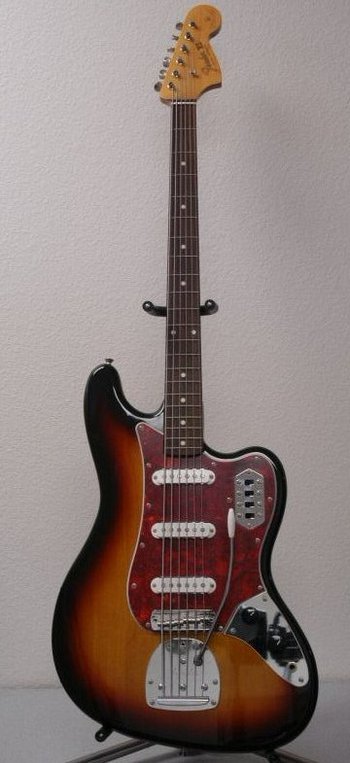
Photo: Blackyde / Wikimedia Commons / CC BY-SA 3.0 Fender
Bass VI
1961
Six strings, an octave down. It’s what a guitar player picks up when somebody hands them the bass part.
- Send a picture
Rickenbacker
4001
1961
Geddy Lee bought one to sound like Chris Squire. He plugged it in. It didn’t.
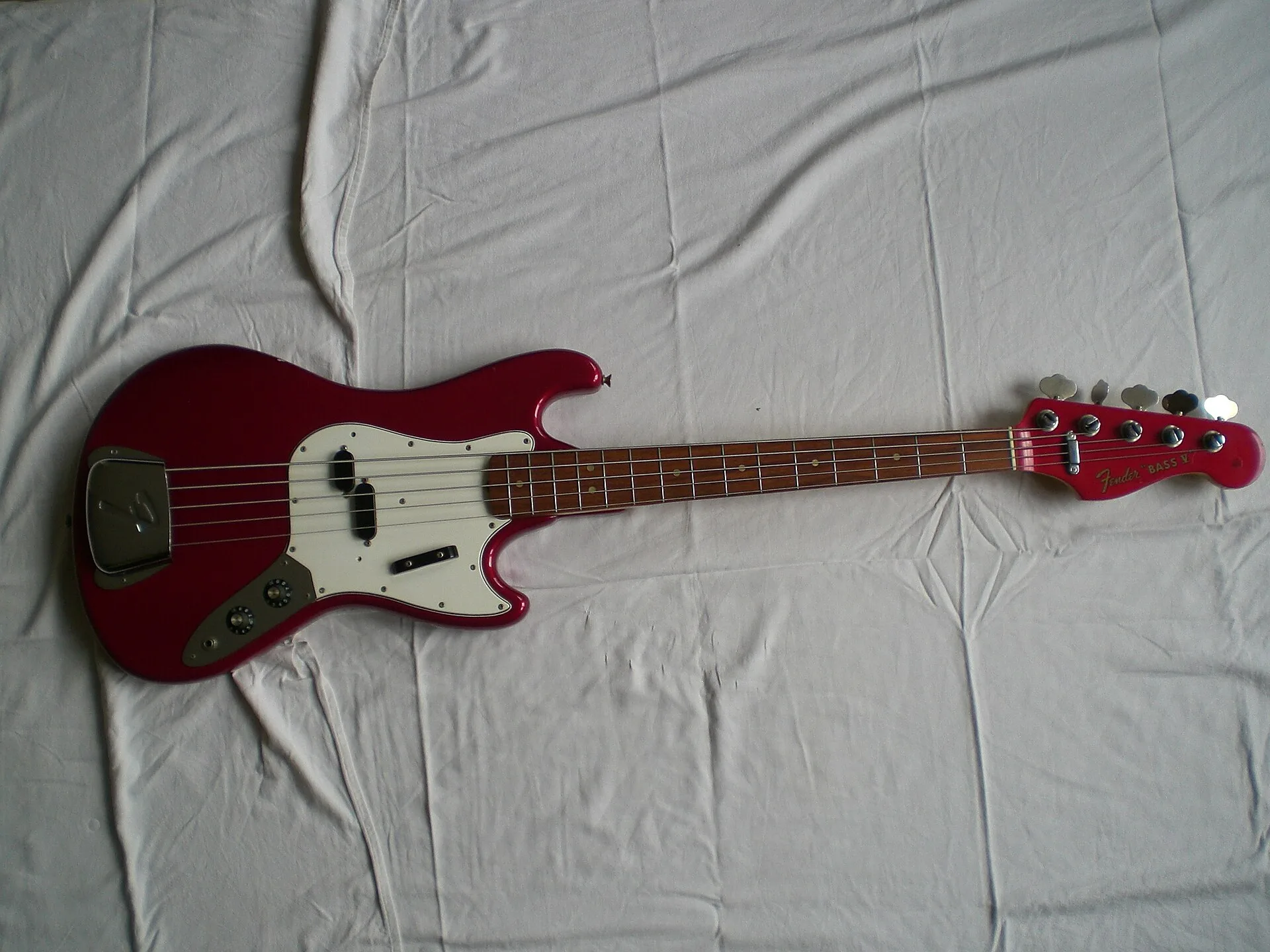
Photo: Bassv at en.wikipedia / Wikimedia Commons / CC BY-SA 3.0 Fender
Bass V
1965
Fender’s first five-string added the extra string on top. John Paul Jones called it the ugliest bass in the world.