Kubicki
Factor
Flip a clasp on the headstock and the E string gets four inches longer and drops to D.
Phil Kubicki spent his twenties building guitars with Fender on the headstock. In 1985 he started selling a bass with his own name on it, and people have been filing it under somebody else’s ever since.
- Introduced
- 1985
- Type
- Solidbody bass
- Class
- Production
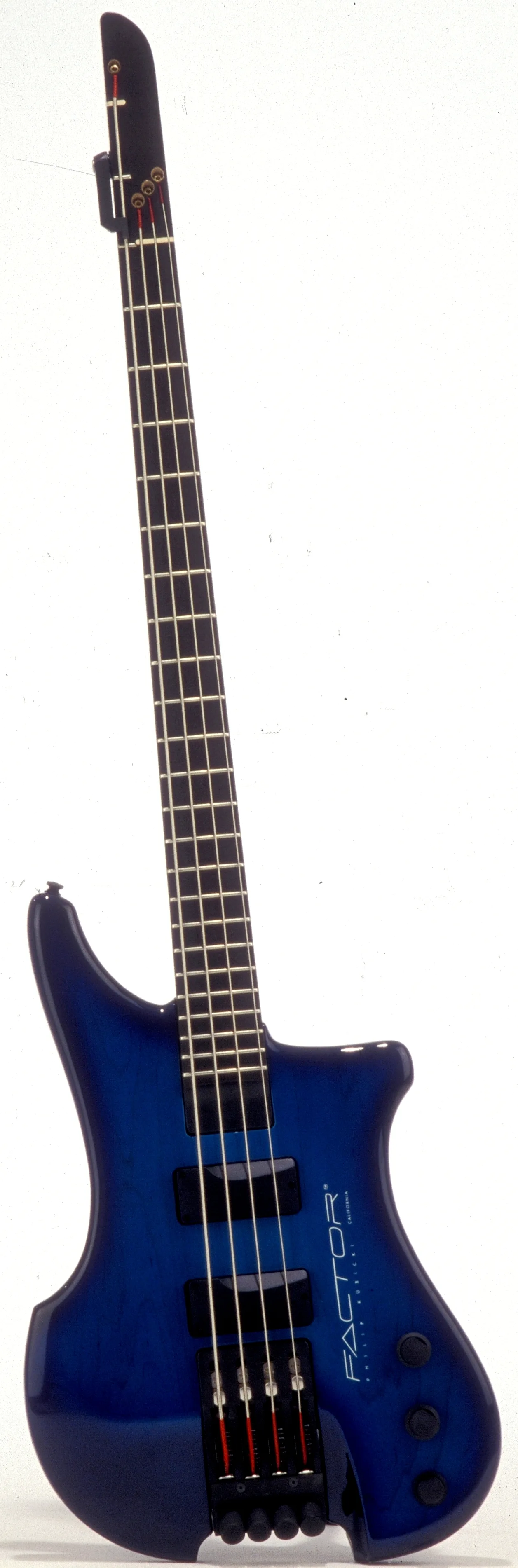
The short version
1963
Fender, at 19
Hired by Roger Rossmeisl two weeks after a tour of the plant. Some accounts say 1964.
1973
Santa Barbara
He leaves Fender in 1973, or is already in Santa Barbara in ’72. The accounts don’t agree.
1983
A line of his own
Work on the bass begins. One magazine later dates its debut to 1983.
1985
The first ones sold
The first production bass sells in January. In February John Taylor plays one on Saturday Night Live.
1988
The Fender years
Fender takes a license. From 1989 to 1991 the Factor is built at the Fender Custom Shop in Corona.
1991
Back home
From July, Kubicki builds them again.
2013
Phil Kubicki dies
He dies on 18 March in Laconia, New Hampshire, at 69.
2025
A new one for Stu Hamm
Hamm gets a new Ex Factor, so his old blue-and-black one can stay home.
Side A
A1
The first Factor on television
On 16 February 1985, the Power Station played Saturday Night Live. John Taylor was on bass, and the bass was number 024, made the month before and sent to him to try. Phil Kubicki later wrote that it was “one of the last in a line of prototypes.” He also wrote that the show was “the first time a Factor Bass was seen on television.”
Nobody watching had a reason to know the name. The man who built it had spent his twenties building guitars with somebody else’s name on the headstock.
A2
Two weeks, at nineteen
Kubicki took a tour of Fender in 1963 and was hired two weeks later, at 19, by Roger Rossmeisl. Some accounts say 1964. He helped design the Telecaster Thinline. He built George Harrison’s rosewood Telecaster, the one on “Let It Be.” That’s a different instrument and a different story, but it tells you where his hands had been.
He was out by 1973, or in Santa Barbara by ’72, depending who you ask. By 1983 he was working on a bass line of his own. The first production bass sold in January 1985.
A3
A headstock with a different job
Most basses hang heavy at the far end. Four big tuners on a long neck will drag it toward the floor. Kubicki moved the tuners into the body, at the bridge. You rough-tune by hand on a wheel and fine-tune at 80:1.
He didn’t throw the headstock away, though. The ball ends of the strings sit in bronze cups up there, so it takes ordinary strings, not the double-ball kind a Steinberger needs. With no tuning keys on the neck to steady it, the neck is a laminate: 34 maple plies today, 32 in older accounts, glued up like plywood.
Flip the record · By the numbers
32" / 36"
Scale length with the clasp shut, and with it open for low D.
80:1
The fine-tuning ratio of the wheels in the body.
34
Maple laminates in the neck today. Older accounts say 32.
£1000+
What the Bass Centre in London was asking for one in September 1985.
Side B
B1
E to D, without the slack
The headstock has one more job, and it’s the reason people buy the Ex Factor.
There’s a clasp on the low E. Thumb the lever, pull the string clear, and the scale goes from 32 inches to 36. The string is longer, so it sounds a D, at the tension it had as an E. Drop-tune an ordinary bass and the low string goes floppy and the frets stop being where your hand expects. Here it doesn’t. Two extra frets live on the headstock to cover the notes between the new low D and the old nut.
A British magazine got “a sort of prototype” in September 1985 and found it fiddly but working. The Bass Centre in London was asking £1000-plus. The short scale changes the strings, too. The low string has to be 46 inches long so it can reach the extra four.
B2
Fender on the paperwork
From 1988 to 1991, Fender held a license. From 1989 the basses were built at the Fender Custom Shop in Corona. Some got a 9-volt board, Fender’s version of Kubicki’s 18-volt circuit. Kubicki said the pickups were the same whoever built the body.
That’s why the Factor gets filed under Fender. It’s not a Precision and it’s not a Jazz. Even the serial numbers that mark the license years don’t agree at the edges. The company has given three versions. What they all agree on is that the bass was a Kubicki the whole time.
In 1994 an announcement went out for Key Factors: Schaller keys on a headstock, a bridge in the top, $1,500 for the four-string against $2,500 for the headless one. You can’t order one now. The only thing on the order page is the Ex Factor.
B3
Still under his name
Stuart Hamm saw an ad in the bass insert of Guitar Player. Then he found the booth at NAMM, while he was staying with Steve Vai. On Kings of Sleep, in 1989, he says the Kubicki was the sound.
It has the sound of the Kubicki bass, which was really instrumental in my explorations.
Vail Johnson got his at the Santa Barbara factory in 1986, the same year he joined Kenny G.
Kubicki moved to New Hampshire in 2008. He died in Laconia on 18 March 2013, at 69. The company kept going. Its 2024 owner’s guide comes from Reading, Pennsylvania, and it still covers the Ex Factor with the D clasp.
In November 2025 Hamm posted about a new Ex Factor, a multi-color one, and thanked Carla Kubicki and Mike Haney for it. That way his old blue-and-black number 45 could stay home. The name on the headstock was still Kubicki.
Put this on
You’ve read about it. Now hear it. Here’s what this guitar sounds like, and what to listen for.
The Power Station on Saturday Night Live
John Taylor on bass number 024, which Kubicki called the first Factor seen on television. The band played “Some Like It Hot” and, by one setlist, “Get It On.” Which song shows it best isn’t logged, so watch for him.
Watch it on YouTube (opens in a new tab)Kings of Sleep
Hamm calls this album the sound of the Kubicki bass. Try “Black Ice,” the tapped Bach “Prelude in C,” the title track, and “Terminal Beach.”
Find it on YouTube (opens in a new tab)
The cast
The people, and the specific guitars, that made the legend.
1985
John Taylor
Ex Factor 024, made January 1985
Sent to him to try. Kubicki called it one of the last prototypes and the first Factor on television, with the Power Station on SNL.
1989
Stuart Hamm
Blue-and-black Ex Factor
Saw the ad, found the NAMM booth, and made the bass his sound on Kings of Sleep. Got a new one in 2025.
1986
Vail Johnson
Ex Factor from the Santa Barbara shop
Got his at the factory in 1986, the year he joined Kenny G.
1985
Phil Kubicki
Designer
About ten years at Fender, then a bass that kept its headstock for a different job.
Liner notes
Specs, construction, rarity, value, and every source we used.
Ball ends in the head and tuners in the bridge, with a clasp that drops E to D at full tension — Kubicki’s Ex Factor, not a Steinberger and not a Fender.
- Body
- Alder. Gloss polyurethane. Factory: 19-3/4" long, 13-1/2" wide, 1-9/16" deep; 44-1/2" overall; 8-1/2 lb.
- Neck
- Laminated hard-rock maple, bolt-on. Factory now: 34 laminates, glue lines perpendicular to the board. Truss at the head, screwdriver, strings left on.
- Fingerboard
- Ebony, 7-1/2" radius. 23 frets, plus 2 on the headstock that carry E down to D. Resin side dashes, not face dots.
- Scale
- 32" (36" with the clasp open). Factory Ex Factor card.
- Pickups
- Two Kubicki humcancelling. Height and tilt. Active or passive from the same switch.
- Hardware
- Body-mounted bridge/tuner. Internal wheels, .750" spacing, stainless saddles, 80:1 knobs at 35°. String clasp on the head. Ball ends in bronze cups. Ordinary strings, not double-ball.
- Electronics
- Kubicki 18V. Stacked volume/pan and treble/bass. Six-position rotary: three passive, two active, standby.
- Finish
- Gloss polyurethane, made to order, “any color.” Gallery also shows pearls, bursts, and exotic veneers.
- Nut
- Phenolic, 1-17/32". The extended-E fret and the zero fret are taller wire (.118" × .058", Dunlop 6000). The rest are .103" × .046" (Dunlop 6155).
Open the full research fileConstruction details, the complete player record, production numbers, dated value estimates, and sources
Current typical = made-to-order Ex Factor 4 (kubicki.com/store/basses, fetched 21 October 2026). Factory direct. No dealer net. Case is on the card. Fretless, lined or not, is the option. Factor 4 on the factors page is 34", 24 frets, eastern soft maple or alder, same bridge/tuner, and the clasp copy says the clasp is Ex Factor only. Key Factor 4 and 5 are headed: Schaller keys, a bridge in the top. Factor 5 is a prototype page. The Blaster and the Japanese Extender sample were never licensed. Not a Fender Precision or Jazz, license years included. Not a Steinberger (steinberger-xm). Standalone. No Gibson SKUs. The factory card is inches only. Dealer cards print 19 mm against .750" / 3/4", and 3.94 kg / ≒4.45 kg against 8-1/2 lb. Mix flagged. Do not convert. Do not average 32" / 33" / 34", or the factory 1-17/32" with the Music Zoo’s 1.61".
Construction
The job was a bass that stayed put, and a low D that did not go slack. Headstock weight is what drags a long scale off your shoulder. Philip Kubicki left the head on so the ball ends had a home, and moved the tuners into the body. Santa Barbara, not Fullerton.
The Fender years are why this bass gets filed under the wrong brand. Vintage Guitar (Ward Meeker, 19 March 2013): a tour in 1963, hired two weeks later at 19 by Roger Rossmeisl. Wikipedia’s Factor page says 1964, and a late-1973 exit. Vintage Guitar has Santa Barbara in ’72. Jedistar, citing American Basses, has 1973. Keep both pairs. He helped design the Telecaster Thinline and built Harrison’s rosewood Tele, the one on “Let It Be.” Not this bass. Neither is Fogerty’s “Slugger,” the bat guitar on the 1985 hit “Centerfield.” Jedistar: a late-1970s Collins-Kubicki partnership with Carla Collins. The bridge patent later sat with Collins Kubicki, Inc.
Wikipedia and No Treble (Kevin Johnson, 21 March 2013): a line of his own starts in 1983, and the first production bass sold in January 1985. The factory FAQ: designed, patented, and produced beginning in 1985, serial 1. Phil’s email of 4 August 2008, via Jedistar: they first appeared in 1985. Premier Guitar (Heiko Hoepfinger, 11 May 2013) says the originals debuted in 1983. Vintage Guitar folds the design and the start of building into 1985, beside Centerfield. Wikipedia’s infobox prints 1983–present over a body that dates the first sale to January 1985. Keep 1983, and Premier Guitar’s debut. This plate starts in 1985.
The FAQ chart dates a bass. It is not a census. 1–22 prototypes, no month. 23–761, February 1985–February 1988, Santa Barbara. Phil’s letter on John Taylor’s bass, quoted by Heritage Auctions: serial 024, made January 1985, “one of the last in a line of prototypes.” The chart’s production block starts at 23 in February 1985. A January 1985 number 024 fits neither sentence cleanly. Keep the letter and the chart.
The bridge is the tuner. Ball end in a bronze cup in the head, the tail on a wheel: rough tune by hand, fine tune at 80:1, knobs at 35°. Ordinary ball-end strings. Not Steinberger’s double-ball (steinberger-xm). Not Status graphite (status-series-ii).
The clasp is the other half, and the factory says it is only on the Ex Factor. Thumb the lever, pull the E clear, and the scale goes from 32" to 36". Pitch goes to D at the tension of that longer string, so the fretting does not move the way a slack drop forces it to. D# is the fret between open D and the old nut. Premier Guitar: lower pitch without the slack. Tony Bacon, One Two Testing, September 1985, on “a sort of prototype”: fiddly, and it works. He calls that sample a 34" scale. The living card is 32" / 36". The Music Zoo’s Corona bass, serial 2705, stamp 09 90, prints 33". Do not average them. Factory strings for the short scale are .045, .065, .085, .105: 32" is 6 percent shorter than 34", and the same string at the same pitch loses about 11 percent of its tension. The .105 has to be 46" overall, 39-1/2" of wrap. Bacon’s prototype E was already too short for the extension.
The neck has no keys to balance a vibrating string, so it is a laminate. Factory now: 34 plies, perpendicular to the ebony. No Treble and Wikipedia say 32 rotary-cut pieces. Bacon: “loads of 1/16in maple veneers.” Keep 32 and 34. Do not turn the count into a thickness.
Not the Factor 4. Same wheels, 34" and 24 frets, maple or alder, no clasp in that spec. Its card reprints the Ex Factor’s overall length and a width “at the 23rd fret” on a neck it also calls 24 frets. Not a second measurement. Not the Key Factor. Wikipedia: during the license years the work shifted to Key Factor 4 and 5. George Dibos, 27 May 1994, an announcement he said Phil authorized: Schaller keys, a bridge in the top, list $1,500 (four-string) and $1,700 (five) against $2,500 for the headless four. The same note says the original Factors had gone to soft maple earlier in 1994. The living Ex Factor card says alder. The Factor 4 card says eastern soft maple or alder. The FAQ now sells only the Ex Factor 4, fretted or fretless.
1988–1991, Fender held a license. The bass was still a Kubicki. The FAQ sentence: serials 1293 through 3049, 1988 through 1991. The chart splits the block. 1000–1292, February 1988–February 1989, licensed, still at the Santa Barbara shop. 1293–3049, March 1989–February 1991, Fender Custom Shop, Corona. 3050 on, July 1991, Kubicki again. Phil’s 2008 email draws the license as 1287 through 3050, and says he made the others. Three company statements. They date a bass. They do not meet at the edges. Pickups, he wrote, are the same whoever built the body. Some Fender-made basses, not all, got a 9V board that was Fender’s version of his 18V. Nine volts is not a Fender model. Not a Precision. Not a Jazz.
The Blaster is the misfile on the other side. Factory: a Japanese firm was asked about a Japan-only line and sent a Blaster and an Extender. Neither was approved. No contract. The Fender license was the following year. The samples later “seemed to multiply.” The bridge/tuner does not interchange with an Ex Factor 4. A listing that calls a Japanese Blaster an Ex Factor is the other object.
He died 18 March 2013 in Laconia, New Hampshire. Vintage Guitar, Wikipedia, and Premier Guitar say 69. The Vintage Guitar headline also prints 1948, which is not 69 in 2013. Pancreatic cancer that January (Wikipedia: mid-January; Vintage Guitar: stage four). New Hampshire in 2008. The October 2024 owners guide is Philip Kubicki, LLC, Reading, Pennsylvania, still covering the Ex Factor with the D-tuner. The order page is still that bass alone. Hamm, 21 November 2025, thanks Carla Kubicki and Mike Haney for a new one. A new Ex Factor is still this slug.
James Tyler’s shop used Kubicki parts before the Studio Elite (james-tyler-studio-elite). That is a guitar. Not this bass.
Players
Stuart Hamm. The player the clasp is tied to. Guitar World / Bass Player (18 April 2022), on Kings of Sleep (1989): “It has the sound of the Kubicki bass, which was really instrumental in my explorations.” Black Ice, a tapped Bach Prelude in C, the title track, Terminal Beach. The same piece names the Fender Urge as another bass. Not this one. Stuart Clayton’s February 2022 interview: an ad in the bass insert of Guitar Player, then the NAMM booth, while he was staying with Steve Vai. His post, 21 November 2025: a new multi-color Ex Factor, so blue/black #00045 could stay home. Serial 45 sits in the Santa Barbara block that starts at 23. He does not date it in that post. Radio Free Albemuth (1988) is the album before. The Guitar World piece does not name the bass on it. Don’t pin it.
John Taylor (Duran Duran / the Power Station). Phil’s letter, via Heritage: Ex Factor 024, January 1985, sent for him to try. The Power Station spot on Saturday Night Live was, he wrote, “the first time a Factor Bass was seen on television.” That episode is 16 February 1985 (IMDb). IMDb credits “Some Like It Hot.” setlist.fm also lists “Get It On.” The letter does not split the songs. Two production Ex Factors followed. The letter’s white one was then at the Rock and Roll Hall of Fame — a 2004 claim, not a 2026 check. Bass Player (December 2007) lists a Kubicki Factor among the ’80s and ’90s basses. FretlessBass.com: a fretless Kubicki, for a while, not identified as 024. “Girls on Film” is not this bass. Guitar World (8 February 2025) has that line on an Aria SB 700.
Vail Johnson. Bass Musician Magazine (30 April 2020): the Ex Factor in the frame is the one he got in 1986 at Phil’s Santa Barbara factory. Wikipedia’s history section, flagged there as original research, says the Kenny G tours on an Ex Factor are what spread the bass. He joined Kenny G in June 1986 (For Bass Players Only, 3 August 2009). No Kenny G album is pinned here.
Also known to play stays short. No Treble’s obituary names Roger Waters and Victor Wooten. No album credit this pass. None invented.
Rarity
You can order a new Ex Factor 4. Made to order, direct, not rare as a current model. Factor 4, the Key Factors, and the five-string are not on that line.
No factory total was published. None invented. The serial blocks date a bass. They don’t count a year, and the edges don’t match: the chart, the FAQ’s 1293–3049 sentence, and Phil’s 1287–3050 email. The chart also jumps from 761 to 1000. What filled 762–999 is unpublished. That is why a first-year number is unknown.
What is actually thinner: prototypes 1–22; Taylor’s 024, if you follow the letter and call it a late prototype; a 9-volt board from the license years, which Phil said was some of those basses, not all; a Key Factor, which you cannot order. Hamm’s #00045 and Taylor’s 024 are single objects. They are not a vintage Factor. A Blaster is not in this count.
Value
Informal estimate, 21 October 2026. Not an appraisal.
Ask vs sold labeled. Celebrity lots are not-comps. No invented medians or factory counts. No Reverb Price Guide band this pass. Flag: thin sold-comp access. Odd-cent figures are non-US displays. Don’t treat one as a US hammer. Historical money, not 2026 street: One Two Testing, September 1985, £1000+ through the Bass Centre; Dibos, 27 May 1994, $2,500 list on the headless four-string.
New street. The factory page prints no price. You write, they invoice. Named dealer asks, not a MAP: TiesStore on Reverb, new birdseye Ex Factor 4, $9,155.20 (from $9,637.06); new purple burst, $8,641.50, that card’s weight 3.94 kg. Do not average those asks. Do not average 3.94 kg with 8-1/2 lb.
Used modern. Named asks, not a midpoint. Ikebe, 1996 black, displayed $3,903.72, about 4.45 kg, bridge printed 3/4" (19 mm). Reverb, 1995 gloss black, 18V, the seller’s “post-Fender” line, ask $6,286.24. A 1990s white from a London shop, displayed $7,475.41. A 1992 red listing has sold; the page still shows 8 lb 11 oz and not the hammer.
Vintage / collectible. Santa Barbara and the license years. TalkBass ads marked sold, at the figure on the ad, not an auction receipt: 1989, $3,500 (26 November 2024); 1990 black, serial 1970, $3,750 (3 March 2026). Music Zoo ask, serial 2705, stamp 09 90, $4,199.00, and that shop prints 33" and 9V. A Fender Custom Shop listing has sold; the last figure on the page is £2,319.77, not a confirmed hammer. Do not average a 1989 classified with the London ask. Taylor’s 024 sold at Heritage on 17 April 2004. The hammer is behind the login. Not a comp.
See also
- steinberger-xm — the other full-size headless bass of these years; double-ball strings, no low-D clasp
- status-series-ii — 1984 graphite headless, tuners at the bridge; not this maple wheel
- james-tyler-studio-elite — Kubicki parts in the shop years; a guitar, not this bass
Sources
- Kubicki, Ex Factor 4 — made to order; alder; 34-laminate maple; ebony; 7-1/2" radius; phenolic nut 1-17/32"; 32" (36" extended); 23 frets plus 2; .750" spacing; two humcancelling; 18V; six-position rotary; 44-1/2" overall; 1-9/16" deep; 8-1/2 lb; clasp Ex Factor only; 32" is 6 percent shorter than 34" and about 11 percent less tension; 80:1; knobs at 35°; bronze cups (fetched 21 October 2026)
- Kubicki, The Factors — Ex Factor against Factor 4 (34", 24 frets, eastern soft maple or alder, no clasp in that block) and Key Factor 4/5 (Schaller, top bridge, 9V on the Key)
- Kubicki, FAQ — serial blocks 1–22 prototypes, 23–761 (02/85–02/88, Santa Barbara), 1000–1292 (license, still Santa Barbara), 1293–3049 (03/89–02/91, Fender Custom Shop, Corona), 3050+ from 07/91; produced from 1985, serial 1; license sentence says 1293–3049, 1988–1991; only the Ex Factor 4 is on sale; fretwire Dunlop 6000 / 6155; string gauges .045–.105; Blaster and Extender samples never approved
- Kubicki, Did Fender make Factor basses? — same license years; Kubicki services all of them
- Kubicki owners guide PDF, October 2024 — Philip Kubicki, LLC, 460 Wegman Road, Reading, PA; covers Factor 4 and Ex Factor 4 with D-tuner; made in America
- Wikipedia, Philip Kubicki Factor Bass — 1983 ambition; first production sold January 1985; infobox “1983–present”; Fender 1964–late 1973; Arrow/Express, 275; Fender license 1988–1991; Key Factor during those years; 32-piece neck; patents cited as 4,712,463 / D286,892 / D362,262; Vail Johnson / Kenny G (history section flagged original research); died 18 March 2013, age 69. Lead only
- No Treble, Kevin Johnson, 21 March 2013 — design 1983; first production 1985; bridge tuner, E-to-D, 32-piece neck; players named: John Taylor, Stuart Hamm, Vail Johnson, Roger Waters, Victor Wooten
- Vintage Guitar, Ward Meeker, 19 March 2013 — died 18 March 2013, Laconia, age 69; headline also prints 1948; tour 1963, hired at 19; Thinline; Harrison rosewood Tele, “Let It Be”; Santa Barbara ’72; Factor designed and begun 1985; Fender license ’88–’91; New Hampshire 2008
- Premier Guitar, Heiko Hoepfinger, 11 May 2013 — clasp drops E to D, scale 32" to 36", two extra frets, tension kept; debut wording 1983; died at 69
- One Two Testing, Tony Bacon, September 1985 — “a sort of prototype”; clasp, Eb, 80:1, plastic wheels, 1/16" maple veneers; he calls the sample 34" scale; UK £1000+ via the Bass Centre; quantities expected that winter
- Jedistar, Phil Kubicki Factor Basses — American Basses: left Fender 1973; Collins-Kubicki; bass line 1985. Phil’s email, 4 August 2008: first appeared 1985; license serials 1287–3050; he made the others; some Fender basses, not all, got 9V; pickups the same; roughly 1988–1991
- US 4,712,463 — bridge and tuner on the body, not the head; filed 24 February 1986; granted 15 December 1987; Philip Kubicki and Geoffrey Richardson; later assigned to Collins Kubicki, Inc.
- Justia, Philip Kubicki patents — D286,892 “Guitar head,” filed 6 June 1984, granted 25 November 1986; D362,262 “Electric guitar,” filed 1 September 1994, granted 12 September 1995. Wikipedia’s footnotes map those design numbers onto the clasp and the overall bass. Justia’s titles don’t. Keep both.
- Guitar World / Bass Player, Stuart Hamm, 18 April 2022 — Kings of Sleep (1989) as the Kubicki sound: Black Ice, Bach Prelude in C, title track, Terminal Beach; Fender Urge is the other bass
- Stuart Clayton, interview with Stuart Hamm, 11 February 2022 — ad in the Guitar Player bass insert; NAMM booth; staying with Steve Vai
- Stu Hamm, 21 November 2025 — new Ex Factor from Carla Kubicki and Mike Haney; compared with blue/black #00045
- Heritage Auctions, John Taylor Ex Factor prototype, lot 16196 — Phil’s letter: serial 024, January 1985, late prototype; Power Station, Saturday Night Live, first Factor on television; later production basses, white one then at the Rock Hall; sold 17 April 2004; hammer not shown
- IMDb, SNL Pamela Sue Martin / Power Station — aired 16 February 1985; soundtrack “Some Like It Hot”
- setlist.fm, Power Station at SNL, 16 February 1985 — “Some Like It Hot” and “Get It On”
- Duran Duran, Bass Player interview, December 2007 — Kubicki Factor among ’80s and ’90s basses
- FretlessBass.com, John Taylor — a fretless Kubicki, for a while
- Guitar World, John Taylor, “Girls on Film,” 8 February 2025 — Aria SB 700 on that track; not this plate
- Bass Musician Magazine, Vail Johnson, 30 April 2020 — the Ex Factor shown is the one from Phil’s Santa Barbara factory in 1986
- For Bass Players Only, Vail Johnson, 3 August 2009 — with Kenny G since June 1986; the bass is not named in this piece
- rec.music.makers.bass, George Dibos, 27 May 1994 — Key Factor announcement he says Phil authorized; list $1,500 / $1,700 against $2,500 for the headless 4-string; maple change earlier in 1994
- The Music Zoo, Ex-Factor serial 2705 — date stamp 09 90; ask $4,199; shop prints 33", 9V, 1.61" nut, 8 lb 14 oz. Mix flagged against the factory card
- TalkBass, 1990 Ex Factor serial 1970 — ad $3,750, marked sold 3 March 2026
- TalkBass, ex-factor tag — 1989 classified marked sold at $3,500, 26 November 2024
- Reverb, new birdseye Ex Factor 4 — TiesStore ask $9,155.20 from $9,637.06
- Reverb, new purple burst Ex Factor 4 — ask $8,641.50; listing weight 3.94 kg; 19 mm pitch. Mix flagged
- Ikebe, 1996 Ex Factor 4 black — displayed $3,903.72; about 4.45 kg; 3/4" (19 mm). Mix flagged
- Reverb, 1995 Ex Factor gloss black — ask $6,286.24; seller calls it post-Fender, 18V
- Reverb, 1990s Ex Factor white — London seller; displayed ask $7,475.41
- Reverb, 1992 Ex Factor red — sold; hammer unpublished; one bass at 8 lb 11 oz
- Reverb, Fender Custom Shop edition — sold listing; last displayed £2,319.77; not a confirmed hammer
Keep digging
Guitars this one gets compared to, confused with, or descended from.
- Send a picture
Steinberger
XM
1987
Bill Wyman said the little Steinberger looked like a machine gun. The full-size one, he kept.
Photo: Andrew Hurley from Wallasey, England, United Kingdom / Wikimedia Commons / CC BY-SA 2.0 Status
Series II
1984
Rob Green looked at a room full of expensive basses and said he could build a better one. Then he did.
- Send a picture
James Tyler
Studio Elite
1987
Built in a North Hollywood shop with no sign, for the session players whose names were in the small print.