Status
Series II
Rob Green looked at a room full of expensive basses and said he could build a better one. Then he did.
Romford, Essex, the early 1980s. Rob Green is working at Soundwave, the music shop that also gave the world Trace Elliot amps, surrounded by expensive basses. He looks them over and decides he can do better.
- Introduced
- 1984
- Type
- Solidbody bass (headless graphite)
- Class
- Closed run
The short version
1984
Strata becomes Status
The first review, that February, calls it the Status. Until just before, it was the Strata. £995.
1985
The all-graphite one
The Series 2000 arrives, one moulded piece. Series II is the name for the wood-winged bass beside it.
1986
“Lessons in Love”
Mark King records the thumb line on a red Status at Maison Rouge in London. Which model, nobody wrote down.
1987
Chelmsford
Four people and an outside moulder, building graphite basses in Essex.
1990s
A truss rod after all
Status starts fitting rods. The later version of this shape becomes the S2-Classic.
2014
Fourteen for thirty years
Green builds fourteen Series IIs to mark the anniversary, as close to the original as he can.
2026
No new orders
Status stops taking orders. Leftovers only.
Side A
A1
A room full of expensive basses
Some people see a bass they can’t afford and start saving. Rob Green saw a room full of them and decided they weren’t good enough.
Green had learned the trade at Shergold, the British guitar maker, from a man named Norman Houlder. Then he landed at Soundwave in Romford, the shop that also hatched Trace Elliot. The room was full of expensive basses. He told a journalist later that he looked at them and thought he could make a better one.
So he set up on his own as Green Machine Technology. His bass was going to be called the Strata, right up until just before the first review. By February 1984 it was the Status, and it listed at £995.
A2
Graphite in the middle, wood on the sides
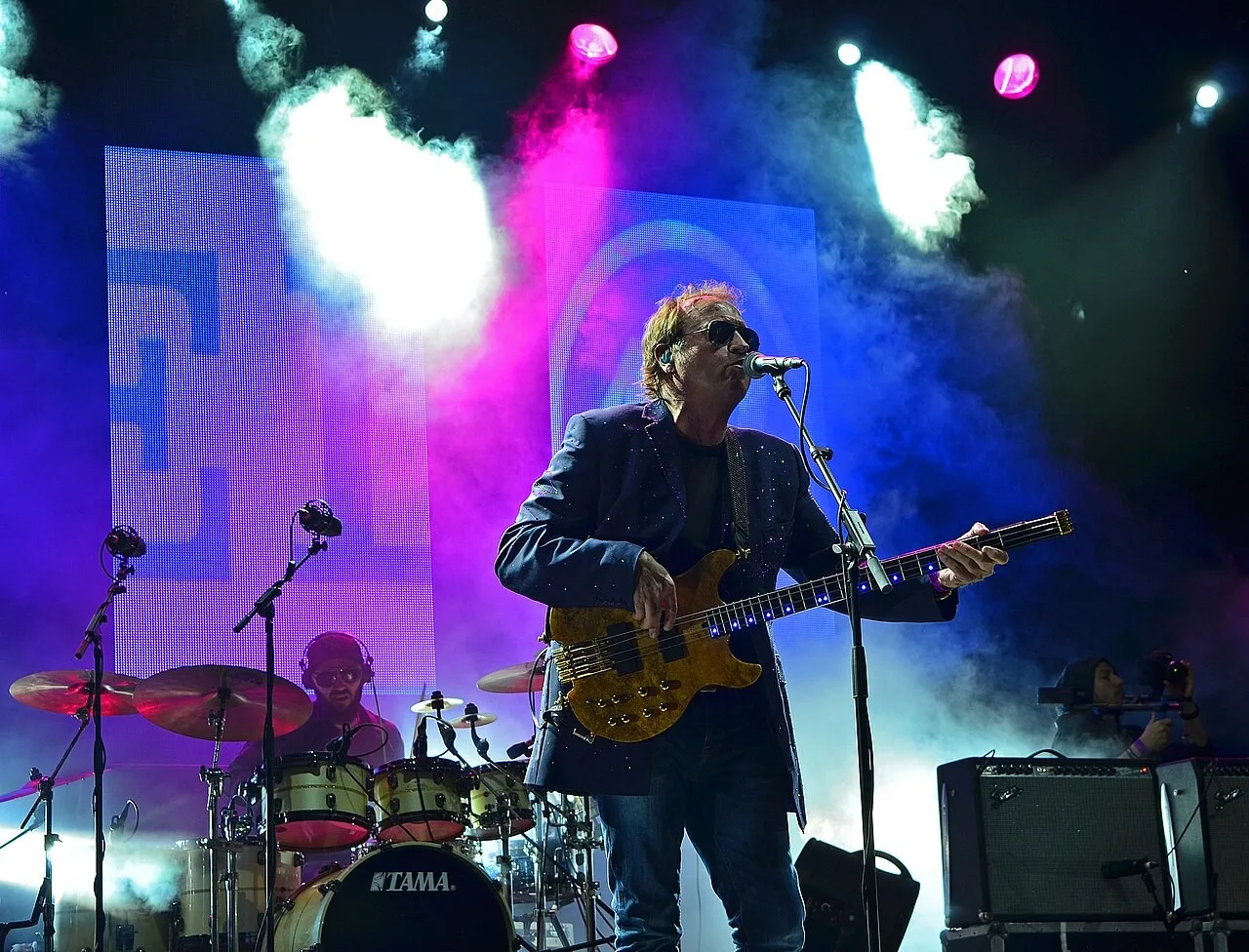
The idea was a bass that wouldn’t move with the weather. Wood necks shift when it gets damp or dry. Graphite doesn’t. So the middle of the Status, the neck and the spine running through the body, was moulded carbon graphite, and there was no truss rod at all. The fingerboard was phenolic, a hard resin, with side dots only.
The wings on either side were wood. Green was honest about what the graphite did. He didn’t claim it had a tone of its own. It colours the sound less than maple or mahogany, he said, it opens up the range and kills dead spots, and then what you hear is the strings and the pickups. The wood was there because every plank is different. Flame maple, cocobolo, padauk. That’s where each bass got its personality.
There’s no headstock. The tuners are down at the bridge, the same direct-pull idea Steinberger was using, and GMT said so openly. The nice touch was that you didn’t have to buy special strings. Double-ball or ordinary, both worked. Two humbuckers, two 9-volt batteries, and a switch for active or passive.
Green didn’t claim graphite had a sound. He claimed it got out of the way.
A3
The II, and the one after it
The name “Series II” makes the most sense next to what came after it. By 1985 Green had a second bass, the Series 2000, moulded all in one piece of graphite with the weave showing through. That one went for £1,095 with the case. Series II is the name for the one with the graphite spine and the wooden wings.
It wasn’t a big operation. By early 1984 there were “somewhere in the region of 40 instruments,” every model included. By the summer of 1985 there were orders for more than fifty. Even the reviewers couldn’t agree on the neck. One found it wide and shallow, like a Precision. Another found it “still quite round” and chunky up by the body. Depends whose hands.
Flip the record · By the numbers
£995
List price in the first review, February 1984.
~40
Instruments the company had made by early 1984, all models together.
0
Truss rods in an early Series II. The graphite spine was supposed to make them unnecessary.
14
Series IIs Green built in 2014 for the thirtieth anniversary.
Side B
B1
Postman Pat red
Mark King of Level 42 spent his first years with the band playing a wooden Jaydee. Before that he’d tried a few Wals, wood married to graphite, and said the wood was moving. Then he got into Status.
In March 1986, at Maison Rouge in London, he recorded “Lessons in Love” with two basses. The thumb line, the one everybody knows, the one that runs all the way through, is on his red Status, the bright Postman Pat red of the children’s TV show. The finger line is on a Jaydee. The graphite, he said, suited the thumb part: “a sort of cool, calm aggression.”
Which red Status? Nobody wrote down whether it was a Series II or the all-graphite 2000, and both existed by then. King himself says he was using “the Status Series One and Two basses on and off in between the JayDees.” That’s as close as the record gets. His own KingBass came later, in 2000, and it’s a different design.
Chris Wolstenholme of Muse bought his first headless Series 2 from a friend, because he liked how it sounded. More Status basses, and eventually his own signature model, came later.
B2
Four people and a phone number
In 1987 Status was in Chelmsford, with four workers and an outside company doing the moulding. The shops that did it were used to defence contracts, and they charged prices Green called telephone numbers. A bad layup couldn’t be fixed. It went in the bin.
In the 1990s Status started fitting truss rods after all, and later the shape turned into the S2-Classic, with a bolt-on option and a midrange knob. The owner of one 1987 Series II, the old way with no rod, says the neck has never moved.
B3
As close to the original as he could
In 2014, thirty years on, Green built fourteen new Series IIs, “as close to the original as he could.” In April 2026 Status said it wasn’t taking new orders.
He started out sure he could build a better bass than anything on that wall in Romford. Thirty years later, the bass he was trying to live up to was his own first one.
The cast
The people, and the specific guitars, that made the legend.
1984
Rob Green
Designer and builder
Learned the trade at Shergold, then set up Green Machine Technology, GMT, to build this bass.
1986
Mark King
The red Status
Level 42. Used “the Status Series One and Two basses” between his Jaydees, and later got his own KingBass.
Chris Wolstenholme
Headless Series 2
Muse’s bassist bought his first headless Series 2 from a friend, for the tone. Status later built him a signature bass.
1996
John Entwistle
Not this one
Entwistle played a Status Buzzard, a different all-graphite design. Not a Series II.
Liner notes
Specs, construction, rarity, value, and every source we used.
A graphite spine, wooden wings, and the tuners at the bridge — Status’s Series II, not the all-graphite 2000, not a Steinberger, and not a Buzzard.
- Body
- Graphite through-neck spine, wooden wings. Feb 1984 review bass: flame-maple face, amazaque back, thin ebony veneer. Angular, long horns, chamfered.
- Neck
- Moulded carbon graphite. Bodnar: Precision-wide, shallow, black gel coat. No truss rod, no neck bolts. IM, July 1985: the Status neck was still quite round and large toward the body. Keep both.
- Fingerboard
- Phenolic. Side dots only; no face markers. Fretted or fretless. Bajos y Bajistas, on 1987 #273: 24 frets.
- Scale
- 34" on that 1987 bass. No millimetres in the review.
- Pickups
- Two GMT Solid Humbuckers, fingerboard and bridge (Feb 1984). The 1987 review calls the period ones soapbars.
- Hardware
- Headless. Satin-lacquered brass string anchor, bridge, and tuner/tailpiece. Direct-pull, brass trays. Double-ball or ordinary strings.
- Electronics
- Two PP3s, on with the jack. Volume, balance, active/passive. Fretted: bass and treble. The Feb 1984 fretless loaner: parametric, 80 Hz–5 kHz, ±18 dB.
- Finish
- Gloss. Bodnar calls the back of the review bass mirror-like. Wings are the exotic of that build.
- Nut
- Brass string anchor, not a shaped nut. Width unpublished in the 1984 review.
Open the full research fileConstruction details, the complete player record, production numbers, dated value estimates, and sources
Classic living example = 1980s headless Series II, 4-string, graphite spine and wood wings (Romford, then Chelmsford). No new one. Status, 24 April 2026: not taking new orders. S2-Classic is the later name of this outline — truss rod, bolt-on option, three-band mid — not this table. Series 2000 is the all-graphite moulding. KingBass is Mark King’s later signature. Status Buzzard (B-1 / B-2) is John Entwistle’s other bass. Not a Pedulla Buzzard. Not a Warwick Buzzard. Mix flagged: the 24 August 2009 S2-Classic list prints headless 34" (864 mm) and headed 34¾" (882 mm) on one page. Do not paste 864 mm onto the 1987 34". Do not average Bass Direct 18 mm spacing on a 1985 and a 1990 Series II with that list’s 19 mm 4-string standard, or with the 16.5 mm custom the later list ties to King’s own basses. Bass Direct also prints 42 mm nuts and, on the 1990, 4.2 kg / 9 lb 5 oz. One card. Not a factory spec.
Construction
The job was a British bass that would not wander with the weather, and would not look like a stick. Steinberger already had the headless idea. Modulus already had graphite necks. Rob Green came from Shergold, where Norman Houlder taught him the work, into Soundwave in Romford — the shop that also hatched Trace Elliot. The room was full of expensive basses. He told Tony Bacon he could make a better one. Green Machine Technology is his name on the door. The bass was called Strata until just before the review. By February 1984, Andrew Bodnar, in One Two Testing, has it as the Status.
The loaner was fretless. Fretted was already the other standard. Graphite spine, bookmatched wings, phenolic board, no truss rod, no face dots. Brass hardware, satin-lacquered against discolouration. The tuners are Steinberger’s direct-pull, and GMT said so: brass trays instead of the jaws. Ordinary strings or double-ball. Two Solid Humbuckers, two PP3s, volume and balance, active or passive. Fretted: bass and treble. That fretless: 80 Hz to 5 kHz, ±18 dB. List £995.
He does not claim the graphite makes a tone. Bacon, April 1987: it influences the sound less than maple or mahogany, opens the range, kills dead spots, and then you hear the strings and the pickups. The wood stays because the planks are not the same. Flame maple and amazaque on the review bass. Cocobolo over sipo on 1987 #273. Padauk on an owner’s #251.
Series II is the name that splits this bass from the next one. Bodnar, March 1985: the first Status was unveiled “just two years ago.” International Musician, July 1985, looking back at March 1984: the carbon weave had just gone into the Series II, and the bass on the bench now was the Series 2000, one moulded piece, weave showing, same angular horns. “Somewhere in the region of 40 instruments” by that March 1984 review. Orders for over 50 by July 1985. All of GMT, a region-of, then a pile of orders. Not a Series II lifetime. The 2000 was £1,095 with the case. Parametric, IM says, had just been dropped. Bajos y Bajistas on #273: two bands, 3.8 kHz and 85 Hz, 15 dB, still two 9-volts. Do not average 15 and 18.
The neck reviews do not agree. Bodnar: wide and shallow, a Precision idea. IM: still quite round, large toward the body. Bajos: the 1987 has no rod, the owner says it has not moved, and Status fitted rods from the 1990s.
April 1987, Bacon is in Chelmsford. Four workers, an outside moulder. Defence-contract graphite shops charged what Green called telephone numbers, and a bad layup is scrap. The 2000 Mk II — another circuit on the all-graphite bass — launched at Frankfurt that February. Not this plate.
S2-Classic is this outline after the rod, the bolt-on, and the midrange. Price list archived 24 August 2009, Colchester, 15% UK/EU VAT in, shipping extra. Headless 34" (864 mm), 24 frets and a zero fret. Headed 34¾" (882 mm), 24 frets. Phenolic, dual-action rod, soapbars, treble/bass plus a switched mid, 18 volts. Four-string 19 mm; 16.5 mm custom. Bolt-on 4/5/6 £1,425 / £1,550 / £1,675. Through-neck £1,975 / £2,100 / £2,224. Handedness and a headstock are free. A later undated factory list still calls 16.5 mm the spacing on King’s own basses. Not this table.
Then the old models stopped. The Series-23 page: no orders for previous instruments; the new neck is graphite-reinforced maple, not a moulded spine. The page dated 24 April 2026: not taking new orders. Leftovers only. The 1984 through-neck, no rod, against nothing you can commission.
Players
The Jaydee, the Alembic signature, the KingBass, and Entwistle’s Buzzard are other basses.
Mark King. The first four Level 42 years are the Jaydee. Guitar World (Nick Wells, 24 November 2022): Polydor advance £5,000, £500 for a bass, three or four Wals tried and not bought, Jaydee Supernatural Classic 0003SA from Sounds, off Charing Cross Road. He told Making Music in April 1986 that those Wals were wood married to graphite, and the wood was moving. Status is the next graphite. Not that Wal.
Early March 1986, Maison Rouge, “Lessons in Love”: two basses on the tape. Thumb line, all the way through, on his Postman-Pat-red Status. Finger line on Jaydee number two. You hear the wood in the Jaydee, he said; the graphite suits the thumb part, “a sort of cool, calm aggression.” The article does not print Series II or Series 2000. Both existed by then. Don’t give the red bass a serial it doesn’t have. In the 2022 piece he says he had been using “the Status Series One and Two basses on and off in between the JayDees.” Series One is his phrase. Bass Direct’s 1990s Series 1 is a maple neck and a rosewood board. This plate is the Two. On camera for iBass (2013) he puts the start at 1984, then “83, 84.” Keep the hedge. The KingBass is 2000, a new body drawn with Green. The 2009 list: 34" standard, BendWell a 32" custom. The later list puts 32" and 16.5 mm on his own basses. Not the 1984 spine.
Chris Wolstenholme. Status’s page: he bought his first headless Series 2 from a friend, early 1980s, for the tone. Headed S2-Classics, a GP-Artist, and a KingBass Mk-II came later. The signature moved the bridge pickup 20 mm off the bridge and the neck pickup 10 mm toward the board, and turned the knobs around. His bass. Not this table.
Entwistle’s Status is the Buzzard. Whotabs: Warwick, then Modulus, then Status — an all-graphite one-piece, 26-fret phenolic, Roman numerals. First known live use 29 June 1996, Hyde Park. Retail signatures from 1998. The 2009 list still shows a B-2, graphite bolt-neck on an alder body, 26 frets. Not a Series II. Pedulla’s Buzzard is a 1980 Brockton fretless.
No second name goes on the list without a bass this plate can point at. A Series 2000 is not one.
Rarity
You cannot order a new Series II. The April 2026 page is leftovers, not a commission book. S2-Classics from the 2000s still turn up used. Later spec. Not a gel-coat through-neck with no rod.
GMT never published a Series II total. The closest named figure is IM’s “somewhere in the region of 40” instruments by the March 1984 review, then orders for over 50 by July 1985, every bass he was selling. Serials date one bass. They don’t count a year. Owners on Basschat put #251 as a 1986 delivery and #263 as finished 24 November 1986, and one of them already asked if the numbers were even one sequence.
What is actually thinner: a through-neck from before the 1990s rod; a parametric fretless from before that circuit was dropped; the 14 Bajos y Bajistas says Green built in 2014, thirty years of the Series II, “as close to the original as he could.” Fourteen is that run. King’s red Status has no serial on this plate. It is one object, not a vintage Series II.
Value
Informal estimate, 22 September 2026. Not an appraisal.
Ask vs sold labeled. Celebrity instruments are not-comps. No invented medians. No clean Reverb Price Guide band isolated this pass. Flag: thin sold-comp access. Period £995 (One Two Testing, February 1984) is 1984 money. The Series 2000 at £1,095 with case (IM, July 1985) is the other bass.
New street. None. Not taking new orders (Status, 24 April 2026). Last full S2-Classic list in hand is the 24 August 2009 archive, VAT in, shipping extra: bolt-on 4-string £1,425, through-neck 4-string £1,975, 5- and 6-string as in Construction. That is a 2009 cart for the later spec, not a 1984 through-neck and not a 2026 order.
Used. The whole market is used, and the 1980s bass and the S2-Classic are different money if you let them blur. Named asks, not hammers: Bass Direct, 1985 Series II, serial 187, rosewood over walnut, year field printed 1985?, £3,799, out of stock; 1990 Series II, serial 508, rosewood, £3,699, out of stock. Do not average them with a 2000s S2-Classic. King’s red bass and Wolstenholme’s early Series 2 have no auction figure here. Not comps. The 2014 run of 14 has no price in the Bajos piece.
See also
- steinberger-gl — headless graphite guitar; Bodnar says these tuners started from Steinberger’s bass system, and the GL is not this bass
- alembic-series-i — King’s Alembic signature is not Alembic’s Series I, and not this Status
- pedulla-buzzard — 1980 Brockton fretless; not Status’s Series II and not Entwistle’s Status Buzzard
Sources
- One Two Testing, Andrew Bodnar, Status Bass, February 1984 — lately Strata; graphite centre and wooden wings; headless; phenolic; Solid Humbuckers; two PP3s; parametric fretless 80 Hz–5 kHz, ±18 dB; fretted bass and treble; brass trays; double-ball or ordinary strings; no truss rod; £995
- One Two Testing, Andrew Bodnar, Status 2000, March 1985 — first Status unveiled “just two years ago”; Series 2000 entirely graphite; not this plate
- International Musician, GMT Status Bass Series 2000, July 1985 — Series II as spine plus timber wings; weave just into the Series II at the March 1984 review; ~40 instruments then; orders over 50 by July 1985; parametric just discontinued; neck “still quite round”; side dots only; Series 2000 £1,095 with case; Hyper-active pickups by Kent Armstrong on that 2000
- Making Music, Tony Bacon, Mark of Distinction, April 1986 — Maison Rouge, early March 1986; Postman-Pat-red Status on the “Lessons in Love” thumb line; Jaydee number two on the finger line; Wal wood/graphite necks moving in 1980
- Making Music, Tony Bacon, Graphiti, April 1987 — Chelmsford; four workers plus an outside moulder; Series 2 wood and graphite, Series 2000 all graphite; graphite as a neutral, dead-spot claim; Shergold and Soundwave
- Guitar World, Nick Wells, 24 November 2022 — Jaydee 0003SA, £500 of a £5,000 advance; “Series One and Two” between the JayDees; KingBass from sitting down with Green in 2000
- Mark King for iBass Magazine, 2013 — Status since 1984, then “83, 84”; headless bend past the zero fret as the thing the KingBass was built to restore
- Bajos y Bajistas, via Musicosmos, 27 December 2021 — 1987 Series II #273, cocobolo over sipo, neck-through, no truss rod, 34", 24 frets, soapbars, 2-band at 3.8 kHz and 85 Hz, ±15 dB; rod from the 1990s; 2014 run of 14 for thirty years of the Series II; do not confuse with the later Series 2
- Status price list, archived 24 August 2009 — S2-Classic scales 34" (864 mm) headless and 34¾" (882 mm) headed; 19 mm / 18 mm spacing; 16.5 mm custom; bolt-on and through-neck prices; VAT 15% in, shipping extra; KingBass 34" standard, BendWell a 32" custom; B-2 is another model
- Status bass price list, undated copy — 16.5 mm and 32" BendWell listed as the options on Mark King’s personal basses
- Status, Series-23 — not producing or taking orders for previous models; maple neck with graphite reinforcement
- Status, basses 2026 — 24 April 2026; not taking new orders; leftovers and experiments only
- Status, Chris Wolstenholme — first headless Series 2, early 1980s, bought from a friend; signature pickup moves 20 mm and 10 mm
- Whotabs, Entwistle 1986–2002 — Status Buzzard, all-graphite one-piece; 26 frets; Roman numerals; Hyde Park 29 June 1996; retail signatures 1998
- Bass Direct, Series 1 Quilted Maple — 1990s Series 1; maple neck; rosewood board; not the Series II
- Bass Direct, Series II Rosewood 1985 — ask £3,799; serial 187; year field 1985?; 34"; 42 mm nut; 18 mm spacing; out of stock
- Bass Direct, Series II Rosewood 1990 — ask £3,699; serial 508; 34"; 42 mm nut; 18 mm; 4.2 kg / 9 lb 5 oz; out of stock
- Basschat, “Get your STATUS-GRAPHITE basses out!”, page 33 — owner dates for #251 (delivered 1986) and #263 (24 November 1986); serial sequence already questioned on the thread
Keep digging
Guitars this one gets compared to, confused with, or descended from.
- Send a picture
Steinberger
GL
1984
No headstock, no wood, and designed by a man who didn’t play. Eddie Van Halen wrote two songs on it in days.
- Send a picture
Alembic
Series I
1972
The sound wizards behind the Grateful Dead got tired of noisy pickups, so they built bass players a better one.
Photo: אהוד אמיר / Wikimedia Commons / CC BY-SA 4.0 Pedulla
Buzzard
1980
A fusion bassist botched his homemade fretless. The builder who fixed it went on to build him a better one.