MTD
Kingston
He sold his own name to Gibson. The Kingston is how you get his neck without waiting on his bench.
Michael Tobias builds about ten basses a month by hand in Woodstock, New York. Everybody else who wanted his neck needed another way in. For twenty-five years it has been built overseas, then set up back home in Kingston.
- Introduced
- 2001
- Type
- Solidbody electric bass
- Class
- Production
Have a photograph of this guitar? Send a picture
The short version
1990
Tobias goes to Gibson
Michael Tobias sells the company with his name on it, on New Year's Day.
1994
MTD
The non-compete runs out. Fifty Eclipse basses come first, then the name Michael Tobias Design.
2001
The Kingston line
Built in Korea to his specifications. The first is a one-pickup Artist.
2006
The Z
Four- and five-string. A dealer in 2008 said it arrived "last year." Keep 2006 and 2007.
2008
Thirty ZX basses
Signed and numbered, with a preamp voiced after the handmade one.
2011
The AG ships
Andrew Gouché's production signature, after a collaboration begun in 2010.
2019
Back to Kingston
After "a great decade" with a distributor, the line comes home to New York.
2026
Wiped clean
The line is rebuilt in alder and roasted maple, closer to the handmade bass.
Side A
A1
The name he sold
On New Year's Day 1990, Michael Tobias sold Tobias Guitars to Gibson. The company had his name on it, and now it didn't belong to him. He signed a non-compete that ran through December 1993.
At the start of 1994 he started again. The first instruments out of the new shop were called Eclipse, fifty of them, mostly 35-inch bolt-ons, three of them neck-throughs. Then he gave the business a new name: Michael Tobias Design.
A2
Ten a month
The handmade MTD shop is small. About ten basses a month in Woodstock, New York, with a couple of part-timers. The 535 on the current handmade sheet is a 35-inch bolt-on with 21 frets and a zero fret. That's his bench, and if you want one, you wait for it.
The Kingston was built for everybody who wanted his neck and didn't want to wait on that bench. It's the other door.
That's his bench, and if you want one, you wait for it.
A3
Built in Korea, set up in New York
The Kingston line dates to 2001, made in Korea to his specifications. The early ones were plain. A 2002 Artist four-string is basswood with a maple neck and a rosewood board, one Music Man-style pickup, a volume and a tone. Whether those early Artists were 34 or 35 inches depends which listing you read. Nobody has a 2001 catalog to settle it.
The Heir came in 2003. The Z, the one that became the flagship, came in 2006 or 2007, depending who you ask, and a six-string followed in 2008. That year there were also thirty ZX basses, signed and numbered, with Bartolini pickups and a 9-volt preamp voiced like the 18-volt one in the handmade bass.
By 2009 the spec sheet was mostly his ideas: a one-piece asymmetric neck with twin truss rods, 24 frets, a quick-release bridge, a zero fret, and the Buzz Feiten tuning system. One owner says his early Artist didn't have the Feiten system. Keep the exception.
Flip the record · By the numbers
~10
Basses a month from the handmade shop in Woodstock. The reason the Kingston exists.
50
Eclipse basses before MTD had its name. Three were neck-throughs.
30
ZX basses in 2008, signed and numbered.
32"
Scale of Lynn Keller's Kingston, built for a player who's "a petite person."
Side B
B1
Korea, then Indonesia, then China
Where a Kingston was built is not a single answer. Korea first. When the Korean shop closed, Michael said in 2021, it went to Indonesia, which he wasn't happy with, and then to shops in China. Forum owners mention Vietnam briefly, and one said an Artist was identified as Czech. Keep all of it. Don't average a country.
What stays put is the last step. Setup and quality control happen in Kingston, New York. In 2019, after "a great decade" with a distributor, Michael and Daniel took the line's distribution back to Kingston too.
B2
Basses for particular people
The line kept growing by way of players. Andrew Gouché already had a handmade signature, and in 2010 the two of them set out to bring its features to a Kingston. The AG went on sale in August 2011.
Lynn Keller's came in 2023. Hers had been a USA-shop bass, and the Kingston version is 32 inches. She put the reason plainly: "As I'm a petite person, I needed a bass that fit me and could be easily worn for long hours without causing neck and back pain."
Then Norm Stockton, part of the family since 1997, with his own handmade signature from 2013 or 2014, depending which page you read. His Kingston five came in 2025, with the same mid frequencies as the USA version. At NAMM he said he still loves the American bass and uses it all the time. The Kingston, though, blew away what he'd expected, and he says people are shocked it isn't the American one.
B3
Closer to home
At NAMM 2026 the company wiped the Kingston line clean, apart from a couple of signatures. The Z had been mahogany, modeled on a 535 or a 635. The new one is alder and roasted maple, five- and six-string only, 35 inches, 24 frets, chosen to sit closer to the bass Michael builds himself.
A 2002 Korean Artist with one pickup and the 2026 Z are the same line, not the same bass. What they have in common is the reason they were built. A man who sold his name kept his neck, and found a way to hand it to people who couldn't wait for him to make it.
The cast
The people, and the specific guitars, that made the legend.
Michael Tobias
Every Kingston
Founded Tobias Guitars, sold it to Gibson in 1990, and started over as MTD in 1994. The Kingston carries his neck and his specs.
Andrew Gouché
Kingston AG (2011)
Friends with Michael for years and already had a handmade signature. The AG brought its features to the Kingston line.
Norm Stockton
Kingston KNSJ5 (2025)
With MTD since 1997, on a handmade signature first. The Kingston, he said, blew away what he expected.
Lynn Keller
Kingston LK (2023)
A 32-inch bass she could wear for long hours, after a USA-built artist bass came first.
Liner notes
Specs, construction, rarity, value, and every source we used.
A production bolt-on with his asymmetric neck and the Feiten system — MTD’s import line, not a Woodstock 535, and not the Tobias he sold.
- Body
- Alder. Maple-burl top on Natural Burl Matte, Trans Mocha, and Deep Cherry Burst only. The color list also prints Mocha Matte. Bolt-on, contoured.
- Neck
- Asymmetric roasted maple, carbon-fiber reinforcement. Five- and six-string on this sheet.
- Fingerboard
- By finish: roasted maple (Natural Burl Matte, Deep Cherry Burst), ebony (Primer Gray), rosewood (Mocha Matte). Compound 10"–14". 24 frets.
- Scale
- 35" on the five and the six. No millimetre printed.
- Pickups
- MTD split-coil. The page also says “reverse split coil.” Bartolini USA is listed as an upgrade, not the stock line.
- Hardware
- Black. Licensed Hipshot Ultralight. Top-loading Quick Release bridge.
- Electronics
- Active 3-band, ±6 dB, volume, blend, bass, middle, treble. Buzz Feiten.
- Finish
- Natural Burl Matte, Deep Cherry Burst, Primer Gray, Mocha Matte.
- Nut
- 1.75" (five-string), 2" (six-string). Spacing 19 mm / 18 mm. Mix flagged.
Open the full research fileConstruction details, the complete player record, production numbers, dated value estimates, and sources
Classic living example = 2026 Kingston Z, five- or six-string (factory page, “Updated for 2026”). Mix flagged: nut widths in inches beside spacing in millimetres. No millimetres invented for the 35" scale. Super (2026): ash, 34" on the four and 35" on the five, MTD MM/MM, series / single / parallel, spacing 20 mm / 19 mm. Nut unpublished. Saratoga page without a 2026 banner: basswood, flame maple, 34", maple or laurel, 21 frets, MTD J/J, active/passive, 20 mm / 19 mm. DJ at NAMM 2026 describes a rebuilt Saratoga in alder and roasted maple. Do not average. AG: alder, figured maple, purpleheart, 35", Bartolini, nut 1.75" / 2", spacing 19 mm, mid shift 250/800 Hz, and ±12 dB in the prose. NSJ: five-string only, 35", 21 frets, quilted maple, mid 250/450 Hz. LK (2026): 32", alder, roasted maple, nut 1.5" / 1.75". Artist, Heir, and CRB are earlier rungs. Not a 535. Not a Tobias Classic (tobias-classic).
Construction
The job was a bass with his neck that did not have to wait on the bench. He sold Tobias Guitars to Gibson on 1 January 1990. The non-compete ended in December 1993. He started MTD at the beginning of 1994. The first New York instruments were Eclipse: fifty, mostly 35" bolt-ons, three of them neck-through. Then the name Michael Tobias Design. Wikipedia’s count on the handmade shop is about ten a month in Woodstock, with two part-timers. Headquarters is Kingston. The current handmade sheet’s 535 is a 35" bolt-on, 21 frets plus a zero fret. That is his bench. This plate is the other door.
Blue Book dates the Kingston line to 2001, built in Korea to his specifications. A Barcelona dealer still tags a 2002 Artist 4, serial 02120318: Korea, basswood, maple, rosewood, 35", one MM-style Alnico, volume and tone. A Reverb seller dates a fretless K5 to 2001, also Korea. A Loud & Clear card on a modified Artist prints 34" and a 1.5" nut. A 2008 TalkBass note “believes” the early ones were 34", in the same post that calls one Artist Czech. Do not average 34" and 35". No 2001 catalog scan was in hand. This page’s year is 2001 because that is the introduction Blue Book prints, with those dated instruments on it. Not a month. Heir, same book: 2003. The Z: 2006 for the four and the five, 2008 for the six. A February 2008 dealer says the Z arrived “last year.” Keep 2006 and 2007.
Summer NAMM 2008, Craig Costigan at Dana B. Goods: Artist, Heir, and Z, bolt-ons, manufactured in Korea under exclusive license. Sound on Sound, 17 December 2009: “the Far East,” to his specifications — quick-release bridge, 24 medium-jumbo frets, one-piece asymmetric neck, twin truss rods, a zero fret, Buzz Feiten. The 2026 Z sheet prints carbon fiber, not twin rods, and no zero fret. A Musician’s Friend AG line says “double-action,” which is one rod. Don’t merge them. One TalkBass owner’s older Artist has no Feiten system. The 2002 Barcelona listing has it. Wikipedia says every current MTD, Kingston included, uses it. Keep the early exception.
The ZX, March 2008, was thirty instruments, signed and numbered. Bartolini pickups and a 9-volt preamp, “voiced similarly” to the 18-volt handmade system, switchable mid, active/passive on a push-pull. First run: burled maple, hi-gloss translucent black.
Where they were built does not sit on one map. The 23 July 2010 company page still says Korea for the Kingston, the Heir, and the Saratoga. Blue Book: imported from Korea, final setup in New York. Michael, November 2021: the Korean shop closed — the name did not survive the caption — then Indonesia, which he was not happy with, then shops in China. Wikipedia now says China. Reverb’s Z4, Z5, and Super pages say China. A Bill’s Music Z6, serial MTD09120240, is marked China. One Z6 listing writes Indonesia in the prose and China in the category. A TalkBass owner says Tobias identified one Artist as Czech. The same 2008 thread puts Grendel in the Czech Republic. Grendel is another name. A 2010 post says Korea, then briefly Vietnam, then China. Keep them. Do not average a country. Setup and QC, on the current pages, happen in Kingston, New York. Hipshot USA and Bartolini USA upgrades are installed there.
Saratoga and CRB were the next job: a J and a P, still his neck. NAMM 2009, on Premier Guitar: first samples, no options yet, maple or rosewood to come. No Treble, 16 August 2010: shipping within the month, 34", carved basswood, four- and five-string. Premier’s 15 February 2011 review of a five: 34", rosewood on that bass, maple and ebony offered, four-bolt heel, two passive J pickups, two volumes and a tone. Wikipedia calls the CRB Precision-inspired and the Saratoga a Jazz-style bass, and calls both Chinese-made. Blue Book’s other Saratoga, 2001–07, is the old-school bass the Deluxe page says it picks up from. Not this Kingston model. The Saratoga page that does not say 2026 still prints basswood, a flame top, 21 frets, active/passive. DJ at NAMM 2026 describes the rebuilt one as alder, roasted maple, noiseless single-coils, the USA Saratoga preamp, chrome, clover tuners. Two sheets. Not averaged.
The AG began in 2010, to put features of the handmade Andrew Gouché signature on this line. Audiofanzine, 20 March 2011: on sale that August. Its prose gives the preamp ±12 dB and a mid shift at 250/800 Hz. The 2026 Z preamp is ±6 dB. The Kingston NS mid is 250/450 Hz, which the company says matches his USA signature. Lynn Keller’s Kingston is later. No Treble, 26 February 2023. The 2026 LK sheet is 32" and alder. An older LK page still says basswood. The site prints both Lynn and Lynne.
Dana B. Goods had the US distribution. Bass Gear, 26 April 2019, Michael: after “a great decade,” Daniel and he take the line back to Kingston. A batch was due at the port the next week. He does not start the decade in 2001. Don’t.
NAMM 2026. No Treble: wiped clean except a couple of signatures. DJ: the Z had been mahogany, a maple neck, maple or laurel, modeled on a 535 or a 635, and they moved it to alder and roasted maple to sit closer to the USA bass. The living sheet matches that. Five and six only. 35". Twenty-four frets. MTD split-coils. The Z table still lists Bartolini as an upgrade. No Treble’s write-up of the same show says proprietary Bartolini preamps through the new line. Keep both.
Classic vs current: a 2002 Korean Artist — one humbucker, passive, basswood — against the 2026 Z. Same line. Not the same bass. Not a 535. Not a Tobias Classic.
Players
Do not hang a Hollywood Tobias record on this plate. Do not hang a Woodstock 535 on it either. Andrew Gouché’s handmade signature, Norm Stockton’s USA Artist Saratoga, and Lynn Keller’s USA artist bass are the other instruments. The Kingston with the name on the headstock is the one that belongs here. No album is pinned to one of them in the sources below.
Andrew Gouché. The production signature. The company: friends for years, a handmade Gouché model already in the American line, then a 2010 collaboration to bring features of that bass onto the Kingston. Shipping, Audiofanzine: August 2011. Five-string retail $2,399, street $1,989; six-string retail $2,659, street $2,189. Purpleheart, AG Burst, Bartolini soapbars the company calls identical to the USA pickups. Bob Lee’s California list has him as a Tobias endorsee. That is the company Michael sold. Not this bass. Gospel sides are not credited to the Kingston AG here.
Norm Stockton. MTD’s page: part of the family since 1997. The same page dates his USA signature to 2013. A shop post dated 26 June 2014 introduces that Artist Saratoga — quilted maple on alder, bird’s-eye board, titanium inserts, Bartolini dual-coils that split with no volume drop. Keep 2013 and 2014. The Kingston is the later one. NAMM, January 2025, in his own words: he still loves the American bass and uses it all the time; the Kingston “blew away” what he expected; people are shocked it isn’t the American one. Street, Bass Magazine and No Treble: $2,099. He told the booth the slap ramp does not come on the bass. Michael built that ramp for him. Mid select 250/450 Hz. No session on the Kingston NS is named here. Lincoln Brewster and Bobby Kimball are on the 2014 post about the USA bass.
Lynn Keller. No Treble, 26 February 2023: the Kingston version of an artist bass that had been a USA-shop instrument. Her line, on the factory page: “As I’m a petite person, I needed a bass that fit me and could be easily worn for long hours without causing neck and back pain.” That is why the scale is 32". The page spells her Lynne in the prose and Lynn on the quote. No record is pinned to the LK here.
Also known to play stays empty. A signature sheet is not a discography.
Rarity
You can order a new Kingston. The 2026 Z, Super, Saratoga, AG, NSJ, and LK are the living list. You cannot order a new 2002 Korean Artist, and you cannot order the ZX.
No Kingston total was published. None invented. The ten a month, and Blue Book’s older “nearly one hundred instruments per year,” are the handmade shop. The Eclipse fifty is before the MTD name. A serial dates a bass. It does not count a model.
What is actually thinner: one of the thirty signed ZX basses from 2008; a Korean Artist from 2001–02, before the Z existed; an early one an owner says shipped without the Feiten system. A 2026 alder Z does not make those common. A 535 is scarce for a different reason, and it is not this count.
Value
Informal estimate, 8 October 2026. Not an appraisal.
Ask vs sold labeled. No celebrity lot turned up, so none is treated as a comp. No invented medians. The factory price-list page did not print a dollar this pass. Pounds and a spoken “around” stay in their own sentences. Flag: the Reverb guide below is the mahogany-era Z5, not a 2026 alder sold series.
New street. Not one tag. zZounds, the alder / roasted-maple Z5 in Deep Cherry Burst: $1,599. Bass Central is still listing mahogany V2 Z-5s at $1,449, and it prints a V1 Z-4 “retail $1,799 / sale $1,349” and a V1 Z-6 retail $1,889. Guitar Center’s mahogany Z5 natural gloss: $1,449, sold out. Those are the previous body. MTD’s own Reverb shop, this pass: a 2025 Z5 in tobacco with the Bartolini upgrade, $2,099 new and $1,899 b-stock; a seafoam 2025 Z5 b-stock $1,159; a Z6 with the full Bartolini upgrade $2,199 new. KNSJ5, Bass Magazine and zZounds: $2,099. zZounds open-box on that five: $1,754, was $1,789. Music & Arts, AG5, special order: $2,149. Same shop, AG6 NOS b-stock: $1,879.99. Super 4 b-stock $999, Super 5 b-stock $1,049, LK4 with Bartolini $1,549, LK4 b-stock $829. Don’t average a Z into an AG. Historical, not 2026 street: Sound on Sound, December 2009, Artist £530–£642, Heir £794–£924, KZ £1,093–£1,117. August 2011 AG: five-string retail $2,399 / street $1,989, six-string retail $2,659 / street $2,189. A February 2008 dealer’s “Artist around $500, Heir around $800” is booth talk. The NAMM video’s “$15.99 and $18.99” did not resolve. Omitted.
Used modern. Reverb Price Guide, Kingston Z5, fetched this pass: $670–$953, 28 orders, Good to Mint. The guide’s model years and body line are the mahogany Z, 2020–2025. Visible dollar hammers, not a fresh 2026 alder run: 16 December 2025 Mint $807.49; 26 November 2025 Mint $1,275; 22 October 2025 Mint $925; 1 September 2025 Mint $700; 29 July 2025 Very Good $550; 24 July 2025 Mint $810; 1 May 2025 Very Good $675. An Australian page converts the same idea and is not a US median. A left-handed Z6, Very Good, was still asking $1,000 (from $1,100) about a year before this pass. Ask, not a hammer.
Vintage / collectible. The early Korean basses are the old end of the same line, not a separate auction market this pass. No ZX hammer isolated. Named in-store used, not a series: Musician’s Friend, a 2002 Kingston five-string, Fair, $849.99 from $999.99. A USA 535 is a different price, and it is not borrowed here.
See also
- tobias-classic — the Hollywood neck-through he sold to Gibson; not this import, and not a 535
- music-man-stingray — the single-humbucker job the early Kingston Artist was built next to; not an MTD
- fodera-monarch — the other way to wait on a New York bench; a Brooklyn custom, not a Kingston
Sources
- Blue Book of Guitar Values, MTD — Kingston line introduced 2001, Korea; Artist 2001; Heir 2003; Z4/Z5 2006; Z6 and Z5 X 2008; CRB and Kingston Saratoga 2010; AG 2011; separate Saratoga 2001–07; Eclipse, fifty, three neck-throughs; 250 instruments by 1 October 1997; Dana B. Goods, Ventura
- Blue Book, Kingston series category — imported from Korea; final setup in New York
- Wikipedia, Michael Tobias Design — founded 1994; about ten a month in Woodstock, two part-timers; Kingston, Heir, and Saratoga in China; Buzz Feiten on current MTD including Kingston; CRB as the Precision-inspired bass; Saratoga as the Jazz-style bass
- MTD, company history (live) — building from the beginning of 1994; non-compete through December 1993; Eclipse, fifty, largely 35" bolt-ons, three neck-throughs. 2010 archive: Kingston, Heir, and Saratoga manufactured in Korea
- MTD, handmade options — 435/535/635; 35" bolt-on; 21 frets plus a zero fret standard
- MTD, Kingston Z, 2026 — flagship; alder; maple burl on named finishes; roasted maple; 35"; nut 1.75" / 2"; spacing 19 mm / 18 mm; MTD split-coil; ±6 dB; Bartolini listed as an upgrade
- MTD, Kingston Super, 2026 — ash; 34" / 35"; MM/MM; series, single, parallel; spacing 20 mm / 19 mm
- MTD, Kingston Saratoga — page without a 2026 banner: basswood, flame maple, 34", 21 frets, J/J, active/passive; “old-school Saratoga”
- MTD, Kingston AG — began 2010; alder, figured maple, purpleheart; 35"; Bartolini; ±12 dB in the prose; mid 250/800 Hz
- MTD, Kingston NSJ — USA signature dated 2013 on this page; Kingston mid 250/450 Hz, “same frequencies as the USA version”
- MTD, Kingston LK, 2026 — 32"; alder; roasted maple; nut 1.5" / 1.75"; the page prints both Lynn and Lynne; her petite-player quote
- MTD, Norm Stockton Artist, 26 June 2014 — introduces the USA Artist Saratoga; Lincoln Brewster; Bobby Kimball / Toto
- Guitar Shop Barcelona, 2002 Artist 4 — serial 02120318; Korea; basswood; 35"; one MM-style Alnico; volume and tone; Feiten on that listing
- Gearwire, Summer NAMM 2008 — Dana B. Goods; Korea under exclusive license; Artist, Heir, Z. The spoken dollar line did not resolve
- The Perfect Bass, 13 February 2008 — Z “last year”; ZX, thirty total; Artist “around” $500 and Heir “around” $800, dealer talk
- Audiofanzine, Kingston Z “X,” 14 March 2008 — thirty; first thirty signed; Bartolini; 9-volt; translucent black burl
- Audiofanzine, AG, 20 March 2011 — August 2011; five-string retail $2,399 / street $1,989; six $2,659 / $2,189
- Sound on Sound, 17 December 2009 — Far East; zero fret; twin truss rods; UK prices in pounds
- Premier Guitar, NAMM 2009 — Saratoga and CRB, first samples
- No Treble, CRB and Saratoga, 16 August 2010 — shipping within the month; 34"; carved basswood
- Premier Guitar, Saratoga review, 15 February 2011 — 34"; rosewood on the review bass; passive J; two volumes and a tone
- LowEndLobster, shop visit, 12 November 2021 — Korea, then Indonesia, then China; Korean shop name unresolved in the caption
- Bass Gear, 26 April 2019 — “a great decade” with Dana B. Goods; distribution back to Kingston
- No Treble, NAMM 2026, 4 February 2026 — line rebuilt; Bartolini preamps “throughout,” DJ via Jody Miller. Video: Z was mahogany, modeled on a 535 or 635; moved to alder and roasted maple; Saratoga described as alder
- No Treble, KNSJ5, 17 October 2025 — $2,099; his quote
- Bass Magazine, 16 October 2025 — street $2,099
- thebassnerds, NAMM 2025 — he still uses the USA bass; “2100 bucks”; slap ramp is not included
- No Treble, Lynn Keller, 26 February 2023 — Kingston version of a USA artist bass
- zZounds, Z5 roasted maple — alder, maple burl, roasted maple; Deep Cherry Burst $1,599
- zZounds, KNSJ5 — $2,099; open box $1,754 from $1,789
- Music & Arts, AG5 — $2,149, special order
- Reverb Price Guide, Kingston Z5 — $670–$953, 28 orders, Good to Mint; mahogany years 2020–2025; hammers through 16 December 2025 as listed
- Reverb, MTD official shop — asks this pass: 2025 Z5 Bartolini $2,099 / b-stock $1,899; seafoam b-stock $1,159; Z6 Bartolini $2,199; AG6 NOS b-stock $1,879.99; Super and LK b-stock as cited
- Bass Central, Kingston Z — mahogany V2 Z-5 at $1,449; V1 retail tags $1,799 and $1,889
- TalkBass, Kingston / Grendel, 2008 — one owner says Tobias called an Artist Czech, and “believes” early Artists were 34"; Grendel filed as Czech in the same thread. Forum
- TalkBass, Heir, 2010 — a 2003 and a 2002; Saratoga owners noting China
- TalkBass, where they were built, 2010 — forum: Korea, then briefly Vietnam, then China
- TalkBass, older Artist, 2010 — one passive five-string Artist, 35" on his bass, which the buyer says has no Buzz Feiten system
- Loud & Clear, modified Artist — card prints 34" and a 1.5" nut; pickup, bridge, and tuners replaced, so not stock
- Guitar Center, Z5 natural gloss — mahogany, $1,449, sold out
- Reverb, Kingston Z6 — left-handed Very Good asking $1,000 from $1,100; one listing’s prose says Indonesia and the category says China
- Musician’s Friend, used 2002 Kingston five — Fair, $849.99 from $999.99
- Bill’s Music, Z6, serial MTD09120240 — Made in China; listing ended years before this pass. Dollar omitted
Keep digging
Guitars this one gets compared to, confused with, or descended from.
- Send a picture
Tobias
Classic
1986
You didn’t take a Tobias Classic off a wall. You ordered one from a Hollywood shop, and you waited.
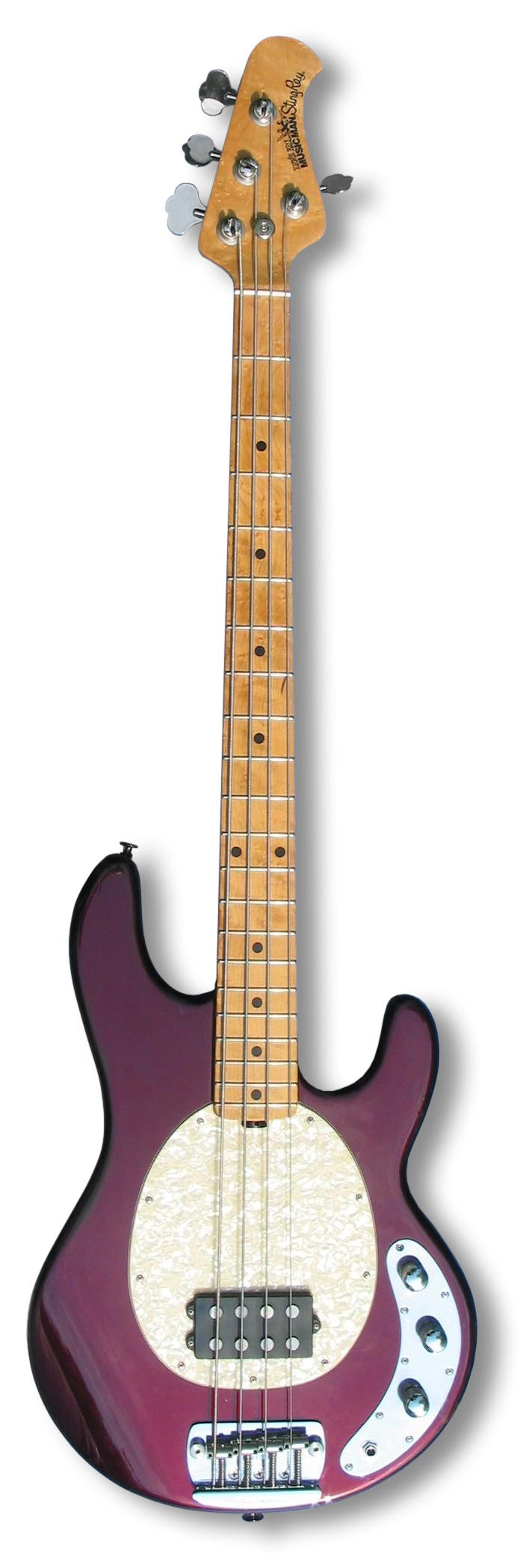
Photo: Th. Ott / Wikimedia Commons / CC BY-SA 3.0 Music Man
StingRay
1976
Leo Fender wanted a wide, bright bass. Louis Johnson hit it with his thumb, and funk had its sound.
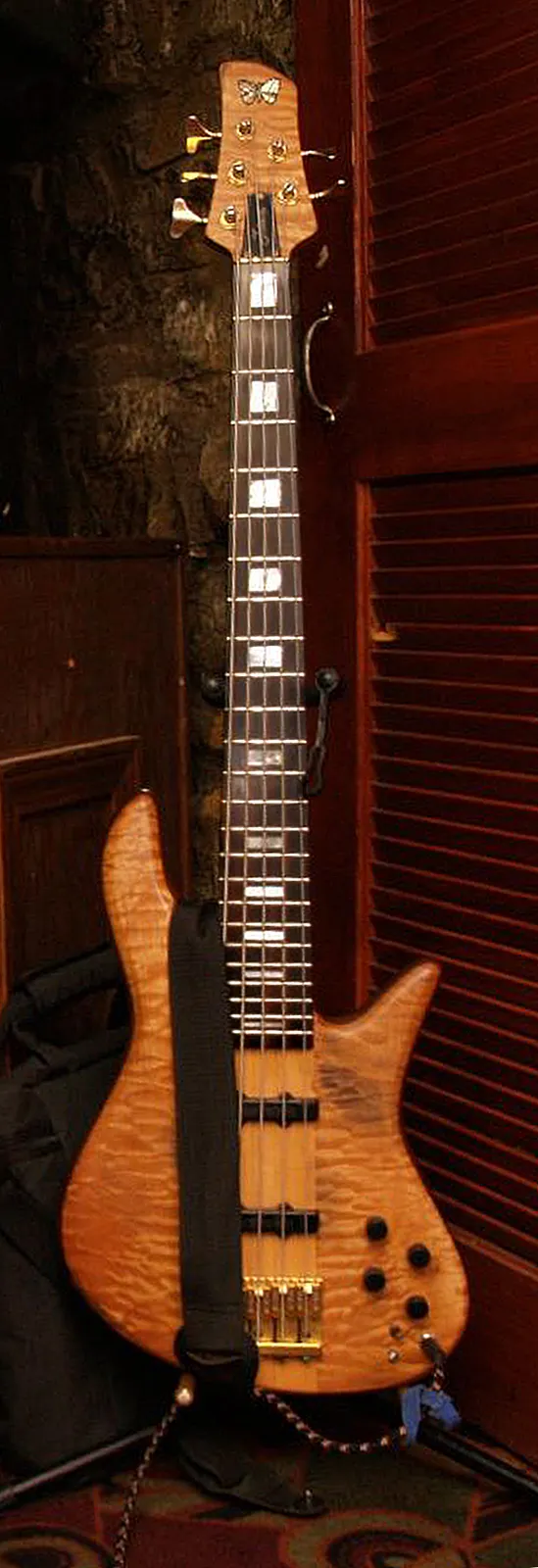
Photo: christina rutz / Wikimedia Commons / CC BY 3.0 Fodera
Monarch
1983
In 1983 a new Brooklyn shop brought a bass to a teenager’s session. It’s still Victor Wooten’s number one.