Music Man
Sabre
From across the room, a Strat. Up close, two humbuckers, a preamp, and a choice of necks.
In 1978 Music Man put out a six-string credited to Leo Fender and George Fullerton, in two versions that differed only in the neck. It lasted a couple of years. The name has outlived it twice.
- Introduced
- 1978
- Type
- Solidbody electric
- Class
- Production
The short version
1976
The StingRay bass
Music Man’s one-pickup bass with a preamp. The Sabre guitar borrows the preamp idea.
1978
Fullerton, spring
Sabre bodies are dated in April. In June a British magazine calls the Sabre I and II new.
1980
A couple of years
The six-string ends around 1980, or runs to 1982. Depends who you ask.
1984
Ernie Ball, and a film
Ernie Ball buys Music Man on 7 March. Stop Making Sense comes out the same year.
1991
The bass bows out
The two-pickup Sabre bass, which outlived the guitar, ends its run.
2012
The bass name returns
A Sabre bass is back for the first time in more than 20 years.
2020
A new Sabre
Ernie Ball Music Man gives the name to an all-new guitar. Passive, okoume, a modern tremolo.
Side A
A1
Across the room, a Strat
In Fullerton, California, in the spring of 1978, Sabre bodies were already getting dated: one on 12 April, another the next day, a neck on 18 April. By June a British magazine was calling the guitar new.
From across a room you’d take it for a Stratocaster. Double cutaway, contoured, a bolt-on maple neck, and a man named Leo Fender in the credits, alongside George Fullerton. That’s where the resemblance ends.
Music Man already had the StingRay bass, from 1976: one humbucker by the bridge and a preamp. There was a StingRay guitar too. The Sabre was a smaller, contoured six-string beside it, in two versions, Sabre I and Sabre II. Same body, same pickups, same electronics. Different necks.
A2
Two necks
That neck split is the most personal thing about the Sabre.
The Sabre I had a flatter 12" fingerboard radius and jumbo frets. The Sabre II had a rounder 7½" radius and standard frets. The ads said the II was “for comfortable, untiring, country-style fingering.” Nobody agrees on the details, though. One later review gives the II a 7.25" radius and puts the regular frets on the I. Leave it disagreed.
Either way, the idea was that two kinds of player could walk into the same shop and each find their own Sabre.
Under the board there’s more. A patent truss rod, flat and rectangular, so the neck could be thinner. Three bolts and a Micro-Tilt adjustment at the heel, with the truss-rod adjuster up at the headstock. A 25½" scale and 22 frets. In June 1978 the British list price was £354.67.
A3
The parts you can’t see
The pickups are two humbuckers, narrower than a Gibson’s. The neck and bridge pickups are different lengths, so the pole pieces line up under the strings where they actually sit.
Then there’s the preamp. A volume, plus active bass and treble, so the tone knobs push as well as cut. A bright switch. A phase switch, which flips one pickup against the other for a thin, hollow sound. A three-way selector. Low-impedance output. That’s a lot of switching for a guitar people kept mistaking for a Strat.
None of it shows. One Sabre II on a scale came in at 9 lb 9 oz, which you’d feel before you saw anything. Another weighed 3.6 kg. Two guitars, not an average.
Flip the record · By the numbers
£354.67
The UK list price in June 1978.
12" / 7½"
The Sabre I and Sabre II fingerboard radius. Some accounts give the II 7.25".
3
Bolts holding the neck on, with a Micro-Tilt adjustment.
2 or 4
Years the six-string lasted. It ended in 1980, or 1982.
Side B
B1
A couple of years
The six-string didn’t last. Some say it ended in 1980. Others say 1982. Either way, it was gone before Ernie Ball bought Music Man on 7 March 1984.
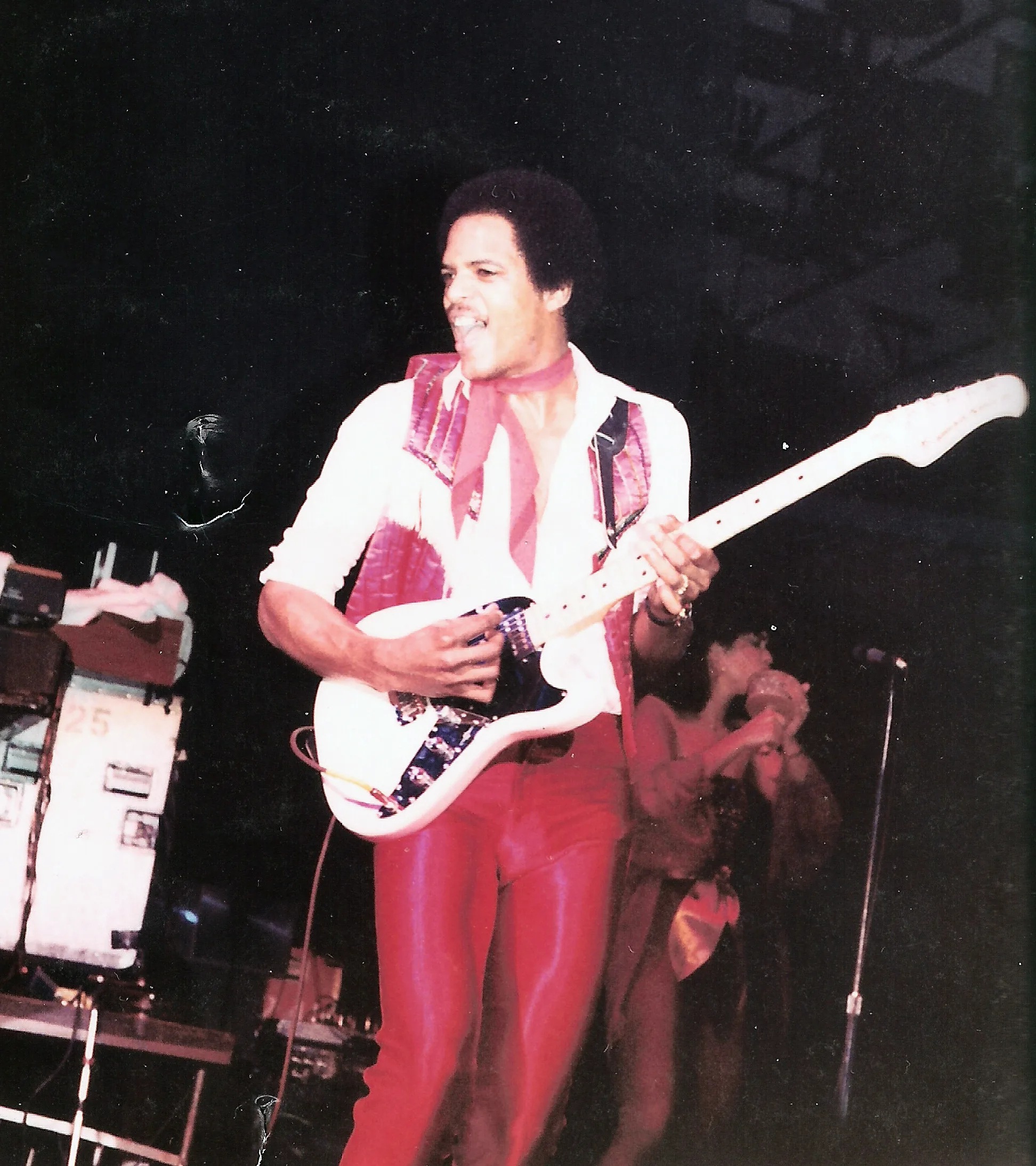
But it got onto film. Alex Weir played white and natural Sabre I guitars with the Brothers Johnson in the ’70s, and then with Talking Heads in the Stop Making Sense years. Jonathan Demme’s film came out in 1984. If you want to see a Sabre six-string working, that’s where it is.
B2
The name kept going
The name went on without the guitar. The Sabre bass, essentially a StingRay with a second pickup, arrived around December 1978 or May 1979, depending on whose records, and official ones from those years don’t exist. It ran until 1991.
Tony Levin says he played one on Peter Gabriel’s “Sledgehammer” and has used it on every Gabriel tour since. Other accounts call that a StingRay. Keep both.
The bass name came back in 2012. Then in 2020 Ernie Ball Music Man gave the name to an all-new guitar: okoume body, passive pickups, a modern tremolo. One magazine called it “more of a tribute … than a straight-up reproduction.” Another reviewer said the new one had “just about zero in common” with them, apart from the Strat-ish outline, a bolt-on neck, and two humbuckers.
From across a room, it looks like the old Sabre. From across a room was always the problem.
Put this on
You’ve read about it. Now hear it. Here’s what this guitar sounds like, and what to listen for.
Stop Making Sense
Alex Weir played white and natural Sabre I guitars in the Stop Making Sense years, and his Sabre is on film in Jonathan Demme’s movie. Which songs aren’t logged, so watch the whole thing for him.
Watch it on YouTube (opens in a new tab)
The cast
The people, and the specific guitars, that made the legend.
1984
Alex Weir
White and natural Sabre I guitars
With the Brothers Johnson in the ’70s, then with Talking Heads in the Stop Making Sense years.
1978
Leo Fender and George Fullerton
Designers
Credited with the Sabre six-string, built at CLF Research in Fullerton.
1986
Tony Levin
Sabre bass, not the six-string
Says he played a Sabre bass on Peter Gabriel’s “Sledgehammer” and on every Gabriel tour since. Other accounts file that song as a StingRay.
2024
Rabea Massaad
The 2020 Sabre, then his own Artist Series model
Picked the new Sabre as the Music Man closest to what he wanted to play. Not a 1978 guitar.
Liner notes
Specs, construction, rarity, value, and every source we used.
Two humbuckers and a preamp on a body you could mistake for a Strat — Music Man’s Sabre six-string, not the bass.
- Body
- Solid double-cut, smaller and contoured than the StingRay guitar. Ash on documented examples; Wikipedia also names poplar.
- Neck
- Bolt-on maple; 3-bolt Micro-Tilt. Patent flat rectangular truss rod (Sound International, June 1978); bullet adjuster at the headstock (Guitar Player).
- Fingerboard
- Maple; rosewood optional (Wikipedia). 22 frets. Sabre I: 12" radius, jumbo frets. Sabre II: 7½" radius, standard frets (Sound International). Guitar Player: II is 7.5" and narrower frets. Ed Mitchell (Guitar World, 2 July 2020): I has regular-size frets, II is 7.25". Do not average.
- Scale
- 25½" (Sound International). No millimetres in that notice.
- Pickups
- Two humbuckers, narrower than a Gibson humbucker; neck and bridge are different lengths (Guitar Player)
- Hardware
- Six individual stainless saddles (Sound International); string-through on Tym’s 1978 II; six-in-line headstock on Woodstock’s 1978 II
- Electronics
- Onboard preamp; volume, treble, and bass; bright switch; phase switch; 3-way. Low-impedance output (Guitar Player).
- Finish
- Natural, black, white, sunburst, walnut; silver called custom (Wikipedia, citing the 1978 catalog)
- Nut
- Not a catalog figure. Hendrix Guitars measured one Sabre II at 1 5/8". Woodstock measured another at approx. 41 mm. Mix flagged. Do not average.
Open the full research fileConstruction details, the complete player record, production numbers, dated value estimates, and sources
Classic living example = 1978 Music Man Sabre I / II six-string (CLF Research, Fullerton). This table is that guitar. It is not the Sabre bass. It is not the 2020 Ernie Ball Music Man Sabre (okoume, passive, modern tremolo). Sabre I and Sabre II are the same guitar with two necks; the fret-size and II-radius lines disagree, so they stay disagreed. No Gibson SKU.
Construction
The job was a guitar you could mistake for a Strat, and a bass with the second pickup the StingRay never had. Music Man already had the 1976 StingRay bass: one bridge humbucker, a 2-band preamp, slab ash (music-man-stingray). The StingRay guitar shipped. The Cutlass guitar, under that first name, did not (music-man-cutlass). What CLF put in a case beside the StingRay I and II guitars was Sabre I and Sabre II.
Sound International, June 1978, calls both six-strings new. Smaller than the StingRay guitar, contoured, 25½", 22 frets, rock maple, six stainless saddles, the familiar preamp with separate treble and bass. The piece they single out is a patent truss rod, flat and rectangular, so the neck can be thinner. UK rrp £354.67. 1978 money. A US list was not on a catalog page in hand. None invented.
The necks are the catalog split, and the fret story does not sit still. June 1978: I is 12" with jumbo frets; II is 7½" with standard frets. Dave Hunter, Guitar Player, 13 January 2022, matches that and quotes the ads — the II was “for comfortable, untiring, country-style fingering.” Ed Mitchell, Guitar World, 2 July 2020, gives the I regular-size frets and the II 7.25" with skinnier frets. Wikipedia swaps the I to standard frets. A Woodstock II is listed at 7.25". Keep June 1978, Hunter, and Mitchell. Do not average.
Hunter and Wikipedia credit Leo Fender and George Fullerton. Dated guitars are already stamped that spring: 12th Fret, body 12 April 1978, serial A001509; Oscar Guitars, body 13 April 1978, neck 18 April 1978, pots from week 33 of 1977 and week 12 of 1978. Hunter’s “around late 1977” stays next to the June press. This plate starts in 1978.
On the guitars people write up: ash, 3-bolt Micro-Tilt, bullet adjuster at the head, two humbuckers narrower than a Gibson’s, neck and bridge made different lengths so the poles sit under the strings. Volume, active bass and treble, bright, phase, 3-way, low-impedance output. String-through is on Tym’s 1978 II. One Hendrix Guitars II measured nut 1 5/8", lower bout 13", depth 1 5/8", 9 lb 9 oz. Woodstock’s II is about 41 mm at the nut and 3,600 g, with a six-in-line headstock. Mix flagged. Two guitars, not a factory average.
How long it lasted is the other split. Wikipedia 1978–1980. Hunter: until 1980 or so. Mitchell: a couple of years. Blue Book and 12th Fret: 1978–1982. Keep 1980 and 1982. Either reading, the six-string is gone before Ernie Ball buys the company. It does not come back as this table.
The bass is the other instrument. Premier Guitar (Jonathan Herrera, 15 September 2013): rolled out in 1978, essentially a two-pickup StingRay, production ceased 1991. Guitar.com (23 April 2015): appeared December 1978, roughly a year after Leo cut his ties. musicmanbass.global: parts by the end of October 1978; the first bass built, 30 December 1978, was an advert instrument on a one-off StingRay serial, B005532, 3-bolt plate; five production basses finished Friday 25 May 1979, 61 more in the last three days of that month, from 1978 parts (Jim Shine); the site thinks spring 1979 NAMM was the launch, and it says official pre-EB records do not exist. Keep December 1978, May 1979, and Premier’s 1978. Five plus 61 is not a year. Guitar.com’s “Leo had already left” does not cancel the six-string’s Fender-and-Fullerton credit.
Pre-EB, on that site: contoured, never the Ray’s slab; C00xxxx on a top-loader; rosewood fretless first, fretted rosewood from late 1979, then ebony for fretless; 2-band boards marked B4 or B5, which the site calls non-epoxy. On that site, toggles last until late 1982, then a lever and a StingRay B3 board. A 10 June 2006 Ernie Ball Forums rundown says the first basses had black epoxy, deleted in 1979, and dates the switch change to 1983. Keep both. That rundown also has the horseshoe bridge. An 18 May 2009 post on the same forum: both pickups 8-pole at the start, a 16-pole neck pickup later in the pre-EB run. Nuts do not agree. The site notes 1.5" on named serials. Andy Baxter measured one 1979 narrow nut at 37.7 mm and one 1980 at 37.8 mm, and wrote that the usual width is closer to 43 mm. Two other 1979s in his shop measured 42.6 mm and 42.7 mm. Not a catalog figure. This is a bass. Not the table.
7 March 1984. Ernie Ball bought the company (Wikipedia; musicmanbass.global). The six-string was over. The bass was not. The site’s EB page runs it 1984–1991 and calls a March 1984 neck one of the first Ernie Ball examples. Premier’s end is 1991. Blue Book splits the badge: Music Man 1978–1987, Ernie Ball section 1988–1991. Keep the split and the 1991 end. No gap invented. The forum rundown dates a 3-band option to 1987 and a 6-bolt, beside a 4-bolt, to circa 1989. Forum summary, not a catalog.
2012–2013 brings the bass name back, not the 1978 guitar. No Treble, 30 November 2012: a Sabre “for the first time in over 20 years,” Tony Levin Sledge finish included, list $3,070, 11" radius, 21 frets. Herrera’s Classic Sabre: covered humbuckers, 16-pole neck pickup, 5-way, 2-band, mutes, a bit smaller than a StingRay, nut 1 5/8", street $1,869. Musician’s Friend’s card: 34" (86.4 cm), 11" (27.9 cm), 6-bolt, Silent Circuit. Mix flagged. Andertons, NAMM 2013: that 11" is the point, against 7.5" on the other Classics. The hosted bass index this pass does not list a Sabre. That is not a discontinue date, and it is not this six-string.
2020. San Luis Obispo reused the name. Guitar World, 17 January 2020, has an all-new Sabre at NAMM. The blog, 20 April 2020, introduces it. Premier Guitar, 27 April 2020: on sale, retail from $3,199. Chris Gill, August 2020: loosely inspired, “more of a tribute … than a straight-up reproduction.” Mitchell: apart from a Strat-ish outline, a bolt-on, and two humbuckers, “just about zero in common” with the originals. Wikipedia’s “reintroduced in 2021” is Gator Burst, a new color on a guitar already shipping (company post, 17 January 2021). Not a second debut.
Hosted table this pass: okoume, thick figured maple, the page also saying a 1/2" bookmatched top. Premier’s announcement says 3/8". Keep both. 25-1/2" (64.8 cm), 10" (25.4 cm), 22 stainless, nut 1-11/16" (43.0 mm), 2-1/4" (57.2 mm) at the last fret. Body size in that same factory block, as dealer sheets reprint it: 12-7/8" × 1-3/4" × 38-1/8" (32.7 cm, 4.4 cm, 96.8 cm). Factory mixed inch/mm flagged. Nothing here gets converted back onto 1978. Passive 500k and .022µF, 5-way, modern tremolo, 5-bolt, Schaller M6-IND. The hosted page prints bridge Alnico 5 and neck ceramic 6. Ed Mitchell’s review sample reads ceramic 8 in the neck (12.2k) and Alnico V in the bridge (18k). Do not average. No pickguard. No bass-and-treble preamp. Not a Sabre I.
Sabre HT and the 2024 Rabea Massaad Artist Series — alder, not okoume, Bare Knuckle Silo, shop $4,149 — are sisters. Sterling by Music Man is another brand (Guitar World, 28 October 2025: Sterling $979). A 1983 Cutlass I / II is a graphite-neck bass. G&L’s October 1980 catalog still shows an L-2000 prototype in a Sabre-bass contour (g-l-l-2000). Leo’s next bass in this bass’s outline. Not a Sabre, and not this guitar.
Classic vs current: 1978 Fullerton six-string — 3-bolt, two narrow humbuckers, 2-band preamp, bright and phase, I or II neck — against a 2020 guitar you can still order, okoume and maple, passive, modern tremolo. Same name. The bass matches neither spec.
Players
Do not hang a StingRay, a Cutlass, a Silhouette, or the StingRay guitar on this plate. Hunter’s Sabre article puts Louis Johnson, John Deacon, Flea, Cliff Williams, and Pino Palladino on the StingRay bass. Palladino’s fretless, Guitar World (2025), is a StingRay. The Sabre bass is not the table. The 2020 okoume guitar is not the table either.
Alex Weir. The six-string. Hunter: white and natural Sabre I guitars with the Brothers Johnson in the ’70s, then with Talking Heads in the Stop Making Sense years, in Jonathan Demme’s 1984 film. Which Brothers Johnson sides are unpublished here.
Tony Levin — bass, not this table. To Ted Drozdowski, Premier Guitar, 16 August 2024: “a couple of Sabres, which are like the StingRay, but with two pickups. I happened to play the Sabre on Peter Gabriel’s ‘Sledgehammer,’ so for all of his tours since — even though I could play it on a fretless StingRay — I’ve used the Sabre.” This catalog’s StingRay plate files that song as a StingRay on earlier magazine consensus. Keep both. The sentence is 2024. It is not a serial, and it is not a six-string.
Tony Franklin — bass. His post, 25 February 2022: the Sabre on the first Firm tour and in the “Radioactive” video. “I liked the bass but didn’t love it. Couldn’t get my sound.” Sold 1987, a shop in Derby. Ebony fingerboard, as he remembers it. Not a log of every Firm track.
Franz Lyons (Turnstile) — bass. Ernie Ball, 24 February 2020: the first one he got, “the mustang red Sabre,” heaviest he owns, his favorite, “the neck never dips.” He also has StingRays. No album pinned.
Rabea Massaad — the 2020 guitar, then a sister. He landed on the Sabre as the Music Man closest to what he wanted to play (his Sweetwater talk). NAMM 2024, on sale that spring: alder, Bare Knuckle Silo, a different tremolo. Not a 1978 Sabre I. Not the hosted okoume table.
Also known to play stays short. The April 2020 page demos the new guitar with Blues Saraceno, Butch Walker, Sadler Vaden, Chance Taylor, and Rafael Moreira. Demos. Not a record credit.
Rarity
Music Man published no Sabre census. None invented. musicmanbass.global says official pre-EB records do not exist, and serials were not kept in order. An A-prefix dates a six-string. A C-prefix dates a pre-EB bass. Neither counts a factory. Five basses on 25 May 1979, and 61 more by the end of that month, are three days. Not a year.
The six-string is the thin run: a couple of years, or through 1982, then nothing until a different guitar took the name in 2020. The factory page is still up. Sweetwater’s Backdraft, this pass, is a special order estimated January 2027. Current, with a wait. Not a 1978 guitar. The bass ran to 1991 and returned as Classic Sabre; the hosted bass list does not show it now. BFR Sabre HT Duello was 80 worldwide (Fall 2022), a sister. Weir’s filmed Sabre I and Franklin’s sold bass are one object each. They are not a price.
Value
Informal estimate, 19 October 2026. Not an appraisal.
Ask vs sold labeled. Celebrity instruments are not comps. No invented medians. Six-string, bass, and the 2020 guitar are three markets. £354.67 (Sound International, June 1978) is UK list, not 2026. No US 1978 list in hand. Reverb’s Sabre I widget printed no clean USD band. Flag: thin sold-comp access on the 1978 six-string.
New street. What is new is the 2020 recipe, not this table. Sweetwater Backdraft $3,599, special order, estimated January 2027. zZounds Blurple $3,599. Launch retail, not this cart: from $3,199 (Premier Guitar, 27 April 2020). Blue Dream BFR $3,499 (Guitar Center). Sabre HT Grape Slushie $3,799 (Sweetwater) — sister. Rabea shop $4,149 — sister. Sterling $979 (Guitar World, 28 October 2025) — another brand. No new 1978. No Classic Sabre on the hosted bass index. Old bass money, labeled old: street $1,869 (Herrera, 2013); Sledge list $3,070 (No Treble, 2012).
Used modern. No named sold of the standard 2020 guitar turned up as a clean line this pass. Guitar Center’s Blue Dream page shows open-box from $2,799.20 — open box, not a hammer. Reverb’s Ball Family Reserve Sabre guide, a sister, printed $1,672–$2,849 (31 orders, Good to Mint). Not this table, and not a 1978 six-string. No clean Reverb band for the standard passive Sabre this pass.
Vintage / collectible. Named ask, not a hammer: Parkway, 1978 Sabre I walnut, A005944, $1,999.95. Bass solds, from Reverb’s Sabre Bass history this pass, no low–high band in the fetch: 18 September 2025 Very Good $2,900; 26 April 2025 Good $3,145.50; 20 January 2025 Good $3,200; 4 October 2024 Good $1,150; 25 September 2024 Very Good $3,415.25; 4 June 2024 Very Good $2,750; 25 May 2024 Excellent $2,950. The $1,150 sits apart. Do not average it in. Weir, Levin, and Franklin are not comps.
See also
- music-man-stingray — Leo’s 1976 one-pickup bass; the Sabre bass is the two-pickup sibling, and this catalog files “Sledgehammer” there on earlier sources
- music-man-cutlass — the Strat-rooted 1970s name that did not ship; Sabre I / II did
- g-l-l-2000 — Leo’s next bass; the October 1980 prototype still wears a Sabre-bass contour
Sources
- Sound International, June 1978, “Music Man’s six-string Sabre” — Sabre I and II new; smaller and contoured than the StingRay guitar; I 12" jumbo, II 7½" standard frets; 25½"; 22 frets; patent flat truss rod; six stainless saddles; preamp with treble and bass; UK rrp £354.67
- Dave Hunter, Guitar Player, 13 January 2022 — Leo Fender and George Fullerton; around late 1977 through 1980 or so; jumbo / 12" on the I, narrower / 7.5" on the II; narrow humbuckers of different lengths; bright, phase, low-impedance output; Alex Weir Sabre I with Brothers Johnson and in Stop Making Sense; StingRay-bass names kept off this plate
- Ed Mitchell, Guitar World, 2 July 2020 — 1978 debut, a couple of years; I regular-size frets, II 7.25" and skinnier frets; 2020 guitar “just about zero in common” with the originals; review sample neck ceramic 8 at 12.2k, bridge Alnico V at 18k
- Chris Gill, Guitar World, August 2020 — 2020 model introduced that year; tribute, not a reproduction; bass also offered in the Eighties and 2010s
- Wikipedia, Music Man Sabre (electric guitar) — 1978–1980; ash or poplar; maple, optional rosewood; 22 frets; HH and 2-band preamp; colors via the 1978 catalog; fret-size line not followed against Sound International; “reintroduced 2021” is a color year, not the April 2020 launch
- 12th Fret, Sabre 1 walnut, serial A001509 — body date 12 April 1978, Fullerton; ash; 12" maple; 3-bolt; 1978–1982 in the shop text
- Oscar Guitars, 1978 Sabre I natural — body 13 April 1978; neck heel 18 April 1978; pots week 33 of 1977 and week 12 of 1978
- Tym Guitars, 1978 Sabre II — ash; Strat-like, contoured, otherwise quite a slab; 25.5"; string-through; 3-bolt; II at 7½" with standard frets
- Hendrix Guitars, 1978 Sabre II VA184 — one measured II: 25½", 7.5" radius, nut 1 5/8", lower bout 13", depth 1 5/8", 9 lb 9 oz, ash
- Woodstock Guitars, 1978 Sabre II — one II: 7.25" listed, 22 small frets, nut approx. 41 mm, 3,600 g, six-in-line headstock, 9V preamp. Mix flagged
- musicmanbass.global, Pre-EB Sabre — advert bass 30 December 1978, serial B005532; first production 25 May 1979 (5, then 61); contoured, never slab; C-prefix on the bridge; toggles until late 1982; official records do not exist
- musicmanbass.global, EB Sabre — Ernie Ball purchase March 1984; Sabre bass continued 1984–1991
- Premier Guitar, Jonathan Herrera, 15 September 2013 — bass rolled out 1978, ceased 1991; Classic Sabre street $1,869; 16-pole neck pickup; 5-way; 1 5/8" nut
- Guitar.com, Classic Sabre bass review, 23 April 2015 — bass appeared December 1978, “roughly a year after Leo Fender cut his ties”; discontinued 1991
- No Treble, 30 November 2012 — Sabre bass back after more than 20 years; Sledge Sabre list $3,070; 11" radius; 21 frets; 5-way; 2-band
- Ernie Ball Forums, Sabre bass history, 10 June 2006 — forum rundown, not a ledger: black epoxy, deleted 1979; horseshoe bridge; top-load; toggle to slide in 1983; 3-band option 1987; 6-bolt circa 1989 beside 4-bolt; production ceases 1991. That post’s “1985 Ernie Ball adopts” line is not the purchase date used here
- Ernie Ball Forums, dating a Sabre, 18 May 2009 — early pre-EB pickups 8-pole each; later pre-EB neck pickup 16-pole. Forum, not a ledger
- Premier Guitar, 27 April 2020 — 2020 guitar available; retail from $3,199; okoume; 3/8" maple top in the announcement
- Ernie Ball Music Man, Sabre — hosted 2020 table: 1/2" top; 25-1/2" (64.8 cm); 10" (25.4 cm); 1-11/16" (43.0 mm) at the nut, 2-1/4" (57.2 mm) at the last fret; 500k / .022µF; Schaller M6-IND; Alnico 5 bridge, ceramic 6 neck; mixed inch/mm
- DuBaldo, Sabre Backdraft spec sheet — factory size block reprinted: 12-7/8" × 1-3/4" × 38-1/8" (32.7 cm, 4.4 cm, 96.8 cm)
- Ernie Ball Music Man blog, 20 April 2020 — introduction; demo names
- Ernie Ball Music Man, New for 2021 — Gator Burst is a new color, not the model’s debut
- Sweetwater, Sabre Backdraft — $3,599, special order, estimated January 2027; open-box prices on the solidbody index
- Sweetwater, Sabre HT Grape Slushie — $3,799; HT sister
- zZounds, Sabre — Blurple $3,599
- Guitar Center, BFR Sabre Blue Dream — $3,499; open-box from $2,799.20
- Ernie Ball Music Man shop, Rabea Massaad Sabre — $4,149; alder, not the okoume table
- Guitar World, 17 January 2020 — NAMM 2020 unveil of the all-new Sabre
- Guitar World, 28 October 2025 — Sterling Sabre $979; artist guitar $4,149
- Guitar World, Pino Palladino, 10 November 2025 — fretless is a StingRay, not a Sabre
- Ernie Ball Music Man, NAMM 2024 — Rabea Artist Series Sabre, spring 2024; alder sister
- Andertons, NAMM 2013 Sabre bass — Classic Sabre 11" radius against 7.5" on other Classics; 16-pole neck, 8-pole bridge
- Andy Baxter, 1979 Sabre walnut — one bass, nut 37.7 mm
- Andy Baxter, 1980 Sabre black — one bass, nut 37.8 mm; usual width “closer to 43mm”
- Andy Baxter, 1979 Sabre sunburst — one bass, nut 42.7 mm
- Andy Baxter, 1979 Sabre natural — one bass, nut 42.6 mm
- Reverb, Ball Family Reserve Sabre — used guide $1,672–$2,849, 31 orders, Good to Mint; sister, not the 1978 six-string
- Rabea Massaad, Sweetwater demo — he chose the Sabre as the Music Man closest to what he plays; artist model is the sister
- Ernie Ball Music Man, BFR Fall 2022 — Sabre HT Duello, 80 worldwide
- Premier Guitar, Tony Levin, 16 August 2024 — Sabre on “Sledgehammer”; Sabre on Gabriel tours since; could also be a fretless StingRay
- Tony Franklin, 25 February 2022 — Sabre bass, first Firm tour and “Radioactive”; sold 1987
- Ernie Ball, Turnstile Q&A, 24 February 2020 — Franz Lyons, mustang red Sabre
- Blue Book of Guitar Values, Sabre II — six-string mfg. 1978–1982
- Blue Book of Guitar Values, Sabre bass — bass 1978–1987, Ernie Ball section 1988–1991
- Parkway Music, 1978 Sabre I — ask $1,999.95; serial A005944; 2-piece ash
- Reverb price history, Music Man Sabre Bass — named 2024–25 solds on the Sabre Bass guide; no clean low–high band in the fetch; bass, not the six-string
- Wikipedia, Music Man (company) — Ernie Ball purchase, 7 March 1984
- Musician’s Friend, Classic Sabre — 34" (86.4 cm), 11" (27.9 cm), 6-bolt, Silent Circuit. Mix flagged
Keep digging
Guitars this one gets compared to, confused with, or descended from.
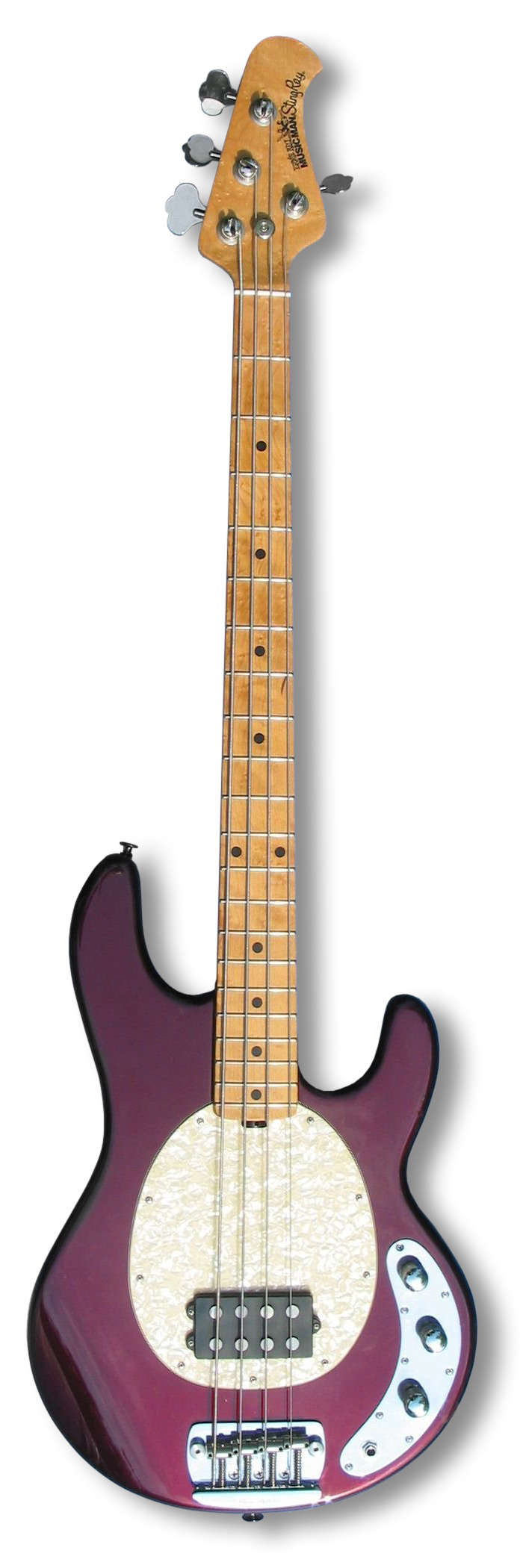
Photo: Th. Ott / Wikimedia Commons / CC BY-SA 3.0 Music Man
StingRay
1976
Leo Fender wanted a wide, bright bass. Louis Johnson hit it with his thumb, and funk had its sound.
- Send a picture
Music Man
Cutlass
2016
Leo Fender drew up the Cutlass in the ’70s. It took about forty years to make it onto a wall.
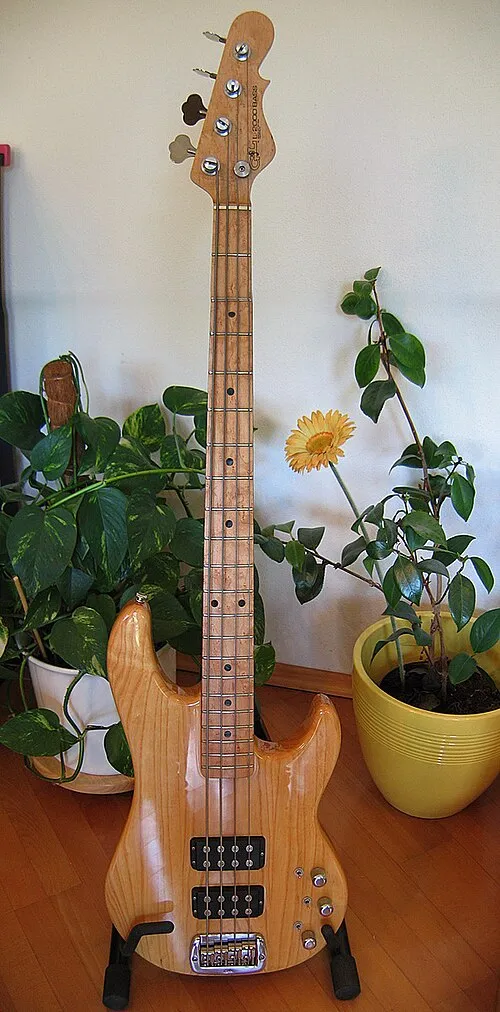
Photo: Jodeli / Wikimedia Commons / CC BY-SA 3.0 G&L
L-2000
1980
Leo Fender had already built the Precision and the StingRay. In 1980 he built one more, with more switches.