 Guitaripedia
National
Glenwood 99
Nobody at National drew it as a map. Everybody who has held one since calls it one.
Chicago, the early 1960s. The company that owns the National name works out how to mold a professional electric instead of carving one. At the top of the line is a Seafoam Green guitar with a pickup hidden in the bridge, and a body that looks like the East Coast.
- Introduced
- 1962
- Type
- Semi-hollow electric
- Class
- Closed run
Have a photograph of this guitar? Send a picture
The short version
1942 or 1943
Valco
The National name ends up with Valco in Chicago. The accounts give both years.
1961
Res-O-Glas
Valco develops bodies molded from resin and glass fiber.
1962
Professional Excellence
The Glenwood 99 is in the National catalog, at the top of the fiberglass line.
1963
Newport
The plainer Val-Pro maps are renamed Newport.
1964
A master volume
A big master knob by the jack shows up on later guitars.
1965
The end of the maps
The Res-O-Glas map guitars stop, and one account blames the cost.
1969
The auction
After Valco buys Kay and collapses, a few maps are put together from leftover parts to sell off.
1976
A white National in Fort Collins
Bob Dylan plays slide on one. His biographers say it's a Glenwood 98; others say 99.
Side A
A1
Professional Excellence
Chicago, 1962. A National catalog, a page headed "Professional Excellence," and at the top of it a guitar called the Glenwood 99.
By then the National badge had already been on another kind of guitar entirely. The name meant nickel resonators. Now it sat on Valco, a Chicago company building Nationals and Supros and filling other people's catalogs besides. What Valco wanted this time was a professional electric it could make its own way, and sell under its own name.
Its own way meant not carving it at all.
A2
Glass threads and a wood spine
Valco called the stuff Res-O-Glas: glass fiber pressed into a mold with resin. Developed in 1961, first offered in 1962.
A Glenwood is two thin hollow shells clamped around a narrow wood core. The neck, the pickups, the controls, and the tailpiece all anchor to that block. A vinyl bead runs around the seam where the halves meet, like the welt on a car seat. There's no paint to chip. The color is in the resin itself.
The neck is bolt-on maple with magnesium inside it, and Valco sold it with a five-year promise that it wouldn't warp. The catch was that there was no easy way to adjust it after that. Most of them, by one account, stayed straight anyway. Which is a good thing, because the guarantee ran out a very long time ago.
A3
Maine, Florida, and the border
Here's why people stop walking when they see one. Hold it with the neck to the right and the bass horn is Maine, the treble horn is Florida, and the lower cut is the border. A map of the United States, near enough.
Except it wasn't drawn as one. The guitars weren't designed as maps, and the nickname came later. Collectors use it anyway, for the whole family: Glenwood, Val-Pro (renamed Newport in 1963), and the wooden Westwood. Nine models in all, in one historian's count, the numbers standing for colors and pickup layouts.
The 99 was the top of that pile. The way it's usually described: Seafoam Green, gold hardware, a Bigsby, Grover tuners, three pickups, seven knobs. The red Glenwood 95 was the plain one, the white 98 the middle. Even here the paperwork argues. The catalog's own feature list says chrome and never mentions a Bigsby. And a white guitar with "99" on the tag might be an early one, or might be a 98 with the wrong number on it.
Flip the record · By the numbers
9
Models in the map family, in one historian's count, wood and fiberglass together
3
Pickups on the 99, one of them inside the rosewood bridge
5 years
How long Valco promised the neck wouldn't warp
$25–$30
How much more a Glenwood cost than a Stratocaster, in one account
Side B
B1
The pickup in the bridge
The two big pickups look like humbuckers. They're wide single-coils. The third one is the strange one: a Silver-Sound unit sitting inside the rosewood bridge, under the strings.
The catalog is not modest about it:
"Produces a concise life-like electronic voicing of the natural acoustic string sound."
What it actually is depends who you ask. Some call it a contact pickup, an early transducer. Others say it's magnetic, a wound pickup like the other two. Dealers still write "piezo." The catalog never uses the word. What it was after is clear enough: an electric that could also sound a little acoustic. By 1964 a big master volume had appeared by the jack, and a guitar with three volumes, three tones, and a master is a lot of knobs for a map.
B2
The white one on the back of Hard Rain
The white National most people mean is a fight.
Fort Collins, 1976, the concert filmed as Hard Rain. In the middle of the set Bob Dylan straps on a white National for a slide figure on "Shelter from the Storm." He'd bought it that spring from Don Vargas of Woodland Hills, one of three Nationals. He carried it on the 1978 tour, and it's on the back of the Hard Rain sleeve. A Reseda dealer said Dylan bought strange guitars for how they looked.
Dealers like to call it a Glenwood 99. The book that tracks his guitars calls it a 98, the white one. The same book dates it to the early 1950s, which can't be right for a model that first turned up in 1962. Somebody's wrong about something. What nobody has is a 99 with that night on it.
The other famous maps are siblings too. Rick Nielsen is named as a fan of the 99, but the National his own shop sold was a red 95. John Entwistle's was a red 95 as well. Robert Smith's in the "Lovesong" video is a Newport. And Jack White's red department-store guitar isn't a National at all. It's an Airline, the same Chicago glass under Montgomery Ward's badge.
B3
Out by 1965
The maps were finished by 1965. One account blames the cost. Valco bought Kay, collapsed in 1968, and at the asset auction the next year a few last map guitars were assembled from leftover parts, some with Italian hardware. Nobody published how many 99s there were. The resin and the short run left fewer than you'd guess.
One that has an owner's name on it is a 1964 Seafoam 99 with a gold Bigsby, once Arlen Roth's. It hung in the Dangerous Curves exhibit at the Boston Museum of Fine Arts, a molded Chicago guitar in an art museum.
Valco wrote "Professional Excellence" over it, and never once called it a map. The people who kept them did that.
The cast
The people, and the specific guitars, that made the legend.
1964 guitar
Arlen Roth
1964 Glenwood 99, Seafoam Green, gold Bigsby
Previously his, and shown in the Dangerous Curves exhibit at the Boston Museum of Fine Arts. No released track is tied to it.
1976
Bob Dylan
A white National, identified in his handbook as a Glenwood 98
Played slide on "Shelter from the Storm" at Fort Collins. Dealers call it a 99. The book that tracks his guitars says 98.
1962–64 guitar
Rick Nielsen
Glenwood 95, Vermillion Red
Named as a fan of the 99. The National his own shop sold was the red 95.
John Entwistle
Glenwood 95, red
The Who's bassist owned a map guitar too. It was the plain red sibling, not a 99.
Liner notes
Specs, construction, rarity, value, and every source we used.
Two wide single-coils, a pickup hidden in the bridge, and a body molded like a map — National’s Glenwood 99, not an Airline.
- Body
- Two molded Res-O-Glas halves, a wood center block, map outline. A 1962 catalog text quoted by Vintage Silvertones: 15" wide, 18" long, 1 3/4" deep.
- Neck
- Bolt-on maple, magnesium reinforced. Vintage Guitar (June 2001): a five-year no-warp guarantee, and no easy truss adjustment.
- Fingerboard
- Bound rosewood, pearl inlay, zero fret. That catalog text: 20 frets, plus the extra fret at the bone nut.
- Scale
- 24 5/8" in the catalog text. Premier Guitars (Australia) measured 24 3/4" on a 1962 it sold as a Glenwood 99.
- Pickups
- Two Vista-Power single-coils and a Silver-Sound unit in the bridge.
- Hardware
- Grover Rotomatic tuners. Vintage Guitar: gold plating and a Bigsby on the 99. The catalog text says chrome, and does not name a Bigsby.
- Electronics
- Volume and tone for each pickup, and a 3-way. A master volume sits by the jack on later examples.
- Finish
- Color in the resin. Vintage Guitar: Seafoam Green on the 99. White guitars are also sold under the name.
- Nut
- 1.70" on Mecum’s 1964 seafoam 99. 1 3/4" on the Australian 1962.
Open the full research fileConstruction details, the complete player record, production numbers, dated value estimates, and sources
Specs are for the original Chicago Glenwood 99. No current model carries the name. The white guitar Premier Guitars measured may be the sibling Glenwood 98: Vintage Guitar puts white on the 98 and Seafoam Green on the 99. RetroFret’s millimetre figures are for a 1964 Glenwood 98, not this model.
Construction
The resonator with this badge was already another guitar. By the early 1960s the National name sat on Valco in Chicago, building Nationals and Supros and filling other catalogs. Premier Guitar (March 2011) dates the reorganization as Valco to 1943. Vintage Guitar’s June 2001 article says 1942. The job this time was a professional electric Chicago could mold instead of carve, and sell under its own name.
Valco called the material Res-O-Glas. Premier Guitar: in 1961 the company brought out bodies molded from polyester resin and glass threads. Michael Wright, Vintage Guitar, April 2003: the map line was developed in 1961 and first offered in 1962, glass fiber pressed into a mold with a two-part epoxy. The Glenwood 99 is in a 1962 National catalog, quoted by Vintage Silvertones, under the heading “Professional Excellence.” The 1962 date is that catalog. Wright’s 1961 is the year he gives for the development, not a second launch.
The outline is why people stop. Neck to the right, the bass horn reads as Maine, the treble horn as Florida, the lower cut as the border. Vintage Guitar (June 2001) says the guitars were not drawn as maps. The nickname came later. Collectors still say map guitar, and the shape covers a family.
Wright’s count is nine. Glenwood 99, 98, and 95. Val-Pro 88, 84, and 82, renamed Newport in 1963. Westwood 77, 75, and 72. He writes that the numbers stood for colors and pickup layouts. Glenwood and Val-Pro, later Newport, are the fiberglass ones. Westwood is the wooden sibling. Airline’s Res-O-Glas is the same Chicago material on Montgomery Ward’s badge, and a different outline. Supro’s Dual Tone is another Valco guitar, wood and then a fiberglass body of its own. Robert Smith’s map guitar in the “Lovesong” video is a Newport Val-Pro 88 (Mixdown). None of those is a Glenwood 99.
What you hold is two thin hollow shells around a narrow wood core. Neck, pickups, controls, and tailpiece anchor to the block. A vinyl bead covers the seam. The color is in the resin. Vintage Guitar: the neck is bolt-on maple, magnesium reinforced, sold with a five-year promise it would not warp, and with no easy adjustment after that. Most of them, that article says, stayed straight. A Glenwood board is bound rosewood, pearl mixed with plastic, a zero fret, and fret slots cut through the binding. The pickguard floats, with an engraved National shield.
The 99 is the top of that pack. Vintage Guitar (June 2001): Seafoam Green, gold hardware, a Bigsby, Grover Rotomatics, three pickups, seven knobs. The red Glenwood 95 is the plain one. The white Glenwood 98 is the middle. RetroFret, on a 1963 red 95, serial T-88201, puts a white 98 above the 95 and a very similar 99, gold hardware and an aqua top, above the 98. The same page prints April 1962 prices for the lower two only: the 95 at $265 plus $49.50 for the case, the 98 at $295 with the Silver Sound in the bridge, and then says the 98 was the only instrument priced above the 95. Those two sentences do not agree, and neither is a 99 price. CRAVE Guitars says the 99 sold for the same money as a Fender Jaguar, and prints no figure. The Westwood half of the June 2001 article says a Glenwood retailed for $25 to $30 more than a Stratocaster, and prints no figure either.
The catalog text is the pickup recipe: two wide-range Vista-Power units, bass and treble, and a Silver-Sound bridge unit that “produces a concise life-like electronic voicing of the natural acoustic string sound.” Val-Trol is a volume and a tone for each, on a 3-way. Premier Guitar, on a 1964 Glenwood 98, says the covers look like humbuckers and are large single-coils. Vintage Guitar calls Silver Sound a contact pickup inside a rosewood bridge, and calls the third pickup on the top models an early transducer. CRAVE, on the 98 and the 99, calls it magnetic and says piezo is the wrong word. Revolution Music, on a 1964 seafoam 99, says the bridge unit is a wound pickup with magnets, not a piezo. Dealer listings still say piezo. The catalog does not use that word.
The master volume is a 1964 change, per CRAVE, and the 1962 catalog text has none. Vintage Guitar’s 99 has seven knobs: three volumes, three tones, an oversized master, and a selector besides. Premier Guitar’s 1964 white 98 has the master. RetroFret’s 1964 white 98, serial G-37688, has a Bigsby and no master. Wright says the top of the map line selected one pickup at a time. Chicago Music Exchange, on a white guitar sold as a Glenwood 99, serial T89752, pot codes from 1960 and 1963, describes position 3 as the bridge unit blended with the neck. One guitar.
Finish and plating are not one spec. The June 2001 article’s 99 is Seafoam Green and gold. The catalog feature list says chrome, and does not name a Bigsby. Mecum’s 1964, serial G28273, is seafoam with a gold Bigsby, 7 lb 6 oz, nut 1.70", neck 0.95" deep at the first fret and 1.05" at the twelfth. Premier Guitars measured a snow-white 1962 it called a 99 at 24 3/4" scale, 1 3/4" nut, 15" across the lower bout, 1 3/4" deep, 39 3/4" overall, 8.5 lb. White is the 98’s color in Vintage Guitar and at RetroFret, so a white “99” may be an early guitar or a 98 with the wrong number.
RetroFret’s 1964 Glenwood 98 measured 39 3/4 in. (101 cm) overall, 15 in. (38.1 cm) wide, and 1 3/4 in. (4.4 cm) deep, scale 24 3/4 in. (629 mm), nut 1 3/4 in. (44 mm). CRAVE’s 1962 Glenwood 95 measures 25" (635 mm). The only scale the catalog text prints for the 99 is 24 5/8".
Map guitars last until 1965. Wright: fiberglass continued until Valco bought Kay and collapsed in 1968, and some map guitars were assembled from leftover parts for the 1969 asset auction, a few of them with Italian hardware. CRAVE dates the end of the Res-O-Glas models to 1965 and blames cost. No current model carries the name. Eastwood later sold a wood guitar, badged Airline, as a homage to the map shape. A different instrument.
Players
The white guitar people mean is the fight, and the better identification is not this model.
All Across the Telegraph, in a passage quoted on rec.music.dylan in 2004, describes the white National Bob Dylan strapped on in the middle of the 1976 Fort Collins concert, the Hard Rain film, for a slide figure on “Shelter from the Storm.” Don Vargas of Woodland Hills sold it to him in the spring of 1976, one of three Nationals. The white one, that passage says, is a Glenwood 98. Dylan carried it on the 1978 tour. It sometimes came onstage. The book says it seems not to have been played in concert after that 1976 show. It is on the back of the Hard Rain sleeve. Norman Harris, the Reseda dealer, told Guitar Player that Dylan bought strange guitars for how they looked. The same passage dates the guitar to the early 1950s. A Glenwood is an early-1960s model. Guitar Gavel (14 April 2022), writing about the Glenwood 99, says Dylan played one on the Rolling Thunder Revue. Dealers repeat that on white guitars they call 99s. The handbook names a 98.
Rick Nielsen is the other name Guitar Gavel attaches to the 99, and only as a fan. It names no song and no serial. The guitar his own Reverb shop sold is a 1962–64 Glenwood 95 in Vermillion Red, at $3,800. A 95, not a 99. John Entwistle’s map guitar, sold at Sotheby’s in 2003 and later written up by Some Neck Guitars, is a red Glenwood 95 as well.
Jack White’s red department-store guitar is an Airline Res-O-Glas (Reverb News). Robert Smith’s is the Newport already named. Neither is this model.
A Glenwood 99 with a named owner, and no released track attached, is the one Mecum offered from Arlen Roth. Seafoam, 1964, serial G28273, gold Bigsby, previously his, and shown in the Dangerous Curves exhibit at the Boston Museum of Fine Arts. One instrument. No Glenwood 99 session credit turned up in the accounts above.
Rarity
You cannot order a new one. The Chicago run is the 1962 catalog through 1965, and Wright’s leftover guitars from the 1969 auction are parts guitars, not a second production. Valco never published a Glenwood 99 total. Vintage Guitar (June 2001) says the resin and the short run left fewer of them than a person would guess, and gives no count.
Inside that pile the 99 is the thin end: Seafoam Green, gold, a Bigsby, the bridge unit still in the rosewood. A red 95 and a white 98 are the siblings people already meet more often, and a white guitar with “99” on the tag may be one of those. Val-Pro and Newport are the plainer fiberglass maps. Westwood is wood. An original map-shaped case is its own scarce object. So is a neck that is still straight. The five-year guarantee expired in the Johnson years, and there is no truss rod to unwind.
Roth’s seafoam guitar, and any white guitar a seller ties to Dylan, are single objects. They are not a Glenwood 99.
Value
Informal estimate, 30 October 2026. Not an appraisal.
Asking prices are labeled as asks. Nothing below is a new guitar. The April 1962 figures RetroFret prints — $265 for a Glenwood 95 plus $49.50 for the case, $295 for a Glenwood 98 — are 1962 money, and they are not a 99. CRAVE’s Jaguar comparison and Vintage Guitar’s “$25 to $30 more than a Stratocaster” name no dollar for this model. In 2001, Vintage Guitar put Glenwoods, the family, at $1,500 to $2,000. That is a 2001 sentence.
New street. No current model carries the name. There is no new price.
Used modern. There is no later reissue under this name to trade. Eastwood’s wood Airline map is a different guitar.
Vintage / collectible. Reverb’s price guide showed no separate estimate for a National Glenwood 99 on 30 October 2026. A Reverb marketplace listing still up that day, Dayton Vintage Guitars, was a 1964 seafoam National Glenwood at $17,998, Excellent. The copy calls it the top of the line, gold hardware, two standard pickups plus one in the bridge, butterfly inlays, a stairstep tailpiece, and the original case. The model field prints “Glenwood,” not “99.” An ask.
Gary’s Classic Guitars has advertised a 1964 seafoam 99, gold hardware, Bigsby, three pickups, original case, at $10,900 and at $15,900 on sold dealer pages, and at $16,900 on a later page. A Reverb ask of that description at $16,695 ended years ago. Asks, and very likely one guitar moving through listings, not a run of hammers.
Mecum’s page for Roth’s 1964 seafoam 99 shows $11,000 (Las Vegas, 12 October 2019). One owner’s guitar. Carter Vintage’s page for a white 1964 at $5,000 titles it a Glenwood 99 and the specification block on the same page says Glenwood 98, so that ask is not a 99 price. Nielsen’s $3,800 is the red 95 from his shop. A sibling, already sold, and not this model. Dylan’s white guitar, if the handbook is right, is a 98. It is not a comparable sale.
See also
- airline-res-o-glas — Montgomery Ward’s angular Res-O-Glas; same Chicago glass, a different badge and outline
- supro-dual-tone — Valco’s two-pickup Spanish; wood first, then a fiberglass body of its own
- national-style-o — the nickel single-cone resonator that made the name; not this electric
Sources
- Vintage Guitar, Michael Wright, National Westwood, April 2003 — developed 1961, first offered 1962; Glenwood 99/98/95, Val-Pro, Westwood; Newport rename 1963; Res-O-Glas; top models’ three pickups and one-at-a-time switching; map line until 1965; Kay, collapse 1968; 1969 parts guitars
- Vintage Guitar, National Westwood and Glenwood, June 2001 — 1962 fiberglass lines; two hollow halves, wood core, vinyl seam; Silver Sound; Vista-Power; magnesium neck, five-year guarantee; seven knobs; 99 seafoam, gold, Bigsby; 95 red; 98 white; Glenwoods $1,500–$2,000 in 2001; $25–$30 over a Stratocaster; out by 1965; Valco reorganization given as 1942
- Premier Guitar, Dave Rogers, Laun Braithwaite, Tim Mullally, Vintage Vault: 1964 National Glenwood 98, 15 March 2011 — Valco 1943; Res-O-Glas from 1961; 98 has two large single-coils, a bridge pickup, seven knobs, a master, chrome Grovers, a Bigsby, white body
- Vintage Silvertones, National Glenwood 99 — quotes a 1962 catalog: Vista-Power, Silver-Sound, Val-Trol, 15" × 18" × 1 3/4", 24 5/8" scale, 20 frets, bone nut, chrome, case 715-90
- RetroFret, Glenwood 95, item 13302 — April 1962: 95 at $265 plus $49.50 case; 98 at $295 with Silver Sound; 99 described as gold and aqua; 1962–65
- Vintage and Rare, RetroFret Glenwood 98, 1964 — serial G-37688; Bigsby, no master; 39 3/4 in. (101 cm), 15 in. (38.1 cm), 1 3/4 in. (4.4 cm); scale 24 3/4 in. (629 mm); nut 1 3/4 in. (44 mm)
- CRAVE Guitars, 1962 National Glenwood 95 — 1962 introduction; 99 priced with a Jaguar, figure unpublished; master volume added 1964; end by 1965; 95 has two coils and no Silver Sound; 25" (635 mm); Eastwood’s later wood homage
- Premier Guitars (Australia), 1962 Glenwood 99 — snow white; 24 3/4" scale; 1 3/4" nut; 15" wide; 1 3/4" deep; 39 3/4" overall; 8.5 lb
- Mecum, 1964 Glenwood 99, Las Vegas, 12 October 2019 — serial G28273; seafoam; gold Bigsby; nut 1.70"; 7 lb 6 oz; Arlen Roth; Boston MFA; page shows $11,000
- Revolution Music, via Reverb, 1964 seafoam 99 — bridge unit described as wound and magnetic, not a piezo
- Chicago Music Exchange, Glenwood 99 snow white — serial T89752; pot codes 1960 and 1963; position 3 blends the bridge unit with the neck
- Guitar Gavel, Resonance or Resin?, 14 April 2022 — 99 introduced 1962; Dylan on Rolling Thunder; Nielsen as a fan
- rec.music.dylan, quoting All Across the Telegraph, 29 May 2004 — Dylan’s white guitar identified as a Glenwood 98; Vargas, spring 1976; Fort Collins; Hard Rain; Harris in Guitar Player
- Mixdown, Gear Rundown: Robert Smith — “Lovesong” video: National Newport Val-Pro 88
- Reverb, Official Rick Nielsen shop, National — his Glenwood 95 sold at $3,800
- Some Neck Guitars, Glenwood 95 ex-John Entwistle — red 95; Sotheby’s 2003
- Reverb News, Jack White and the Airline — the red department-store guitar is an Airline Res-O-Glas, not a National
- Reverb, Dayton Vintage, 1964 seafoam Glenwood — top-of-the-line seafoam ask; US marketplace showed $17,998 on 30 October 2026; model field prints Glenwood
- Gary’s Classic Guitars, 1964 Glenwood 99 — seafoam, gold, Bigsby; dealer asks attached to the same description
Keep digging
Guitars this one gets compared to, confused with, or descended from.
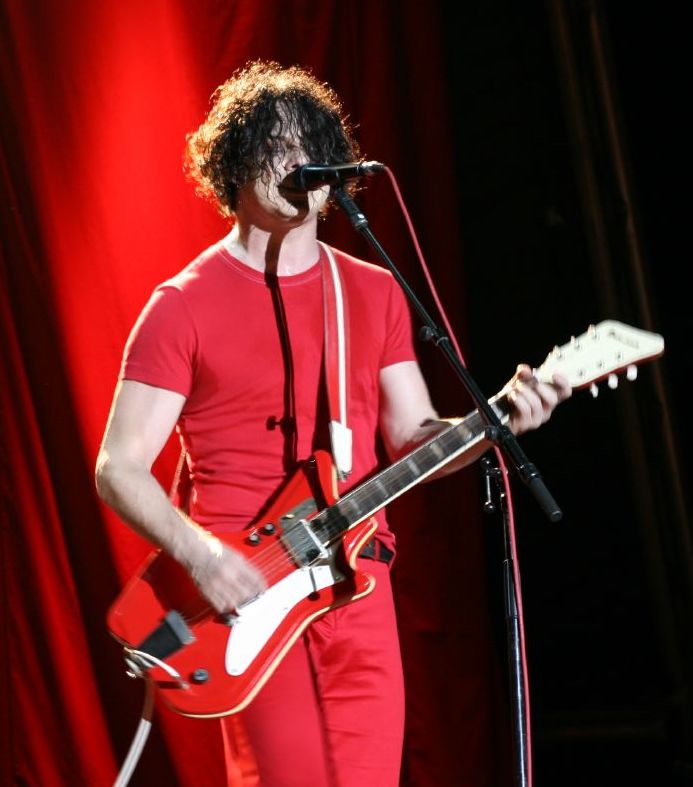
Photo: Michael Morel / Wikimedia Commons / CC BY 2.0 Airline
Res-O-Glas
1964
A fiberglass guitar from a mail-order catalog. Jack White called it a hollow piece of plastic, and meant it kindly.

Photo: Tim from Atlanta, USA / Wikimedia Commons / CC BY 2.0 Supro
Dual Tone
1954
Link Wray posed with one for Rumble. Bowie found two on eBay. James Murphy bought his because Bowie said so.

Photo: Chris J Bowley / Wikimedia Commons / CC BY 2.0 National
Style O
1930
A nickel-plated brass guitar from 1930s Los Angeles, and the one Mark Knopfler wouldn’t sell.