 Guitaripedia
NS Design
CR Bass
Take the box away from an upright bass and you still need somewhere for the bow to go.
Maine and the Czech Republic. Ned Steinberger, the man behind the headless bass, starts over with an upright you can carry onto a plane: a stick of maple at full string length, with a bridge that can listen for the bow or for the pluck. It's an NS Design, not a Steinberger.
- Introduced
- 1990
- Type
- Electric upright bass
- Class
- Production
Have a photograph of this guitar? Send a picture
The short version
1986–87
The headless company goes
Ned sells Steinberger Sound, and Gibson keeps the name. Sources split on the year.
1990
NS Design
Ned starts again. The first instrument is an electric upright, at the acoustic bass's string length, built to bow as well as pluck.
1994
The stick patent
Filed in December, granted in 1996. One tapered blank, no sound chamber, two sensors under the bridge.
2000
CR in print
Bass Player reviews the Czech maple bass by June. Nobody has printed a launch year for the letters CR.
2010
CR-T
The traditional setup, with a higher bridge, heavier strings, and a brass button for your hand, is new.
2026
Still in the catalog
CR-M and CR-T, both made in the Czech Republic for a company that's still in Maine.
Side A
A1
Starting over with a stick
Ned Steinberger had already changed the bass guitar once. He made the headless graphite one, and then he sold the company. Gibson kept the name. The year was 1986 or 1987, depending on whose history you read.
In 1990 he started NS Design. The first thing it made wasn't a bass guitar. It was an electric upright, built around the acoustic bass's 42-inch string length, made to be plucked and bowed.
That last part is the hard one. A bass guitar never has to answer to a bow.
A2
One piece of wood
The patent, filed in December 1994, describes the shape. Body, neck, and headstock come out of a single tapered blank. There's no sound chamber at all. Under the outer feet of the bridge sit two sensors, mixed so the pickup can favor the string moving across the fingerboard or moving straight down into it.
That matters because of what your hands do. A bow drives the string sideways. A sustained pluck pushes it down. The patent's version was wood and graphite, and that laminate became the American-made U.S. Series.
The CR is the other way of building it: solid maple, a flame maple face, made in the Czech Republic. It's 132 centimeters long, 15 wide, 10 thick, and weighs 4.8 kilograms. That's the whole instrument, at a full 106-centimeter upright scale. The finish is a traditional amber stain, so from across a room it at least looks like it's from the same family as the bass it replaces.
When the letters CR first showed up isn't printed anywhere. The earliest dated review is from June 2000, in Bass Player:
The Czech bass "plays so well, in fact, that upright players may find it plays too easily."
A3
A bridge with two ears
NS calls the bridge Polar, and it's why the CR is still in the catalog.
Set it lateral and the bow speaks, and a pluck comes out short and percussive. Set it vertical and a pluck sustains, closer to a bass guitar. Or blend them. An 18-volt EMG circuit runs the show, with treble and bass.
The CR-M adds an EMG magnetic pickup for that electric-bass pizzicato, and a knob to balance it against the bridge. NS is clear that the magnetic is the wrong pickup for the bow. That's the bridge's job.
Four strings are tuned E–A–D–G. The five-string gets a low B or a high C, your choice, but not both.
Flip the record · By the numbers
106 cm
Scale, about 41¾ inches, a full upright's string length
4.8 kg
The whole bass, about 10½ pounds
132 cm
Long, and 15 cm wide. That's the entire body.
2
Directions the bridge listens, across the board and into it
Side B
B1
Not a Steinberger
It's easy to tangle this bass up with Ned's other work, so here's the short version.
It isn't a Steinberger. That was the company he sold. It isn't the Radius either, a headless bass guitar from the 2010s that also carries the letters CR, for Czech Radius. The Omni is a 34-inch crossover for bass-guitar hands. The EU is the graphite-and-maple laminate, built in the Czech Republic to the old U.S. Series spec. The NXT and the cheaper WAV share the idea with simpler parts.
The CR is the solid maple stick with the Polar bridge.
B2
Stupidly full
Tony Levin bought the first NS Design electric upright, by the company's own account, though nobody says that first one was a CR. NS lists him on "EU/CR." He says he sometimes picks the NS when he wants an almost-acoustic sound and a huge bottom end.
Benny Rietveld, Santana's bassist, has a five-string CR-M, and NS prints his verdict on it:
"The sound is so stupidly full, it's been fun to use. A great way to get the upright bass sound in a Rock and Roll setting."
James "Hutch" Hutchinson, Doug Wimbish, and Brittany Frompovich are on the maker's CR list too. None of them has a song tied to it in print.
B3
The brass button
In 2010 NS added the CR-T, and a reviewer called it new. Same maple stick. The bridge is raised, the action is higher, the strings are D'Addario's heavier Traditional set, and there's no magnetic pickup, only the Polar bridge and the EQ.
It also gets one small part the CR-M doesn't. A brass button on the neck at the acoustic bass's "D neck" spot, a landmark an upright player's hand already knows.
Ned took the box away. The CR-T puts the one bit of it a player's hand would miss back on the neck.
The cast
The people, and the specific guitars, that made the legend.
Tony Levin
NS electric upright, EU or CR
Bought the first NS Design electric upright, by the company's account. He reaches for it when he wants an almost-acoustic sound with a huge bottom end.
Benny Rietveld
CR5M
Santana's bassist, on NS Design's artist page with a five-string CR-M and a line about how "stupidly full" it sounds.
James "Hutch" Hutchinson
CR4M
On the maker's artist list with a four-string CR-M, and separately with an Omni.
Doug Wimbish
CR upright
On the maker's list with a CR upright, and a separate Omni.
Brittany Frompovich
CR5M
On the maker's artist list with a five-string CR-M.
Liner notes
Specs, construction, rarity, value, and every source we used.
A stick of maple at upright length, and a bridge that can listen for the bow or for the pluck.
- Body
- Solid stick, no soundbox. Current maker sheet: solid rock maple neck and body, flame maple face. 132 cm (52") long, 15 cm (6") wide, 10 cm (4") thick, 4.8 kg (10.5 lbs.). Amber stain, clear semi-gloss. Czech Republic.
- Neck
- Traditional upright profile, one piece with the body, truss rod. Not headless. The small body leaves the upper register open. CR-T adds a brass button for the acoustic "D neck" spot.
- Fingerboard
- Fretless, graduated, asymmetric relief, cascading dots. Maker, on the CR-M page: 43.1 mm (1.7") wide at the nut, 89.0 mm (3.5") at the widest. Gollihur prints those as the four-string, and 47.6 mm (1.875") / 101.6 mm (4.0") for the five-string. The 2016 NS sheet says maple and ebony. Gollihur's current CR-M sheet says Richlite. The current maker page does not name the wood.
- Scale
- 106 cm (41.73"), maker, on CR-M, CR-T, and the 2016 sheet. MusicRadar's account of the first upright says a 42-inch string length. The 1994 patent says strings "normally about 42 inches."
- Pickups
- Polar piezo in the bridge: lateral vibration for the bow and a percussive pluck, vertical for a sustained pluck, or a blend. CR-M (CR4M, CR5M) adds a low-impedance EMG magnetic with neodymium magnets. The 2016 sheet: the magnetic is not for bowing. CR-T is Polar only.
- Hardware
- Adjustable-height bridge. Maker CR-M page: hard maple, radius 7.9 cm (3.1"), string spacing 81 mm (3.19"). Gollihur's CR-M sheet: black phenolic, same radius and spacing. Worm-gear tuners. Gollihur names Schaller, 20:1. The current maker page says premium worm gears, black, and does not name the brand. The family page includes a tripod, gig bag, and tool kit. The CR-T shop page includes an end-pin stand with that purchase. Gollihur's CR-M page includes the tripod. Strap frames are extra.
- Electronics
- 18-volt active circuit by EMG, mono. CR-M: volume, magnetic/Polar balance, pizzicato/arco balance, treble, bass. CR-T: volume, pizzicato/arco balance, treble, bass. No selector for two magnetics.
- Finish
- Traditional amber stain under clear semi-gloss polymer. Gollihur: other colors by special order.
- Nut
- Maker: radius 7.9 cm (3.1"), string spacing 30 mm (1.19"). Wood unnamed on that page. Gollihur: Macassar ebony, same radius and spacing.
Open the full research fileConstruction details, the complete player record, production numbers, dated value estimates, and sources
The specs above are the current Czech CR-M, the maple stick with Polar and EMG, as the maker and Gollihur describe it. CR-T is the same stick set up traditionally: higher action, D'Addario Traditional strings, Polar only, the brass D-neck button, and it is still sold. The EU is the graphite-and-maple laminate. The Omni is a 34-inch crossover. The Radius is a headless bass guitar that also wears the letters CR. The U.S. Series is the American original the EU page says it copies.
Construction
The job was an upright you could fly with and still bow. Ned Steinberger had already made the headless graphite bass. Gibson kept that name. His history page and Blue Book date the sale of Steinberger Sound to 1986. Wikipedia, and Jim Reilly's shop essay on the NS site (24 September 2026), date it to 1987. He founded NS Design in 1990. The history page, the inside page, Wikipedia, NAMM's 2005 oral-history card, and Blue Book all give that year. MusicRadar (Jim Reilly, 24 August 2017): the first NS instrument was an electric upright, built around the acoustic bass's 42-inch string length, useful pizzicato and arco. That is the start. It is not a catalog line that says "CR."
The stick is the patent. US 5,537,906, filed 8 December 1994, granted 23 July 1996. Body, neck, and headstock cut from one conical blank. No sound chamber. Two sensors under the outer feet of the bridge, mixed so the pickup can favor motion across the board or motion straight into it. The bow drives the string sideways. A sustained pluck drives it down. The patent's example is wood and graphite, strings "normally about 42 inches," a blank 52–53 inches long. That laminate is the U.S. Series. The current EU page says the Czech EU is built to those original U.S. specifications: 27 layers of rock maple and graphite in epoxy, a neck whose back curves in with the board, 5 or 6 strings, 4 kg (9.5 lbs.), the same 132 cm by 15 cm by 10 cm outline and the same 106 cm scale. Blue Book says NS had been building in Nobleboro and Walpole, Maine. The 2016 CR sheet prints 134 Back Meadow Road, Nobleboro.
The CR is the solid-maple Czech bass on that outline, not the laminate. The 2016 instruction sheet: European hard maple, flame face, ebony in the "maple and ebony" line, 4 or 5 strings, Polar standard, EMG optional. Bass Player, June 2000, as Guitar Center and Musician's Friend quote it: the Czech bass "plays so well, in fact, that upright players may find it plays too easily." The sheet's other Bass Player line, undated there, praises the craft and the sound. June 2000 is the earliest dated print of this maple stick under the CR name. No catalog states a single introduction year for those letters. The 1990 upright and the 1994 patent are earlier. They are not a CR launch date printed by the maker.
What the bridge does is why the bass is still in the book. The maker calls it Polar. Lateral, the bow speaks and a pluck goes percussive. Vertical, a pluck sustains, closer to a bass guitar. The blend sits between them. CR-M adds the EMG for that electric-bass pizzicato. The 2016 sheet says the magnetic is the wrong pickup for the bow. CR4 and CR5, on the current control list, are Polar without that second balance knob. CR-T, which Jazzwise on 8 April 2010 called the latest in the CR line and "new," is the traditional setup: bridge raised, NS Electric Traditional strings by D'Addario, higher tension, the brass D-neck button, Polar and the EQ, no magnetic in the control list. The current CR-M page ships NS Contemporary strings by D'Addario. Gollihur's CR-M sheet says D'Addario stainless flatwounds. Most 3/4 upright sets fit. Gollihur: very heavy sets, Eurosonics named, generally will not wind onto the tuners, and a non-ferrous string will not drive the CR-M magnets.
Four strings are E–A–D–G. Five are low B or high C, the player's choice, not both at once. Six strings are the EU, not this bass.
It is not a Steinberger, and it is not the later NS bass guitar. The Radius, shown at NAMM and written up by Premier Guitar on 9 October 2013, is a headless bass guitar: the maker's 17 January 2014 note gives the CR4 Radius a 34-inch scale and the CR5 Radius 35 inches. The letters CR on that guitar mean the Czech Radius. The Omni is the other trap, a short-scale crossover, fretted or fretless, for a bass-guitar left hand, with a bridge you can bow. The maker's shop prints 34" (86.36 cm). Blue Book prints 35 inches. The two figures differ. Hutch is on the maker's list for a CR4M and, separately, a CR Omni. Those are two instruments. The NXT, Blue Book's introduction year 2009, and the later NXTa share the stick, the scale, and the Polar idea, with simpler electronics, from the same Czech shop. The WAV is the cheaper stick. MusicGearReview (16 December 2009) dates it to 2006 and says China. Blue Book says China. The current upright page says India. The Ampeg Baby Bass is the earlier electric upright, a cello-sized plastic body and two discs under the bridge. The Realist, which the NS history page credits to Ned with David Gage, is a transducer for an acoustic bass. It is not this Polar bridge.
Jedistar: CR and EU instruments are made in the Czech Republic with the NBE company. The company is still in Maine. A new CR-M or CR-T is that Czech maple stick.
Players
A U.S. Series bass, an EU, an NXT, an Omni, and a Radius are not this maple CR. Each credit below stays with the series the source names.
Tony Levin. MediaMikes, 17 September 2011, his own line: he sometimes picks the NS electric upright for an almost-acoustic sound and a huge bottom end. He does not say CR, EU, or a song. The maker's upright list puts him on "EU/CR." Jim Reilly, on the NS site, 24 September 2026: Levin bought the first NS Design electric upright. That note does not call the first one a CR. Peter Gabriel footage in the same essay is not tied to a model. The Chapman Stick and the Music Man are other instruments, and he says so in that interview.
Benny Rietveld (Santana). The maker's artist page puts a CR5M in his hands and prints his line: "The sound is so stupidly full, it's been fun to use. A great way to get the upright bass sound in a Rock and Roll setting." No Santana track is named. The same page lists Miles Davis among his groups. The bio's Davis work is the 1988 tour. That is before Bass Player's June 2000 CR review. The page does not put a CR5M on a Davis record.
Les Claypool. Guitar World (Karl Coryat, 8 January 2020) has him checking in on an NS Design electric upright, and still bringing one on the road with the Carl Thompson six-string. The series is not named. Wikipedia's equipment line says "an NS Design upright bass," again with no series. Guitar Lobby (12 April 2026) calls his upright an NXT five-string and dates it to 1995 and Tales from the Punchbowl. Blue Book dates the NXT to 2009. A 1995 NXT does not fit that date. A five-string NS electric upright, bowed, on "David Makalaster II" is an Uberproaudio gear note about Purple Onion (2002), and that note does not say CR.
The maker's artist list, and nothing more specific: James "Hutch" Hutchinson, a CR4M (and a separate CR Omni); Doug Wimbish, a CR upright (and a separate CR Omni; the Spector that carries his name is a different bass); Brittany Frompovich, a CR5M. Bakithi Kumalo is on that list as an NXT upright. MusicRadar says he plays NS uprights and Radius basses. Neither source calls his upright a CR.
Rarity
A new CR-M or CR-T is a catalog bass. Bass Central, on 28 October 2026, had CR4M, CR5M, CR4T, and CR5T posted as in-stock adds. NS Design has published no CR total. A serial does not count a year.
The thin object is the American one. The EU page still describes itself as the Czech copy of the U.S. Series. How many U.S. Series uprights were made has not been published. Bass Central marked an EU-5 and an EU-6 "rare" and priced them apart from the CR. Those are the laminate. They are not a CR census.
Inside the Czech run, nothing in the sources marks a limited CR edition. CR-T is the later traditional setup, in print as new in 2010, not a short run. An Omni, a Radius, an NXT, or a WAV is a different model sitting in the same used market.
Value
Informal estimate, 28 October 2026. Not an appraisal.
Asks are labeled as asks. No celebrity CR sale turned up. An EU price is not a comp for this maple stick.
New street. The living CR is a several-thousand-dollar Czech bass, and the posted numbers disagree. The maker's CR-T shop page showed a range of $5,389.00 through $5,989.00. Bass Central, the same day: CR4T $5,129.00, CR5T $5,709.00, CR4M $5,329.00, CR5M $5,919.00. Gollihur's CR-M page showed $5,329.00, matching the four-string magnetic. A Reverb listing for a new CR4 asked $5,139.47 plus $351.78 shipping. Blue Book prints starting MSR of $3,500 (four-string) and $3,980 (five-string) and does not date those figures. They are not these October asks. MusicGearReview, 16 December 2009, had the CR "in the $3000 range," which is 2009 money. For scale, not as a CR price: Bass Central posted an EU-5 at $6,629.00 (out of stock) and an EU-6 at $7,619.00, both tagged rare, and an NXT4a upright at $2,429.00. The Omni at $4,729.00 there is the 34-inch bass.
Used modern. No sold median was on a price-guide page. One public ask: a 2010s CR4M on Reverb, listed 23 September 2026, $1,825.38 plus $730.15 shipping. An ask, one bass, not a band.
Vintage / collectible. There is no separate vintage market for a Czech CR the way there is for a 1960s electric upright from another maker. A clean older Czech example trades as used modern. A U.S. Series bass would be the scarce American object, and no 2026 hammer for one turned up. Levin's first NS upright and Rietveld's CR5M are not comparable sales.
See also
- Baby Bass — the earlier electric upright, plastic and a diaphragm bridge, not this maple stick
- GL — Ned's headless graphite guitar, from the company he sold before NS Design
- Precision Bass — the horizontal bass an upright player is usually not holding
Sources
- NS Design, history — founded 1990; sale to Gibson given as 1986; Polar; Ned on bowed electrics since the mid-thirties and being "set free"; Realist with David Gage
- NS Design, inside — founded 1990
- NS Design, CR-M instrument page — maple, 132 cm / 52", 4.8 kg / 10.5 lbs., 106 cm / 41.73", 4 or 5 strings (low B or high C), Polar, EMG on CR4M/CR5M, 18-volt EMG, control lists for CR-M and for CR4/CR5, maple bridge, nut spacing, Contemporary strings, gig bag in the overhead
- NS Design, CR-T instrument page — traditional setup, 106 cm scale, brass D-neck button, Traditional strings, higher action, 4.8 kg, loaded 8.2 kg / 18 lbs.
- NS Design, CR-T shop — $5,389.00 through $5,989.00; 15 cm / 6" by 10 cm / 4"; maple bridge; end pin included with that purchase
- NS Design, EU instrument page — Czech EU to the original U.S. Series spec; 27 layers; 5 or 6 strings; 4 kg / 9.5 lbs.; same outline and scale
- NS Design, upright family — CR-M, CR-T, EU, NXTa, WAV (WAV "crafted in India"); Tony Levin listed EU/CR; Hutch CR4M; Doug Wimbish CR; Brittany Frompovich CR5M
- NS Design, 2016 CR instruction sheet — maple and ebony; dimensions; Polar; EMG optional and not for bowing; Nobleboro address; Bass Player "ahead of the pack" line, undated on the sheet
- US 5,537,906 — filed 8 December 1994, granted 23 July 1996; conical stick; dual bridge sensors; strings normally about 42 inches; blank 52–53 inches; wood and graphite example
- MusicRadar, Jim Reilly, 24 August 2017 — NS Design 1990; first instrument an electric upright; 42-inch string length; Radius in 2013; Kumalo on uprights and Radius
- Wikipedia, Ned Steinberger — NS Design 1990; Steinberger sold to Gibson in 1987
- Wikipedia, Steinberger — Gibson kept the name; NS Design since 1990
- NAMM oral history, Ned Steinberger — NS Designs formed 1990; interview 23 January 2005
- Blue Book, NS Design — founded 1990; sale dated 1986; Czech production, WAV in China; earlier shops Nobleboro and Walpole, Maine
- Blue Book, NS Design electric bass — CR four-string MSR from $3,500, five-string from $3,980; NXT introduced 2009; EU copies the U.S. Series; Omni at 35 inches in that text
- NS Design, Tales from the Shop, 24 September 2026 — sale dated 1987; Levin bought the first NS electric upright; Radius, first few in the U.S., then the Czech factory
- Guitar Center, CR Series 4-string — Bass Player, June 2000, "plays too easily"; Macassar ebony board in that dealer copy
- Musician's Friend, CR Series 4-string — same June 2000 sentence; ebony nut; phenolic bridge; Schaller 20:1
- Gollihur, CR-M — $5,329.00 on 28 October 2026; Richlite; phenolic bridge; ebony nut; Schaller 20:1; four- and five-string widths; Eurosonics and non-ferrous notes; bag 137 cm / 54" by 18 cm / 7"
- Jazzwise, CRT review, 8 April 2010 — CRT as the new traditional model in the CR line
- NS Design, CR4 Radius announcement, 17 January 2014 — headless bass guitar; CR4 at 34", CR5 at 35"
- Premier Guitar, CR5 Radius, 9 October 2013 — 2013 introduction of the headless CR5 Radius; U.S. Radius about a year earlier
- NS Design, Omni shop — 34" (86.36 cm); a different bass
- MusicGearReview, 16 December 2009 — WAV introduced 2006, China, under $900 street; CR "in the $3000 range"; NXT around $1,200 street, made by the CR shop
- Jedistar, NS Design — 1990; Nobleboro; CR and EU with NBE in the Czech Republic
- MediaMikes, Tony Levin, 17 September 2011 — he chooses the NS electric upright; no series, no song
- NS Design, Benny Rietveld — CR5M; the "stupidly full" line; Santana and Miles Davis as groups, no track
- Guitar World, Les Claypool, 8 January 2020 — NS electric upright, series unnamed, still on the road
- Wikipedia, Les Claypool — "an NS Design upright bass," no series
- Guitar Lobby, Les Claypool gear, 12 April 2026 — calls it an NXT five-string from 1995 and Tales from the Punchbowl; conflicts with Blue Book's 2009 NXT date
- Bass Central, electric uprights — 28 October 2026 asks: CR4M $5,329, CR5M $5,919, CR4T $5,129, CR5T $5,709; EU-5 $6,629 out of stock; EU-6 $7,619; NXT4a $2,429; CR Omni $4,729
- Reverb, 2010s CR4M — listed 23 September 2026 at $1,825.38 plus $730.15 shipping; an ask
- Reverb, new CR4 — ask $5,139.47 plus $351.78 shipping
Keep digging
Guitars this one gets compared to, confused with, or descended from.
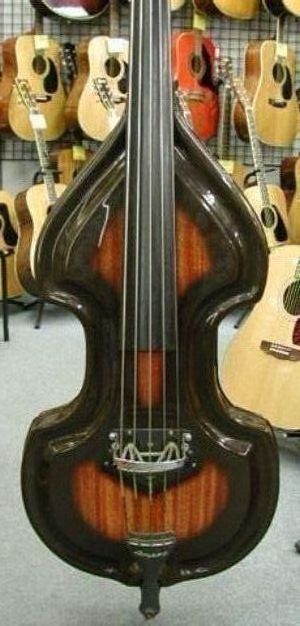
Photo: Mauroconga / Wikimedia Commons / Public domain Ampeg
Baby Bass
1962
Bass players were being handed a Fender. Ampeg handed them a plastic upright with a scroll.
- Send a picture
Steinberger
GL
1984
No headstock, no wood, and designed by a man who didn’t play. Eddie Van Halen wrote two songs on it in days.
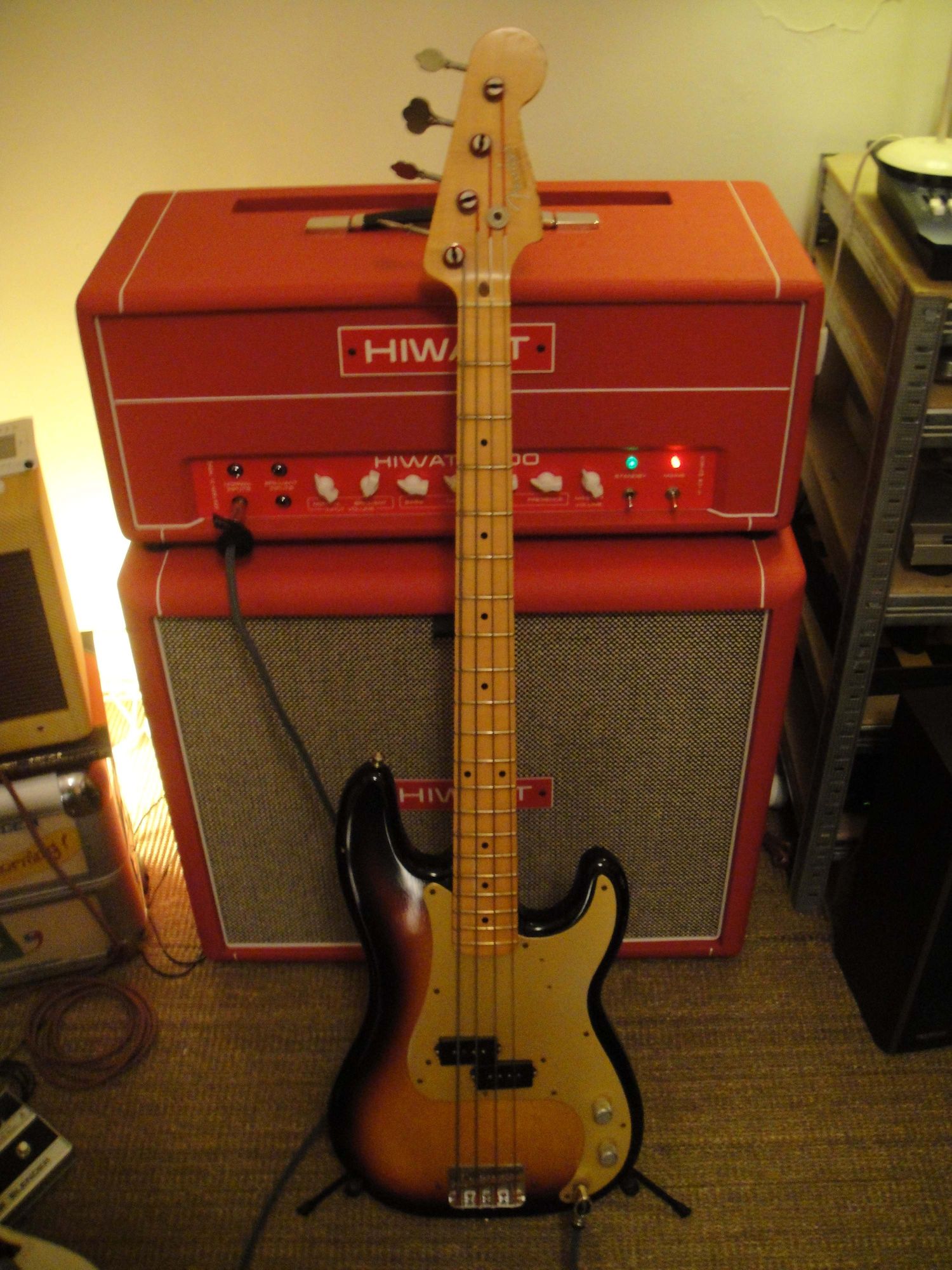
Photo: Infrahertzz / Wikimedia Commons / CC BY-SA 3.0 Fender
Precision Bass
1951
Leo’s bass let the player at the back be heard. You know their lines by heart. You mostly don’t know their names.