Ovation
Breadwinner
Players already called a guitar an axe. In 1971 a man in Ovation’s ad department drew one.
Ovation was the company with the bowl-back acoustic. Then it built a mahogany solidbody shaped like a medieval battle axe, with a preamp inside and a textured coat outside. The man who drew it was laid off before it was built.
- Introduced
- 1972
- Type
- Solidbody electric
- Class
- Production
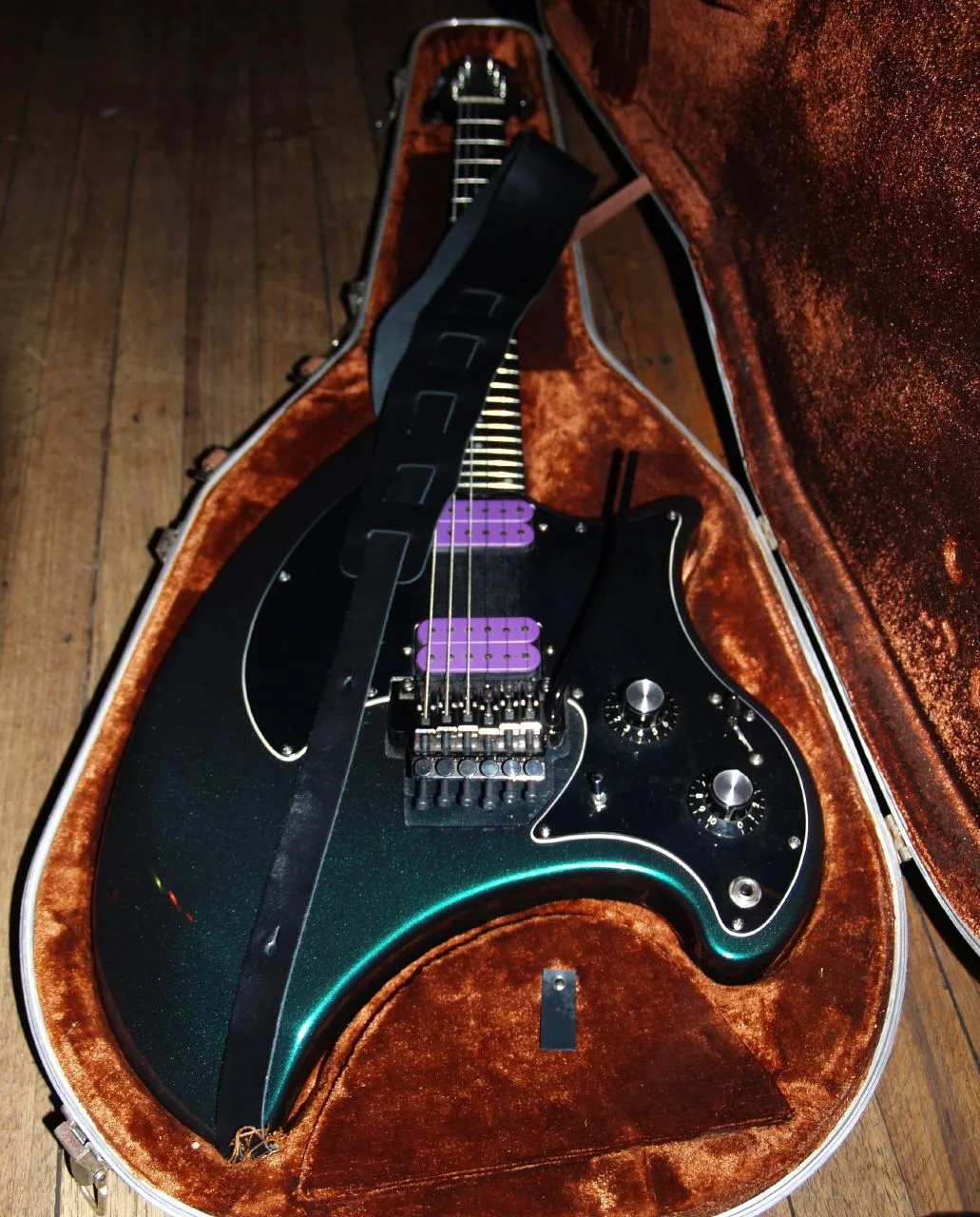
The short version
1966
The bowl
Ovation’s roundback Balladeer. The company’s reputation, and a different guitar.
1971
The drawing
Chief engineer Jim Ricard asks a commercial artist for solidbody sketches. One account has the guitar unveiled this year too.
1972
$349.00
A magazine product note in October introduces the Breadwinner in black, white, tan, or blue, with the Deacon beside it.
1973
The Hotel Diplomat
Ace Frehley plays a white one at early Kiss shows at the Hotel Diplomat. Peter Tosh has one on the Wailers’ Burnin’ tour.
1975
Humbuckers
The toroidal pickups give way to Ovation humbuckers in 1975, or late 1974, or even earlier. Three clocks.
1977
ABBA
Björn Ulvaeus plays a white one on the European and Australian tour.
1979
Axed
The Breadwinner is dropped. The Deacon outlasts it.
Side A
A1
A sketch for the engineer
In 1971 a commercial artist named Mike was working in Ovation’s advertising department when chief engineer Jim Ricard came to him for something new: sketches for a solidbody electric.
This was the company that had taught people a guitar’s back could be a bowl. The Balladeer, in 1966, made Ovation’s name. A solidbody was a different animal, and the electric market wasn’t asking for anything new. It wanted Les Pauls, Strats, and Japanese copies of both.
Mike drew a medieval battle axe. Players already called a guitar an axe, so why not make one?
A2
Sits on the knee
He drew it to be played, too. A deep cutaway under the strings, so you could reach the top frets. A cut at the bottom, so it sits on your knee. He wasn’t an engineer and never claimed a weight study, but balance was in the drawing. Played standing up, it balances.
He wanted the body made of Lyrachord, the resin Ovation used for its bowls, or hollow with a honeycomb inside. He didn’t get that. What shipped was solid mahogany, with a bolt-on neck, an unbound ebony board, dots, and 24 frets.
And he didn’t see any of it built. He was laid off in 1971, before there was a guitar.
A3
Two batteries in 1972
When it arrived depends who’s counting. One history has it unveiled in 1971. A magazine product note in October 1972 introduced it alongside its fancier sibling, the Deacon, at $349.00 in black, white, tan, or blue. Keep both years.
The strange part was inside. The Breadwinner had an onboard FET preamp, running on two batteries, with a volume, a tone, a 3-way switch, and a notch filter that scooped out the midrange. It may have been the first production guitar with active electronics, though the histories hedge that claim. A few makers had already built effects into guitars, and Alembic was exploring active pickups, still as custom work. Ovation even printed a settings guide that mapped the knob positions to other bands’ sounds.
Mike drew a medieval battle axe. Players already called a guitar an axe, so why not make one?
The pickups started out toroidal, wide covers with 12 poles each. Then they became Ovation humbuckers, and the year depends who you ask: 1975, a late-1974 trade-show upgrade billed as “20dB quieter than Humbuckings,” or as early as 1972 and 1973. The finish was textured, not glossy. One writer calls it spackle.
Flip the record · By the numbers
$349.00
A Breadwinner in 1972. The fancier Deacon was $449.00.
24
Frets, a full two octaves, reached through a deep cutaway.
2
Batteries for the onboard preamp, in a guitar from 1972.
$415
The list price in its last years, 1976 to 1979.
Side B
B1
The crazy-looking Ovation
It didn’t sell. Against Japanese Les Paul copies, one history says, sales were “embarrassingly bad.” But the people who did pick one up were not the ones buying Les Paul copies.
Ace Frehley had a white one in 1973, at the Hotel Diplomat, playing early Kiss shows. “I used a crazy-looking Ovation that had an old hand-wound DiMarzio pick-up in it for a few early gigs,” he said. It was the guitar he had when Bill Aucoin saw the band, before signing them.
People have long said it’s on the first Kiss album. Frehley says no. Humbuckers were already in it by then, and he liked the sound, but for the record he remembers a red Epiphone Coronet and a tobacco Les Paul, maybe a Strat. The gigs stay. The album doesn’t.
Peter Tosh had one on the Wailers’ Burnin’ tour in 1973. Marc Bolan held a black one on Top of the Pops for “The Groover.” Björn Ulvaeus took a white one on ABBA’s 1977 tour. A black one is on the original back cover of the Cars’ Panorama.
B2
The man on the couch
List price crept to $395, then $415. It didn’t help. Ovation dropped the Breadwinner in 1979, and the Deacon outlasted it.
Mike had been gone since 1971. He says advertising and selling came in 1972 or ’73, after he left. He was clear about what he did and didn’t draw. The later Limited, with its extra cutaway, was not his.
Years later he was watching a rerun of The Partridge Family, and there it was on the show. David Cassidy, it turns out, played one.
Mike never saw the battle axe come off the line. He caught it on TV, like everyone else.
Put this on
You’ve read about it. Now hear it. Here’s what this guitar sounds like, and what to listen for.
Capitol Session ’73
Filmed during the Burnin’ tour. Peter Tosh is playing a Breadwinner, by the photographic record. Watch his side of the room.
Watch it on YouTube (opens in a new tab)The Groover (Top of the Pops)
Marc Bolan on Top of the Pops with a black Breadwinner.
Watch it on YouTube (opens in a new tab)
The cast
The people, and the specific guitars, that made the legend.
1973
Ace Frehley
White Breadwinner
Of Kiss. Early gigs and the showcase Bill Aucoin saw. He says it isn’t on the first Kiss album.
1973
Peter Tosh
Breadwinner
Of the Wailers. On the Burnin’ tour, in the Capitol Session film.
1977
Björn Ulvaeus
White Breadwinner
Of ABBA. On the 1977 tour of Europe and Australia.
1973
Marc Bolan
Black Breadwinner
Of T. Rex. On Top of the Pops for “The Groover.”
1980
Greg Hawkes
Black Breadwinner
Of the Cars. Pictured with it on the original sleeve of Panorama.
David Cassidy
Breadwinner
Played one on The Partridge Family, which is where the man who drew it finally saw it.
Liner notes
Specs, construction, rarity, value, and every source we used.
Mahogany cut like a battle axe, with the preamp already on board — Ovation’s Breadwinner, not a Deacon and not a roundback.
- Body
- Mahogany solid, axe outline. vintageguitarandbass: length 39½", width 14½", depth 1⅝". Guitar-list prints 991 × 368 × 41 mm. Mix flagged.
- Neck
- Bolt-on. vintageguitarandbass: two-piece Honduras mahogany.
- Fingerboard
- Unbound ebony, dot inlays, 24 frets
- Scale
- 24¾" (vintageguitarandbass). Guitar-list: 24.75". No millimetres on those pages.
- Pickups
- Two toroidal single-coils, 12 poles, on the early guitar. Later: Ovation humbuckers, twin rows of six. The changeover year is split.
- Hardware
- 12:1 machines, chrome. Bridge is split: Wright’s molded plastic and plastic saddles, against vintageguitarandbass’s brass.
- Electronics
- Onboard FET preamp, two batteries, master volume, tone, 3-way, notch / band-rejection. Version F drawing: both pickups out of phase.
- Finish
- Textured. Codes 1251-5 black, 1251-6 white, 1251-7 tan. Blue and red are in the sources and leave on different clocks.
- Nut
- 1 11/16" (vintageguitarandbass). Guitar-list: 1.69". Mix flagged.
Open the full research fileConstruction details, the complete player record, production numbers, dated value estimates, and sources
Classic living example = Breadwinner 1251 (New Hartford), and the early one if the toroidals are still in it. No current Ovation SKU. Eastwood Breadwinner is another factory: maple bolt-on, rosewood, mini-humbuckers, list $899. Eastwood prints 24¾" (628 mm). That conversion is theirs. Deacon (1252) is the gloss sibling. Deacon 12-string (1253) is twelve strings. Breadwinner Limited is Wikipedia’s extra-cutaway tuxedo, and the designer says he did not draw it. Preacher, Viper, UK II, and the Magnum basses are later Ovation electrics. Electric Storm (1968) is a German-body semi-hollow. Not a Balladeer. Not an Adamas. No Gibson SKUs. Mixed inch/mm flagged on 991 × 368 × 41 mm against 39½" × 14½" × 1⅝", and on 1 11/16" against 1.69". Width and depth are the same measurement in two units. The length is not: 39½" is not 991 mm. Do not convert. Do not average.
Construction
The job was a solidbody from the company that had just taught people a guitar back could be a bowl. Charles Kaman’s roundback is the Balladeer, 1966, other plate. By the early 1970s the electric market had gone conservative: Les Pauls, Strats, and Japanese copies of both. Ovation walked in with an axe.
The drawing is 1971. “Mike,” a commercial artist in the advertising department, told the Breadwinner fan page that chief engineer Jim Ricard asked him that year for solidbody sketches. A medieval battle axe, because players already called the instrument an axe. Balance was in the drawing. He was not an engineer and did not claim a weight study. A deep cutaway under the strings for the high frets. A cut at the bottom so it sits on the knee. He wanted the body in Lyrachord, the resin of the acoustic bowls, or hollow with a honeycomb. He was laid off in 1971, before it was built. Advertising and selling, he says, came in 1972 or ’73. He did not design the Limited.
The catalog year is the fight, and it stays a fight. Michael Wright, Vintage Guitar (April 2000): Ovation “unveiled” the Breadwinner in ’71, Deacon in January ’72. Wright’s later UK II piece puts both guitars in ’72. Guitar Player, October 1972, “It’s New,” in Ovation Tribute’s summary, introduces both at once: Breadwinner $349.00 in black, white, tan, or blue; Deacon $449.00, sunburst only; 24 frets, toroidal pickups, FET preamps. vintageguitarandbass.com: launched toward the end of 1972 at $349, a few months before the Deacon, available 1972–79. The Ovation Fan Club’s compiled retail table leaves the 1971 cell for 1251 blank and prints $349 for 1972 and 1973. Wikipedia and guitar-list print 1971–1979. Keep 1971. This plate starts in 1972, the year a price and a product-news item exist.
It is not Ovation’s first electric. Wright: July 1968, Electric Storm, Thunderhead and Tornado, f-hole semi-hollow thinlines, German bodies, bolt-on Ovation necks. Blue Book of Guitar Values: Storm semi-hollows from 1968; American-built solid bodies beginning 1972. Tribute’s summaries of that Guitar Player item and of the 1973 catalog call these two Ovation’s first solid bodies. Both stand if “first” means first solid. The Storm is not this guitar.
What shipped is a mahogany slab. Wright: rounded upper edge, deep cutaway at the double octave, an S along the bottom, the lower bout scooped. Bolt-on neck, two octaves, unbound ebony, dots. vintageguitarandbass: two-piece Honduras mahogany, scale 24¾", nut 1 11/16", body 39½" × 14½" × 1⅝". Mike drew the lower cut so it sits on the knee. Wright’s line is the same guitar balanced when you stand.
The preamp is the part the histories argue about. It is an onboard FET. Wright: arguably the first production active electronic system. Höfner and Vox already had effects on the guitar; he says those were not “active” in the modern sense. Alembic was exploring active pickups and was still custom. Wikipedia, citing André Millard, ed., The Electric Guitar (2004), p. 172, says first mass-produced American guitar with active electronics. Blue Book says “probably.” Keep the hedge.
The 1972 owner’s manual, as Tribute describes it: selector, notch, volume, tone, FET, trims, battery replacement, a neck you can take off. New Hartford. Wright adds linear pots and a trim for each pickup’s level, and calls the notch a band-rejection / midrange bypass. Tribute’s Preamp Version F drawing: neck, bridge, both out of phase; the notch on a toroid inductor; batteries B1 and B2 each marked 9V. The 1251-0-350D and 1251-0-350F summaries also print an 18V figure beside a 9V. They do not say, in one sentence, that 18V is two 9V cells in series. Do not average the rails. Wikipedia’s tone boosts or cuts treble and is “normal” in the center. Ovation printed a settings guide that mapped positions to other bands’ sounds (Wikipedia; Tribute files 1974 and 1975 editions). Those settings are not recopied here.
Pickups start toroidal, under wide covers. Wright: 12 polepieces and six rectangular adjustable screws. Axeology, citing the 1973 catalog: 12 poles, six rectangular and six circular, the circular ones adjustable. Then they change, and the year does not. Wright: 1975, both this guitar and the Deacon, to Ovation humbuckers, metal covers, twin rows of six. vintageguitarandbass: single-coil until 1975, 12-pole double-coil after; an upgrade at autumn 1974 NAMM, “20dB quieter than Humbuckings.” Deacon Wikipedia: toroidals phased out in the 1972 and 1973 model years. Three clocks. Wikipedia says most collectors prefer the toroidal. That line is citation-needed.
The bridge is the same kind of split. Wright: molded plastic, plastic saddles, chrome on this model; metal saddles and gold on the Deacon. vintageguitarandbass: brass bridge, 12:1 machines, chrome throughout. Don’t average plastic and brass. The jack moved. Wright: early ones on the back, then the pickguard, and some guitars with both.
Finish is textured, not the Deacon’s gloss. Wright’s word is spackle: white, black, tan, or blue. Guitar-list and the Deacon Wikipedia page call the coat Lyrachord, on mahogany. A coating. Not the resin body Mike asked for, and not a bowl. Codes, vintageguitarandbass: 1251-5 black, 1251-6 white, 1251-7 tan, plus red and blue until 1976. Axeology: the 6 is white. Wright: blue dropped in ’76, the year the Deacon gained red, black, and natural. Wikipedia’s color list adds gray. Gray is also how that page describes the Limited. Don’t file it as a plain 1251 without that split.
Not the Deacon. Same outline at the start. Gloss, diamond mother-of-pearl, ivory binding, better tuners. Its first year is as split as this guitar’s: Wright’s January 1972; the October 1972 news item that introduces both; vintageguitarandbass’s “a few months” later; Deacon Wikipedia’s 1973–1982; the fan-club table, 1252 listed 1972 through 1980. A short-run Deacon 12-string is Wright’s 1975 (fan-club 1253 from 1976). Roy Clark’s 12-string, on the Deacon page, is that guitar. Jeff Lynne in the film for Electric Light Orchestra’s Discovery (1979) is a Deacon. Not a Breadwinner.
Not the Limited. Wikipedia: a third outline, an extra upper cutaway, tuxedo gray-to-black. The sentence is marked citation-needed. Mike: he did not draw it. Wright’s “around ’77” recontour — a dip in the top edge, on Deacon bodies, sales already bad — is a different sentence. Don’t merge them.
The 1251 ends where the lists go blank. Wright: “officially axed in ’79,” then a clause about the Breadwinner “loosing its head in ’80.” His wording. Not a count. Fan-club 1251 is empty from 1980. vintageguitarandbass and Wikipedia stop at 1979. The Deacon outlasts it on every clock.
Later electrics are other guitars. Wright: 1977 Preacher, Viper, and Magnum basses; 1979 UK II, aluminum under urethane foam. Own-brand electrics done in 1983. Hamer bought in 1988. None of that is a 1251. Not a Balladeer. Not an Adamas. Not a Celebrity.
List price is period money. October 1972 and the 1973 catalog summary: $349.00, Deacon $449.00. Fan-club table after that: $395 (1974–75), $415 (1976–79). vintageguitarandbass’s 1972 context, theirs: a sunburst Strat $367, an SG Special $365.
Classic vs current: a 1972 1251 — mahogany axe, toroidals, FET, textured coat — against no Breadwinner Ovation will sell you in 2026. Eastwood’s $899 copy is a living cart. Maple neck. Not this guitar.
Players
Do not hang a Deacon, a 12-string, a Limited, a Preacher, or a roundback here. Do not move Glen Campbell’s Goodtime Hour onto this slug. Wright’s Campbell is the bowl and the piezo. A Glen Campbell Forums thread says he was seen, 1972–74, with a customized Breadwinner whose covers looked like Gibson humbuckers. A forum. Not a stock 1251 credit. Jeff Lynne’s Discovery guitar and Roy Clark’s 12-string are Deacons, not this list.
Ace Frehley. The one this plate has to get right. A white 1251-6. Lydia Criss’s photographs, via Axeology: Hotel Diplomat, 13 July 1973 and 10 August 1973. Axeology quotes him, 1996: “I used a crazy-looking Ovation that had an old hand-wound DiMarzio pick-up in it for a few early gigs.” Axeology also says no photograph shows the original pickups still in it. The same site reads Eddie Solon’s Bell Sound photos as that guitar being his main instrument on the first Kiss album, with a Fender Thinline Telecaster also in the sessions.
He shut the album down. Guitar World, as reported by Crystal Koe, Guitar.com, 1 March 2024: he does not know who first said the white Ovation is on the first Kiss record. He played it at early shows, and it was the guitar when Bill Aucoin saw the band before signing them. He did not use it on the record. Humbuckers were already in it, and he liked that sound. For the debut he says the red Epiphone Coronet — the one Steve Marriott played — and the tobacco Les Paul, maybe a Strat. The gigs and the Aucoin showcase stay. The album does not.
Peter Tosh. Wikipedia, and Equipboard from a photograph: a Breadwinner on the Wailers’ 1973 Burnin’ tour, in the Capitol Sessions film. Equipboard extends the same guitar to Talkin’ Blues, the Leeds Polytechnic show, Legalize It, and 1974–75 reunions, and says he kept it until his death. That extension is a photo reading. Not a studio log.
Björn Ulvaeus. Wikipedia: a white one on ABBA’s 1977 tour, Europe and Australia. Equipboard has a performance photo. Which songs are unpublished here.
Greg Hawkes. Wikipedia: original back cover of The Cars’ Panorama (1980), a black Breadwinner. Equipboard says the inner sleeve. A later sale, serial E00405, ask $6,000, claims stage and studio use 1976–88 and the 1979 Drive America tour book. A seller. Not a credit, and not a comp.
Marc Bolan. Wikipedia: tuxedo black, Top of the Pops, T. Rex, “The Groover,” 1973. Don’t promote that into a Limited.
David Cassidy. Mike saw one on a Partridge Family rerun. A man watching television, not a cue sheet. Wikipedia states that Cassidy played one on the show.
Also known to play stays short. Wikipedia adds Colin Newman (white, early Wire), Robert Smith (black, early 1980s, Siouxsie and the Banshees, Nocturne footage), Tom Morello (“Ashes in the Fall”), and Dave Gregory of XTC, occasionally. None of that is a log in hand.
Rarity
You cannot buy a new Breadwinner from Ovation. Wright: the axe-shaped pair fell flat against Japanese Les Paul copies, sales “embarrassingly bad,” the Breadwinner axed in 1979. The fan-club 1251 cell is empty from 1980. Eastwood is another factory. Deacon, Limited, the 12-string, Preacher, Viper, and UK II are other objects.
No factory total. None invented. A serial dates a guitar. It does not count a year.
Thinner than an ordinary 1251: toroidals with the jack still on the back; a FET board nobody has bypassed; blue, on Wright’s 1976 cutoff; a Limited, if you take Wikipedia’s third shape. Frehley’s white 1251-6, the black guitar on Panorama, and Tosh’s tour guitar are single objects. They are not a vintage Breadwinner.
Value
Informal estimate, 19 October 2026. Not an appraisal.
Ask vs sold labeled. Celebrity lots are not comps. No invented medians or factory counts. $349.00 (October 1972; the 1973 catalog summary) is 1972–73 money. The fan-club $395 and $415 are that compiled list, not 2026 street.
New street. None under Ovation. Eastwood Breadwinner $899 (eastwoodguitars.com, fetched 19 October 2026). Reverb’s Eastwood new listing also prints $899. Maple neck, rosewood, mini-humbuckers. Another factory. The Eastwood 12-string and the Breadwinner Sitar are other Eastwood objects.
Used modern. Eastwood copies trade used. No clean 2026 sold band this pass. Don’t invent a midpoint.
Vintage / collectible. Reverb’s Ovation Breadwinner page did not print a price-guide band. Flag: thin sold-comp access. Named ask, not a hammer: Gil’s Gear Outlet, 1970s white, $1,750 (from $2,000), listed about four months before this pass. Named sold, not a series: Roadhouse Vintage, 1974 tan, stock, original case, $1,699, page marked sold (12 March 2025). A 1973 white on Reverb Belgium ended at €1,000 with Benedetti pickups and the active circuit bypassed. Modified. Chicago Music Exchange’s $845.75, listed nine years ago, had Seymour Duncan P-rails. Don’t average a modded sale with a stock toroidal. The Hawkes ask at $6,000, and a separate “believe to be owned” Rick Derringer Breadwinner sold at $2,100 (listed three years ago), are provenance claims. Not comps.
See also
- ovation-balladeer — 1966 spruce roundback; the Ovation people mean, not this solidbody
- ovation-adamas — carbon sandwich on a Lyrachord bowl; not an axe
- kawai-moonsault — the other 1970s odd solidbody; a mahogany crescent, not this axe
Sources
- Michael Wright, “Ovation Solidbody Guitars,” *Vintage Guitar*, April 2000 — unveiled 1971; Deacon January 1972; shape; spackle; plastic bridge vs Deacon gold; jack; toroidal poles; FET “arguably” first production active; Höfner/Vox vs Alembic; humbuckers 1975; blue dropped 1976; axed 1979; “loosing its head in ’80”; ~1977 Deacon recontour; Electric Storm July 1968; Preacher/Viper/Magnum 1977; UK II 1979; electrics end 1983; Hamer 1988; Campbell is the bowl
- Michael Wright, “Ovation UKII 1291,” *Vintage Guitar* — Breadwinner and Deacon both in ’72
- Mike, the designer, Breadwinner fan page — 1971; Jim Ricard; battle axe; knee cut; Lyrachord body rejected; Limited not his; Cassidy rerun; selling 1972 or ’73
- Ovation Tribute summary, *Guitar Player*, October 1972 — both introduced; $349.00 black/white/tan/blue; Deacon $449.00 sunburst; 24 frets; toroidal; FET
- Ovation Tribute summary, 1973 solidbody catalog — first solid bodies in that summary; $349 to $449; 12-pole toroidals; FET; bolt-on
- Ovation Tribute, 1972 owner’s manual — selector, notch, volume, tone, FET, trims, battery, removable neck; New Hartford
- Ovation Tribute, Preamp Version F — B1 and B2 marked 9V; both out of phase; notch on a toroid
- Ovation Tribute, 1251-0-350D and 1251-0-350F — summaries also print 9V and 18V; do not average
- vintageguitarandbass.com, Breadwinner — end of 1972 at $349; 1972–79; 24¾"; 39½" × 14½" × 1⅝"; two-piece Honduras mahogany; nut 1 11/16"; brass; 1251-5/6/7; red and blue until 1976; single-coil until 1975; autumn 1974 NAMM “20dB quieter”; Strat $367; SG Special $365; Hawkes listing ask $6,000 on the same page
- Reverb, claimed Derringer 1251-6 — sold $2,100; “believe to be owned”; listed three years ago; not a comp
- Wikipedia, Ovation Breadwinner — 1971–1979; Millard 2004, p. 172; colors including gray; Limited; center-detent tone; Cassidy, Tosh, Ulvaeus, Newman, Bolan, Hawkes, Smith, Morello, Gregory, Frehley
- Wikipedia, Ovation Deacon — 1973–1982; gloss, diamonds, binding; Lyrachord coat; toroidals out 1972–73; Roy Clark; Lynne, Discovery, 1979
- Guitar-list, model 1251 — 1971–1979; 991 × 368 × 41 mm; 24.75"; nut 1.69"; textured Lyrachord
- Ovation Fan Club retail table, 1971–2001 — 1251 blank in 1971; $349 (1972–73); $395 (1974–75); $415 (1976–79); blank from 1980; 1252 listed 1972–1980; 1253 from 1976. Compiled, not a factory scan
- Blue Book of Guitar Values, Ovation electric — Storm 1968; solid bodies from 1972; FET “probably” the first production active electronics
- Axeology, Ace Frehley Breadwinner — 1251-6; Lydia Criss, 13 July and 10 August 1973; 1973 catalog poles; 1996 DiMarzio quote; album reading Frehley later denied
- Crystal Koe, Guitar.com, 1 March 2024 — Frehley to Guitar World: early shows and the Aucoin showcase, not the first Kiss album
- Eastwood Breadwinner — $899; maple; rosewood; mini-humbuckers; 24¾" (628 mm)
- Reverb, Eastwood Breadwinner new — new $899
- Reverb, Ovation Breadwinner — Gil’s Gear ask $1,750 from $2,000; no price-guide band this pass
- Roadhouse Vintage, 1974 — sold $1,699
- Reverb Belgium, 1973 1251 — ended €1,000; Benedetti; active bypassed
- Chicago Music Exchange, 1970s black 1251 — sold $845.75; Seymour Duncan P-rails; listed nine years ago
- Equipboard, Ovation Breadwinner — photo readings for Tosh, Ulvaeus, Hawkes. Not a session log
- Glen Campbell Forums — forum sighting, customized Breadwinner, 1972–74; not the Goodtime Hour
Keep digging
Guitars this one gets compared to, confused with, or descended from.
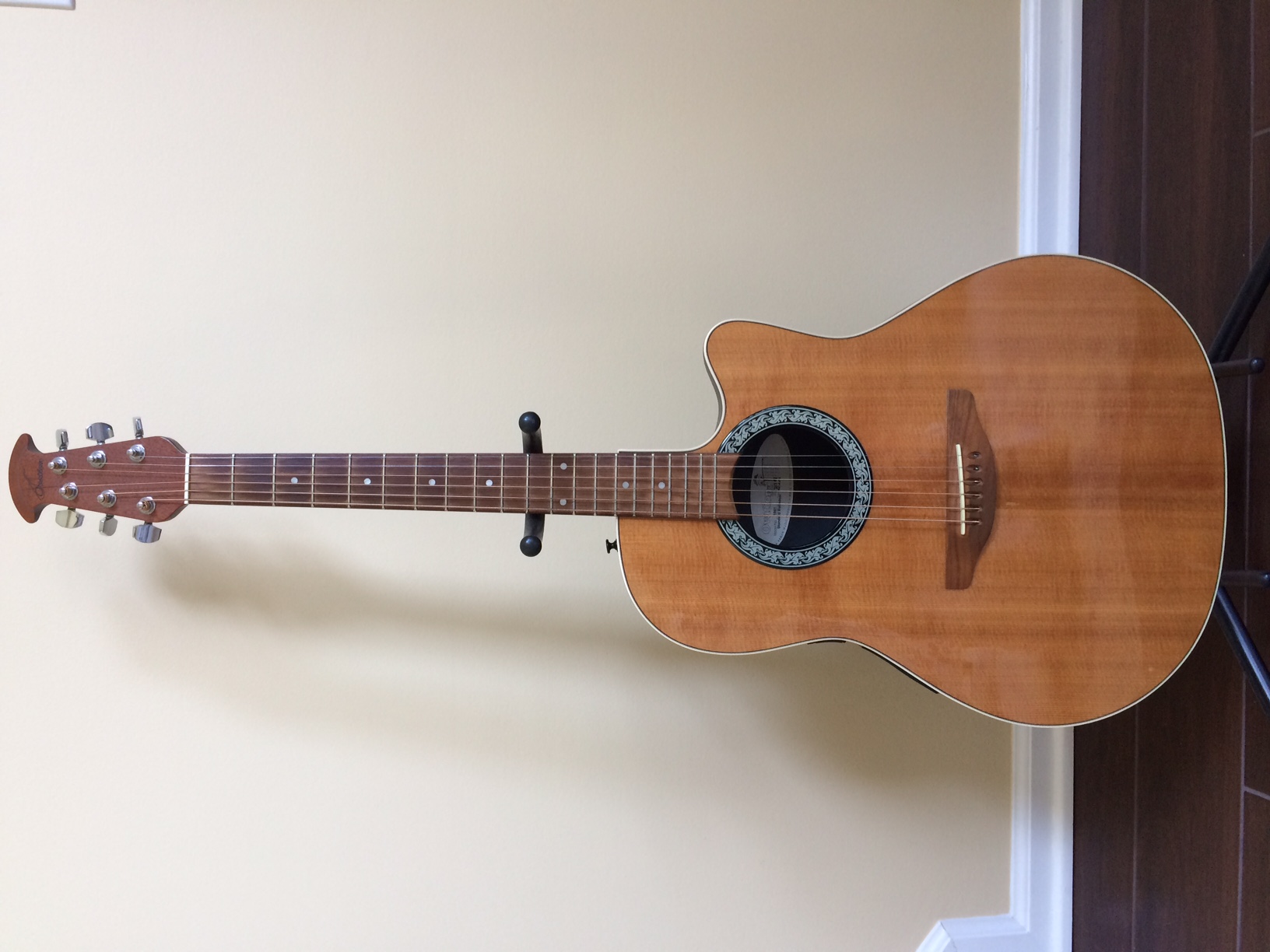
Ovation Model 1861 Standard Balladeer. Photo by Veradrive. Dedicated to the public domain under CC0 1.0. Via Wikimedia Commons. Ovation
Balladeer
1966
A helicopter builder looked at a guitar and asked why the back had to be made of wood. This was his answer.
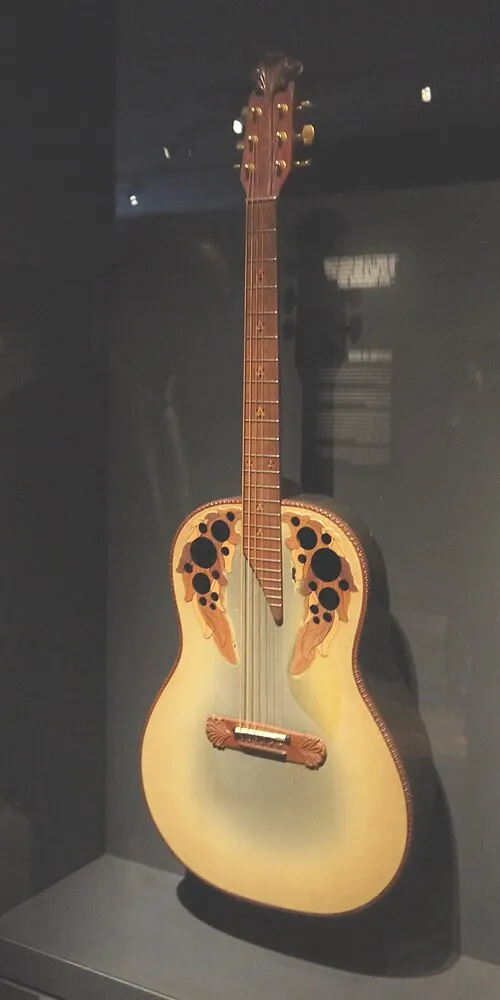
Photo: Eden, Janine and Jim / Wikimedia Commons / CC BY 2.0 Ovation
Adamas
1976
Seven years, 186 changes, and no hole in the middle. Ovation rebuilt the acoustic guitar top from scratch.
- Send a picture
Kawai
Moonsault
1978
Fifty thousand guitars a month with other people’s names on them. Then Kawai had to draw its own.