Sire
Marcus Miller V7
Marcus Miller wanted a student bass you'd never have to graduate from. Then he started playing it himself.
The V7 is a Jazz-style bass with two single-coils, an active preamp with a sweepable mid, and a switch back to passive. It launched in 2015 at $399 with Miller's name on the headstock. It is not the blonde Fender his records were made on.
- Introduced
- 2015
- Type
- Solidbody electric bass
- Class
- Production
Have a photograph of this guitar? Send a picture
The short version
2015
Preorders open
In January Sire opens preorders on the V7, alongside a modern double-cut called the M3. The first customers are promised hand-signed basses.
2015
$399
The alder four-string lists at $399, the ash five at $599, with a 7.25-inch radius and a mini-toggle for passive.
2016
The Vintage
The V7 Vintage arrives with the bridge pickup moved back to '70s spacing. The V7 keeps the '60s spacing.
2018
Second generation
In November, new pickups, ebony instead of rosewood, satin necks, rolled edges, and a 2N in the serial.
2023
In his hands
The bass Miller often plays onstage is the standard V7. Sire points to Jazz à Vienne and Jazz en Comminges.
2025–26
New Gen
Stainless frets, roasted maple on some finishes, and passive mode moved to a push-pull knob. Even Sire dates it two ways.
Side A
A1
The prototypes in Japan
The first prototypes were put in front of Marcus Miller in Japan. He offered the builders his own basses, so they could chase the tone and the feel.
Years later he put the idea in one line:
"a great student bass that you wouldn't have to graduate from."
That's an odd brief for a bass with your name on it. Miller wanted the one a parent could afford, and good enough that the kid wouldn't have to sell it to get serious.
A2
Like crickets
The Korean side of the deal had a pitch of its own. They owned the factory, they'd build it themselves, and they'd sell it direct, putting the money they weren't spending on ads back into the bass.
Preorders opened in January 2015. The V7 was a Jazz-shaped bass in alder or swamp ash, four strings or five: $399 for the alder four, $599 for the ash five. The first customers were promised hand-signed ones, a limited number, never counted in public.
Then, as Miller tells it: "The first year was like crickets, and then all of a sudden…"
A3
The knob he asked for
On paper it's a Jazz Bass. Offset waist, bolt-on maple neck, two single-coils, 34 inches. What makes it a V7 is the preamp.
There are knobs for treble and bass, and a mid knob with a second control that sweeps where the mid lands, anywhere from 200 Hz to 1 kHz. That was the one thing Miller would say out loud, the day it was announced:
"It was really important that it had a sweepable mid-range, because I think that's something that really can help bass players."
On a player's terms: you can push the exact part of the note that cuts through a band, or scoop it out, without walking over to the amp. And if the battery dies or you just want an old-fashioned passive Jazz, the first ones had a mini-toggle to switch the preamp out.
Flip the record · By the numbers
$399
The alder four-string in January 2015.
200 Hz–1 kHz
Where the mid knob sweeps. Miller insisted on it.
34"
The scale, same as a Fender Jazz.
2
Countries that build them, depending on the year and the headstock.
Side B
B1
Not the blonde one
Miller's famous bass is a Fender. A transparent blonde Jazz, modified by Roger Sadowsky. Whether it's a '76 or a '77 depends on who's writing. That's the bass on the records that made his name, and the Sire wasn't there for any of them.
Fender had its own Marcus Miller Jazz Bass for years. It was discontinued in 2015, the year the Sire came out. Different company, different preamp, different bass.
B2
Sixties spacing, seventies spacing
The V7 kept changing without changing its name.
In 2016 Sire added the V7 Vintage, which moves the bridge pickup back toward the bridge, '70s spacing, the way Miller's own bass has it. The plain V7 kept the '60s spacing, bridge pickup a little closer to the neck.
The second generation, in November 2018, got new magnets and coils, ebony instead of rosewood, satin necks, rolled edges, and a 2N in the serial so you could tell. The radius went from 7.25 to 9.5 inches. Swamp ash, one of the V7's two woods at launch, eventually went elsewhere: the upgraded ash bass became the V8, and the V7 is alder today.
The New Generation added stainless frets, roasted maple on some finishes, and moved passive mode to a push-pull on the bass knob. When it arrived depends on how you read Sire's own pages, late 2025 or 2026. Where they're built is two answers too: Indonesia from the start, then a China line as well, both Sire's own plants. A headstock can say one and the company has said the other.
B3
The one in his hands
For a while, the bass Miller carried onstage was a four-string V7 Vintage, or sometimes the V10, then Sire's premium model.
By 2023 the bass often in his hands was the standard V7. Sire points to a film from Jazz à Vienne, and to the encore at Jazz en Comminges, "Come Together," with Tom Ibarra. Asked about it that year, Miller said the first model was based on the bass he played, and "it's called the V7."
A 2026 review calls the V range his current stage instruments, and says he favours the mid-priced V7 over the top model.
He'd asked for a bass you wouldn't have to graduate from. Eight years on, he hadn't.
Put this on
You’ve read about it. Now hear it. Here’s what this guitar sounds like, and what to listen for.
Come Together (encore, Jazz en Comminges 2023)
Sire points to this film as Miller on a standard V7: the plain one, not the Vintage, eight years after the first preorders.
Watch it on YouTube (opens in a new tab)
The cast
The people, and the specific guitars, that made the legend.
2023
Marcus Miller
A standard V7 onstage
Earlier he often carried a V7 Vintage or a V10. By 2023 the bass in his hands was often the plain V7, by Sire's account, and a 2026 review says he favours it over the top model.
Liner notes
Specs, construction, rarity, value, and every source we used.
Two single-coils, a sweepable mid, and a way back to passive — Sire’s Jazz-style bass with Miller’s name, not the Fender the records are on.
- Body
- North American alder, solid; Marcus Miller Jazz shape (New Gen). 2015 also offered swamp ash. Sire’s own later split sent the upgraded ash bass to the V8. Not this table.
- Neck
- Bolt-on. Hard maple, or roasted hard maple on some finishes. C-shape (New Gen). Four-bolt steel plate.
- Fingerboard
- Ebony, hard maple, or roasted maple, by finish. Edgeless rolled edges. Sire: 9.5" radius. Thomann also prints 241 mm (9.5"). 20 frets, 2.4 mm medium stainless.
- Scale
- 34". Thomann and Bonedo’s 2nd-gen review also print 864 mm. Same figure, both printed. Not a second scale.
- Pickups
- Two Marcus Super-J Revolution single-coils. Sire: ’60s spacing on the V7. The Vintage sister is the ’70s spacing.
- Hardware
- Marcus Miller Modern-S bridge. Lightweight open-gear tuners. Chrome. Pickguard depends on the finish.
- Electronics
- Marcus Heritage-3 with mid-frequency control. Volume/tone, blender, treble, middle/frequency, bass. New Gen: the bass knob is the push-pull for passive. 2015 used a mini-toggle. Voltage is not restated on the New Gen sheet.
- Finish
- Gloss colors on the New Gen sheet include tobacco sunburst, antique white, Tide Pool, Mercury, Dark Forest, natural, candy apple red, Yellow Swirl. Neck finish is not restated there. 2nd gen’s sheet said satin.
- Nut
- Bone. Sire: 38 mm (4-string), 46 mm (5-string). Thomann prints the 4-string as 38 mm (1.5"). Mix flagged. Do not average. Do not invent 38.1 mm. Do not invent inches for 46 mm.
Open the full research fileConstruction details, the complete player record, production numbers, dated value estimates, and sources
Classic living example = 2026 New Gen 4-string alder V7. Thomann: available since July 2026. Sire USA list $749; the five is $849, nut 46 mm. 2015 was 7.25", medium-small frets, a mini-toggle, Big Mass, rosewood on alder and maple on ash. 2nd gen (November 2018) is the common used bass. V7 Vintage, V8, V1, V10, P7, and the M3 are other Sires. Not a Fender Jazz. Standalone. No Gibson SKUs. Mixed inch/mm flagged.
Construction
The job was a Jazz-style bass you would not have to outgrow, cheap enough for a parent, with Marcus Miller’s name on it only if the bass met his standard. Sire’s 2026 essay dates the introduction to 2015. No Treble, Kevin Johnson, 25 January 2015: preorder open, the J-style V7 beside a modern cutaway called the M3. Bass Musician saw a five-string at Winter NAMM 2015. Audiofanzine’s worldwide note is 19 March 2015. YAML introduced: 2015 is that catalog year. It is not a claim that a prototype and a shipping bass are the same day.
Sire’s Marcus Miller page puts the first prototypes in front of him in Japan, and says he offered his own basses so the builders could chase the tone and the feel. The page does not date the meeting. Do not invent a prototype year. Ultimate Guitar, 2 August 2024, transcribing Miller on No Treble: “a great student bass that you wouldn't have to graduate from.” The Korean side, in that same transcription, said they owned the factory, would build it, and would sell it direct, advertising money put back into the bass. “The first year was like crickets, and then all of a sudden…” The midrange is the part he would say out loud. No Treble, that January day: “It was really important that it had a sweepable mid-range, because I think that’s something that really can help bass players.”
What left in 2015 is No Treble’s table plus Jonathan Herrera’s Bass Player review, 10 November 2015. Alder or swamp ash. “New Marcus Miller Jazz Type.” One-piece hard maple, C, four-bolt. Premier Guitar, David Abdo, 26 January 2016: a ’70s Fender Jazz often wore three bolts, and Sire did not. 34". 20 frets, medium-small. Radius 7.25". Blocks. Maple board on the ash, rosewood on the alder. Bone nut. Herrera’s pair, ash as tested: nut 38 mm, string spacing 19 mm, 9.2 lbs (four) and 9.5 lbs (five). Do not convert those pounds. Pickups: Marcus Super Jazz, Alnico 5, U.S. heavy formvar (No Treble); Premier adds fiber bobbins. Heritage-3 at 18V (Premier), mids swept 200 Hz to 1 kHz, tone still working with the preamp on, active/passive on a mini-toggle. Bridge: Marcus Big Mass, string-through. Open-gear tuners. Tortoise guard on alder, ivory pearl on ash.
Not a Fender Jazz Bass (fender-jazz-bass). Same job a player already knows: offset waist, bolt-on maple, two single-coils, 34". Different company. Different preamp. No Fender logo. Miller’s famous bass is the other one. Wikipedia: transparent blonde, 1977, modified by Roger Sadowsky with a Stars Guitar and later a Bartolini TCT. Premier, 2016, says a cherished ’77 and does not restate the electronics. Herrera’s 2015 review says a Sadowsky-modded ’76. Keep 1976 and 1977. The preamp sequence is that Fender’s story. Do not hang Miles, “Tutu,” or the session years on a Sire that did not exist yet. Fender also sold its own Marcus Miller signature Jazz. Wikipedia: Japan-made four-string, U.S. five-string, the four later moved to Mexico, both discontinued in 2015. Sweetwater’s pages for that Fender now say it is no longer available. Ash, vintage-style single-coils, a two-band active EQ. A third bass. Off this plate.
2016 added the V7 Vintage, not a replacement. Sire’s essay: the V7 keeps ’60s spacing, bridge pickup a little closer to the neck; the Vintage moves the bridge pickup toward the bridge, ’70s spacing, which Sire says is the spacing on Miller’s own bass. Bonedo’s vintage test is 27 June 2017 and dates that model to 2016.
2nd gen is a revision, not a new name. No Treble, 15 November 2018: pickups “different magnets and coils,” ebony instead of rosewood on the V7, satin necks, rolled edges, a wood battery cover, and 2N on the serial so the generation shows. That $369–$1,199 span is the whole 2nd-gen Marcus Miller line, not a V7 price. Sire’s 2nd-gen V7 sheet, still up: alder, satin maple, 9.5", 2.4 medium frets, bone 38 mm / 46 mm, Super-J Revolution in U.S. plain enamel, ’60s spacing, Heritage-3, Modern-S. Bonedo, 14 July 2019, alder four: radius from 7.25" to 9.5", ebony, 864 mm (34"), one sample 4.5 kg, street €499. The 15 August 2019 five was swamp ash, 4.6 kg, and that review puts two graphite rods in the five-string neck. Those kilograms are two review basses. They are not Herrera’s 9.2 / 9.5 lbs, and they are not a model weight. Mix flagged. Do not convert. Do not average. The 2026 essay calls the 2nd-gen frets medium jumbo. The sheet says 2.4 medium. Keep both. The Vintage 2nd-gen sheet kept 7.25". Do not paste that radius onto this V7.
Sire’s go-to note: alder is what was still called a V7, and the swamp-ash body with the upgrades had become the V8. A 2015 ash V7, a Vintage, a V8, and a later ash reissue are four answers to “swamp ash.” The New Gen V7 sheet this pass is alder only. Vintage New Gen still lists ash.
New Gen is the living bass, and the year is not one sentence. The product page says V7, P7, and V7 Vintage move to New Gen seven years after the 2nd-gen launch. Seven years after November 2018 is late 2025. The essay dates “the New Generation” to 2026. Thomann’s four has been available since July 2026. Thomann’s NAMM 2026 film shows the new basses on the booth. Keep all three. Do not collapse them.
The sheet’s actual changes: a revised C, stainless 2.4 mm medium frets, roasted maple on some finishes, lightweight tuners, Luminlay side dots (the five-string page and the essay), Super-J “newly voiced,” and passive mode on a push-pull of the bass knob instead of the mini-toggle. Heritage-3 stays. Voltage is not restated. Thomann’s sunburst four adds the pairs the sheet leaves in inches only: 241 mm (9.5"), 864 mm (34"), nut 38 mm (1.5"), strings .045–.105, no case and no gig bag. Natural there is a maple board and black blocks. The 2015 preorder had promised a gig bag with the hand-signed first basses. This Thomann New Gen does not include one.
Where it is built is two statements. Herrera, 2015: Indonesia, CNC plus hand work he could not fault. Guitar World, Connor Flys, 28 August 2026, still says a Korean brand, dedicated factory in Indonesia. Sire’s own note, Sire Japan December 2015 and sire-korea.com: the year started in Indonesia, then a China line for finished basses, both plants Sire’s, not an OEM floor. A headstock can say Indonesia. The company has also said China. Do not pick one country for every V7. No unit total. None invented.
The M3 is the other 2015 signature, a modern double-cut. The V1 is the later passive sibling — Guitar World, 2026, mahogany, $329. Miller’s name is on that one too. Neither is a V7.
Players
Do not put the blonde Fender here. Do not put Fender’s discontinued Marcus Miller signature Jazz here. Do not put a V7 Vintage, a V8, a V10, or an M3 on a V7 credit because the headstock says Marcus Miller. The records that made him predate this bass.
Marcus Miller — the V7 as a stage bass, not as the ’77. Identity player. The trap is the instrument. Wikipedia: Sire, a Korean company, began the V7 in 2015, “a signature model based on Miller’s previous Fender Jazz bass.” Herrera, November 2015, wrote that he was playing the new signatures onstage, and reviewed V7s under $600. A 2015 stage claim about the line. Not a session log. Not a claim the Fender left the house. Sire’s later go-to note is tighter: for a while the bass he carried was a four-string V7 Vintage, or sometimes the then-premium V10, and other makers’ basses showed up in the same shows. The company’s Laid Black clip, Estival Jazz Lugano 2019, is a V7 Vintage. Say Vintage. Do not file it here.
That note says that by 2023 the bass often in his hands was the standard V7, and points at two films: Isaiah Sharkey, and Jazz en Comminges 2023 with Tom Ibarra, the encore of “Come Together.” Sire USA, 9 August 2023, identifies a V7 at Jazz à Vienne. Another company post, carrying a 2024 tag, identifies a V7 at the Blue Note in New York. The maker pointing at a video. Not a studio diary. Guitar World, 28 August 2026, calls the V range “Miller’s current stage instruments” and says he favours the mid-tier V7 over the top model. A reviewer’s sentence. Sweetwater, 18 February 2023: the first model was based on the bass he played, “it’s called the V7,” and he has found a Sire already in a studio. No album title in that interview. Afrodeezia is a 2015 record. Nothing here puts a Sire on it. Leave it off.
Also known to play stays empty on purpose. Bass Musician’s 2015 review names a handful of bassists holding early V7s. No session, no record, no serial. Leave them off.
Rarity
You can buy a new V7. Thomann had the New Gen four in stock this pass. Sire USA’s collection page had New Gen fours and fives listed, and showing sold out, at the same moment. Both can be true of a catalog in motion. This is not a scarce bass.
Sire has not published a V7 total. None invented. The 2N in a 2nd-gen serial tells you the generation. It does not tell you how many left the building. That is why a first-year count is unknown, not the chapter.
What is actually thinner: a 2015 alder with the rosewood board, still on the 7.25" radius and the mini-toggle; a swamp-ash V7 from before Sire moved that idea to the V8; the hand-signed V7s No Treble said would go to the first customers. “A limited number.” No figure. A 2nd-gen alder four is the ordinary used one. A New Gen is current production. A Vintage, a V8, a V1, a V10, a P7, an M3, and a Fender Marcus Miller Jazz are not in this count. Neither is the blonde Fender.
Value
Informal estimate, 26 October 2026. Not an appraisal.
Ask is not sold. Euros are not dollars. A 2nd-gen used band is not a New Gen street price. The blonde Fender is not a comp, and neither is Fender’s old signature Jazz. No celebrity hammer on a Miller-owned V7 turned up this pass. No factory total to divide into a price.
New street. Sire USA’s 2026 collection, this pass: New Gen four $749, five $849. zZounds had the five at $849. Thomann, four, available since July 2026, in stock: €599. Left-handed tobacco sunburst on Thomann Spain: €666. Do not average dollars with euros. Vintage Ash New Gen on that Sire collection: $899 / $999. Sister model, not this street price.
Historical list, not a 2026 cart. No Treble, 25 January 2015: alder four $399, ash four $499, alder five $499, ash five $599. Audiofanzine, 19 March 2015: $399 / €379 to $699 / €498. The top does not match No Treble’s $599 ash five. Keep both. Premier, January 2016, $499 on the ash bass reviewed. Herrera, November 2015, $500 / $600. Bonedo, July 2019, 2nd-gen alder four, €499.
Used modern. Reverb’s 2nd-gen four guide, this pass: $324–$558, Good to Mint, 126 orders. Named solds on the same page run inside and above it: 25 March 2025 Very Good $450; 14 May 2025 Very Good $475; 9 May 2025 Excellent $700; 15 June 2025 Excellent $550; 12 November 2025 Excellent $522.50; 16 November 2025 Excellent $546.25; 29 November 2025 Excellent $615. Guide and hammers are not one statistic. Do not average. Five-string guide: $412–$695, 138 orders. Named 2026 solds there: 13 February Excellent $625; 30 July $600; 11 August $600; 11 September $522; 25 September $525; 3 October Mint $600. A 12 October 2026 line at $25, marked Very Good, is not used as a bass comp. No clean guide for a 2015 first-gen, or for a New Gen. One used New Gen Mercury ask, $708, is an ask.
Vintage / collectible. There isn’t one. The model dates from 2015. Early hand-signed pieces have no sold price here. Artist-owned Fenders stay on the Jazz Bass plate.
See also
- fender-jazz-bass — the 34" offset, two single-coils, bolt-on maple; the design this follows, and the blonde bass the records are on
- sadowsky-nyc-bass — Roger Sadowsky’s shop; the preamp in Miller’s Fender is his, and a Sadowsky bass is not a V7
- fender-precision-bass — the other Fender four-string; split-coil, not this Jazz shape, and not this preamp
Sources
- No Treble, Kevin Johnson, 25 January 2015 — preorder; V7 and M3; alder/ash; 4/5; Super Jazz, Alnico 5, heavy formvar; Heritage-3, mids 200 Hz–1 kHz; Miller on the sweepable mid; 2015 street $399 / $499 / $499 / $599; hand-signed first V7s, number not given; spec table
- Audiofanzine, 19 March 2015 — worldwide launch note; alder or swamp ash; 4 or 5; price range $399 / €379 to $699 / €498
- Bass Player, Jonathan Herrera, 10 November 2015, spec box via Sire Korea — made in Indonesia; street $500 / $600; ash as tested, alder optional; bone nut; 7.25"; 20 medium-small; 34"; nut 38 mm; spacing 19 mm; Big Mass; 9.2 lbs / 9.5 lbs; plays the signatures onstage
- Guitar World reprint of Herrera, 8 January 2020 — Korean company; ’76 Sadowsky-modded Jazz in the prose; Indonesia; each under $600
- Premier Guitar, David Abdo, 26 January 2016 — swamp-ash test bass; ’77 Fender comparison; four-bolt; Super Jazz, fiber bobbins, Alnico 5, heavy formvar; Heritage-3 18V; street $499
- Sire USA, The Making of a Flagship — introduced 2015; Vintage 2016; ’60s vs ’70s spacing; 2nd gen 2018, rolled edges, satin, Super-J Revolution; essay dates New Gen 2026; links Reissue, New Gen, Vintage New Gen
- Sire USA, Marcus Miller — prototypes first shown in Japan, undated; he offered his own basses for tone and feel
- Sire USA, V7 New Gen — alder; New Gen C; 34"; 9.5"; 2.4 mm medium stainless; bone 38 mm / 46 mm; Super-J Revolution; Heritage-3; bass knob push-pull passive; Modern-S; “seven years after” the 2nd gen
- Sire USA, V7 New Gen 5-string — $849; lightweight tuners; Luminlay side dots; nut 46 mm
- Sire USA, 2026 Marcus Miller collection — New Gen 4 $749, 5 $849; Vintage Ash New Gen 4 $899, 5 $999; sold-out flags on that fetch
- Sire USA, 2nd-gen V7 alder — satin maple; 9.5"; 2.4 medium; 38 mm / 46 mm bone; Super-J Revolution, plain enamel, ’60s spacing; Modern-S
- Sire USA, V7 Vintage ash 2nd gen — 7.25"; ’70s spacing; maple board; 34"
- Sire USA, go-to bass note — Vintage or V10 earlier; 2023 standard V7; alder still called V7, upgraded ash became V8; Sharkey and Jazz en Comminges 2023
- No Treble, 15 November 2018 — 2nd-gen announcement; ebony replaces rosewood on V7; satin; rolled edges; 2N serial; line $369–$1,199
- Bonedo, 14 July 2019 — 2nd-gen alder four; Indonesia on that review; radius 7.25" to 9.5"; 864 mm (34"); 4.5 kg sample; €499 street
- Bonedo, 15 August 2019 — 2nd-gen ash five; graphite rods in that neck; 4.6 kg sample; 864 mm (34")
- Bonedo, 27 June 2017 — Vintage added 2016; original V7 early 2015
- Thomann, V7 4 New Gen Natural — available since July 2026; €599; alder; 241 mm (9.5"); 864 mm (34"); nut 38 mm (1.5"); 20 stainless; no gig bag
- Thomann, V7 4 New Gen tobacco sunburst — ebony; white blocks; Super-J Revolution; Heritage-3; Modern-S; .045–.105; in stock
- Thomann Spain, V7 4 New Gen TS left-hand — €666; 38 mm (1.5"); 864 mm
- zZounds, New Gen 5-string — $849; alder; 34"; C (New Gen)
- Guitar World, Connor Flys, 28 August 2026 — Korean brand; Indonesia factory; V range as current stage instruments; he favours the V7; V1 is $329, mahogany, passive, not this bass
- Ultimate Guitar, 2 August 2024, transcription of Miller on No Treble — “student bass that you wouldn't have to graduate from”; own factory; direct sale; first year “crickets”
- Sweetwater, Marcus Miller and Sire, 18 February 2023 — first model based on the bass he played, called the V7; active or passive; studios, no album pinned
- Wikipedia, Marcus Miller, Instruments — 1977 blonde Jazz, Sadowsky then Bartolini; Fender signature Japan/U.S., later Mexico, discontinued 2015; Sire V7 2015, Korean company, based on the previous Fender
- Sire Japan, 25 December 2015, China factory note — 2015 began in Indonesia; China line added; not OEM
- Sire Korea, factory note — basses from the Indonesia and China factories; not OEM
- Sire USA, 9 August 2023 — company identifies a V7 at Jazz à Vienne
- Sire USA, Blue Note — company post, tagged 2024, identifies a V7 at the Blue Note in New York
- Sire USA, Laid Black / Lugano 2019 — company identifies a V7 Vintage, not the standard V7
- Reverb price guide, 2nd-gen V7 — $324–$558, 126 orders; named solds $450–$700 on that page
- Reverb price guide, 2nd-gen V7 5-string — $412–$695, 138 orders; 2026 solds; $25 line not used as a comp
- Bass Musician, Vuyani Wakaba, 30 March 2015 — Winter NAMM 2015; early player list left off for lack of a session
Keep digging
Guitars this one gets compared to, confused with, or descended from.
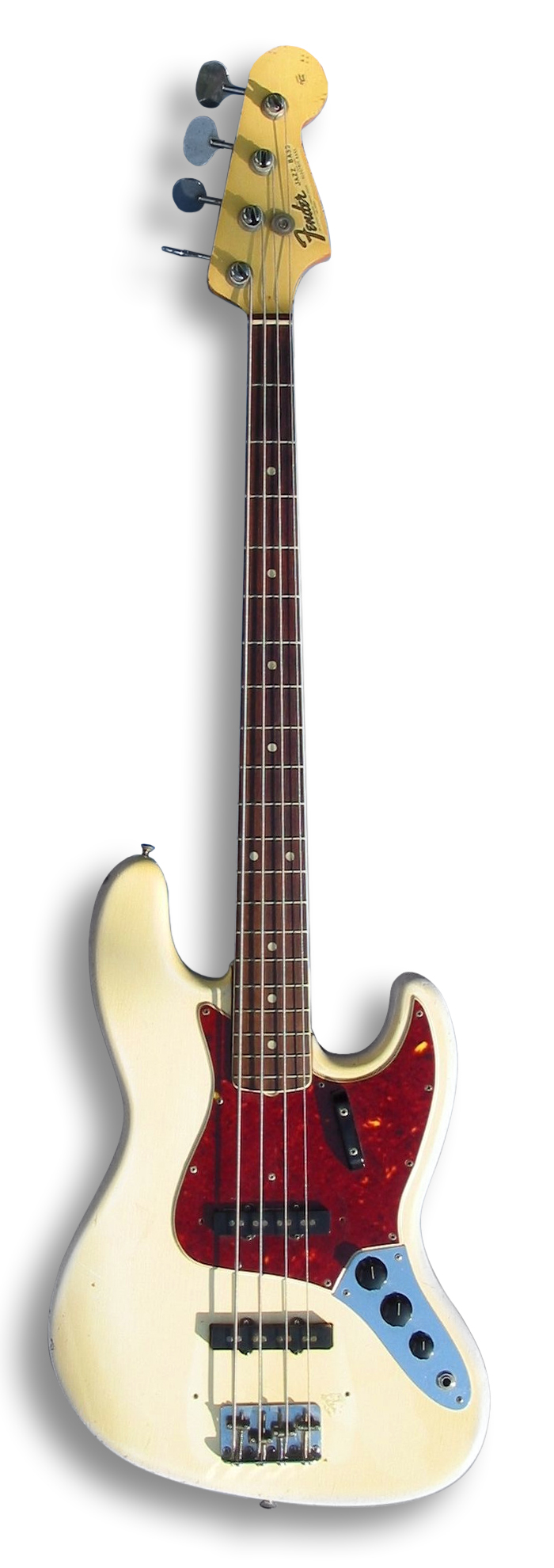
Fender Jazz Bass from 1966 in Olympic white with the transition fingerboard (bindings and dot inlays). Photo by Th. Ott. Licensed under CC BY-SA 3.0. Via Wikimedia Commons. Fender
Jazz Bass
1960
Built for jazz players who mostly passed on it. Then bass players started using it to take the solo.
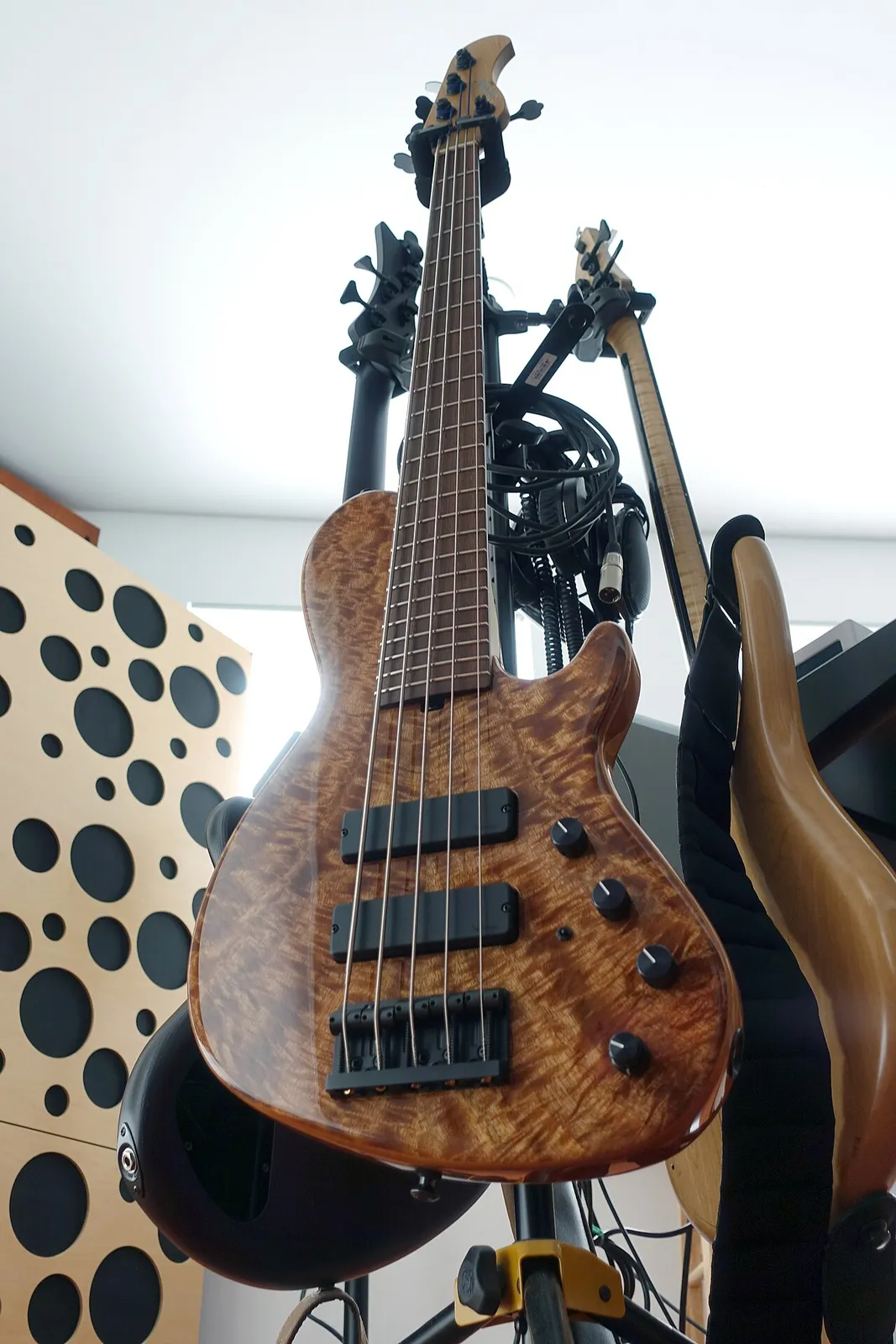
Photo: Nir Yaniv / Wikimedia Commons / CC BY-SA 4.0 Sadowsky
NYC Bass
1982
Built for the New York session bassist whose engineer wasn’t going to reset the board for him.
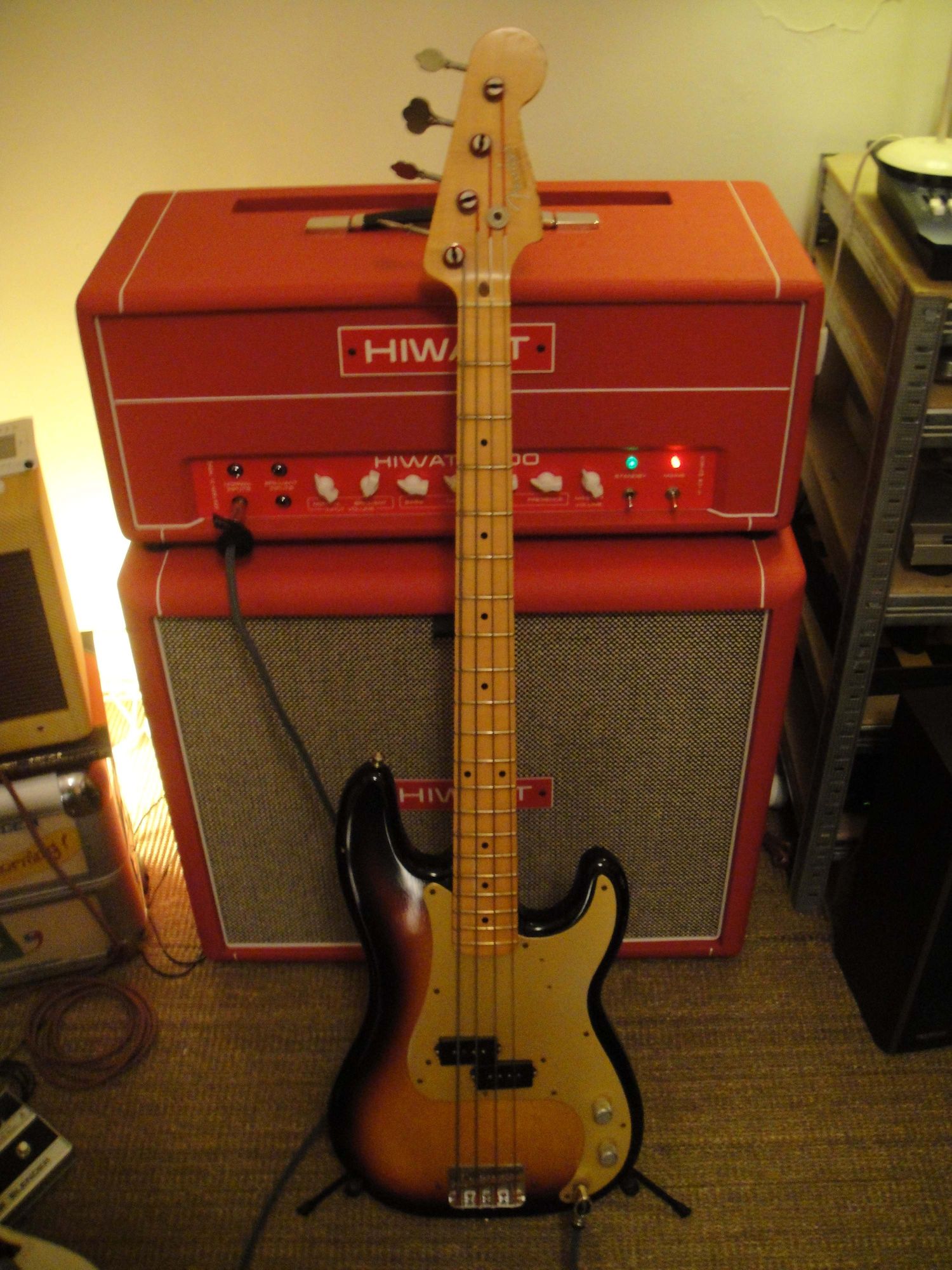
Photo: Infrahertzz / Wikimedia Commons / CC BY-SA 3.0 Fender
Precision Bass
1951
Leo’s bass let the player at the back be heard. You know their lines by heart. You mostly don’t know their names.